After terrorism and war erased centuries of Iraqi heritage, one artist began reconstructing the missing artifacts, creating ghostly stand-ins for objects, histories, and lives that can’t be recovered.
A decade ago, the widespread destruction of Middle Eastern cultural heritage at the hands of the Islamic State was widely publicized. It was meant to be. In light of this destruction, and other such events, the perpetrators didn’t count on the items they destroyed to return as “ghosts” to haunt the world they formerly occupied. That is, at least, the stated mission of one artist, Michael Rakowitz, in his ongoing project dubbed The Invisible Enemy Should Not Exist. This is a work where every detail is stunningly symbolic of the larger message that Rakowitz has fruitfully woven amongst his many artistic undertakings, and is in constant battle against the modern American dialogue concerning the nation of Iraq, whose name has come to mean anything along the lines of war and conflict, and usually nothing more.
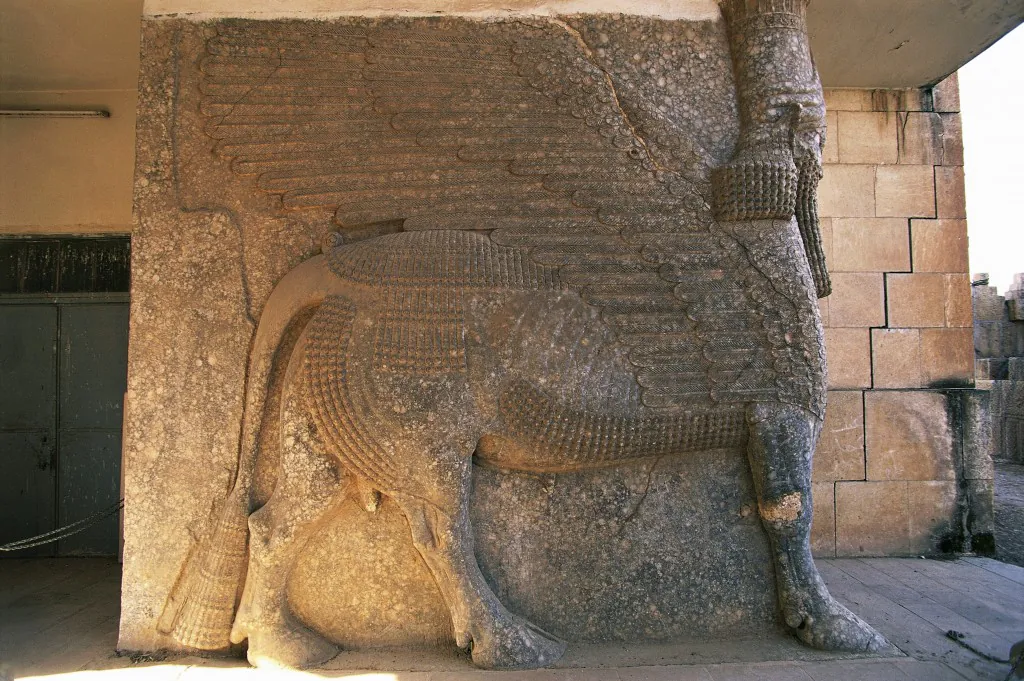
In February 2015, the ancient complex of Nimrud was destroyed by Islamic State militants, and one specific sculpture dating from around 700 BC was drilled and smashed apart. Recently, that item has returned to the public spotlight, in a new and perplexing form. Its creator has described it as “a placeholder for the thousands of human lives that have gone missing and can’t be reconstructed.”
The Invisible Enemy Should Not Exist began in response to the looting of the National Museum of Iraq during the US-led invasion of Baghdad in 2003. Some 15,000 objects were said to have been destroyed or looted, while 7,000 of those have been accounted for (and not all have been returned due to stability concerns). Around 8,000 objects, some as being dated as far back as 4,000 BC, are still unaccounted for, and are potentially lost to the world forever. Certainly, many people at the time felt the same as the artist in that “it didn’t matter if you were for or against the war, we could all agree that this was a catastrophe. It wasn’t simply a local Iraqi loss but one for the whole of humanity.”
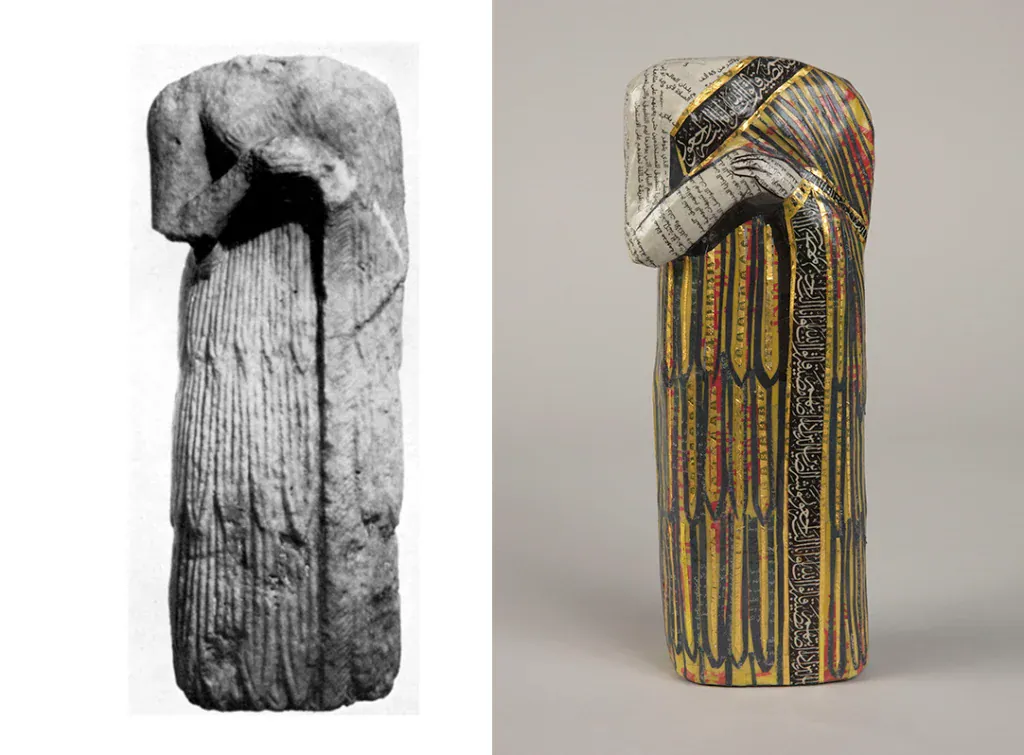
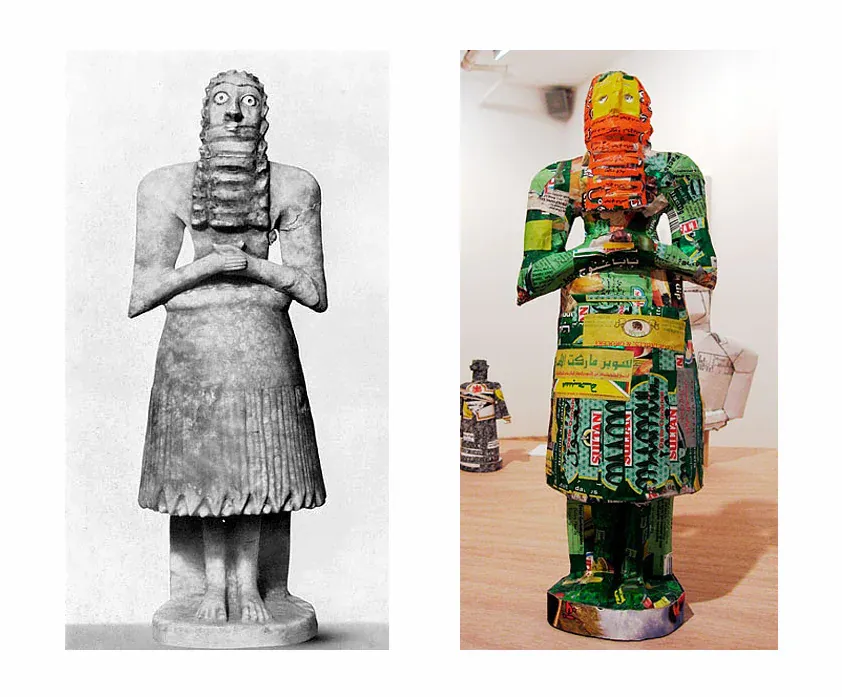
Rakowitz has made it his mission to recreate these looted objects in the interest of keeping them alive in some form, although he frequently acknowledges this work may outlive him. In a BBC radio interview on the project in 2018, Rakowitz says he’s completed somewhere around 800 of these objects in the span of 12 years, only 10% of the total. Since its inception, the project has rather unfortunately expanded to include the items destroyed by ISIS at sites such as those in Nineveh and Nimrud as well as former collections and museums located in cities, most notably the Islamic State capital of Mosul.
The items already ‘resurrected’ include stone-inlaid daggers, plates with calligraphic designs, statues of animals and men dating from the Early Dynastic II era (between 2600–2500 BC), the Mona Lisa of Nimrud, the latter being a relief portrait that survived being thrown down a well during the sacking of the ancient city of Calah, a common method of destroying art at the time. Ironically, it was destroyed after its last home, the National Museum of Baghdad, flooded during the Iraq invasion.
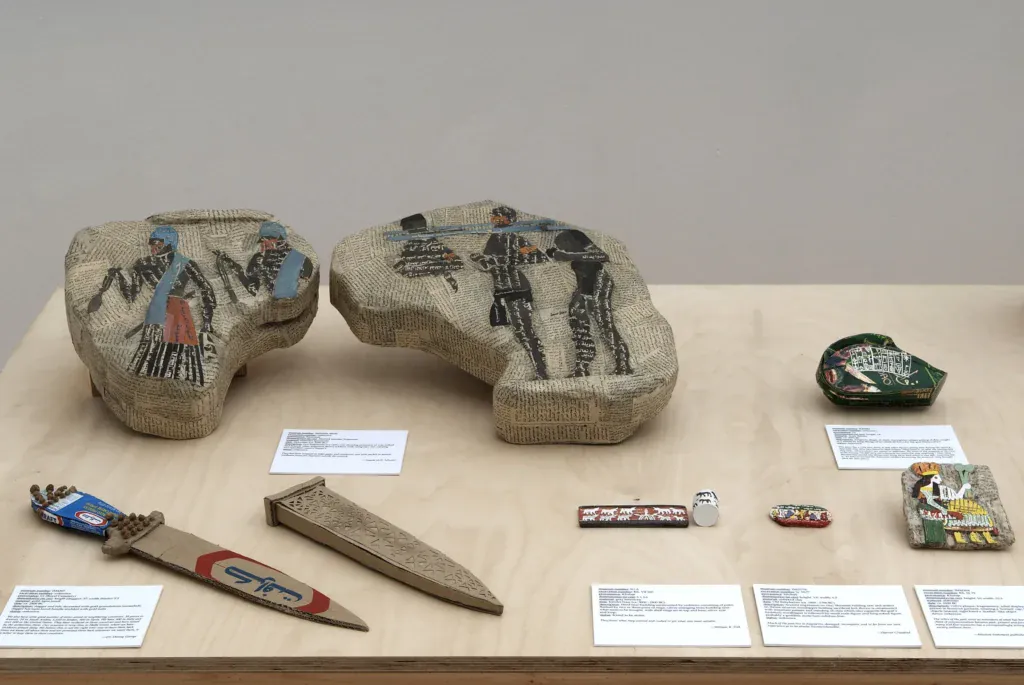
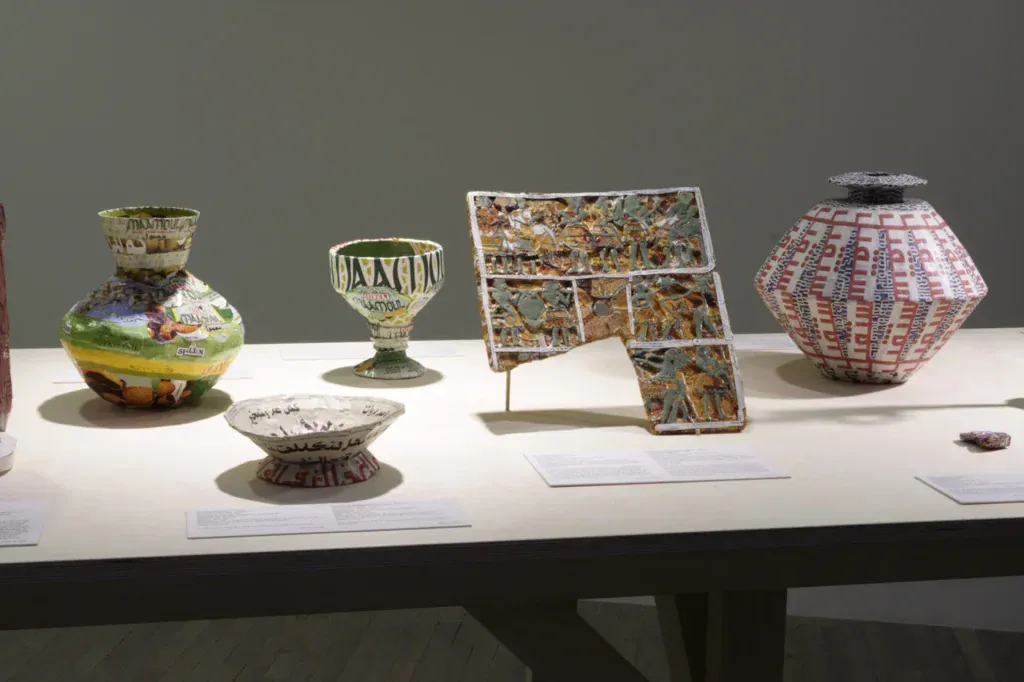
The title of the project is a literal translation of the name of the street, Aj-ibur-shapu, which passed under the famed Ishtar Gate, another cultural object heavily focused on by Rakowitz following his encounter with it upon a visit to the Pergamon Museum in Berlin in September 2006. According to an interview with Frieze, Rakowitz had initially stuck with the title simply because, in his words, “It was the coolest street name I’d ever heard”. When the project was started, the title also seemed very timely and theme-specific “because it spoke to this idea of the ‘phantom threat’: US President George W. Bush’s fabricated existence of weapons of mass destruction and the conflation of the 9/11 attacks with Iraqi President Saddam Hussein”.
Rakowitz, 52, was born in New York in 1973 to an Iraqi-Jewish mother and a second-generation Ashkenazi Jewish father after the former had come to America with her family after fleeing Iraq in 1946 in response to the withdrawal of British colonial forces and the intensifying political unrest. Growing up in Great Neck, Long Island, he began his studies as a sculptor in high school and then a graphic design student at SUNY Purchase, pursuing a master’s degree in visual studies from MIT immediately afterward. Rakowitz is now based in Chicago where he creates most of his work from his home studio and teaches at Northwestern University.
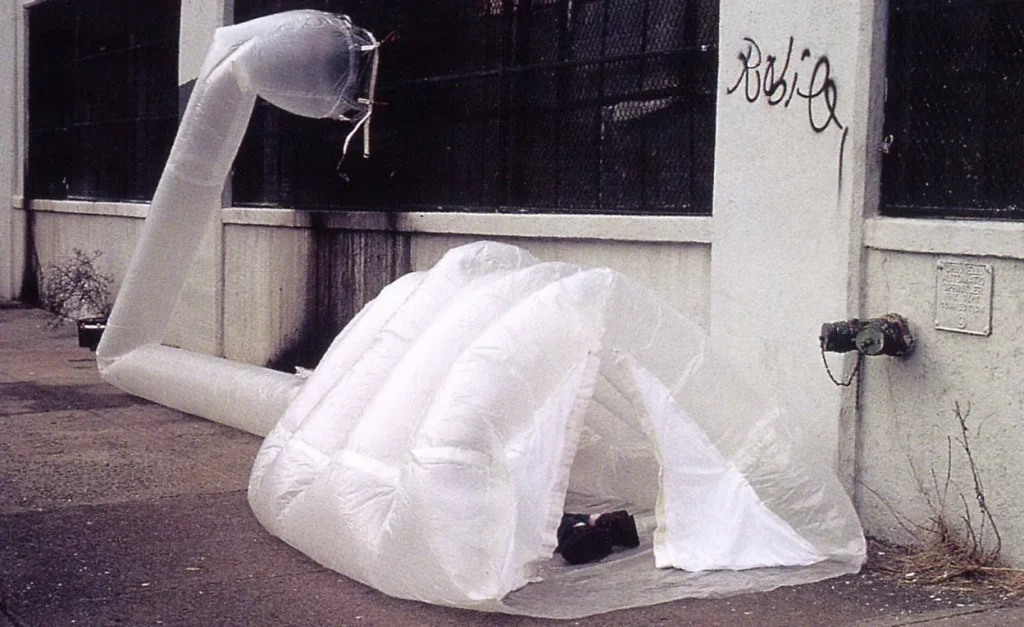
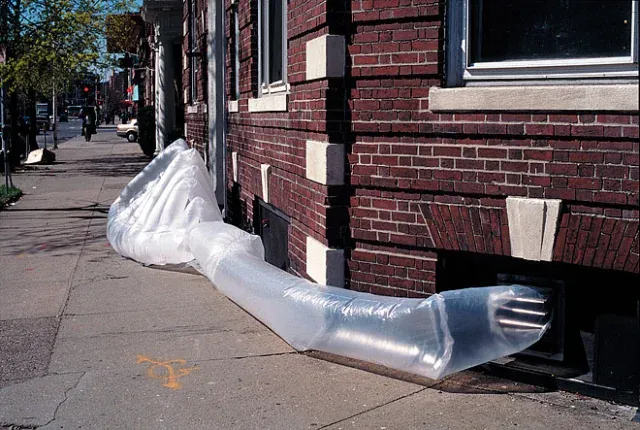
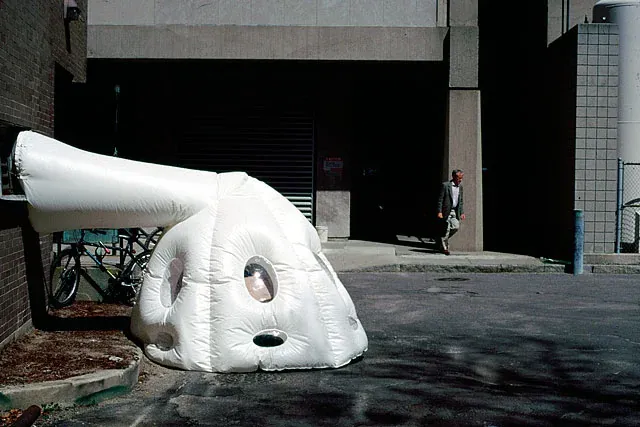
Having been mentored by artists such as Krzysztof Wodiczko and Dennis Adams, who were masters of institutional critique and urban intervention, Rakowitz had made these forms key to his oeuvre. He began his professional career as an artist with various projects including paraSITE, his invention of a tent-like homeless shelter meant to attach itself to the heat vents of buildings for warmth after having studied the designs of Palestinian refugee camps and nomadic Bedouin tents, the latter of which are built according to the direction of the wind.
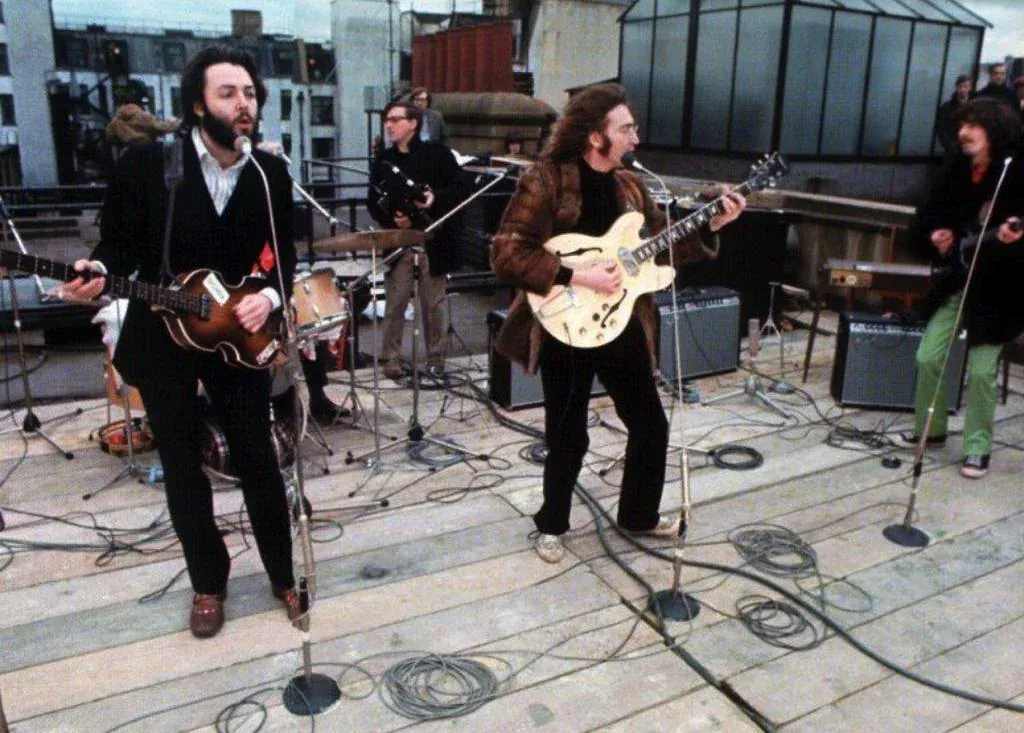
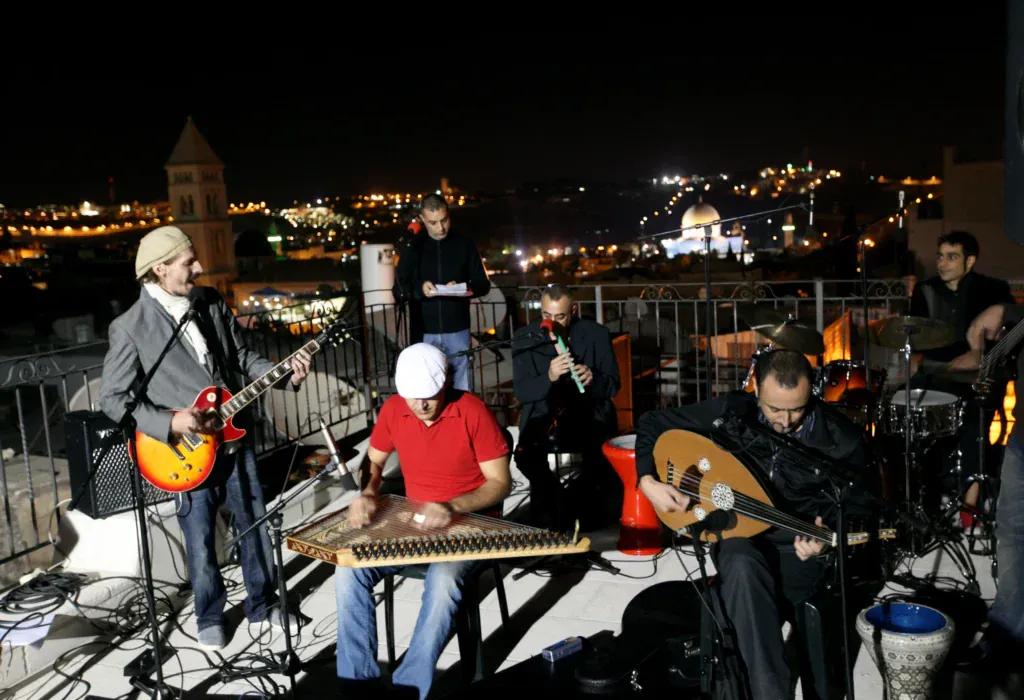
For Rakowitz, one of the main facets of his work is the subtlety through which he brings Iraqi issues and his autobiographical viewpoints into view, often through the familiar lens of the American culture he grew up in. There is a blend of serious sociopolitical commentary paired with lighthearted references to pop culture, such as his 2010 piece The Breakup which compares the simultaneous failure of Israel-Palestine unification with the Beatles’ breakup. Developed with the assistance of the Al-Ma’mal Foundation for Contemporary Art in Jerusalem, the project took form as a multi-part radio broadcast for Radio Amwaj in Ramallah, Palestine, culminating in a live performance of Beatles songs by the Palestinian Arab band Sabreen on a rooftop in Jerusalem, mirroring the final performance by the Beatles, who also performed on a rooftop in London.
Much of his work deals with loss on every scale imaginable. In one interview he states: “There is a certain sadness that comes with the destruction of anything. I hate to see books destroyed, as they contain wisdom. Buildings that are abandoned or left in a state of disrepair give the feeling of loss, and I especially hate seeing art destroyed; no matter how good or bad the artwork, that was someone’s vision and they most likely put their heart and soul into it. It is even more upsetting when ancient artworks are obliterated through the actions of war. As a species, we are so creative, but also so self-annihilative, never seemingly content with accepting the way we are, and each party involved thinking that they are the people in the right while the other side are heinous criminals against humanity.”
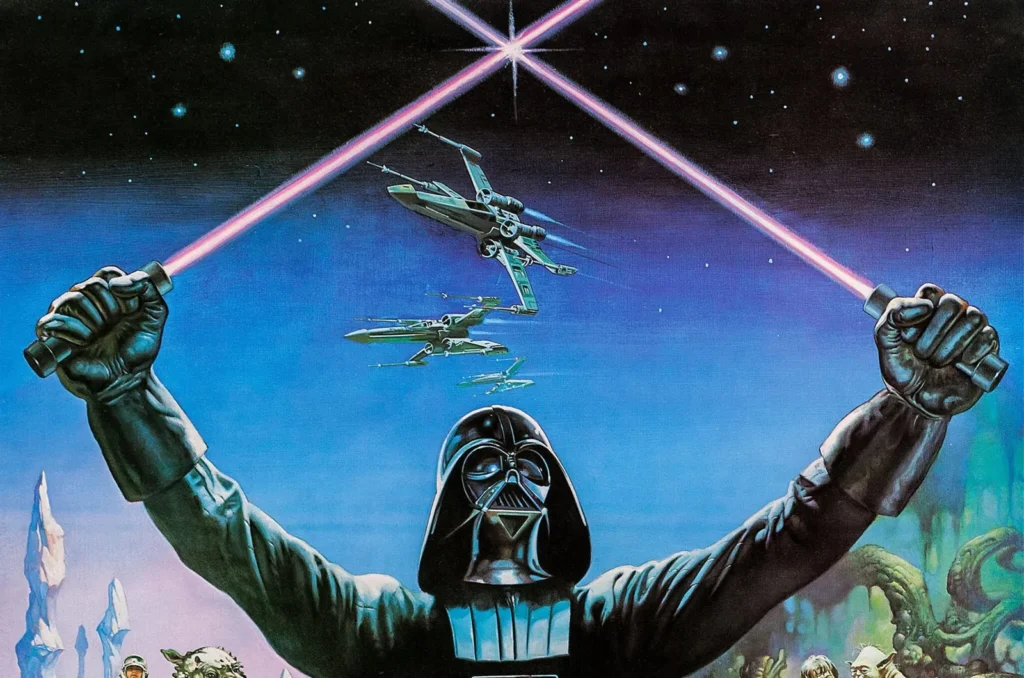
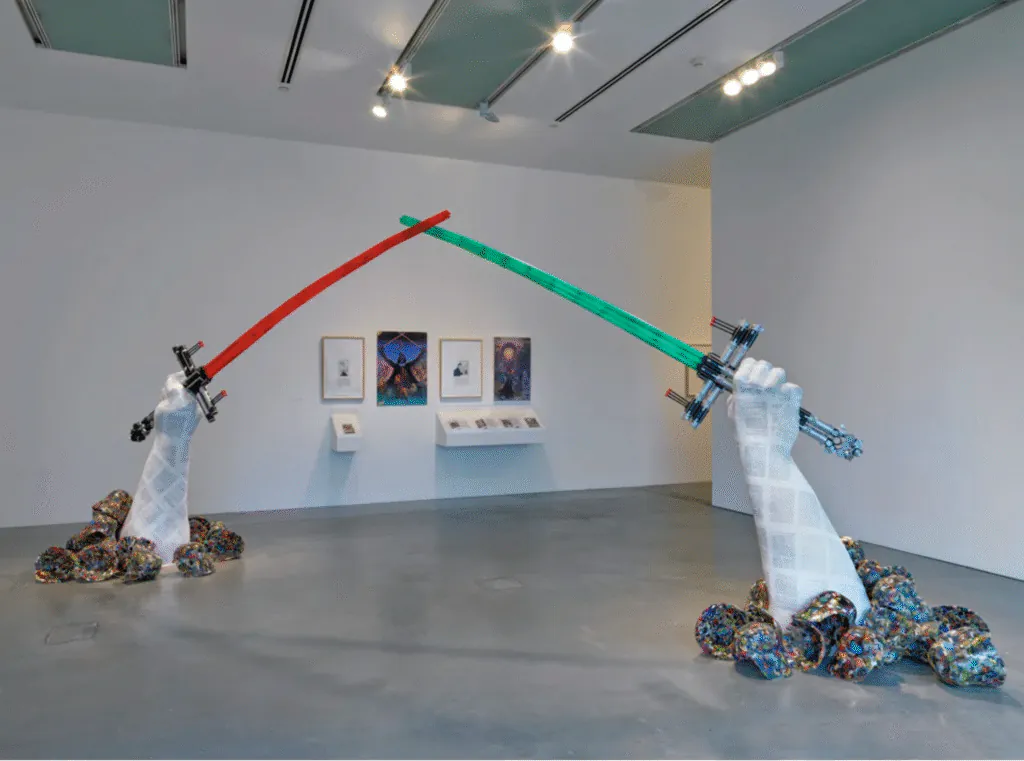
In their execution, Rakowitz’s projects appear very introspective, expositions of his thoughts as the child of an immigrant mother from Iraq. One such project is titled Backstroke of the West, based on a phrase discovered from a Chinese mistranslation of the Star Wars film Revenge of the Sith. In it, Rakowitz juxtaposed several items from the Saddam era with memorabilia from the film Star Wars: The Empire Strikes Back, such as the custom helmets produced for Saddam’s personal guard bearing a suspicious resemblance to the iconic design for Darth Vader’s helmet.
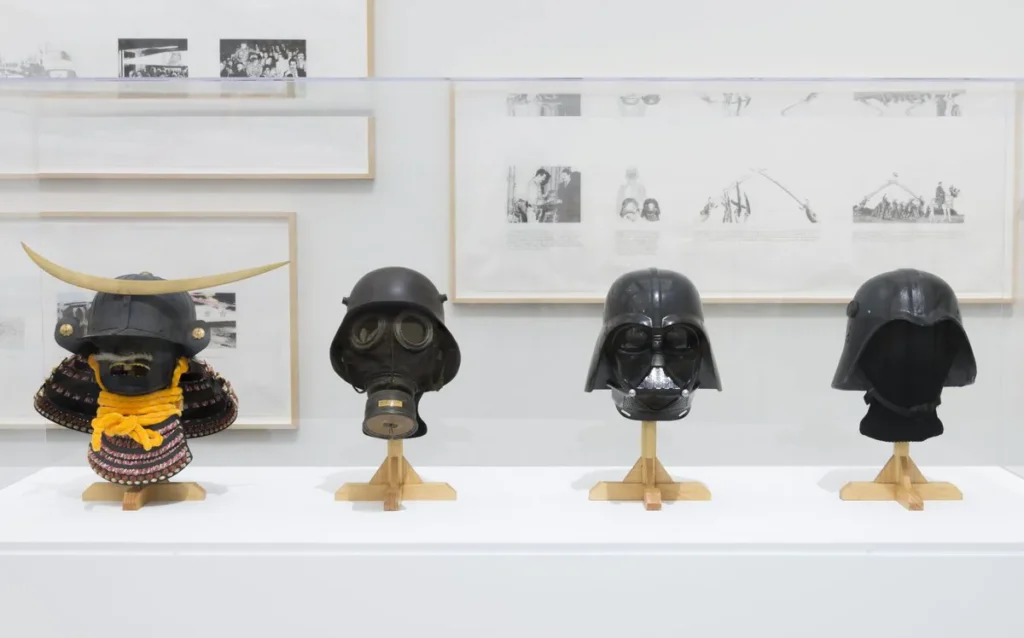

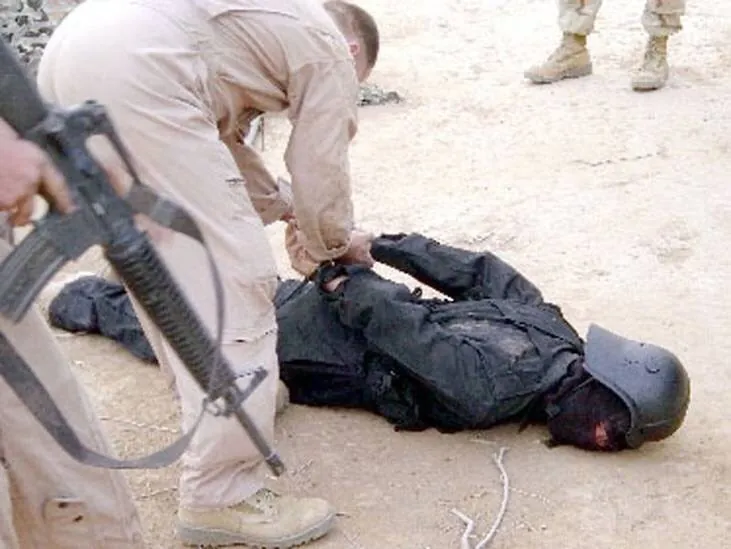
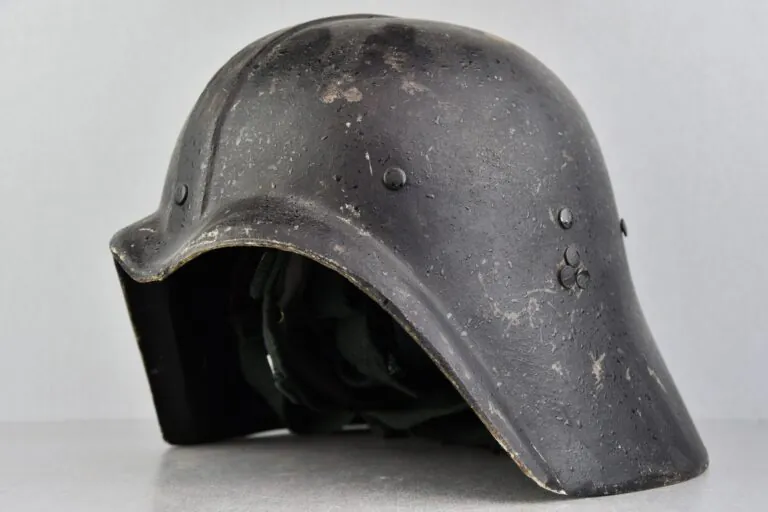
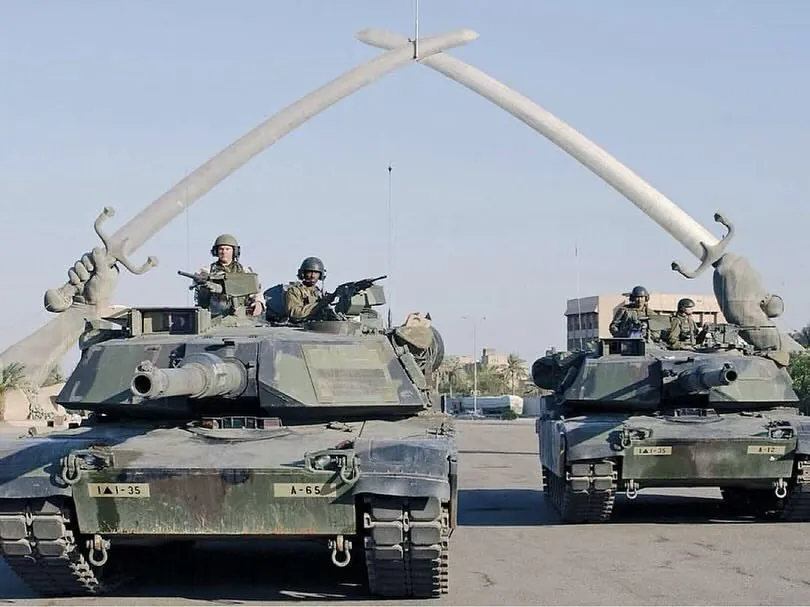
The presentation highlights the uncanny similarities between the imposing aesthetic of the regime and that of the Empire of the films and suggesting that Saddam and his sons were avid fans of the same movie that Rakowitz loved as a child. Rakowitz even included in this exhibit the same movie poster that hung on the wall of his room at the time of the film’s release, alongside photos of a monument with two crossed swords mirroring the pose.
The message suggested to viewers that dictators and other proclaimed enemies of the West are also human and, despite their evils, are not animal or alien to us but enjoy many of the same interests and pastimes that people on the other side of the war do, in a similar vein to the revelations that Kim Jong Un and Osama Bin Laden were players of video games and supposedly had accounts on the gaming platform Steam. For Rakowitz, the perception that Iraqis growing up both at home and abroad had shared interests may have been the profound impetus behind this project. Saddam’s son, Uday, also a big fan of the films, likely grew up watching the films with his father at the same time Rakowitz had seen them in his youth.
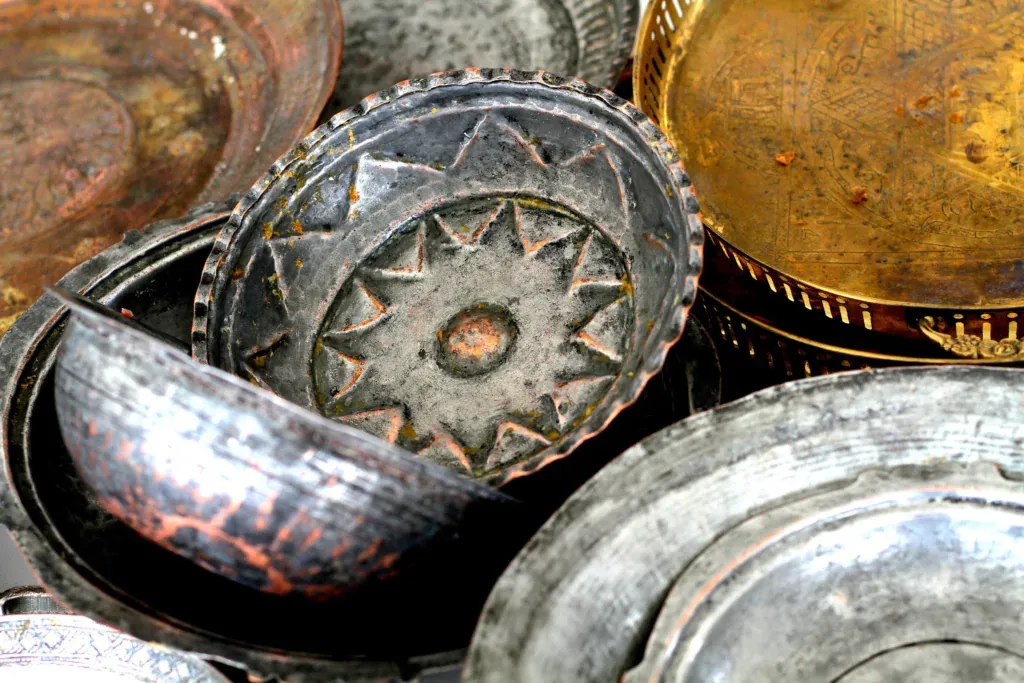
Another project, Spoils, also related to the Saddam era saw Rakowitz controversially purchasing a total of 19 plates looted from the al-Salam Presidential Palace in Baghdad, formerly in the possession of Saddam Hussein for use as restaurant serving plates in an attempt to explore the lines between hostility and hospitality. At the same time that libraries and museums were being raided and destroyed, the palace had seen a similar fate, with plates being looted and distributed to Iraqi citizens, ending up being used as regular dinnerware for some families, “many of them use these plates as their daily dining ware”, Rakowitz stated to The New York Times.
The plates featured the former Iraqi president’s insignia while others featured the symbol of the royal house of King Faisal II, the nation’s last reigning monarch and an individual greatly admired by Saddam. In a strange poetic twist, the plates of the former King were similarly looted from his palace during a revolution in 1958 and ended up in Saddam’s collection. According to a description on Rakowitz’s site: “It has been reported that Hussein was so obsessed by the young King’s short life and violent demise that he would make secret visits to his tomb, often asking guards to open the grave so he could gaze upon the monarch’s remains.”
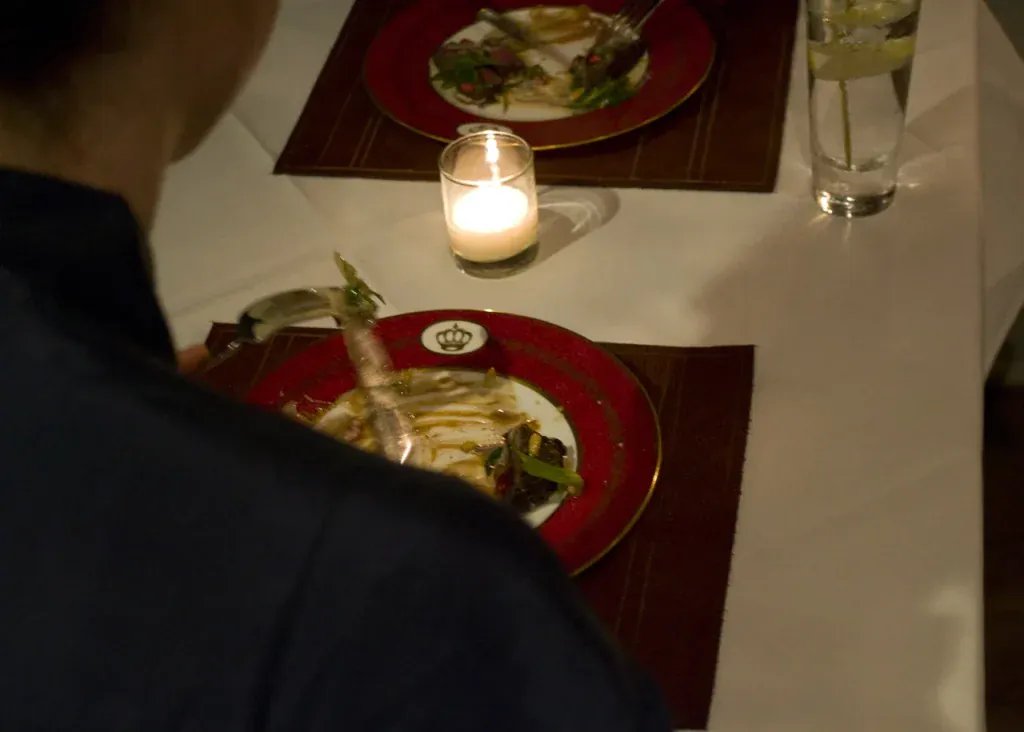
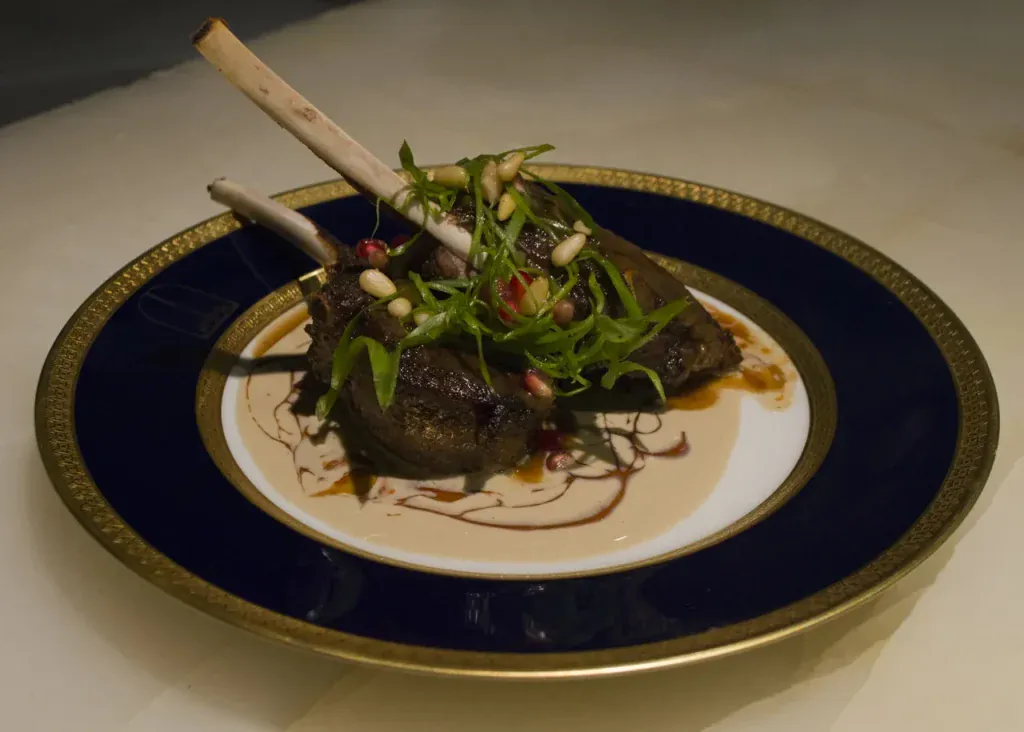
According to Rakowitz, the plates were legally purchased off eBay from two collectors of militaria: Usama Alkhazraji, an Iraqi refugee living outside Detroit whose father belonged to the pro-Saddam Iraqi Republican Guard and Lorenzo Luna, a soldier formerly serving in the 1st Brigade, 4th Infantry Division of the US Army (the same unit involved in the capture of Saddam in December 2003) and himself an avid specialist on Iraqi history. Although the plates cost roughly $200–300 each, the idea that the plates had come from both a serviceman stationed in Baghdad and a civilian involved in the war only added more context to the work.
Upon receiving the plates, Rakowitz partnered with New York chef Kevin Lasko and crafted a dish combining American and Iraqi ingredients, in this case, American venison and Iraqi date and tahini sauce to be served as a fall menu item at the upscale Park Avenue Autumn restaurant in Manhattan (which changes its name and menu every season). The goal was to present a delicious entree with a tainted presentation, namely atop the dinnerware and memory of a man many considered to be a dictator. Whether the plates made their way to the restaurant as trophies of a righteous intervention or an unnecessary adventurism was left to the perspective of the diner.
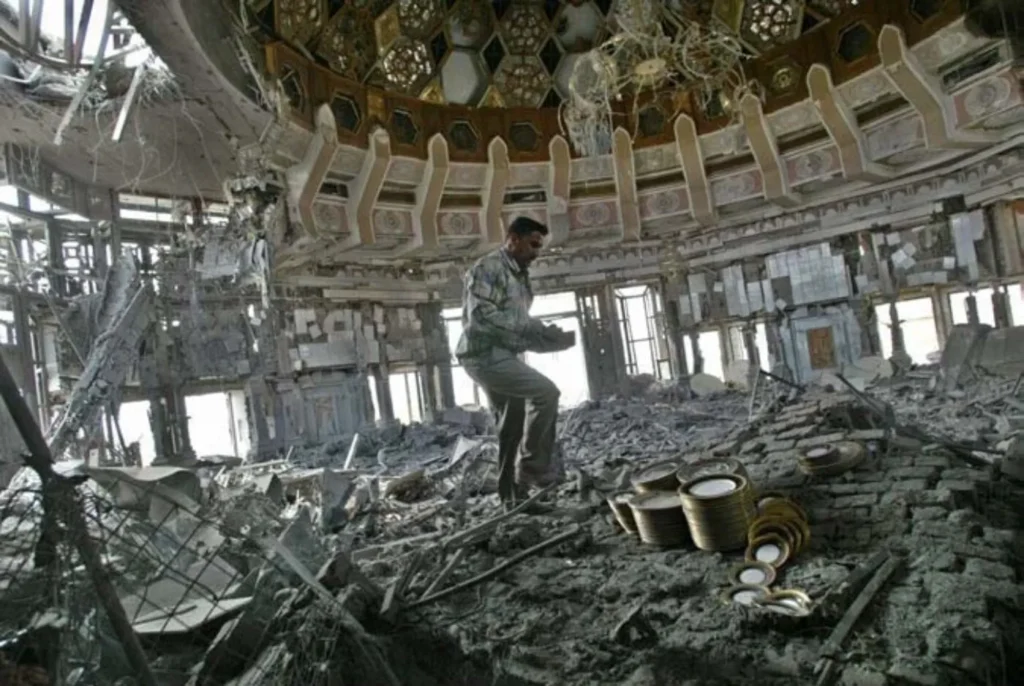
Naturally, customer opinion was divided, some were interested while others expressed offense; Rakowitz himself could not bring himself to eat from the plates, personally. Expectedly, the project attracted attention from across the board, including the interest of the State Department, which sent Rakowitz and the restaurant a cease and desist letter just two days before the item was set to officially go off the menu, informing the parties involved that the plates were to be immediately surrendered to the U.S. Attorney’s office of the Southern District of New York for repatriation to Iraq as looted artifacts.
The Iraqi Prime Minister, Maliki, had been in the United States on an official visit and had learned about Spoils, he then requested from then-president Obama that the plates be collected and loaded on the Prime Minister’s plane on his way back to Baghdad.
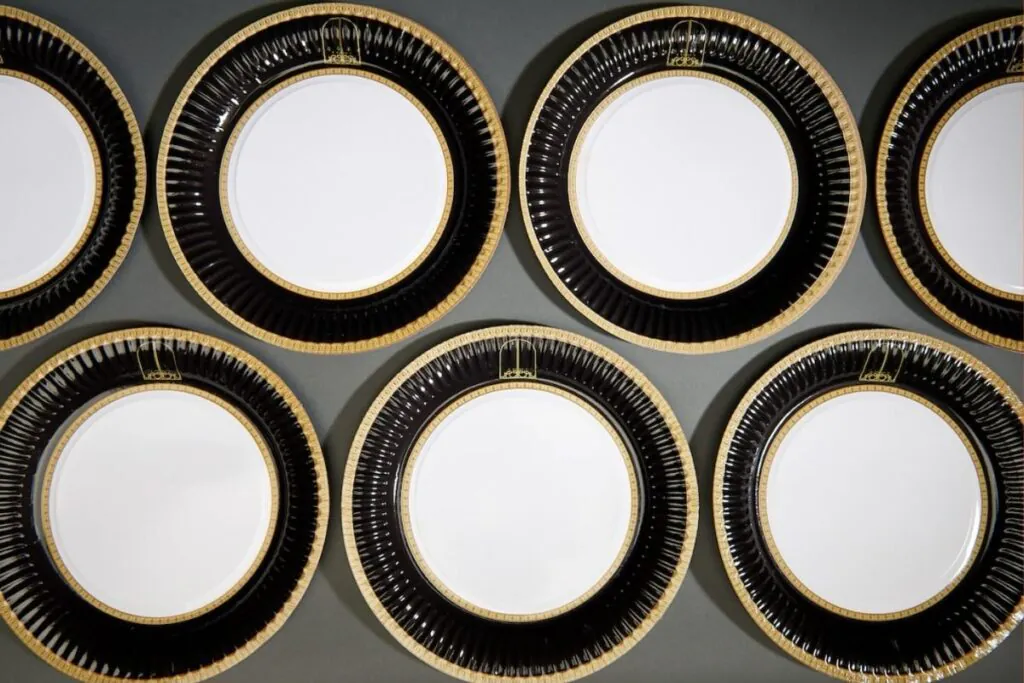
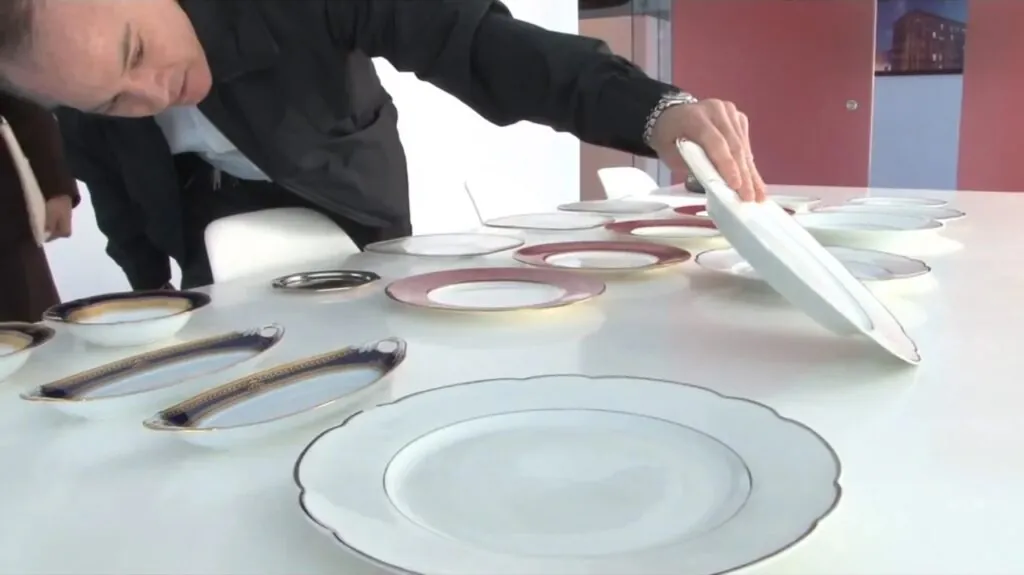
This development did not dismay Rakowitz and his team, it presented a new dimension to the project. Following an inspection of the 19 plates by US Marshals from the Asset Forfeiture Unit, Rakowitz accompanied the items to the Iraqi embassy for the official repatriation ceremony. In doing so, Rakowitz was technically the first of his family to have stepped foot on Iraqi soil for the first time since his mother and her family left in 1946. It was announced that the plates would make their way into a museum exhibit on Saddam inside one of his former palaces and would mention Rakowitz’s work with them. The artist had now left his mark on Iraqi culture.
At one point, Rakowitz asked the Iraqi ambassador if the gun retrieved from Saddam during his capture and now owned by George Bush would also be demanded back to Iraq. After all, it was not a gift of the Iraqis, but also a spoil of war collected by US soldiers. He was essentially told that there are different rules for Bush. Rakowitz, by no means a supporter of the former president, had this to say of the man: “I won’t look at [Bush’s] paintings, I won’t acknowledge the memes that are all so cuddly about his relationship with Michelle Obama and all this other shit that is part of a fucked up celebrity culture. There shouldn’t be this rehabilitation of his image, there should be a rehabilitation of Iraq.”
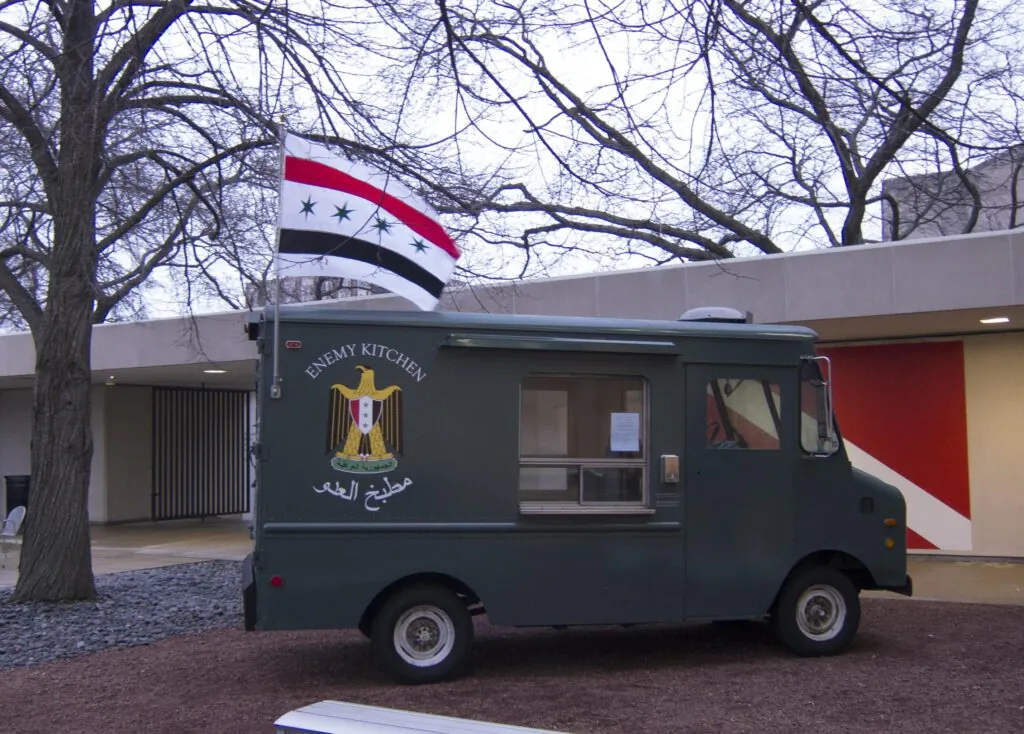
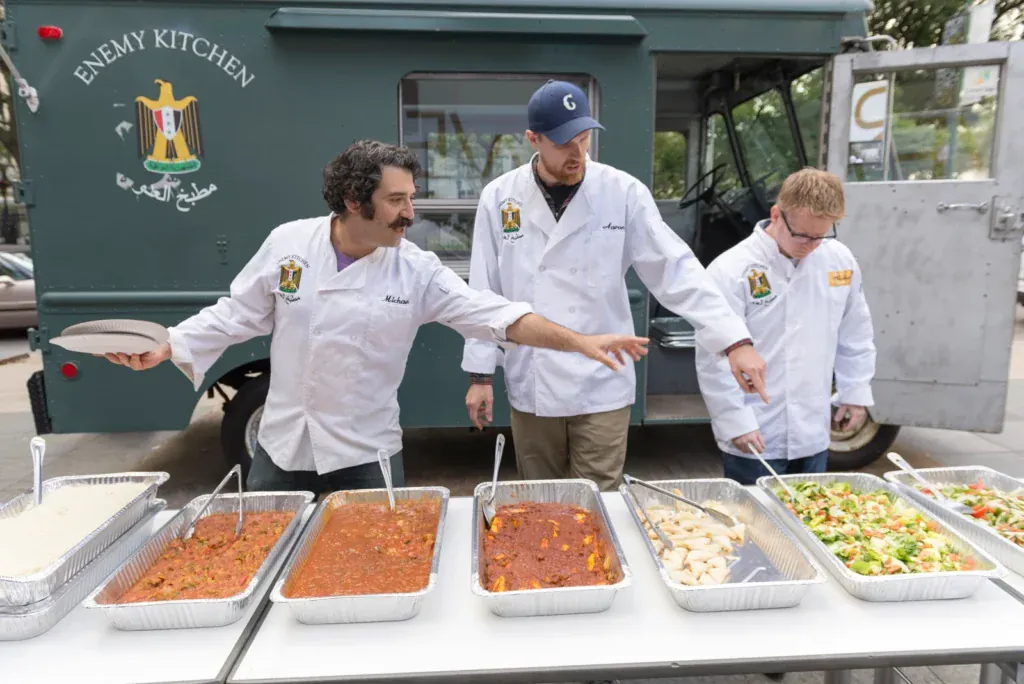
The project and theme of culinary hospitality versus hostility would be referenced and explored in subsequent ventures, namely Enemy Kitchen, in which Rakowitz’s familiar Iraqi-Jewish food was jointly prepared by both Iraqi chefs and American veterans – Enemies, supposedly – and served for free on paper plates (based on the infamous ones owned by Saddam, of course) out of a refurbished 1960’s ice cream truck decked out in an Iraqi flag and insignia, Arabic writing, and military color scheme. The final touch? The cutlery used to prepare the dishes was reportedly commissioned to Haidar Sayyed Mushin, the former sword maker to Saddam Hussein himself, now living in Egypt.
During their tours of service, the veterans were forbidden from interacting with local Iraqis (one veteran was reportedly punished for giving an old woman a drink of water), the project had served to finally break down that barrier through food, with overwhelming community support. Some, however, still did not understand the purpose of the food truck and reacted with anger and even violence, the truck itself was vandalized and broken into during the project.
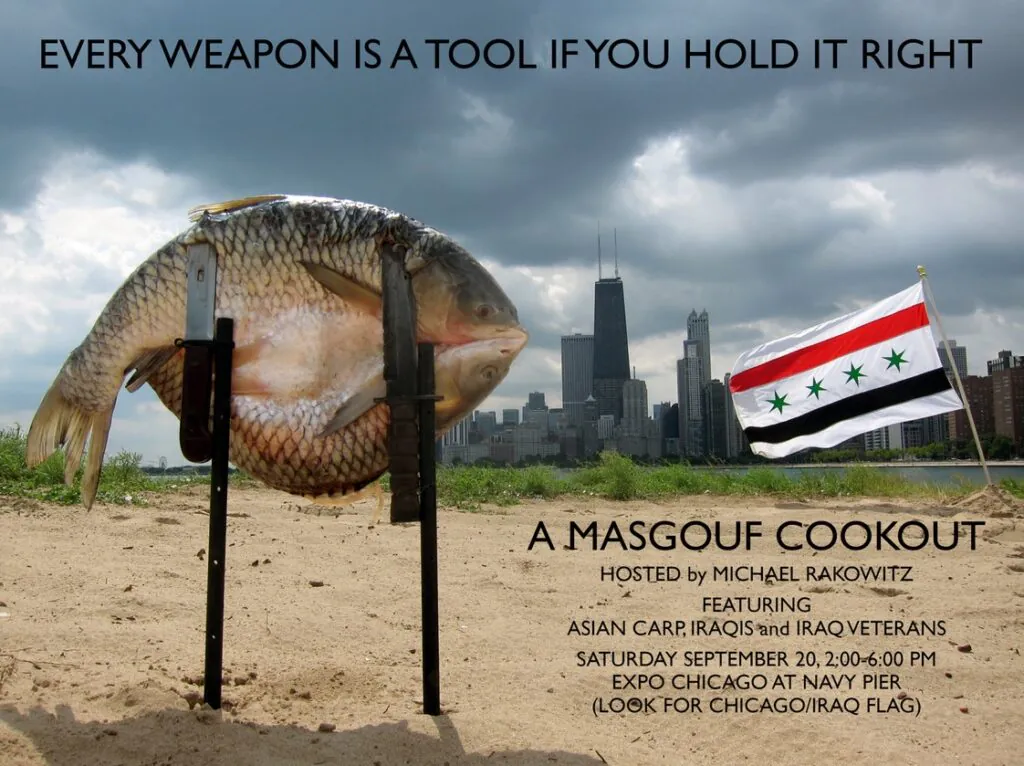
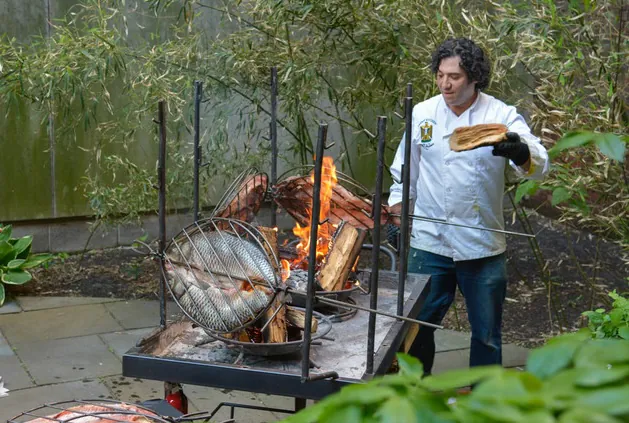
In another project, Every Weapon Is a Tool If You Hold It Right, Rakowitz caught carp from the waterways of Chicago and cooked them over fires using bayonets from Iraq as skewers and parts from Humvees used in Iraq as the grill to create masgouf, another traditional Iraqi dish. Rakowitz intended to light the fire by carrying a flame over from the Tomb of the Unknown Soldier.
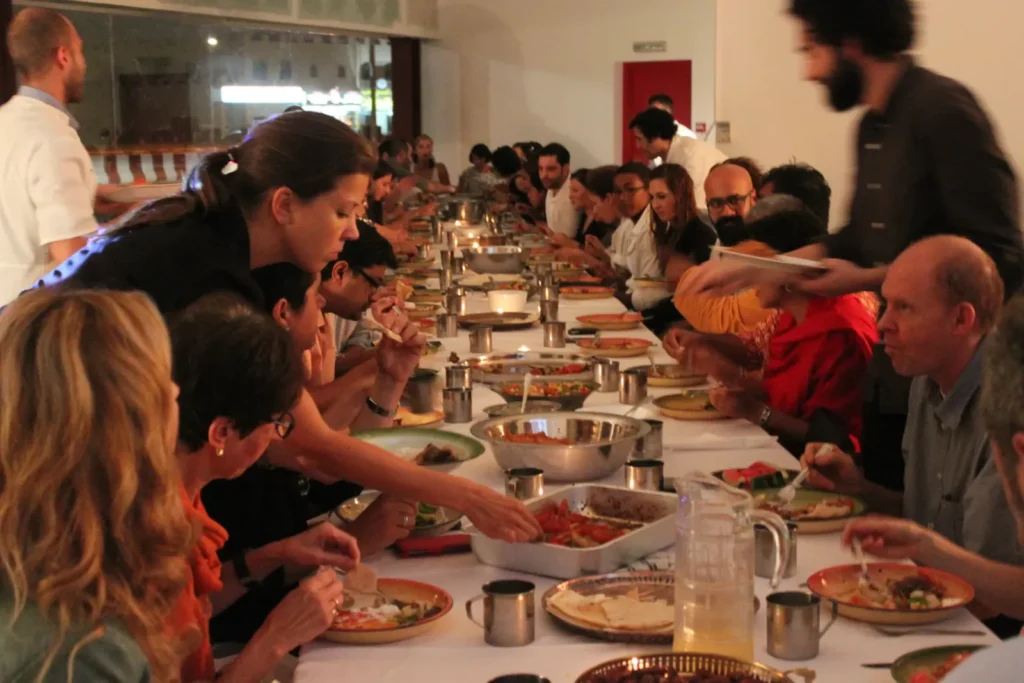
Following the success of these projects, Rakowitz steadily continued the theme of food in his work and was eventually invited to open a pop-up restaurant of Iraqi-Jewish food in Dubai in 2013. Titled Dar al-Sulh, Arabic for “domain of conciliation” and the term to refer to non-muslim territories that make peace with Muslims, was reportedly the first restaurant to do so since the Jewish exodus from the Arab countries of the 1950s. The restaurant, however, wasn’t advertised as such, as local municipal codes prohibit the use of the word “Jewish” on public signage, so the restaurant’s subtitle was written as the “Cuisine of an Absent Tribe”. It called back to the relationship of Rakowitz’s Iraqi-Jewish ancestors with their majority Muslim neighbors.
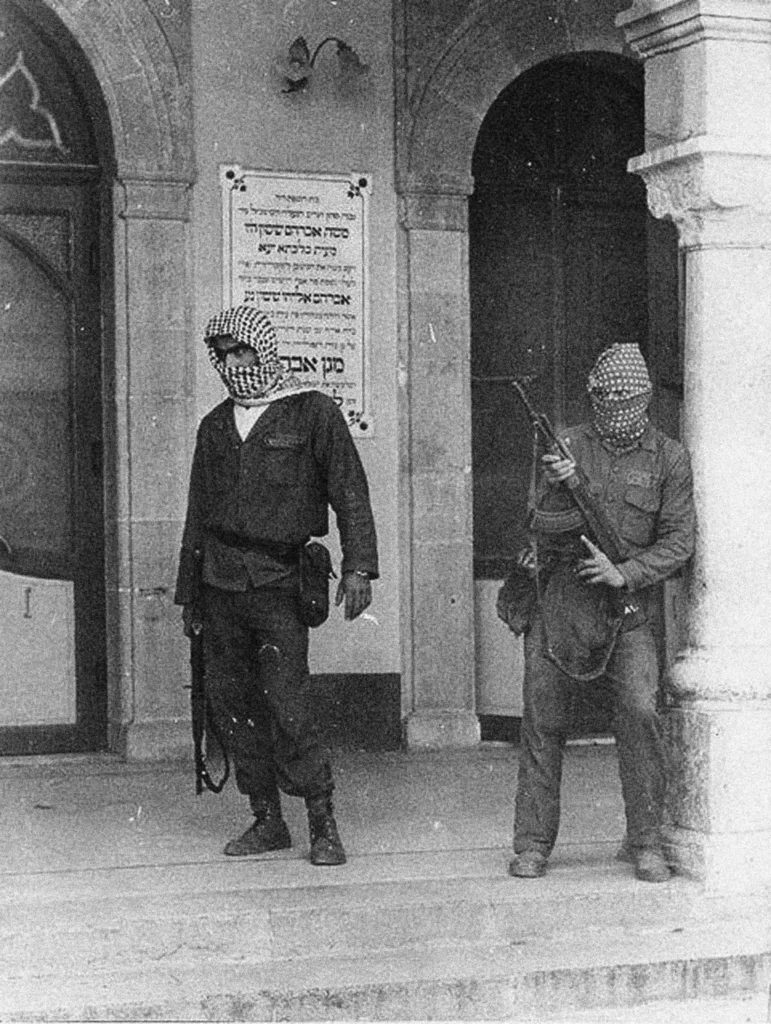
A single photograph hung on the walls of the dining hall of Dar Al Sulh: an image showing Palestinians guarding the Maghen Abraham Synagogue in Beirut during the Lebanese Civil War in 1975. The photograph stands in for other moments that were never recorded, particularly the actions of Muslims and Christians in Baghdad who protected the homes of their Jewish neighbors during the Farhud, the anti-Jewish riots that erupted in the Iraqi capital in June 1941.
Rakowitz had been so keen to use the idea of food in his work due to its ability to mend ties between people as well as become its own form of protest after witnessing how the customer lines for Afghan restaurants were unusually busy in the aftermath of the 9/11 attacks, he saw how people stood up against anti-Afghan and anti-Muslim rhetoric by visiting the restaurants of those communities and supporting them. The artist lamented that people weren’t able to do this during the invasion of Iraq because there were no Iraqi restaurants officially available and what Iraqi restauranteurs were serving food did so under the generic title of “Mediterranean.”
In the 2003 invasion of Iraq led by the US military, what followed were thousands of lives lost and irreparably damaged. What accompanied that human loss was another loss, a cultural one. Practically every library, museum, or cultural site sustained some extent of damage. Some places were looted or vandalized while others were outright destroyed. Much of it was purposeful, such as the burning of the library Basra, formerly home to centuries-old manuscripts, where over 50,000 items were destroyed.
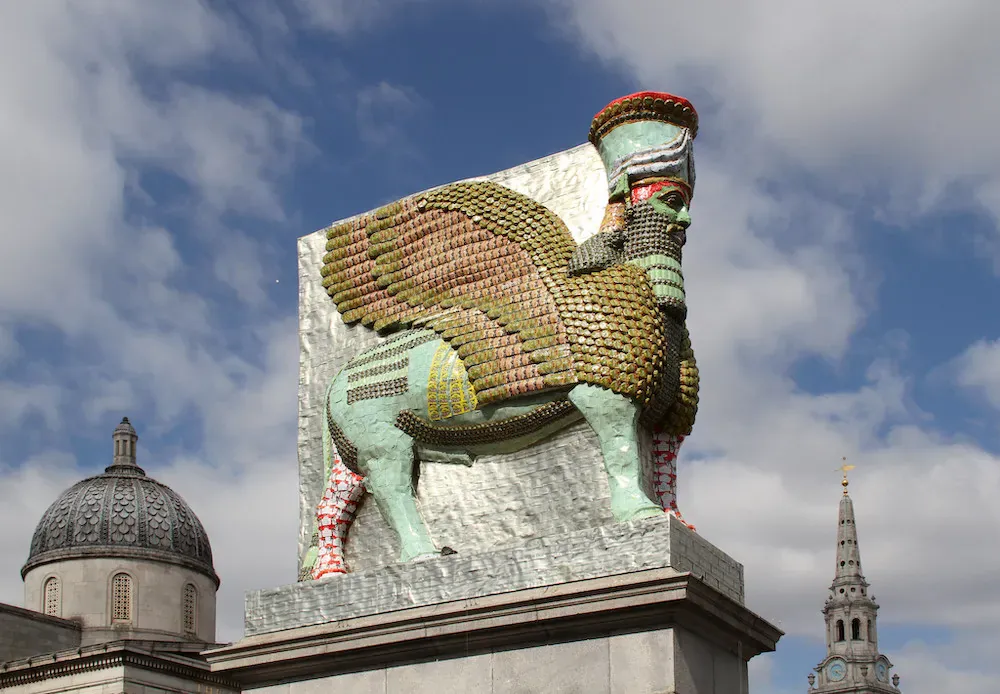
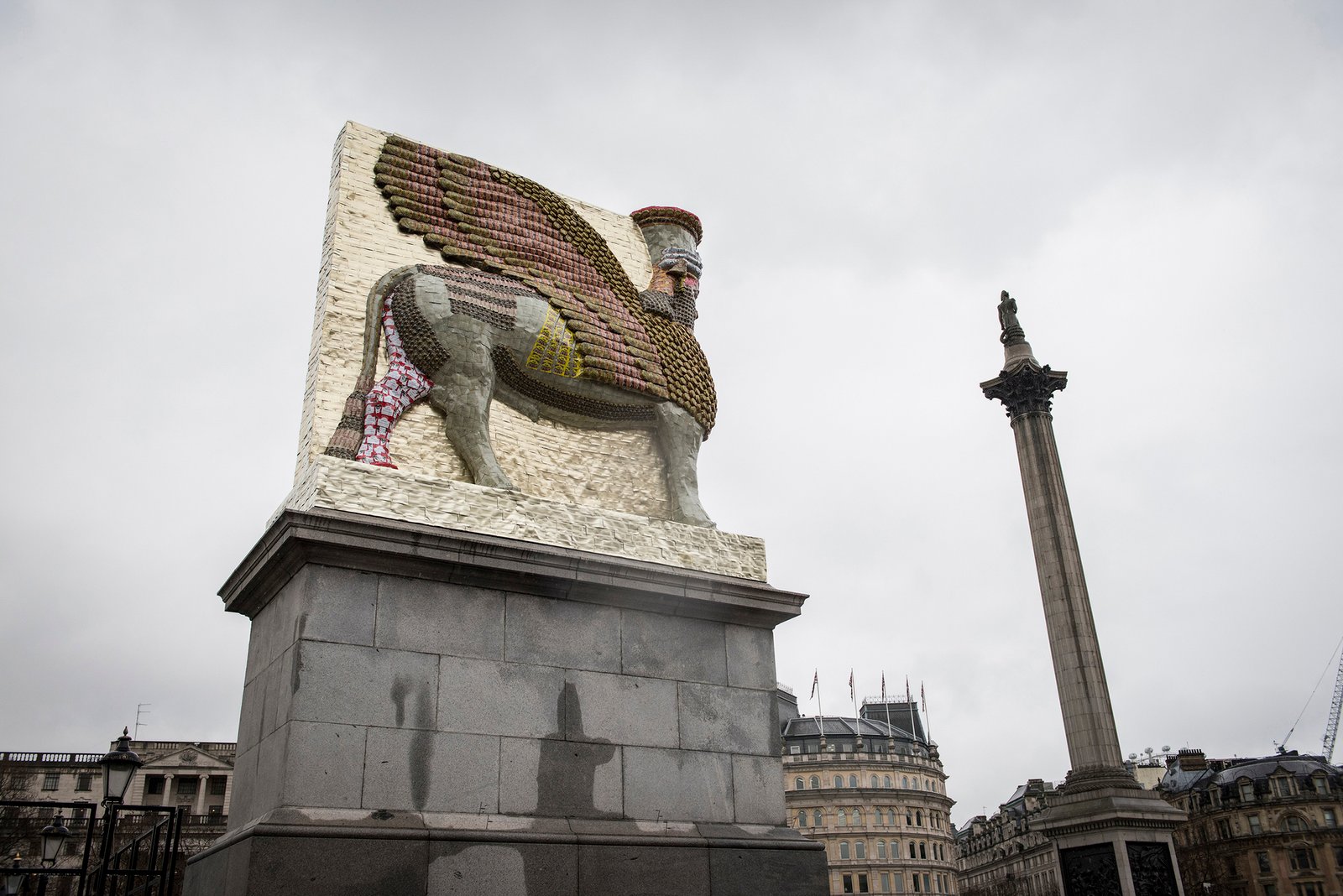
The project entered into the view of the public eye when Rakowitz’s full-scale replica of a Mesopotamian protective deity, the Lamassu, won the honor of being displayed on London’s fourth plinth public art space in Trafalgar Square until 2020. Originally meant to house a statue of the British King William IV, the plinth (designed by Sir Charles Barry in 1841) stood empty for over a century and a half due to a lack of funding for the statue. Since 1998 it has served as a space in which various works were installed for several years at a time, a product of Labour Party initiatives for public art through the Royal Society for the Encouragement of Arts, Manufactures and Commerce (RSA). The Lamassu is the twelfth installation on the plinth so far, following such sculptures as a giant blue rooster, a ship in a bottle, and a hand showing an extra-long thumbs up.
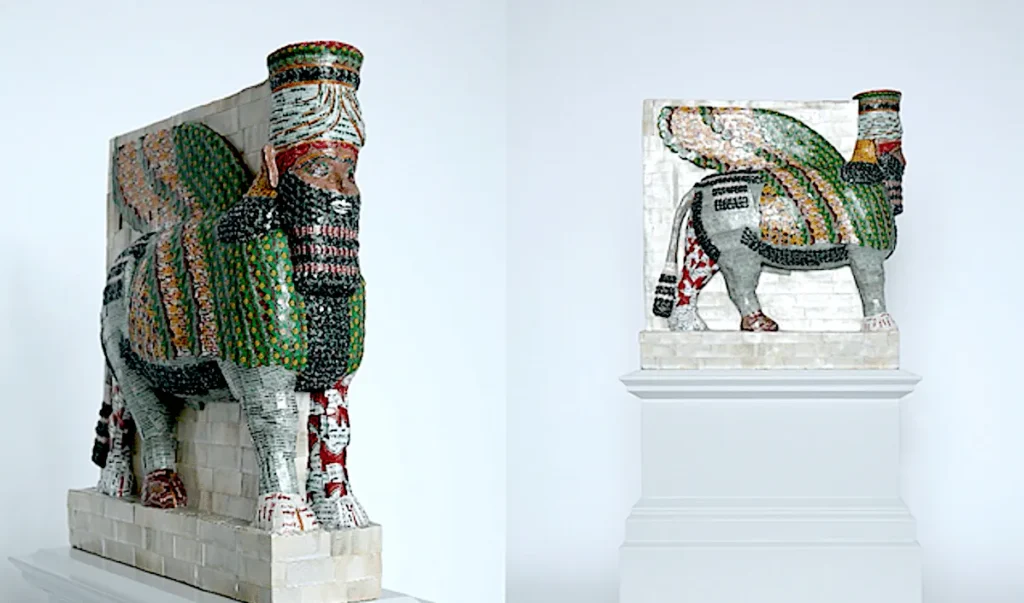
Although instead of being carved from limestone, like its predecessor, this piece was rendered in tin using thousands of recycled Iraqi date syrup cans. Rakowitz has compared it to the nearby fixture of Nelson’s Column for the fact that these sculptures were borne out of war and imperialism as well as the fact that they both employed repurposed materials as a medium. In the case of the latter, it was cannons melted down and salvaged from the HMS Royal George instead of food packaging.
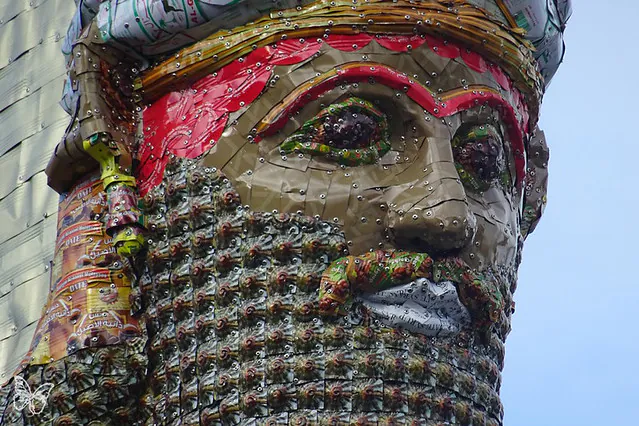
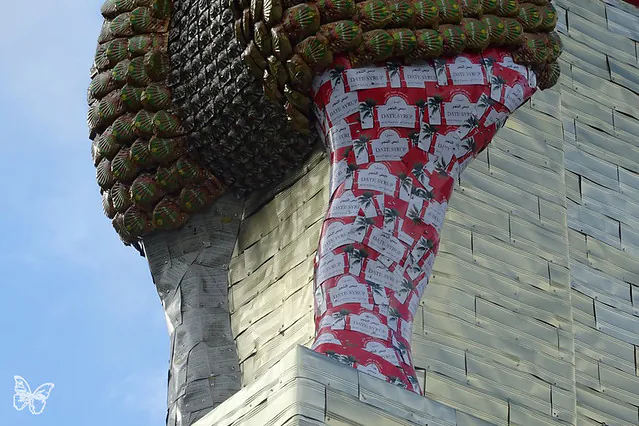
The Lamassu is an imposing mythological being featuring the wings of a bird, the body of a bull or lion (depending on the style), and the head of a man. Respectively, these elements are said to symbolize freedom, strength, and wisdom. Similar in purpose to the Egyptian sphinx or the guardian lions of China, the Lamassu frequently appeared as a guardian of palaces and people since as early as the 3rd millennium BC. Frequently, the figure has commonly been used as a symbol throughout the Middle East. Since the invasion of Iraq, the Lamassu has also taken a place on the insignia of invading forces, such as the British 10th Army and the flag of the United States Forces in Iraq.
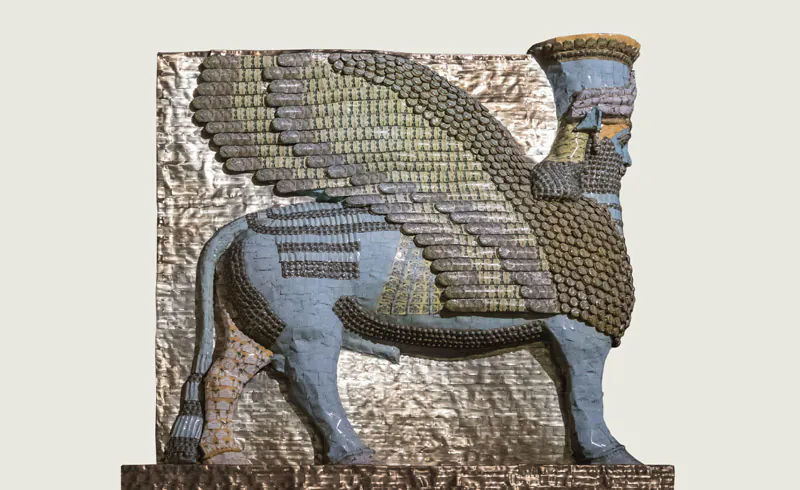
The sculpture was based on a sculpture of the Lamassu that faithfully guarded the Nergal Gate of the ancient Assyrian site of Nineveh in northern Iraq from around 700 BC until its purposeful destruction by the Islamic State in February 2015. It is listed among the most monumental victims of the cultural destruction from the last few years that left some of the most well-preserved cultural and historical sites reduced to dust, and many institutions across the world are still reeling from the consequences. Over the past few centuries, similar sculptures have made their way over to Western museums, where they are thankfully insured from destruction, in a bittersweet manner.
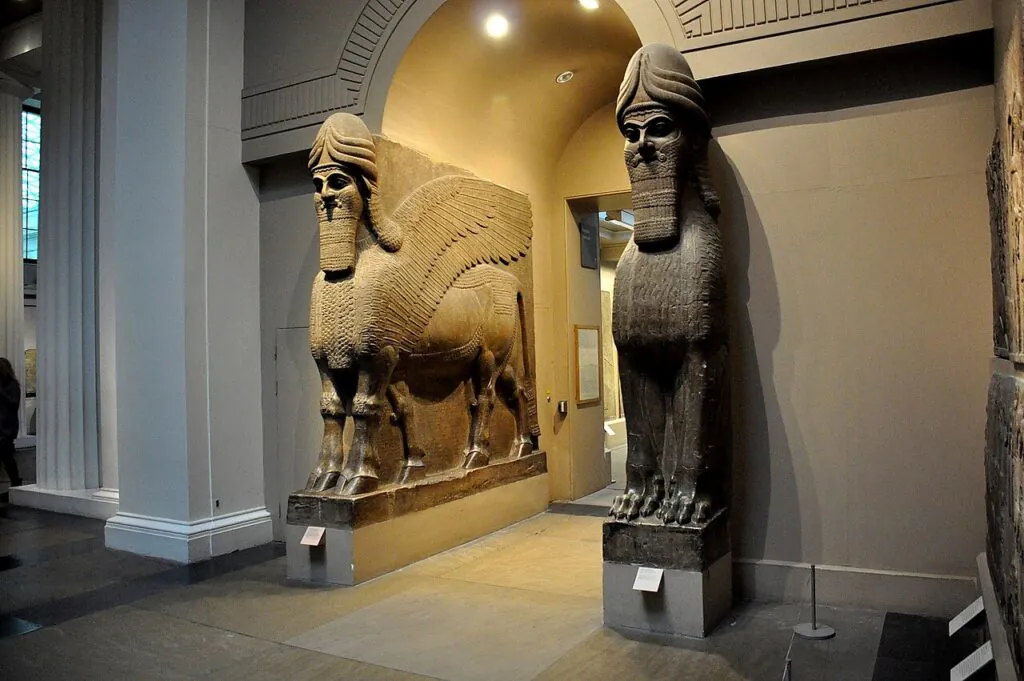
The choice to render this figure in particular is by no means a result of circumstance. Rakowitz’s affinity for the Lammasu began early on in his life, at the age of 10, specifically on a visit to the British Museum while on a trip to see members of his family, describing the sight as “a primal scene in my life and in my art-making”, he tells the Evening Standard.
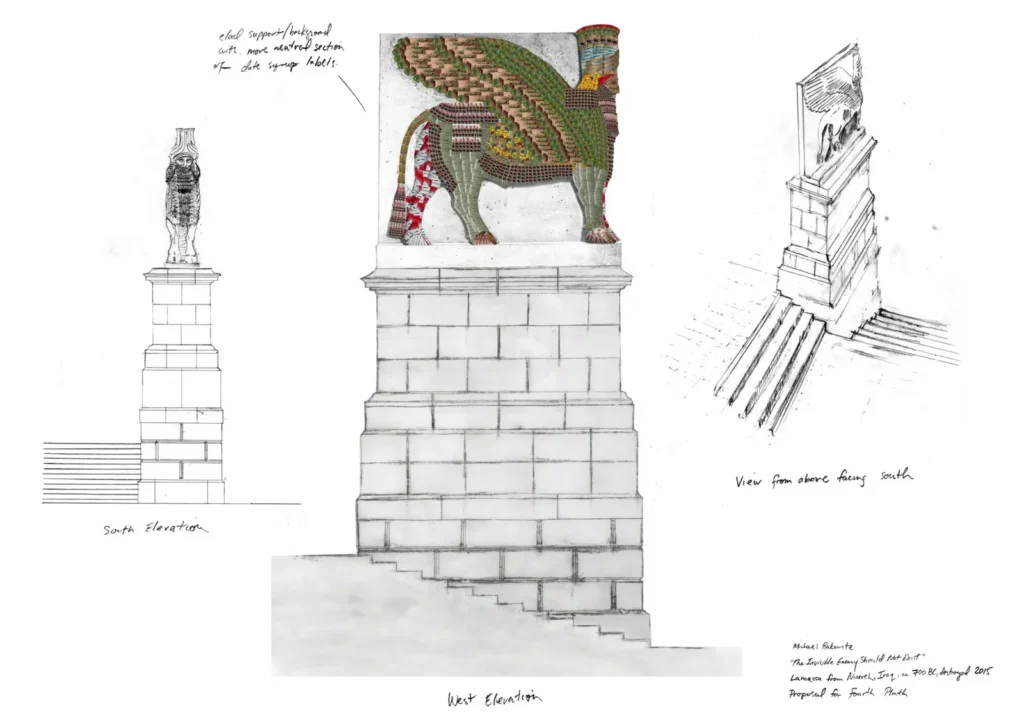
Years later, upon seeing the footage of the Nineveh Lamassu being demolished, he immediately set himself to reconstructing the sculpture. He began by referring to 19th-century measurements and sketches of the sculpture from the British archaeologist Austen Henry Lanyard, the same individual who originally brought the other pair of Lamassus witnessed by Rakowitz inside the British Museum. The 14ft sculpture happened to be just the appropriate size for the plinth and thus, a proposal was submitted to the Fourth Plinth committee.
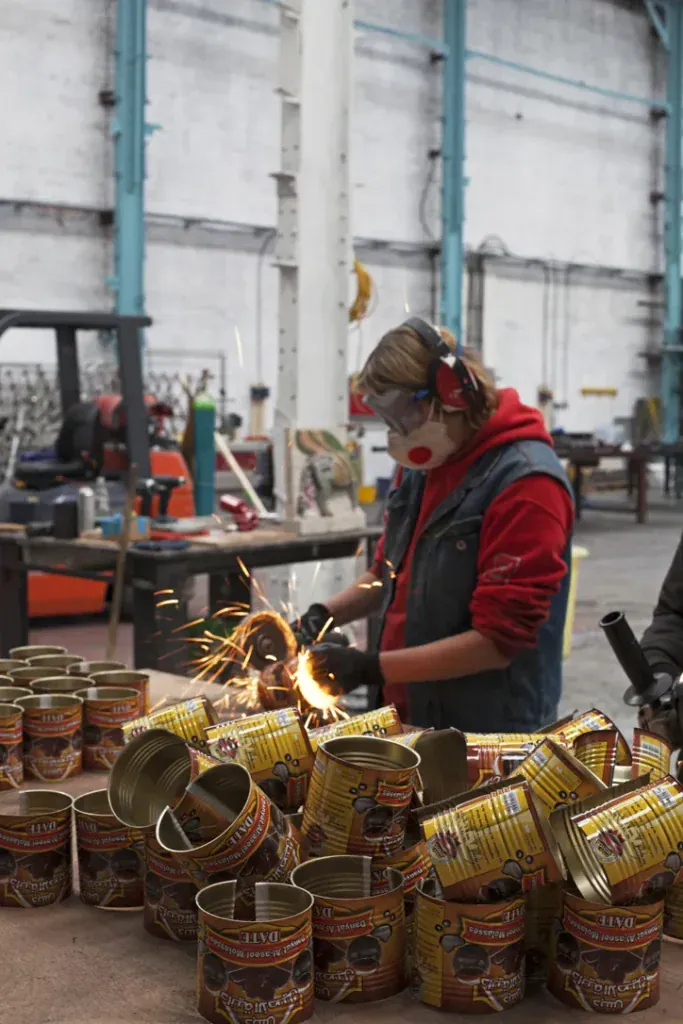
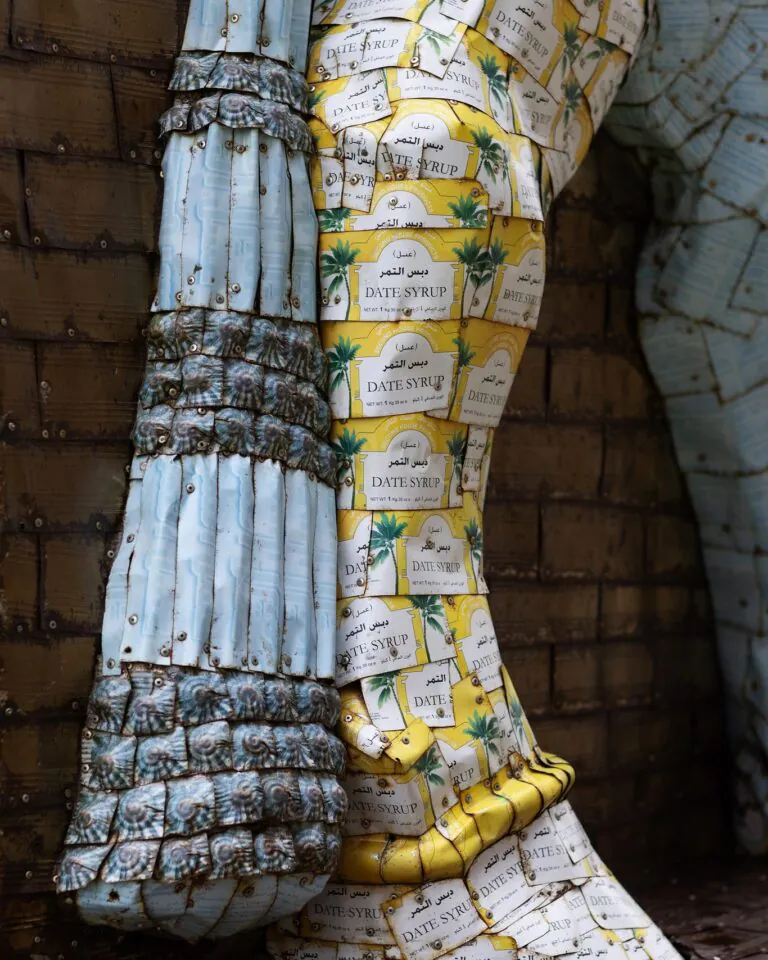
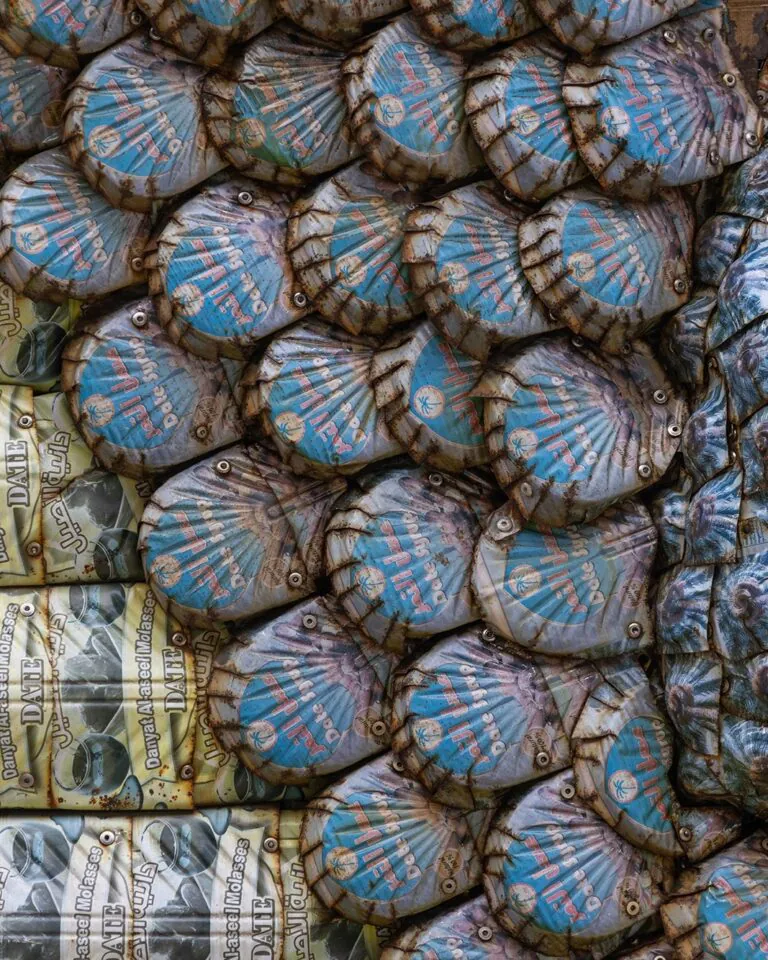
In constructing the sculpture, Rakowitz initially stress-tested the date syrup cans for their aversion to rust by nailing them to the wall of his Chicago studio for several days to see if they could withstand the similarly overcast climate of London. Having approved their quality, he proceeded to get in touch with several producers of date syrup in Iraq with the unusual request that they send him strictly empty cans of date syrup. After learning of the project and Rakowitz’s goals for the cans, many of the companies were more than eager to supply him, with one business even returning date syrup to their product stock out of a willingness to support Rakowitz’s efforts.
The date syrup is no arbitrary choice either, the layered symbolism behind it has parallels in much of the artist’s work going back over a decade. In the simplest context, the symbolic use of empty cans of food, objects that would regularly be meant to be discarded into the trash, being used to recreate a sculpture that, too, has been sent into the waste bin of humanity should be clear enough. However, the notion of date syrup adds a historical background that may not be clear to those outside of the Iraqi community.
The date, and, subsequently, the syrup it comes from, is indelible to the culinary history of Iraq, once the world’s foremost exporter of dates and where over 600 varieties were available at one point. Dates were once the second most important export in the nation, second only to oil. Before the Iran-Iraq war and continuing troubles ravaged the nation’s date industry, there were an estimated 30 million date palm trees growing roughly four decades ago, compared to only a few million today.
Reportedly, a $150 million effort to reinvigorate the industry by tripling the nation’s amount of date farms was interrupted due to the rise of the Islamic State. Rakowitz, who once compared the allure of the Iraqi date to the Cuban cigar for its distinctive flavor and difficulty to acquire, first began his love affair with the Iraqi date on a project in which he sought to import several tons of Iraqi dates into the US directly from the place they were grown.
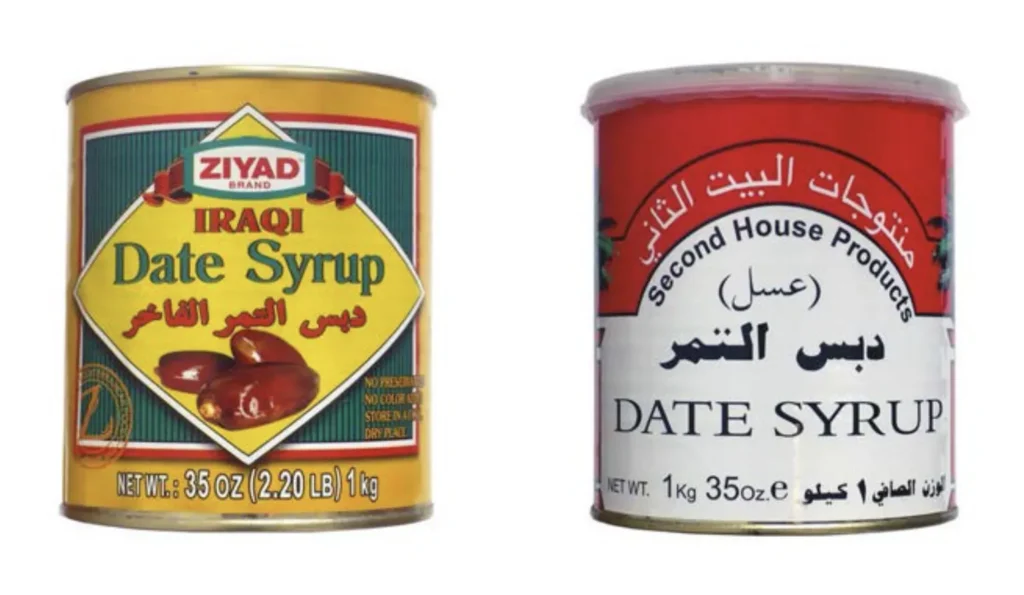
As a commentary on the trade embargoes and sanctions placed on Iraq since its invasion of Kuwait in 1990, the artist sought to demonstrate how difficult it had become for average people to make economic and cultural connections with each other, even after trade barriers have been lifted. After learning that a can of date syrup labeled ‘Product of Lebanon’ was grown and pressed in Baghdad, sent to be canned in Syria, and finally labeled in Lebanon, Rakowitz was surprised at how Iraqis had been circumventing costly and convoluted US trade restrictions by routing their product through other countries and in a time when refugees from Iraq themselves were making similar journeys to get to the West, he considered that there was something very poignant about this lesson.
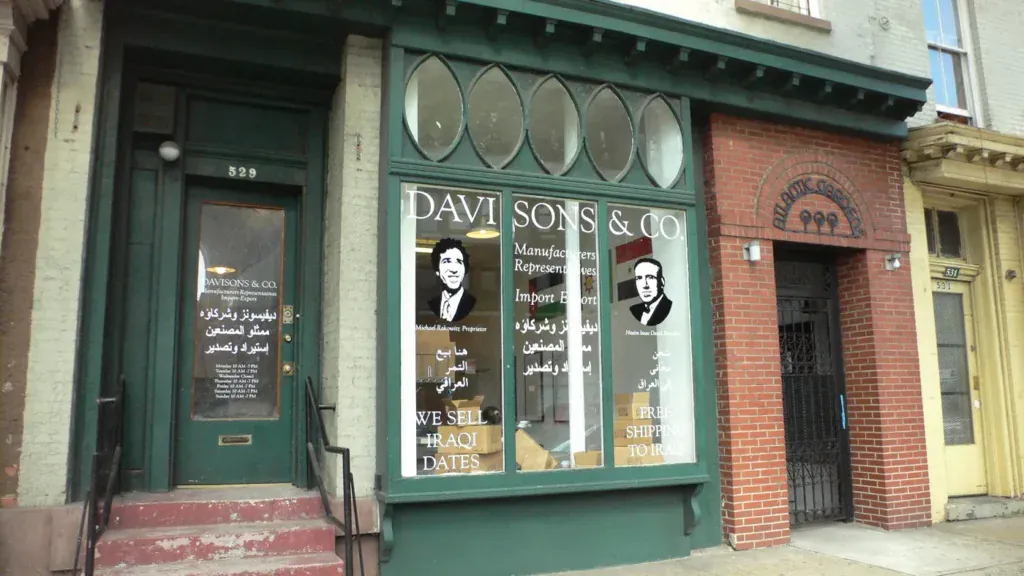
In 2006, sixty years after his family came to America and three years after official sanctions were lifted, Rakowitz used an empty storefront on Atlantic Avenue in Brooklyn’s Boerum Hill neighborhood, home to many Middle Eastern immigrants, for several months as an imported date store titled Davisons & Co, the name of the import-export business run by his maternal grandfather, Nissim Isaac David, in Baghdad and America following his immigration. While the store sold regularly accessible dates and date products, Rakowitz arranged with an Iraqi producer, Al Farez Co., for one ton of dates to be imported directly to America through the assistance of Sahadi Fine Foods, also on Atlantic Avenue and the place where he originally discovered the can of date syrup that spurred the endeavor.
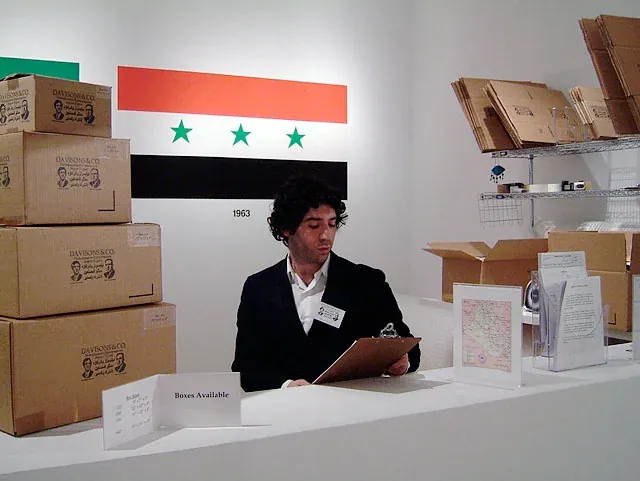
The journey of the Iraqi dates lasted several months. Picked at the city of Hilla in September, the dates made their way to the Jordanian border from Baghdad where they waited alongside thousands of Iraqis fleeing violence, the goal was to reach the city of Amman. After four days of waiting, the dates and many of the Iraqis were refused entry into Jordan numerous times and were eventually re-routed to Syria and were doomed to sit and decay at the airport in Damascus.
It was by then that a decision was reached to send dates by DHL. “The dates had been suffering the same fate as the Iraqi people” as Rakowitz put it. Indeed they did, Once they reached the US, the dates were inspected for a total of three weeks by several government agencies including Customs and Border Patrol, the USDA, and Homeland Security, ending up at Rakowitz’s store on December 5.
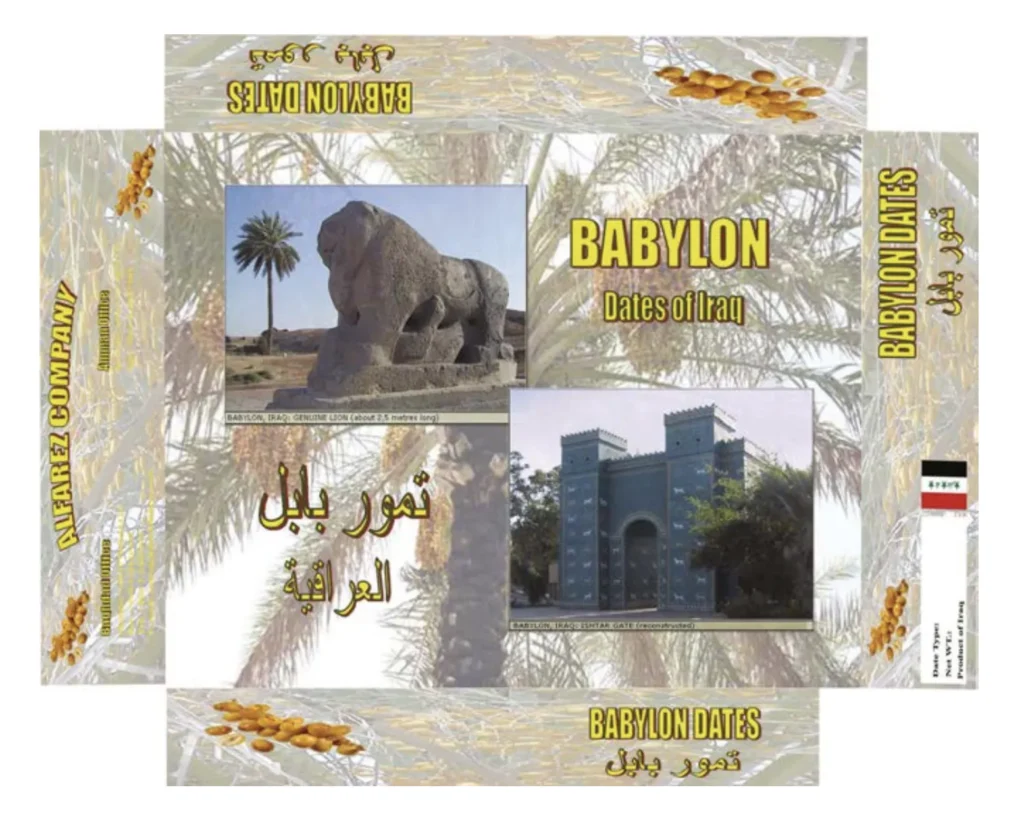
Supposedly, the Iraqi dates successfully reaching the American market had been the first time in over 25 years that such an event occurred. Since the dates and ultimately, the project ended up being out of Rakowitz’s hands, it bolstered the original statement and supported the question of why there continued to be so many obstacles to doing business with Iraq and helping to rebuild its society if that was allegedly the stated goal of the US government, even after the American and international sanctions were lifted. A stack of paperwork from the entire ordeal was a visual representation of the journey.
The date, and the cans of date syrup derived from them, is representative of Iraq and its people as well as its overall decline from decades of troubled history. Consuming the sweet delicacy is a cultural practice, and one tradition among the Iraqi people is to place a date in the mouth of a newborn, a signifier that the first taste of life should be sweet and according to Rakowitz, “a harbinger of good things to come”.
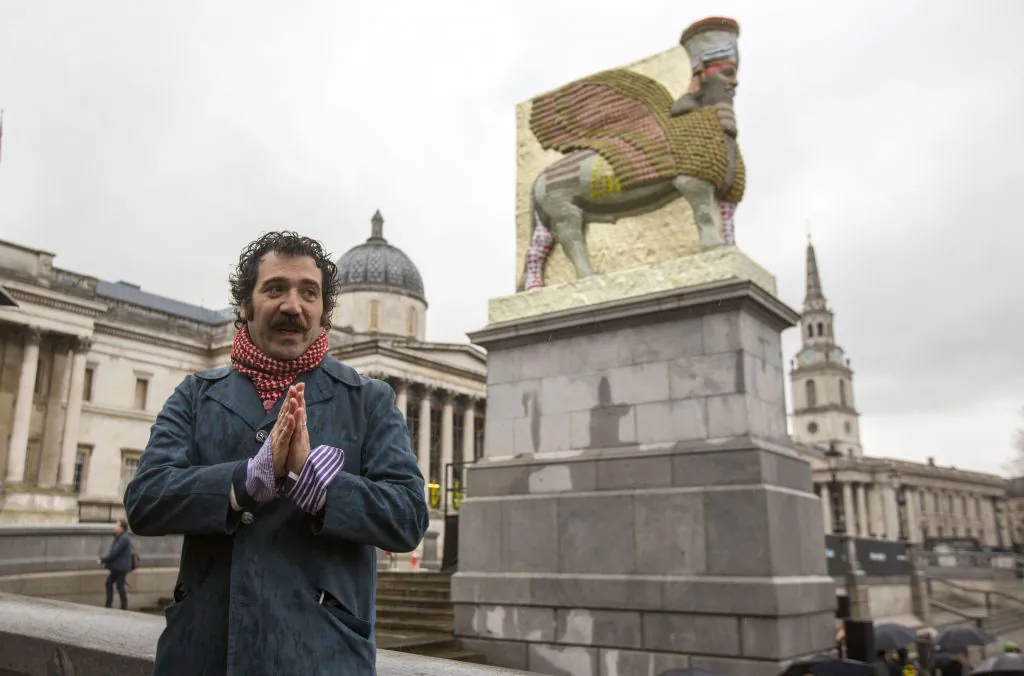
Thus, the variety of brightly colored tin cans at Rakowitz’s disposal now meant he had a particularly unorthodox, and necessarily symbolic, palette to work with in recreating the Lamassu. The finished piece consisted of a total of 10,500 syrup cans, held together by 39,500 rivets, and weighing somewhere around 13,200 pounds. The six-and-a-half-ton sculpture was then installed onto the plinth and unveiled by the artist along with London’s mayor, Sadiq Khan, in an official ceremony on March 28, 2018. Rakowitz then became the first non-European artist to artist to be selected for display on the plinth. It was quickly pointed out that the meaning that charged the sculpture was incredibly timely for a city that, at the time, had been rocked with terrorist attacks but remained stalwart.
In keeping with the theme of dates, the official Plinth store sold additional pieces created by Rakowitz, most notably an edition of 2,376 cans of Karbala brand date syrup, the same number of them as included in the creation of the sculpture, and a signed book of recipes from various chefs around the world, including the artist’s mother, Yvonne Rakowitz. The whole range of products including tea towels, aprons, and wooden spoons all feature the same proverb in English and Arabic: “A House With A Date Palm Will Never Starve”. A portion of the proceeds was pledged to support educational initiatives by London’s mayor.
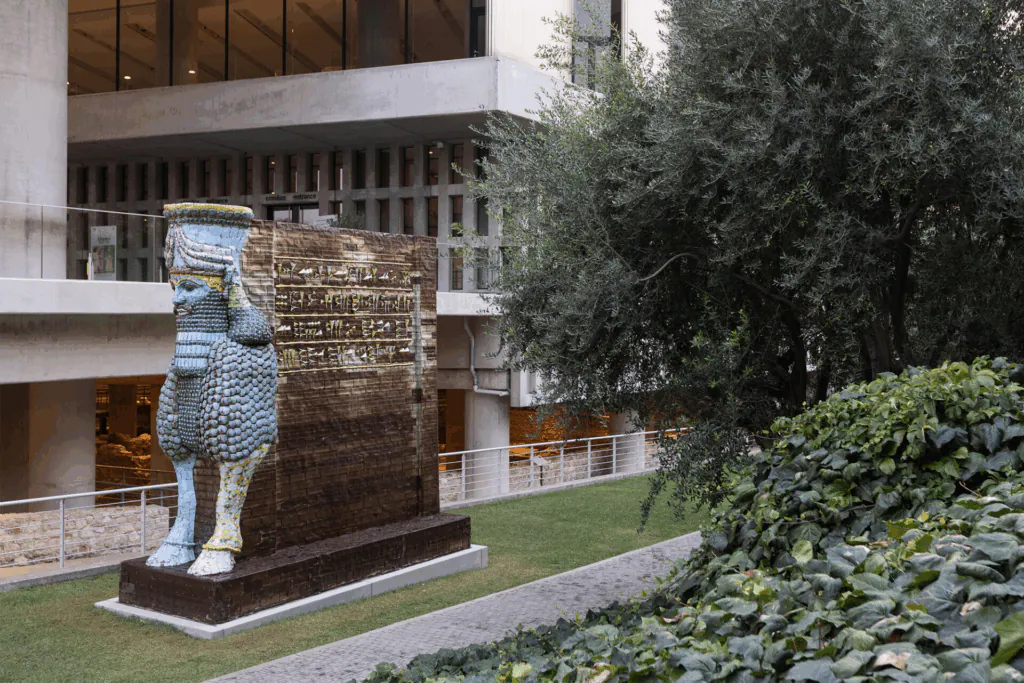
Looking southeast to Nineveh, the sculpture is as much a symbol of loss and destruction as it is of new beginnings. Following the sculpture’s scheduled removal in 2020, Rakowitz hoped it could be donated to the National Museum of Iraq or placed somewhere near the original home of its predecessor in Nineveh in the form of “circular ecology”, in Rakowitz’s words. Today, it currently has a home outside the Acropolis Museum in Athens, Greece.
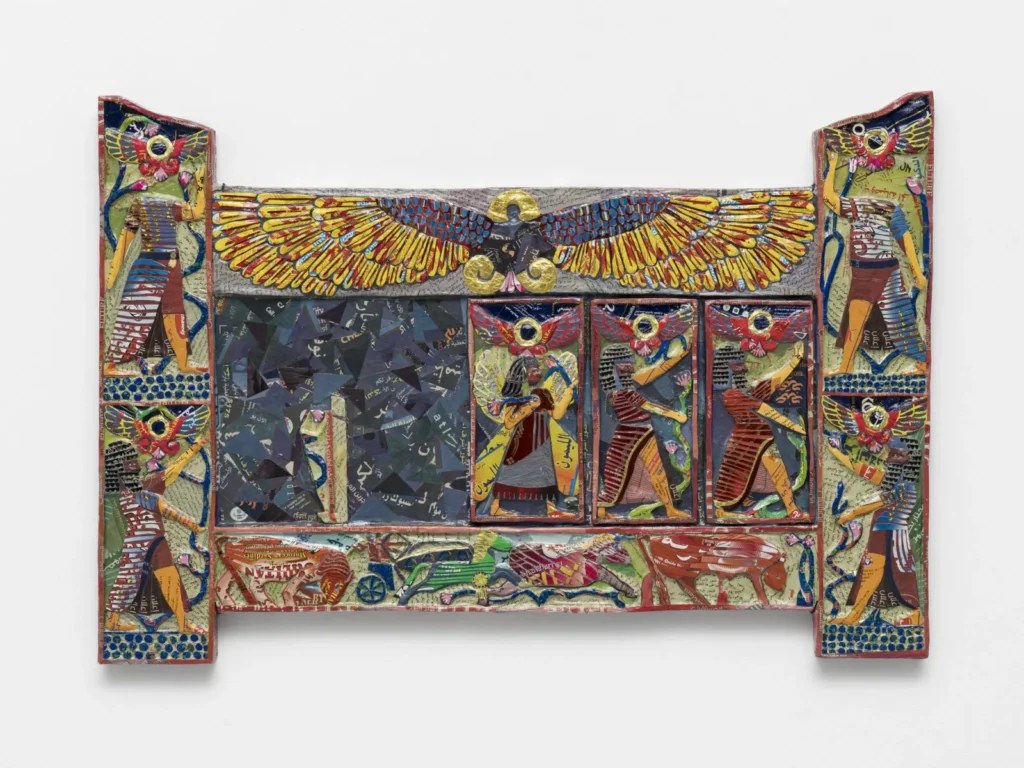
But this widely-acclaimed reconstruction was merely one item of several from the 9th Century BC palace of Nimrud recreated by Rakowitz and his team, and just one facet of the larger purpose behind The Invisible Enemy Should Not Exist. In his earlier exhibitions, Rakowitz created full-scale reproductions of the seven reliefs also destroyed by Islamic State militants from the same complex, even having had the exhibition space reconstructed to imitate the layout of Room Z of the northwest palace of King Ashurnasirpal II, as it was known to archaeologists since its excavation in 1854, and placing the reliefs in the locations where they would have been in the real palace before their destruction.
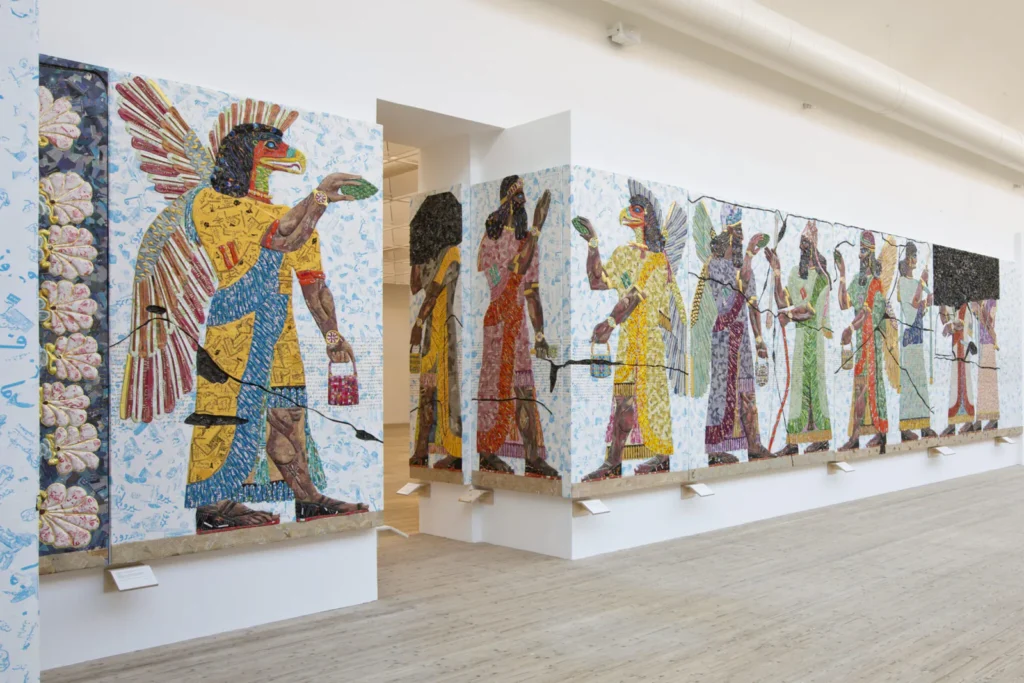
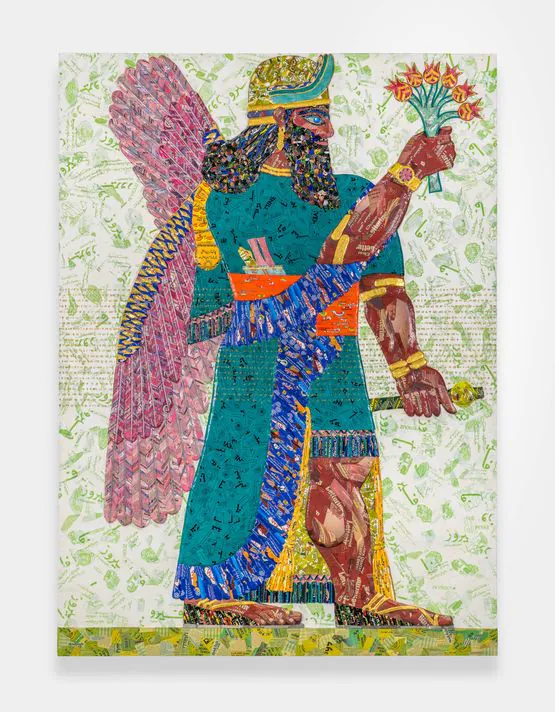
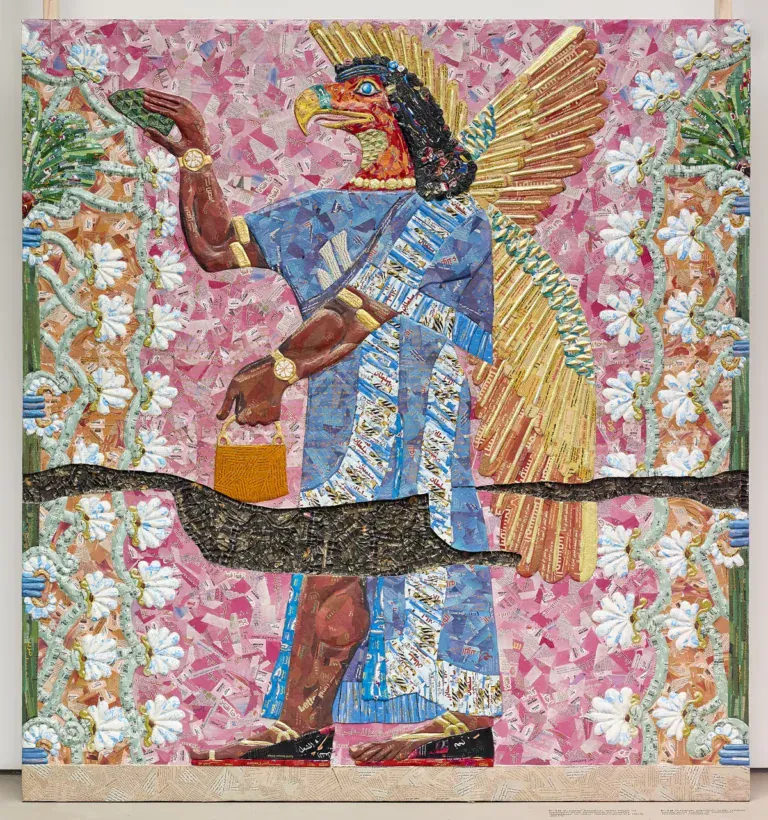
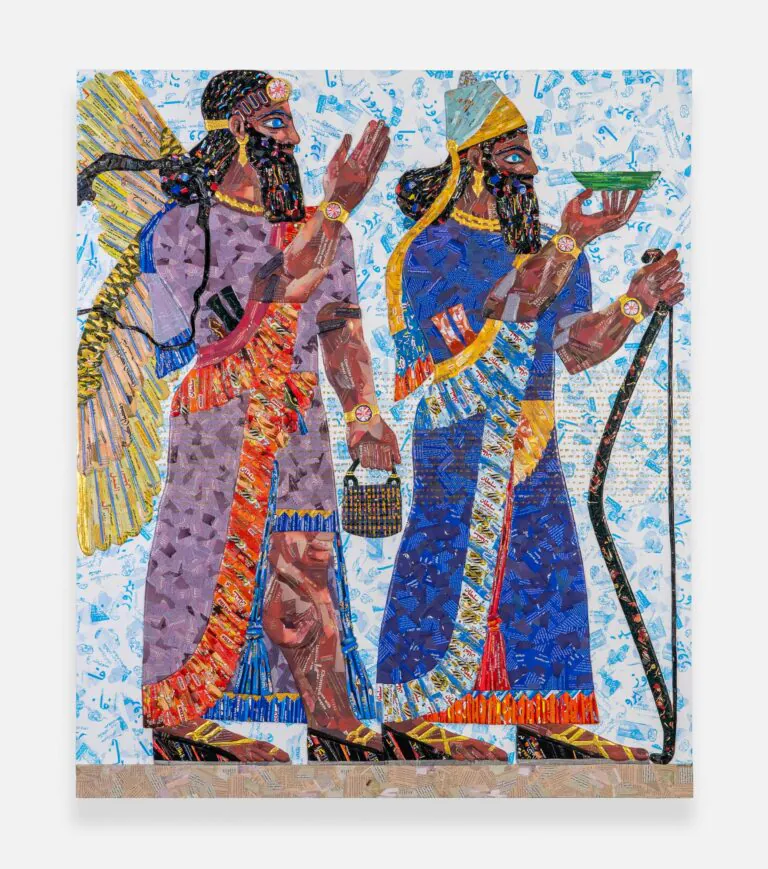
In time, he plans to recreate the entire palace, room by room, although he leaves black spaces in the reliefs that were not destroyed but fragmented and moved into museums across the world. The six reliefs that were taken in whole are represented as empty gaps in the exhibition. And once more, the symbolism of the dates takes precedence in the decision to recreate these reliefs, as the Apkallu (guardian creatures with wings and human heads) depicted in them are seen holding in their hands the pollen and fronds of date trees, symbolizing the fertility of the kingdom.
Furthermore, the figures themselves are depictions of kings, elevated to godlike proportions, and various mythical beings. The cuneiform inscriptions on the reliefs describe them as strong and invincible monarchs who reign over all with the support of the gods, among other exaltations. In Rakowitz’s words, “These are their own expressions of imperialism, conquest, and war, and to see them in the frame of the victims of war is this really incredible moment of discomfort”.
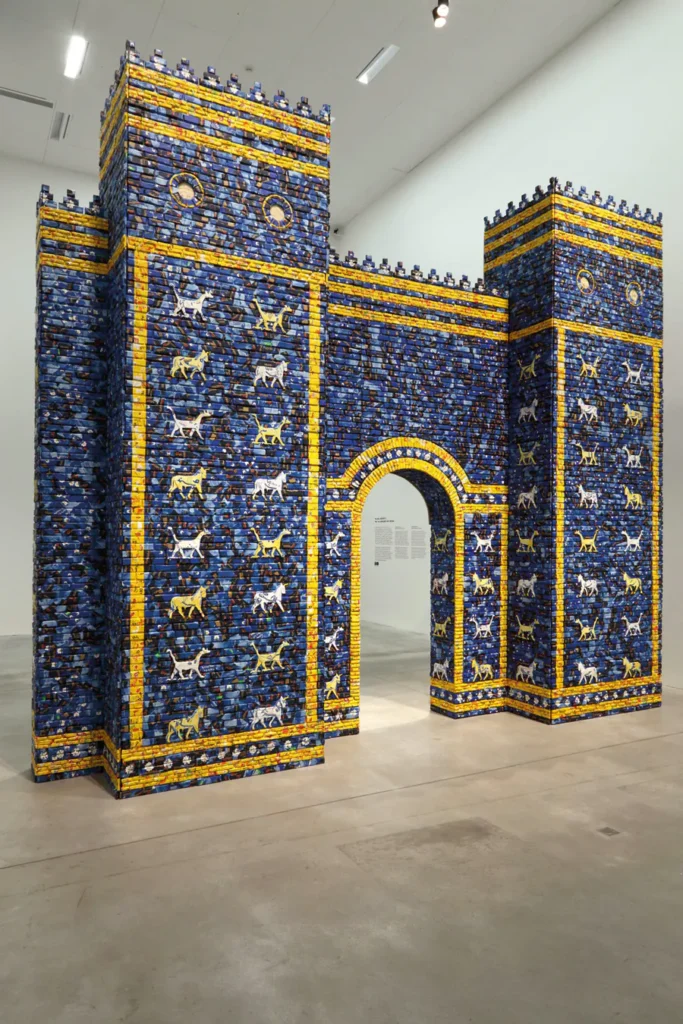
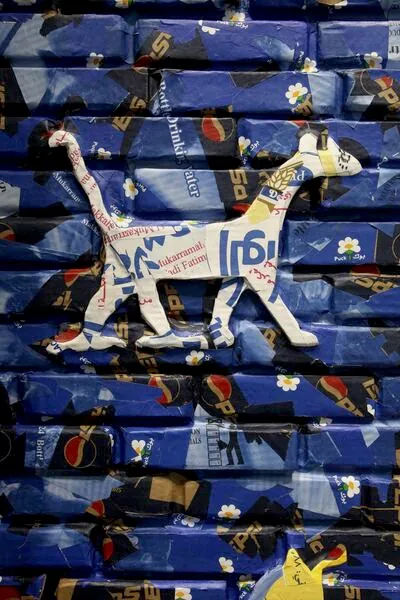
The project at one point also pointed its institutional criticism to Germany for its extraction of the Ishtar Gate from Iraq in an effort led by archaeologist Robert Koldewey between 1902 and 1914. In a space just three kilometers away from the original gate, Rakowitz held an exhibit titled May the Arrogant Not Prevail, a direct and alternative translation of the same street that ran under the gate that gives the wider project its title, Rakowitz created a three-quarter-scale reconstruction of the ‘new’ Ishtar Gate commissioned in the 1950s to serve as the entranceway for a national museum that never materialized, a replica of a replica, to demonstrate how no rebuilding of previous works can rival the original item if it is gone.
Constructed from packages of Lipton tea and cans of Pepsi localized for an Arabic-speaking market, the piece shows how imitations often pale in comparison to the original and always include trace elements of their new time and place of creation, even if only subconsciously so. The imitation Rakowitz’s piece was based on was flawed in its own way, it was not constructed out of stone as the original was, but rather out of plywood and plaster, more resembling a piece for a movie set than a successor to an ancient marvel.
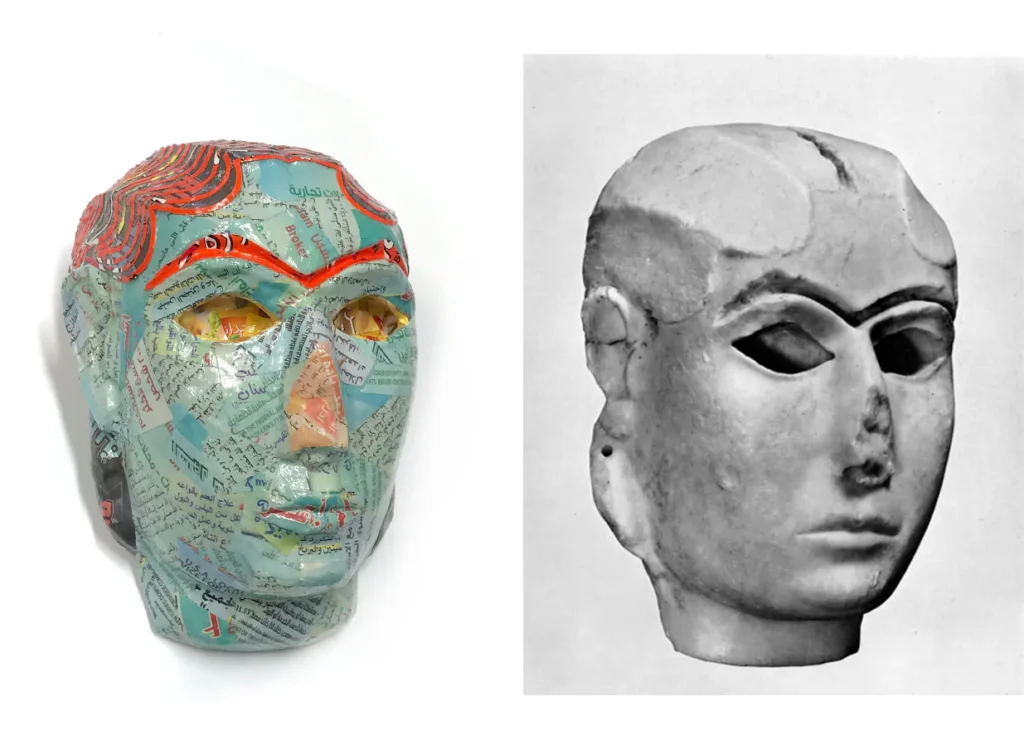
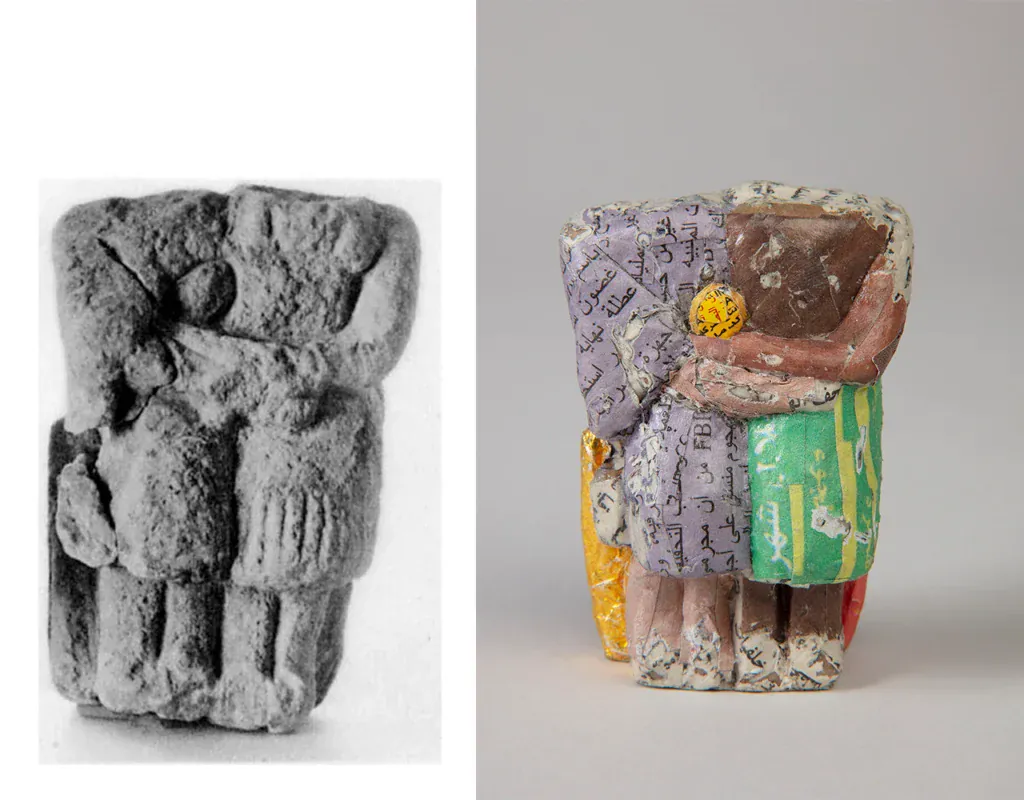
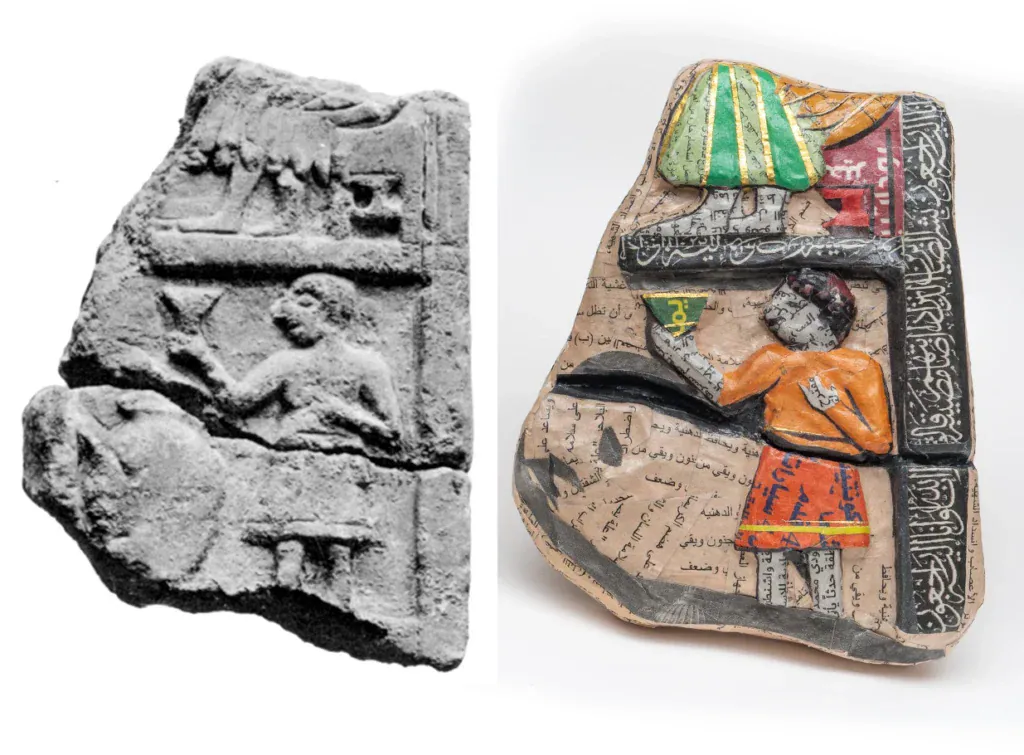
Thus, this example stands out as a larger example of Rakowitz’s work. Much of his recreations are meant to appear clearly as inferior imitations, often compared to the appearance of a haunting ghost, ironically symbolizing a loss through their presence. Most sculptures are formed by way of a cardboard “core” and are then adorned on the outside with newspaper, date cookie packaging, tea bags, sardine containers, or any other Arabic-language or Middle Eastern objects the artist can successfully source.
The items are collected by Rakowitz and his studio assistants, separated by color, and treated with archival spray before they are finally put together using references of whatever object is currently being recreated. Originally, the sculptures were intended to match the original colors of the artifacts as best as possible, but after some time, the artist encouraged his team to experiment with varying and contrasting colors. With these bright, playful, colors, the objects now resemble naïve, juvenile, even temporary objects perhaps intended for destruction, resulting in some comparisons to the appearance of piñatas, reflecting the misfortunes that fell upon the objects that gave rise to the creation of this art in the first place.
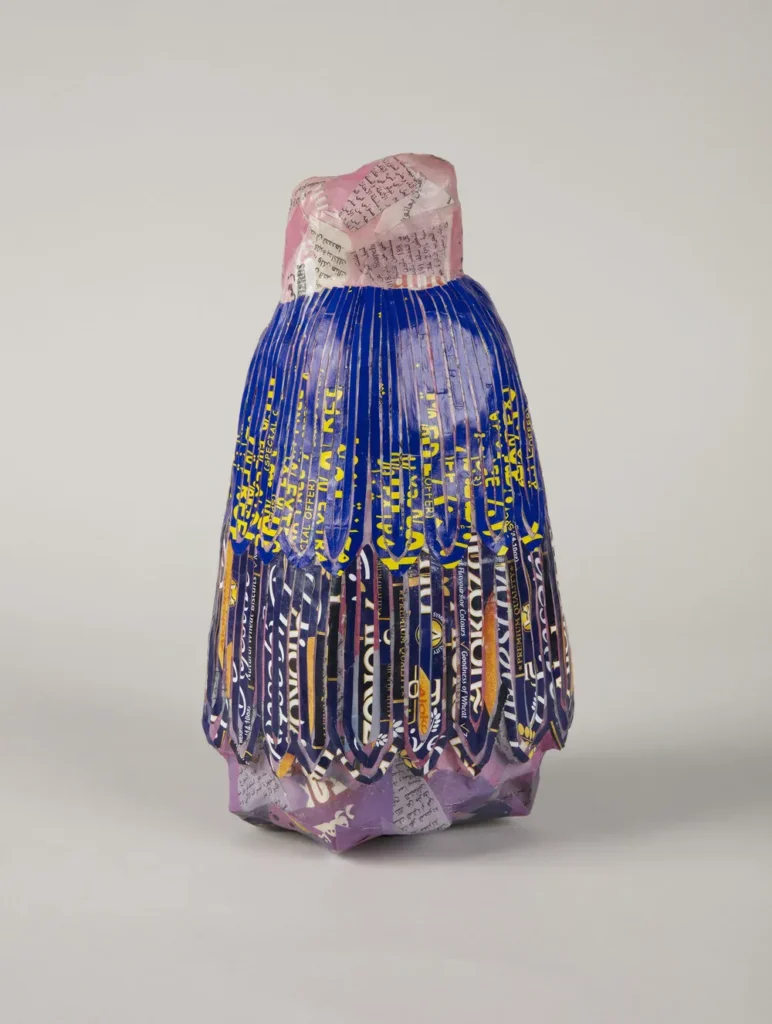
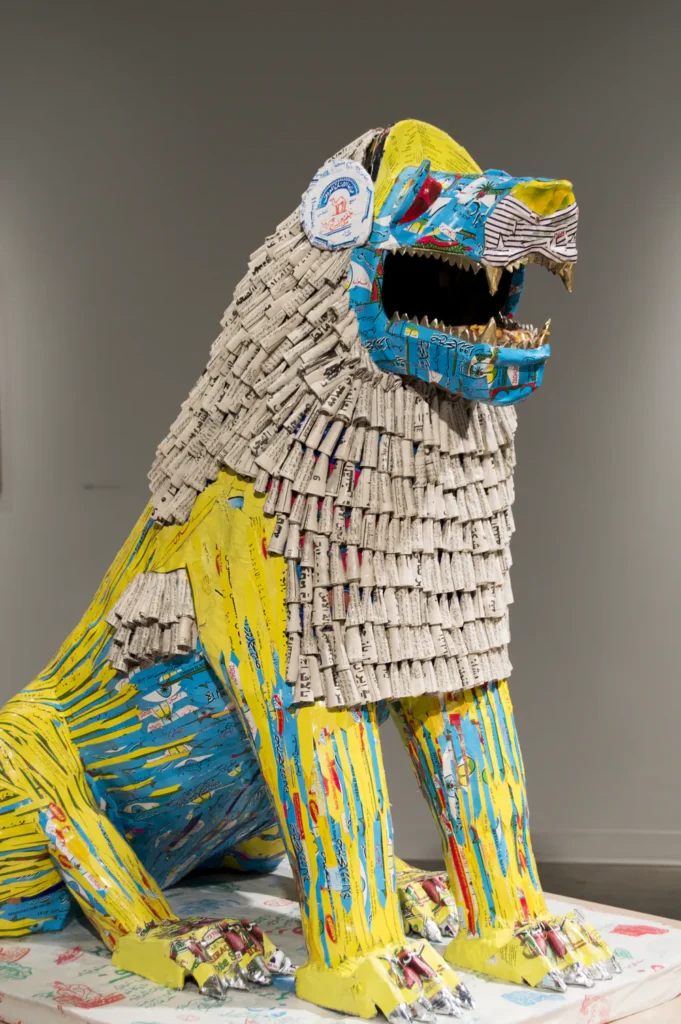
According to the artist, all of these items were specifically chosen because the modern-day communities that stem from the same lands as these lost artifacts come from end up buying the same products as a way to retain a cultural link back to home, and in the work of an artist that necessarily depends on linking back, the context is ideal. The Arabic-language newspapers are particularly significant, as they serve as documents of the events and issues relevant to Middle Eastern immigrant communities, from the fall of Saddam at the beginning of the project to the subsequent rise and fall of ISIS in the last few years. Among these upheavals are also excerpts of reports on sports and other innocuous topics.
Often in the form of grainy index photographs or 19th-century renderings, the references are mainly found through databases of the lost artifacts on the Interpol website as well as one created by The Oriental Institute of the University of Chicago and, as in the case of the Nimrud reliefs, they are blown up and printed to be pasted down onto the cardboard bases in the initial stages. The Oriental Institute’s decades-long cooperation with various institutions in Iraq meant that it had the documentation necessary to complete the project.
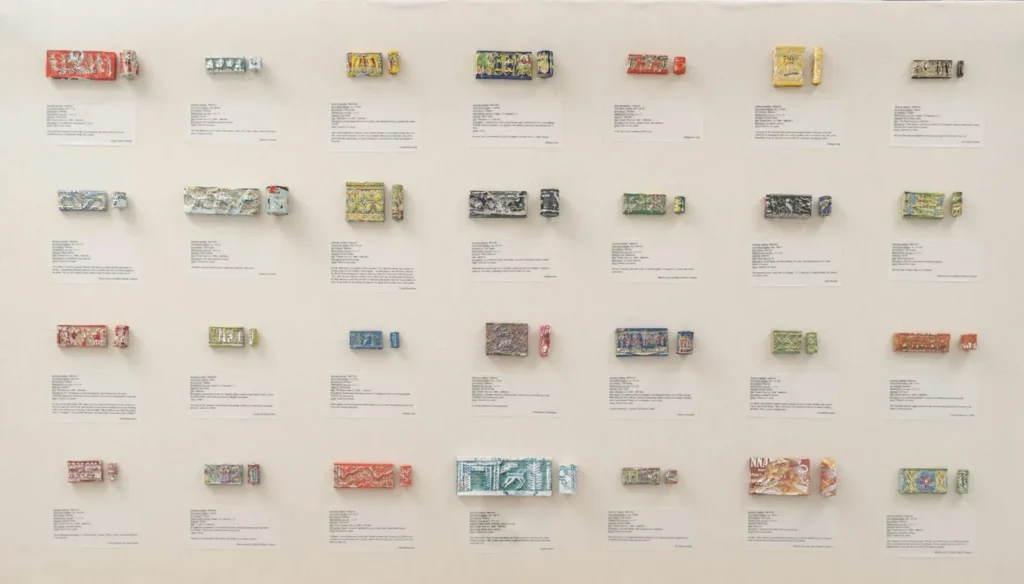
These connections often meant that crucial details in the recreations were not missed, such as the cuneiform inscription on the Nineveh Lamassu, hidden between brickwork, that was never readily visible nor photographed. Through the help of a researcher at the University of Mosul, Ali Yasin Jubouri, the text of the inscription was supplied and is found on the finished sculpture. The inscription reads: “Sennacherib, king of the world, king of Assyria, had the inner and outer wall of Nineveh built anew and raised as high as mountains.” The fact that a side of the sculpture that was never meant to be seen is fully visible means that something “very wrong and very violent has been visited on this thing”, Rakowitz states.
Eventually, the work caught the attention of one man who was particularly invested in recovering the lost collections of the Iraqi National Museum, Donny George Youkhanna, who also happened to be its former director. Youkhanna was instrumental in tracking down many of the museum’s 7,000 recovered objects and continued to search for the rest until his death in 2011, for this he received much acclaim, commendation, and also threats, the latter in the form of a single bullet sent to him in the mail. He fled the country in 2006.
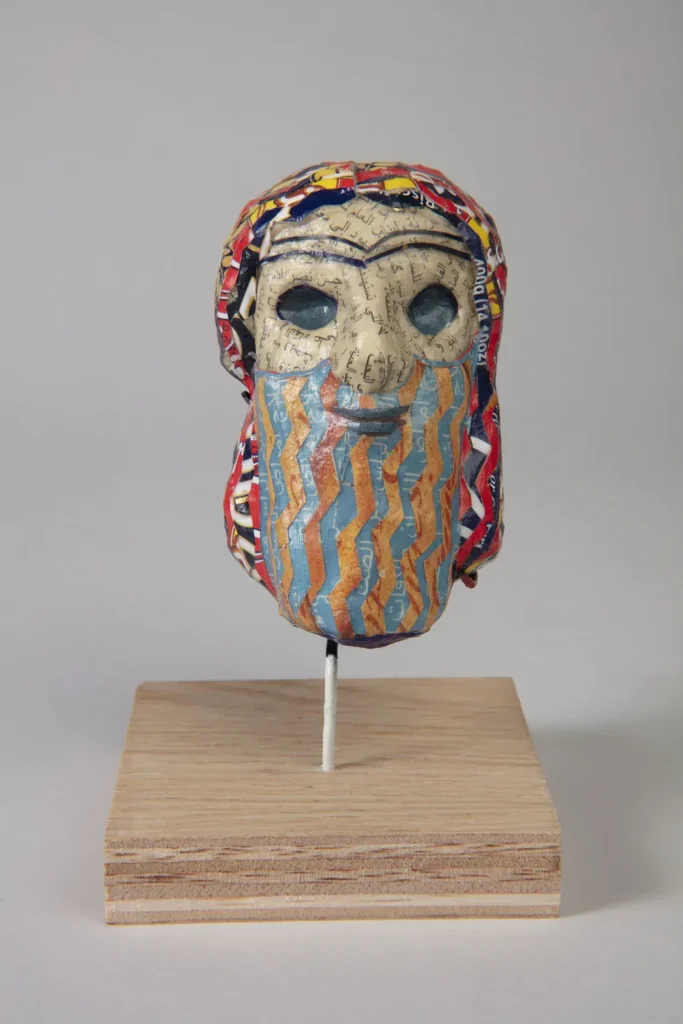
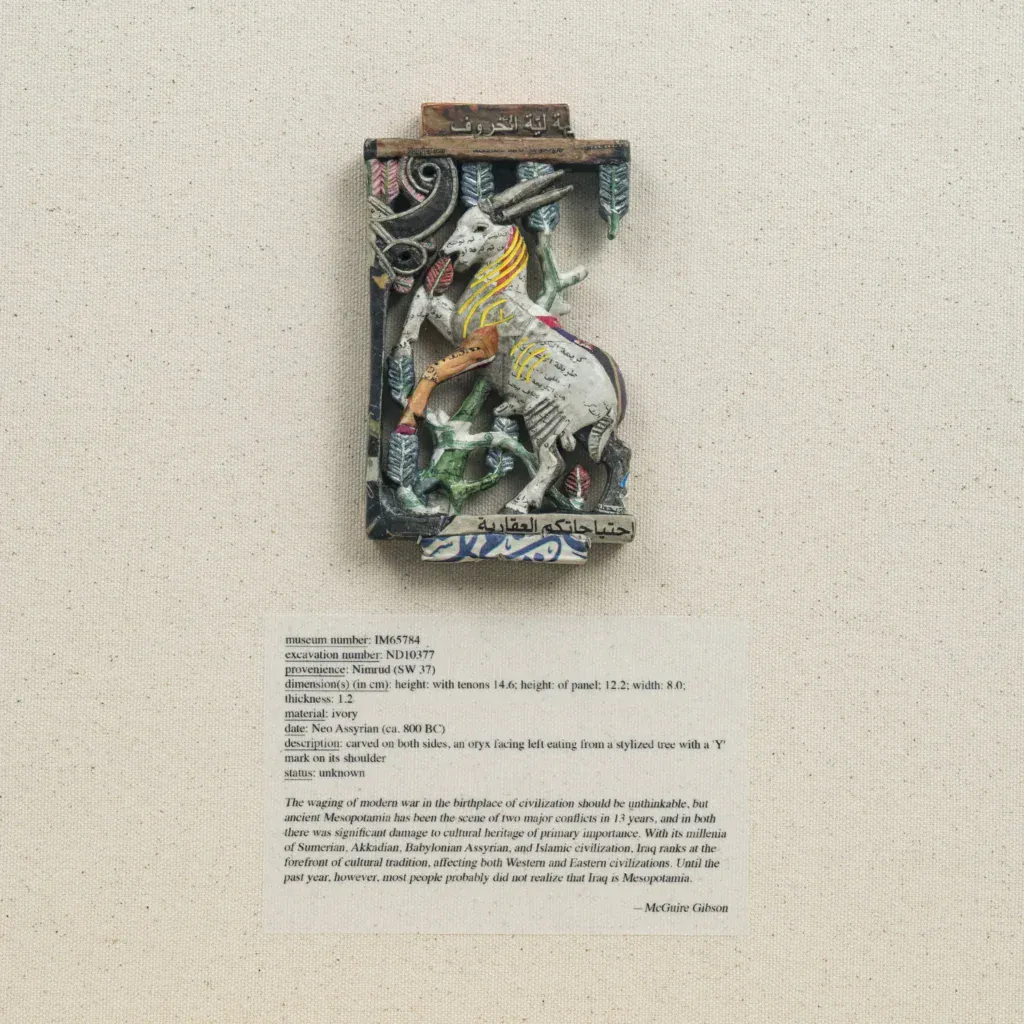
Upon encountering the lost items in an exhibition of Rakowitz’s work, he was struck by how precisely and accurately they were recreated using alternative materials. Youkhanna returned to them on a daily basis and began giving unofficial tours of the objects as though they were the original objects he had once known. Here, the careers of this man and Rakowitz intersect, leading to a dialogue that furthers both of their work. According to Rakowitz, he was told by Youkhanna that it “was as close as he was ever going to get to those objects again.”
Ultimately, it was Youkhanna who changed Rakowitz’s mind about Iraqi heritage being held in Western Institutions, convincing him that they were not so much hostages as they were refugees from a war-torn region, unable to return for fear of their safety. As Rakowitz explains, immediately following the destruction of Iraq’s cultural heritage during the 2003 invasion, Iraqis in the West were known to have visited museums where some Iraqi art was held just to be relieved that some of it was still safe, at least in one part of the world. The dialogue between the two continued until Youkhanna died in 2011.
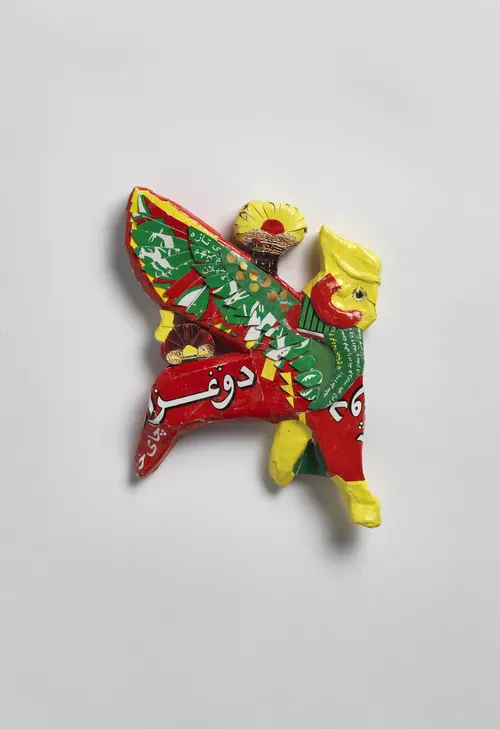
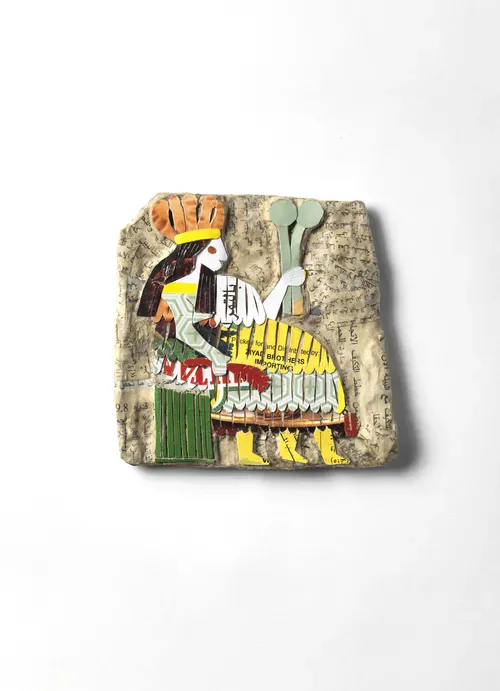
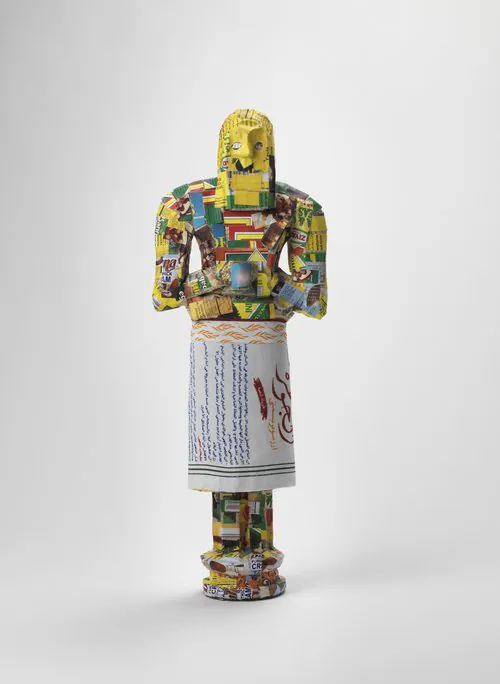
The recreations of lost Iraqi art are Rakowitz’s most visually visible works, the materiality of these objects lend them to be more easily demonstrated as physical art pieces, reflecting the perception of artifacts not as items to be studied and left alone in their home, but bought and sold by collectors and institutions. Recently, the project has sought to call to attention the illicit trade of antiquities conducted by Islamic State members within Iraq and Syria, a business that has reportedly seen $300 million worth of items enter the market, a market where items change hands and travel great distances with incredible speed, as one 2018 seizure of several Iraqi objects from an antiquities dealer in London suspected of illegal trading suggested.
Rakowitz, however, seemingly has no plans to sell his pieces on the art market but does note that several of his pieces from the project have been bought by the British Museum to be displayed alongside allegedly looted artifacts from Iraq as a method of self-critiquing the museum’s troubled history of bringing those items to them and their own participation in the world’s illegal antiquities market. He is also wary of critiquing what he deems “low-hanging fruit” as he understands that many of the people behind the illegal trade in stolen antiquities were doing so to make enough money to escape a war-torn country.
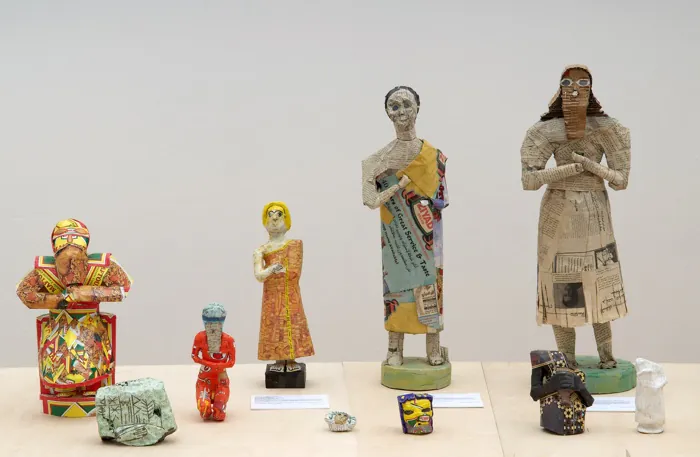
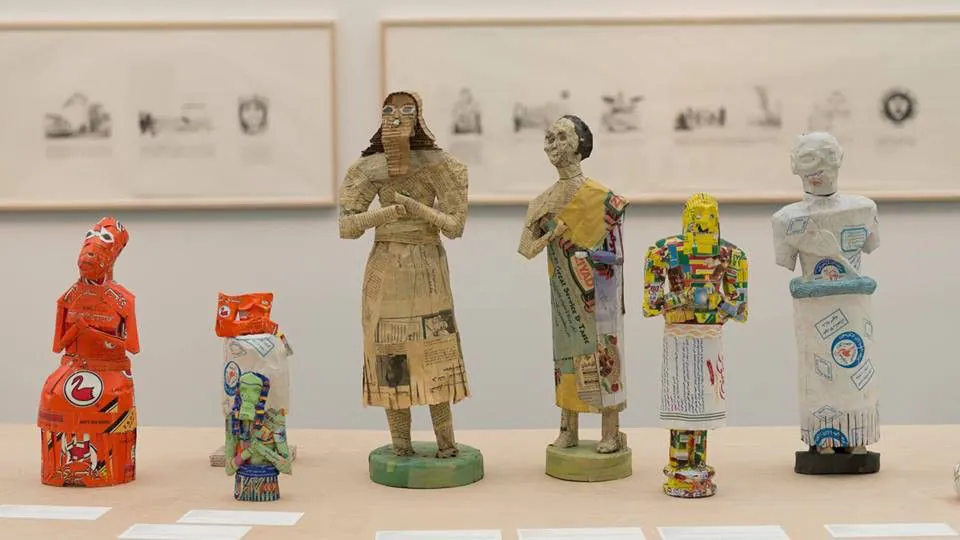
Like the votive statues of standing figures with their hands clasped in prayer, Rakowitz sees his works as votives in their own right to represent all of the lives lost as a result of the wars in Iraq, after his frustration that much of the world’s outrage and mourning over the loss of Iraqi cultural heritage was not equally directed towards the loss of life. He stressed what he called “that tension between the object and the people who are dying alongside the objects”. All of the efforts and artistic statements Rakowitz has made in the past have, satisfyingly, coalesced in his recreations.
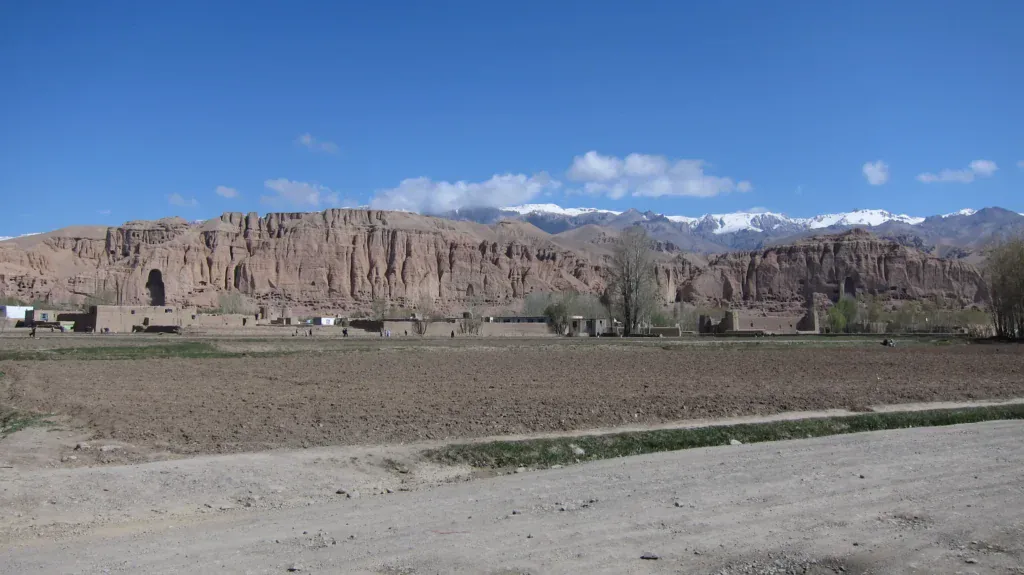
On a much grander scale, the famous 6th century AD sandstone Buddha statues in the Bamiyan Valley of Afghanistan, destroyed in 2001 by the Taliban, could not possibly be recreated by any artist, even by one with such dedication as Rakowitz. The impetus, however, is the same as the one behind The Invisible Enemy Should Not Exist and remained throughout Rakowitz’s education and career as an artist. The demolition of the Buddhas, described by Rakowitz as “a particularly cataclysmic moment” led him to eventually visit the site of the Buddhas and study their remnants under German researcher and restoration expert Bert Praxenthaler.
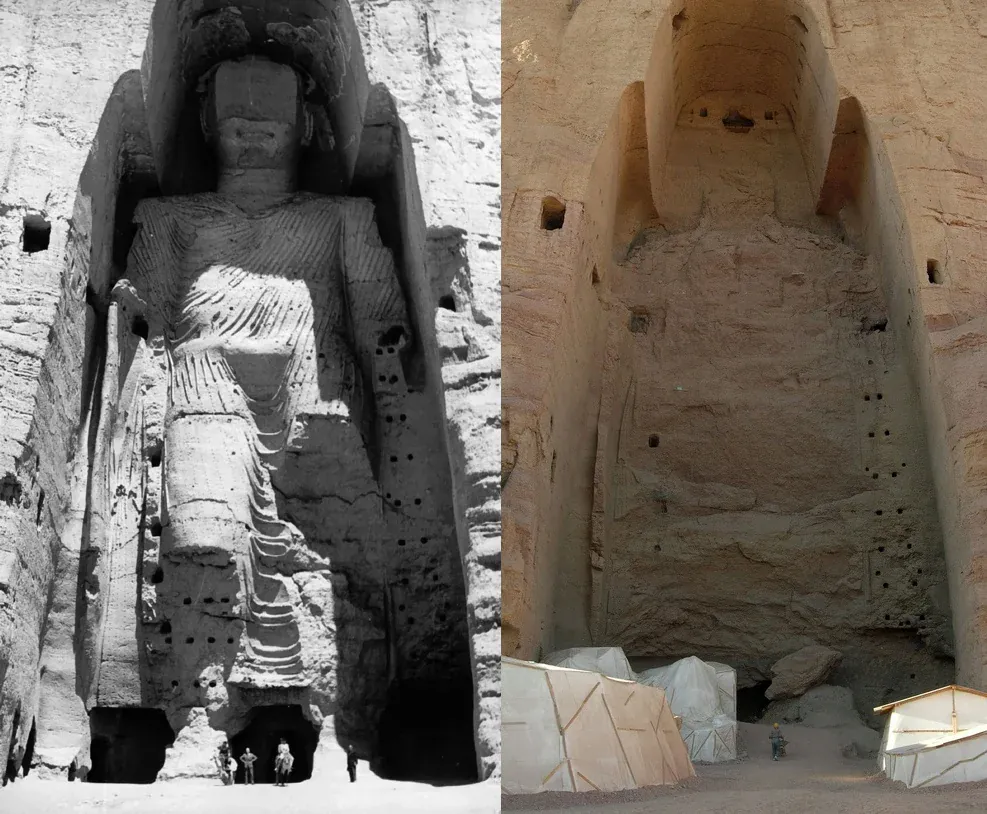
Rakowitz remarked how the locals insisted to him that the Buddhas still exist to this day, their absence paradoxically reasserting their presence even more, the local Hazara people had revered these statues for generations and even wished to rebuild them, but were reportedly denied by UNESCO and International Council on Monuments and Sites. Rakowitz perhaps understood the Sisyphean prospect of bringing something back into its original form and instead believed in the importance of revering the skills and traditions that led to the creation of art such as the Buddhas in the first place.
In May 2012, for the project What Dust Will Rise?, commissioned by the exhibition Documenta 13 in Germany, he returned to the place where he learned to help others do the same, just one month before the exhibition. In a cave in the Bamiyan Valley, the art of stone carving and calligraphy that originally gave rise to the Buddha statues had not existed in the area for 200 years due to conflict. Working with a group of 12 amateur artists, half men and half women, and a veteran stone carver named Abbas al-Adad (who was hunted for years by the Taliban for creating realistic stone carvings), Rakowitz set up a week-long course in stone carving in which he took his students through the art of stone carving in the same way as he would in his class at Northwestern, everything from prehistoric stonework to the art of Henry Moore.
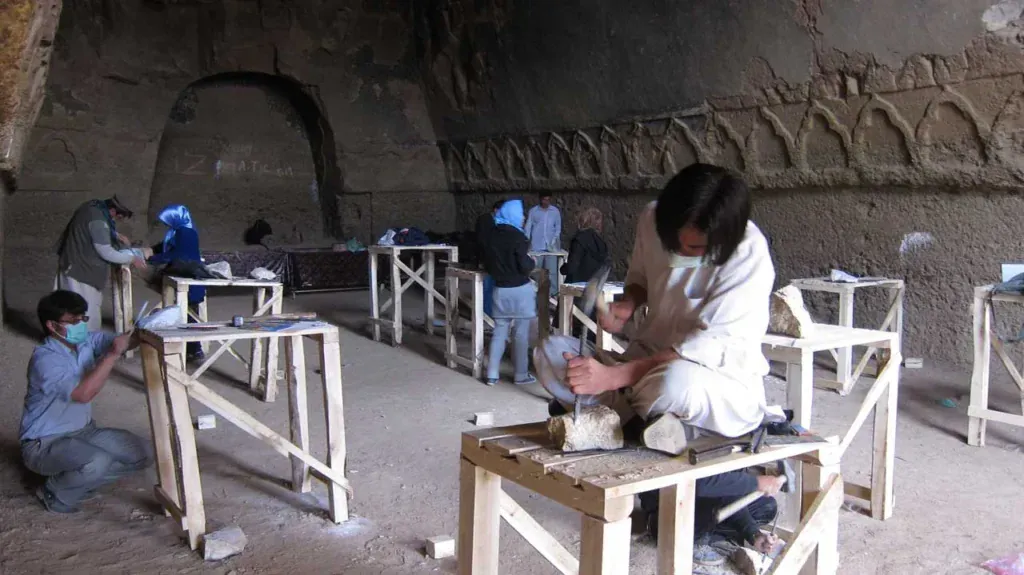
“I thought that if we re-introduced the techniques, locals could do whatever they wanted, without relying on Western institutions”, Rakowitz explains. Interestingly enough, the name of this project comes from a quote by Mullah Mohammed Omar, who gave the order to blow up the statues in response to a group of Swedish archaeologists who refused to provide their preservation funds to support the locals and insisted that it would be for the statues only. A lesson that caring for cultural products and not focusing on the people that made them often leads to more unnecessary destruction.
When the time came for students to create their own work, the tools had to be improvised. Rakowitz and his class ended up going to the local blacksmith, who made chisels and other tools for the class using salvaged items from the skeletons of old Soviet and American war equipment that littered the local landscape. The stone artist working with Rakowitz also provided his input and was eventually given land by the local government to open a permanent workshop after the project concluded, where three of the students remained to continue their work.
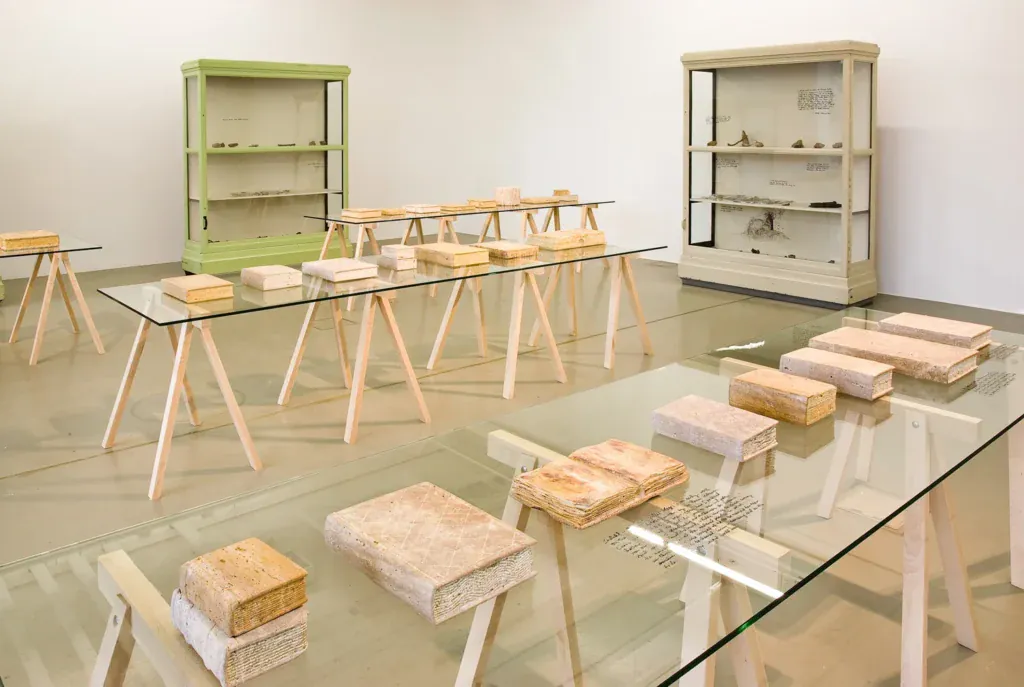
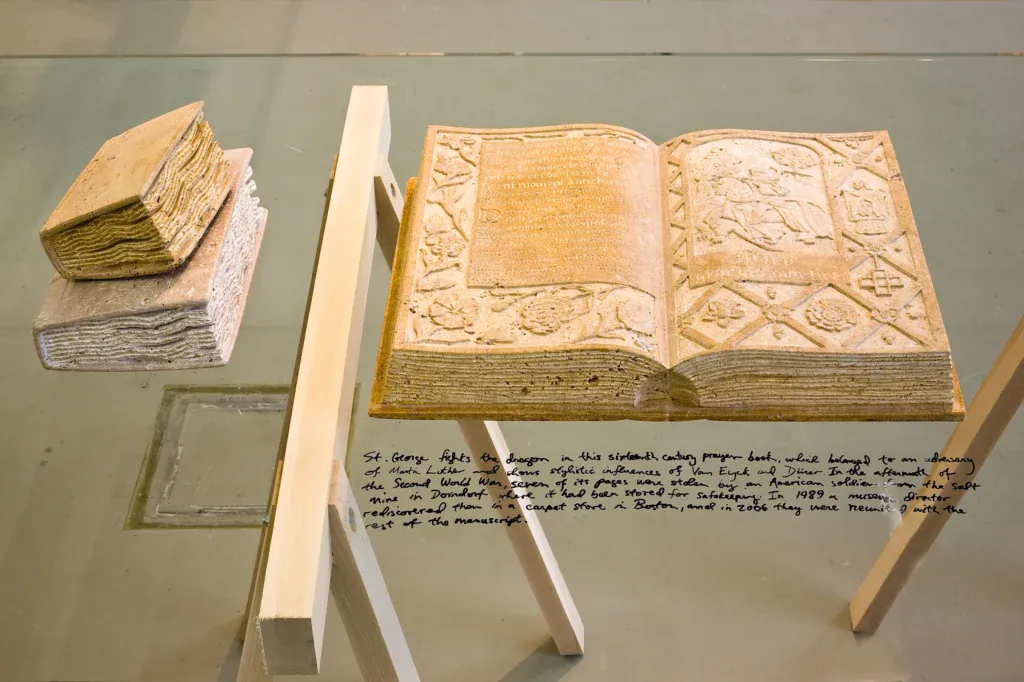
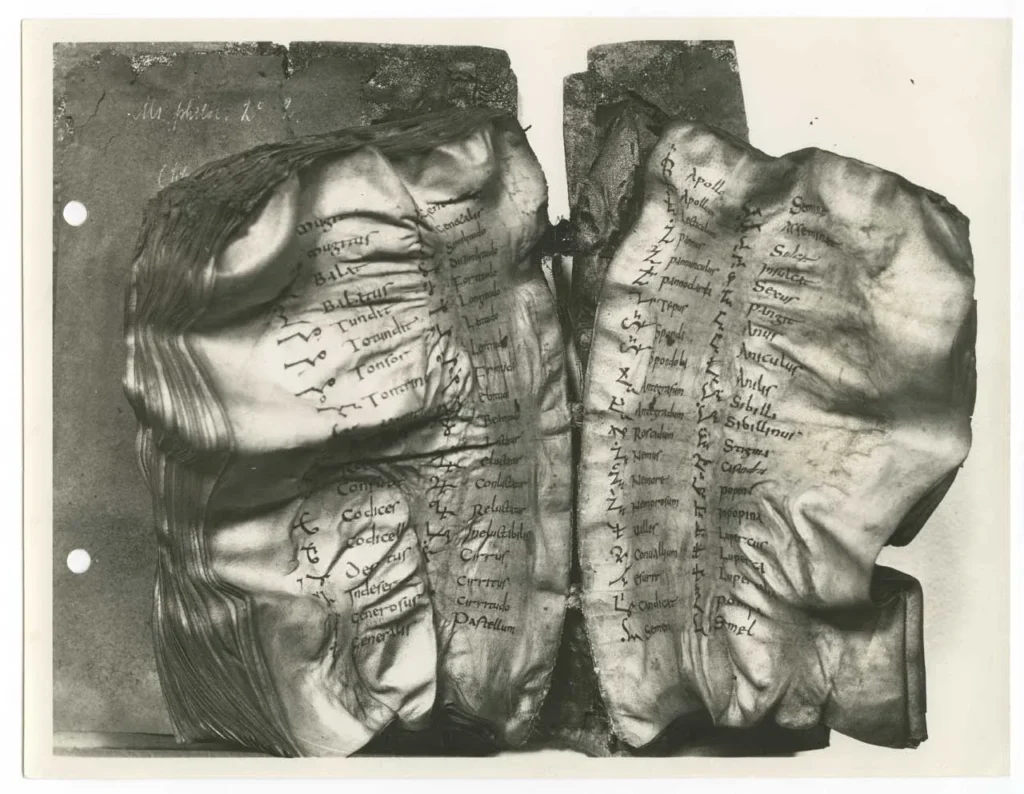
With the help of experts from Italy, their work in Afghanistan culminated in the recreation of medieval books lost in the World War II bombing by the British Royal Air Force that destroyed portions of the State Library of Hesse-Kassel in the Fridericianum museum (also the site of the Documenta exhibitions since 1955) on September 9, 1941. Travertine was quarried in the hills and caves of Bamiyan and transformed into unreadable placeholders for lost books, resembling tombstones through their stony forms.
The choice to use stone likewise meant that the same fires could not destroy them a second time, much in the way that so much Mesopotamian writing exists today, it was written on clay tablets, which fire baked into hardened forms. Rakowitz tried to convey that it didn’t matter for what cause a culture and the people behind it was being destroyed for, it was wrong, “because in the end what happens with any of these instances of libricide, burning of books, destruction of artifacts is that books burn and people burn,” he argues.
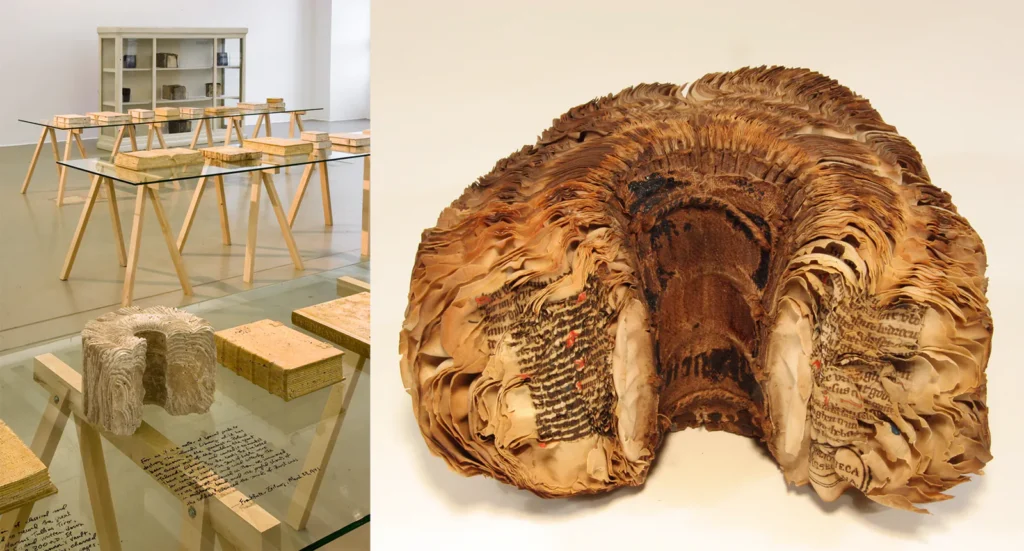
Upon exhibiting the books at the Fridericanum in Kassel one month later, Rakowitz was shown a picture of schoolchildren and SS officers working together to try and save the books in the Hesse-Kassel library from perishing in the fire. He was stunned at the thought that these same officers might have been tasked with throwing books into a fire during a book-burning ceremony just several years prior (several thousand books from the collection of the library were destroyed at a Nazi book-burning ceremony in 1933), an important example of the duality of mankind.
Ultimately, Rakowitz’s part in the Documenta exhibition ended up as a testament to loss and the anticipation of loss; alongside the travertine books was granite from the World Trade Center, burnt pages of books from the Fridericianum library, irradiated minerals from the Manhattan Project tests, a Sumerian cuneiform tablet, a brick from the Pruitt-Igoe apartments, and pieces of the Bamiyan Buddhas, naturally.
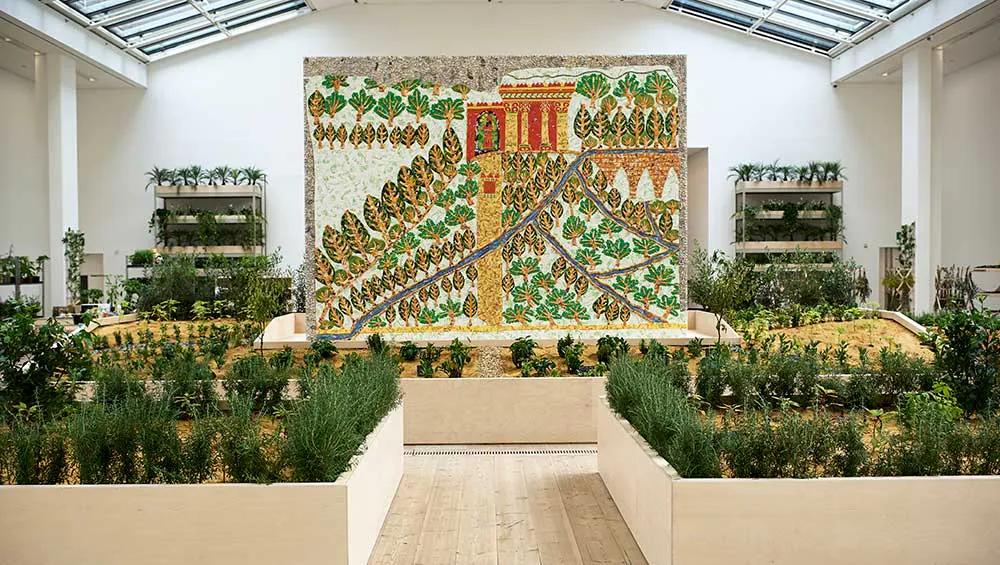
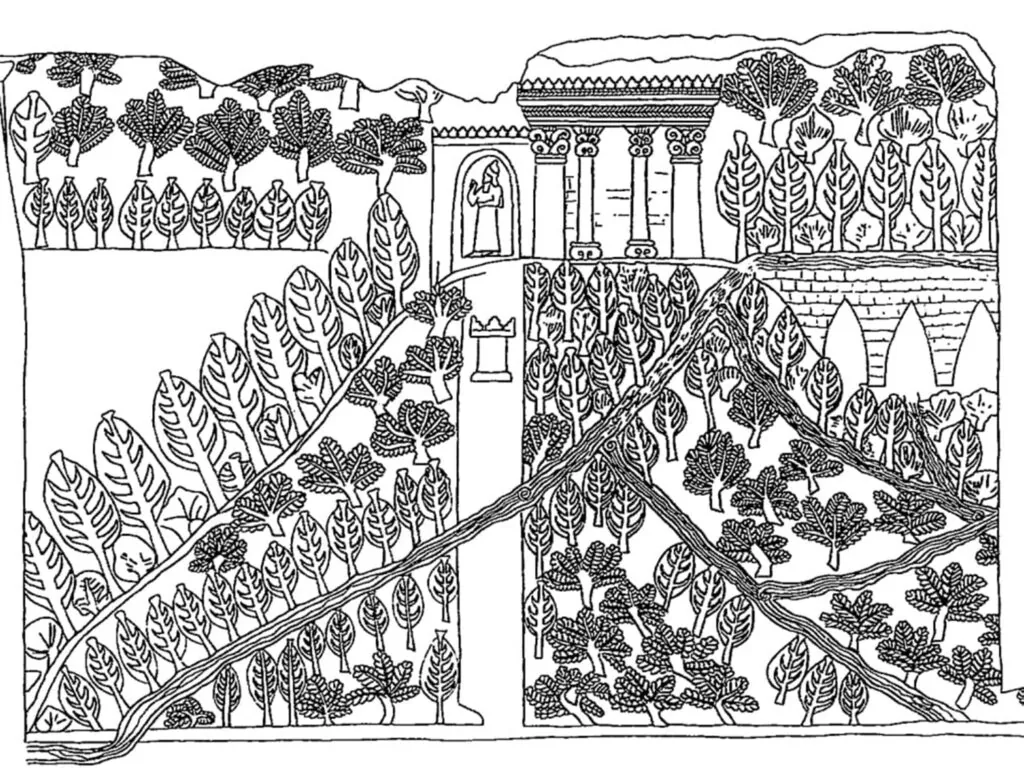
The displacement of people also plays a critical role in Rakowitz’ creative universe. A more recent project, The Waiting Gardens of the North, Installed at the Baltic Centre for Contemporary Art in Gateshead in 2023, expanded on his long-running interest and saw a large gallery transformed into a living indoor garden inspired by ancient Assyrian royal gardens depicted in reliefs from the North Palace of Ashurbanipal in Nineveh. At its center is a monumental sculptural reconstruction of one of these reliefs, today held in the British Museum, while the surrounding space is filled with real plants, herbs, and fruit trees arranged to echo the garden architecture shown in the ancient image.
The project was developed in collaboration with refugees and asylum seekers living in Newcastle and Gateshead, many of whom helped choose the plants based on species that reminded them of home. Olive trees, herbs, and vegetables from across the Middle East, Africa, and Asia form a kind of memory landscape, linking distant homelands to a temporary place of refuge. Workshops, communal meals, tea rituals, and spice-grinding sessions activated the space throughout the exhibition, turning the garden into a social gathering place rather than a static sculptural display.
In this sense the work reflects the uncertain condition of displaced people: plants are carefully tended while they take root, just as migrants themselves wait in bureaucratic limbo for the chance to build stable lives. The garden becomes a metaphor for exile and belonging, a “hanging garden for lives hanging in the balance.”
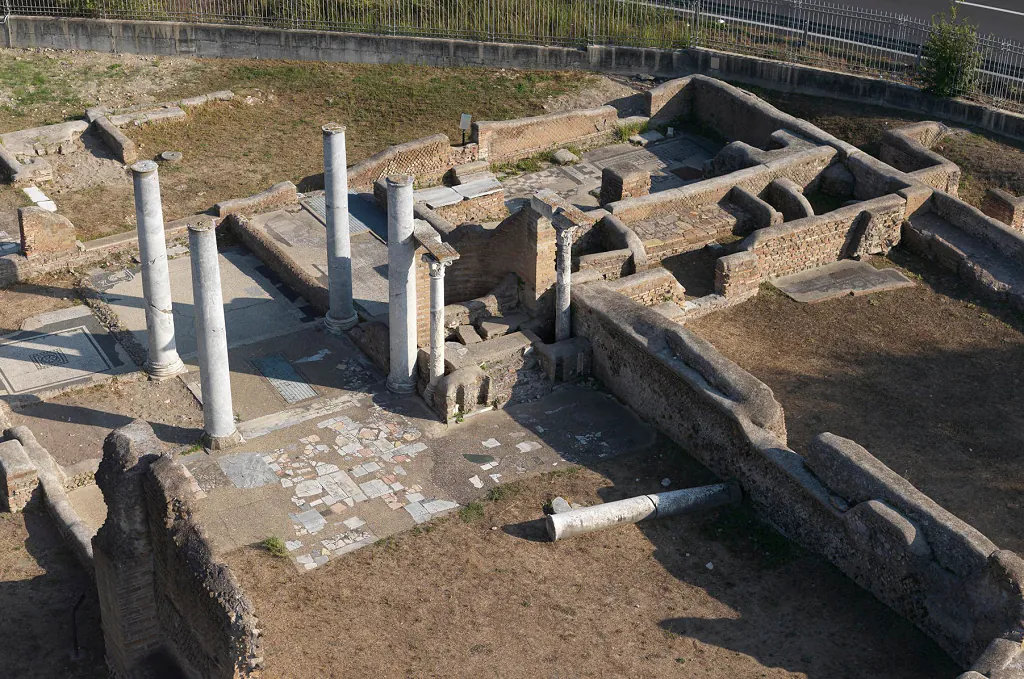
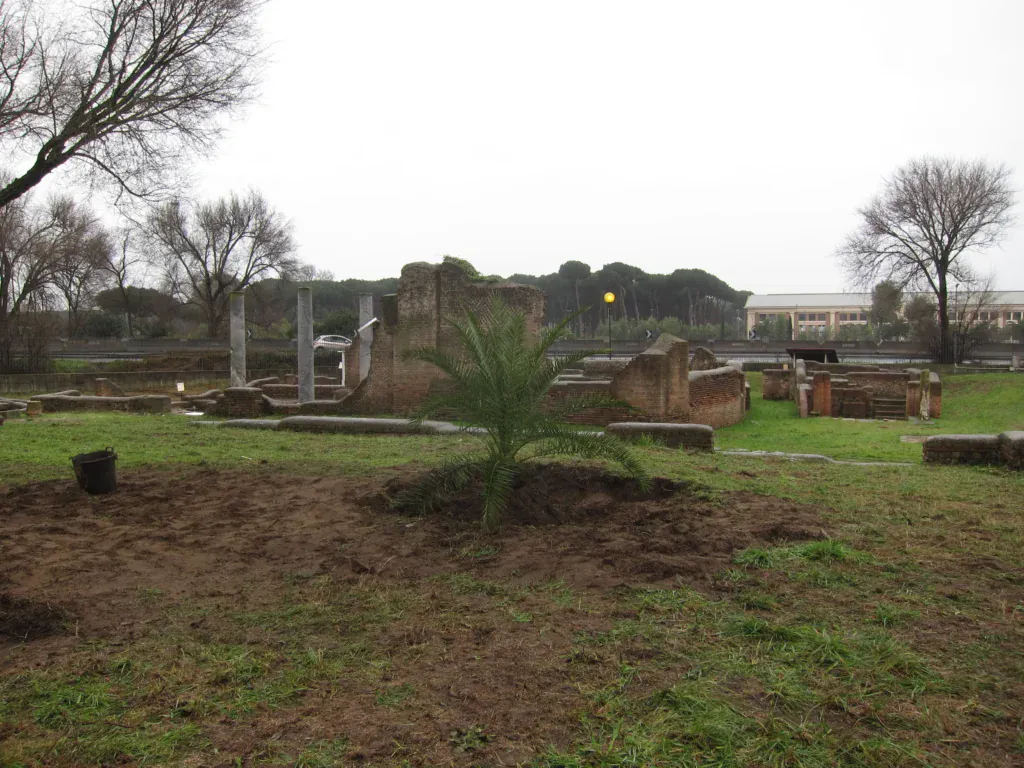
But even Rakowitz, through all of his works addressing cultural loss and preservationism, understands that things are not made to exist forever and at some point must be put to rest, despite our best efforts. Throughout his life, Rakowitz has engaged his religious and ethnic roots through collecting centuries-old Iraqi-Jewish antiques including texts, scrolls, and cups. Thought by Rakowitz to eventually become a personal archive of sorts in the interest of reviving his inherited Jewish background, he realized it was actually a geniza, a depository of damaged religious materials that are required to be buried according to Jewish law.
At the invitation of Arte in Memoria, an Italian organization that facilitates the use of archaeological sites as art spaces, Rakowitz voluntarily set this collection into the ground at the Ostia Antica synagogue (the oldest one in Europe) and buried it. “It is a way of saying farewell to the things that need to rest, which is the hardest thing to do when trying to stay alive,” Rakowitz writes on his site. The site of the burial was marked with a date palm.