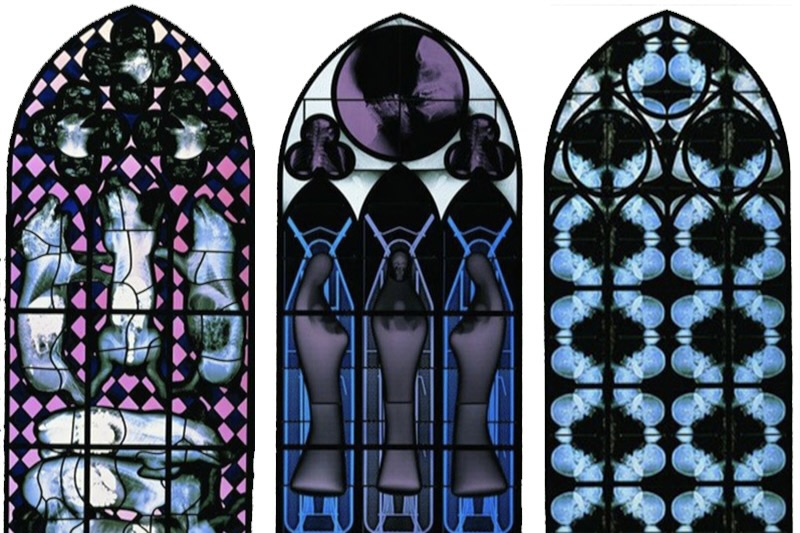
A Belgian artist turned medical X‑rays into Gothic stained glass, replacing saints with skeletons and radiography with cathedral light. The works represent the culmination of a lifelong pursuit in Delvoye’s practice: meeting the sacred with the the profane on his own terms.
Belgian artist Wim Delvoye has built a reputation by transforming the mundane and industrial into objects that resemble relics of a lost cathedral workshop. Throughout his career he has taken discarded machinery, tires, and heavy industrial forms and worked them into intricate sculptures that appear as though they had always belonged within the architecture of Gothic Europe. Ornamental tracery, ecclesiastical geometry, and painstaking craftsmanship recur throughout his practice, the result of an effort to push the visual language of medieval cathedrals into an age of factories and mass production.
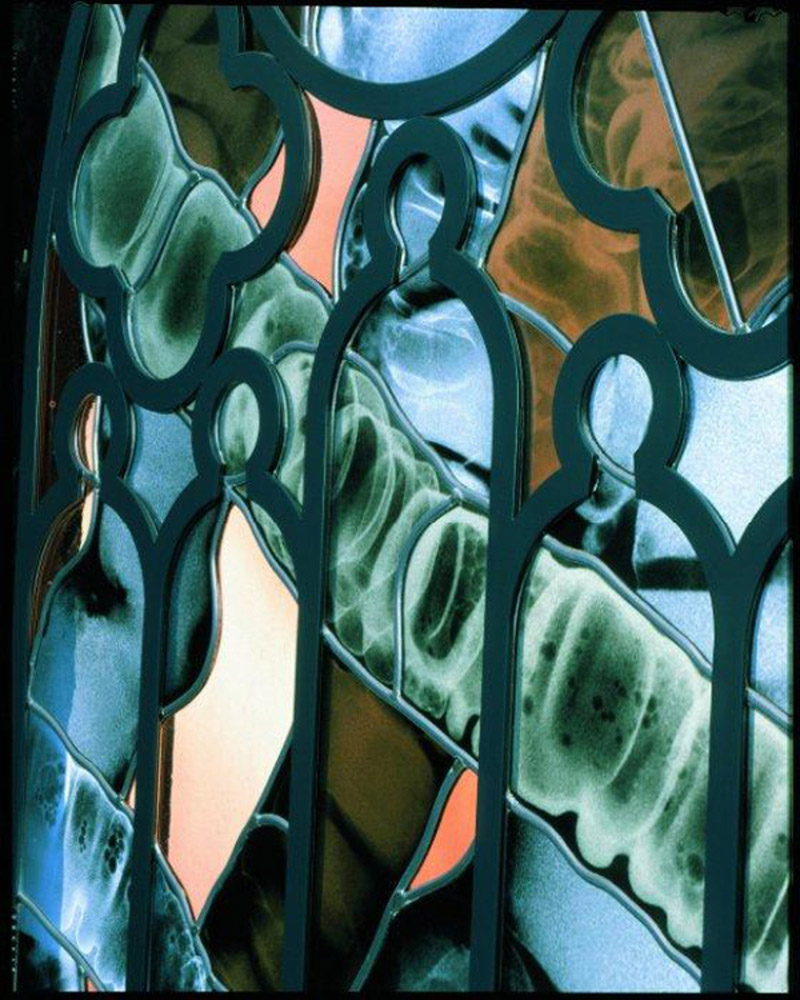
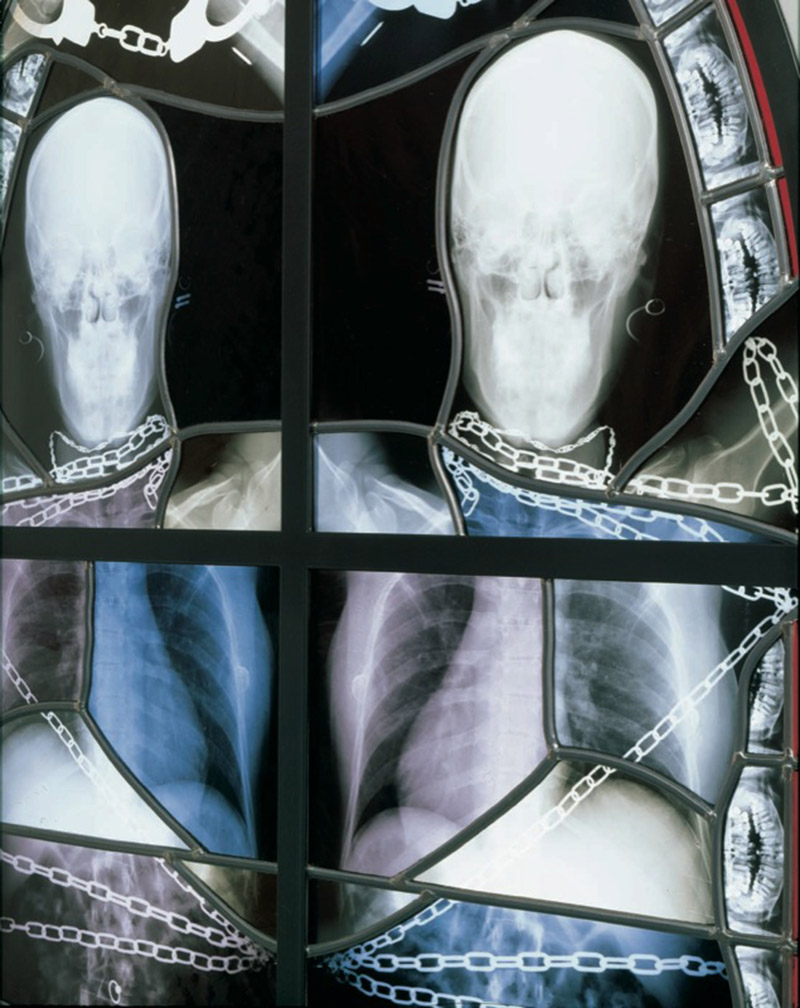
Yet beneath this refined surface lies a distinctly darker tension of imagery, particularly visible in Delvoye’s stained glass and chapel works, a series in which the familiar beauty of religious architecture is quietly undermined by unsettling subject matter. The works are often installed within elaborate chapel structures fabricated from laser-cut steel and modeled after seventeenth-century Flemish Baroque churches. At a distance the installations resemble traditional devotional spaces, complete with delicately framed windows glowing with colored light. they would not look out of place in a cathedral. That is, until you approach them more closely and see what they truly are.
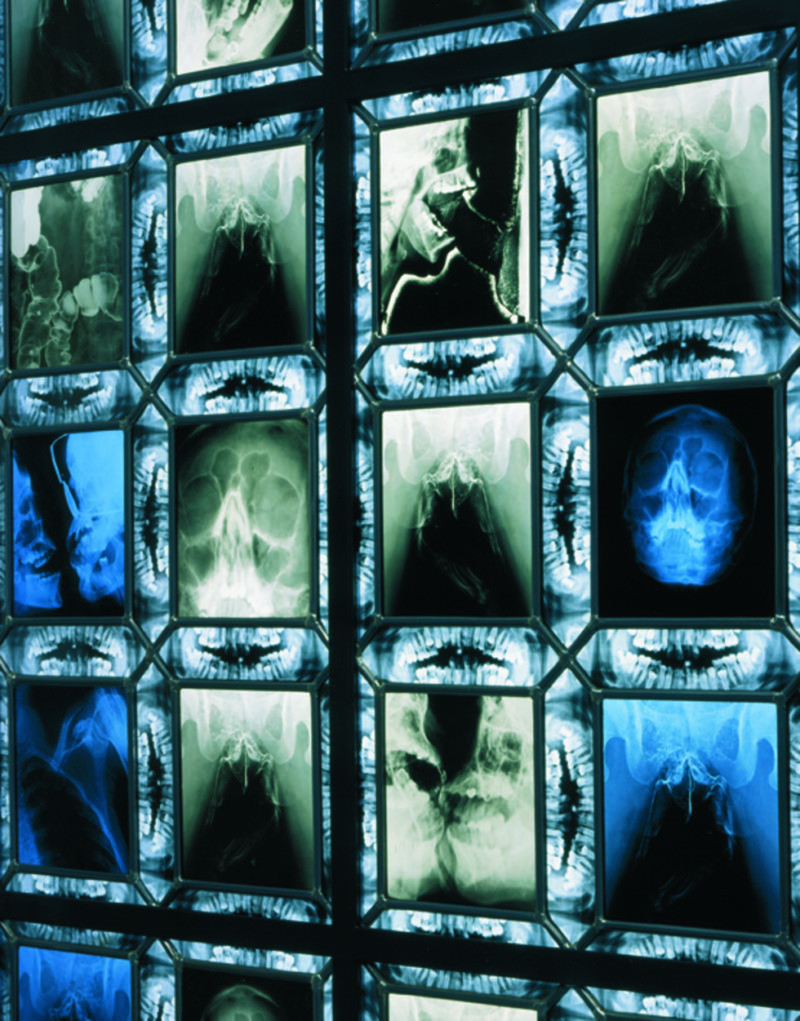
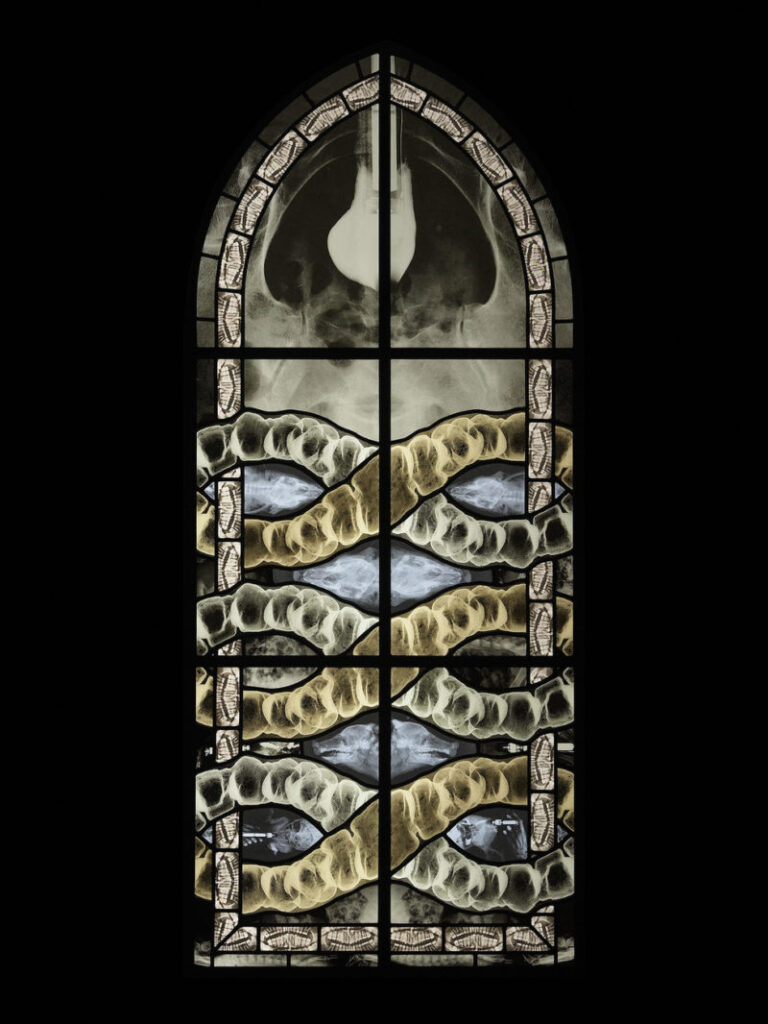
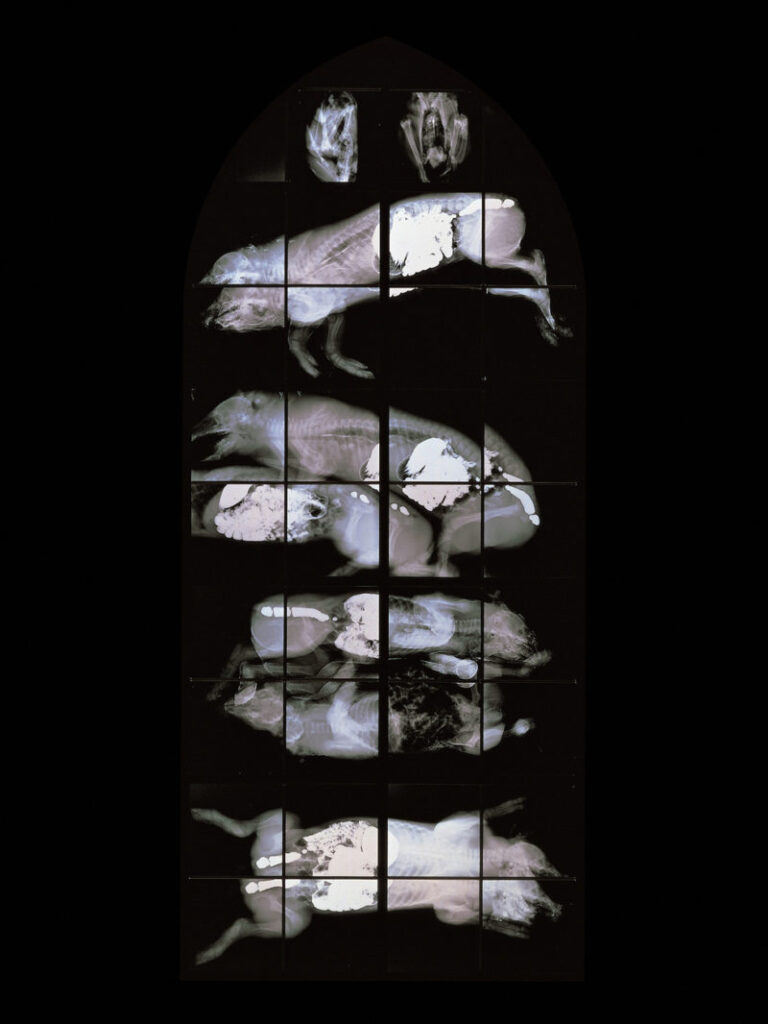
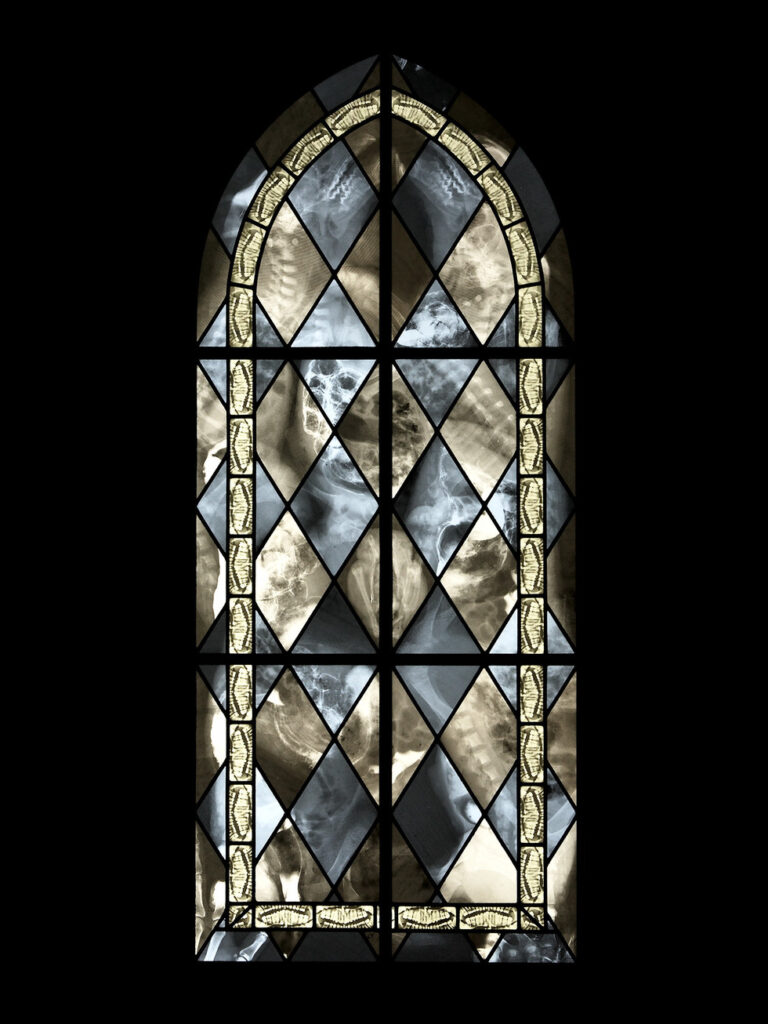
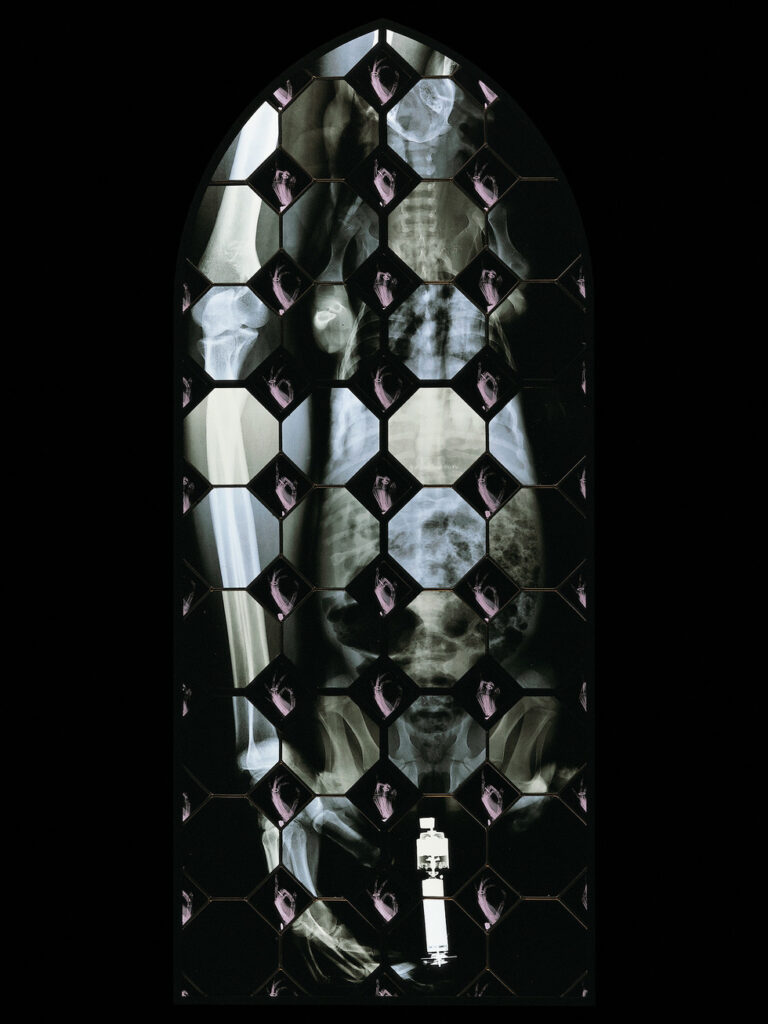
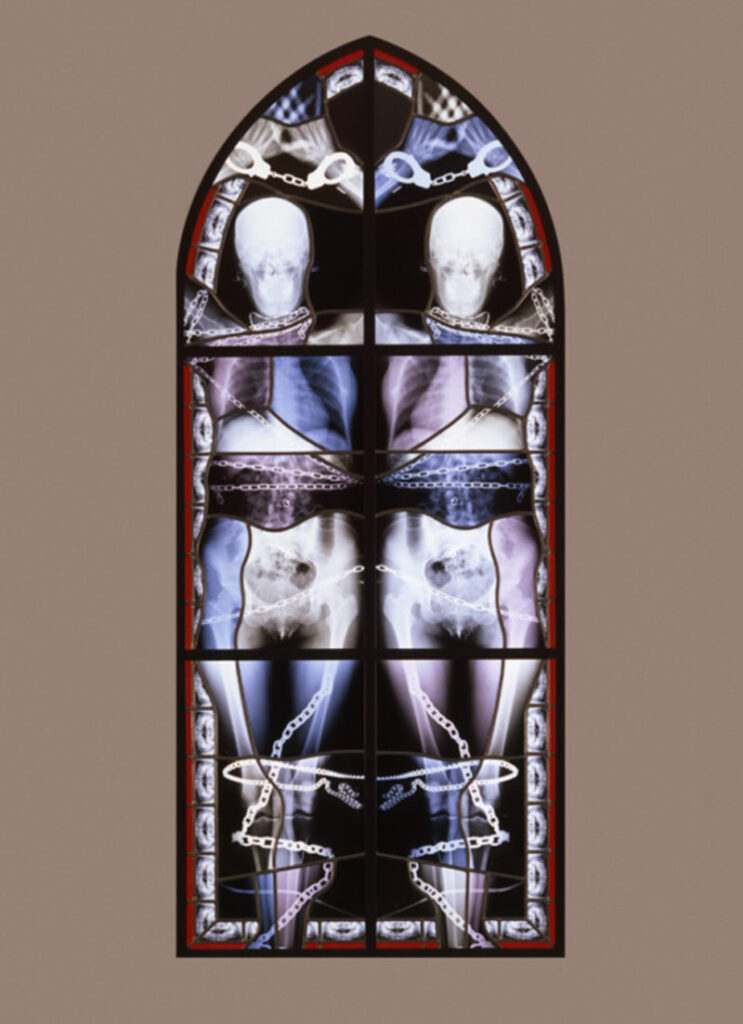
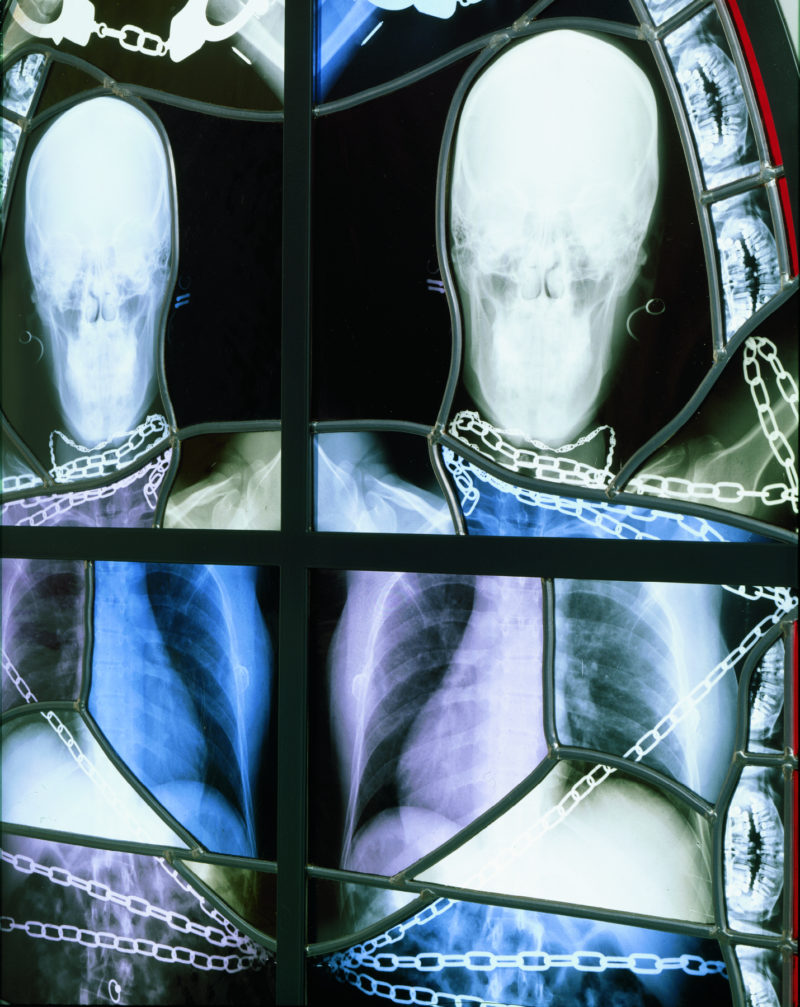
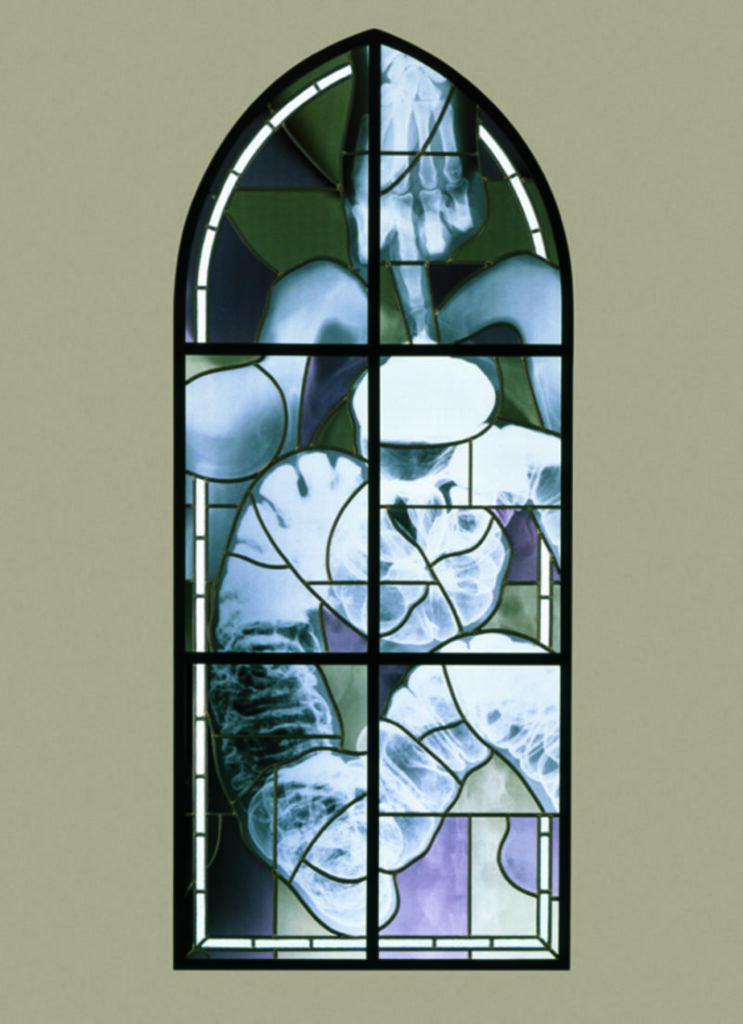
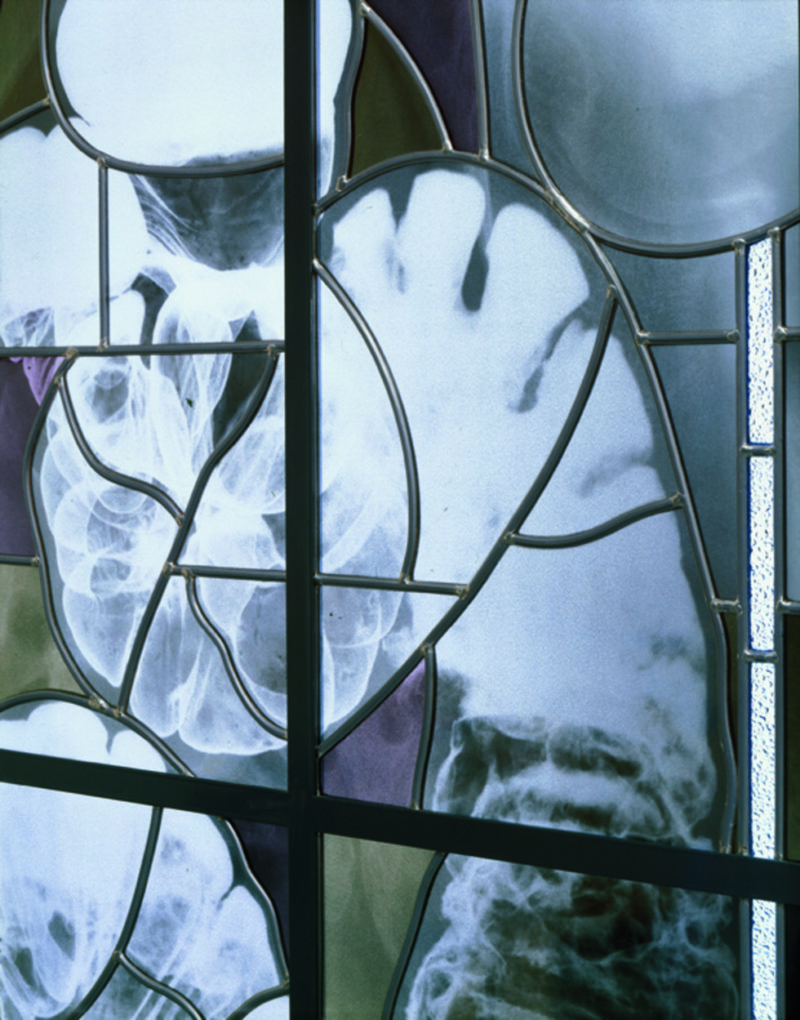
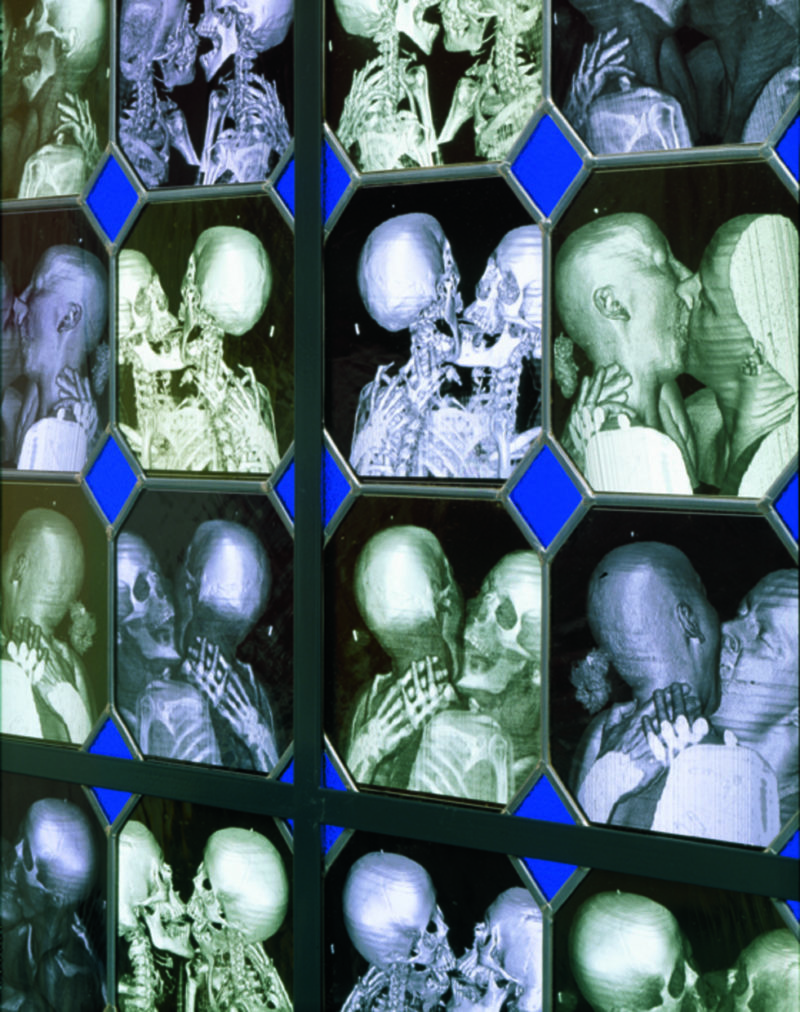
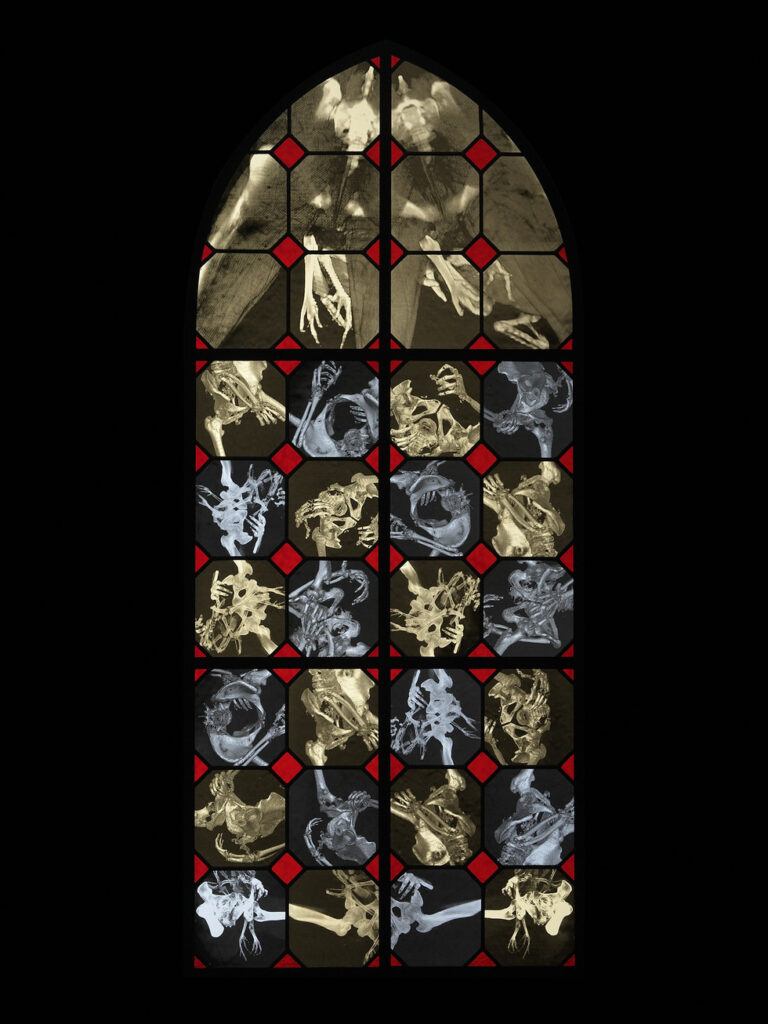
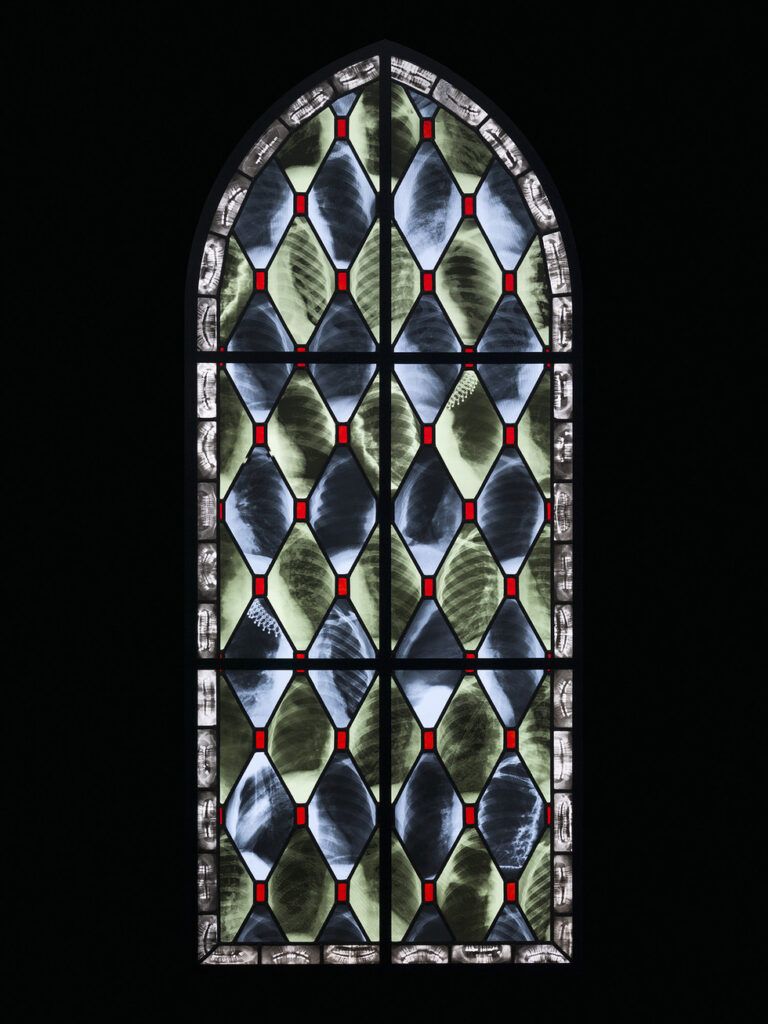
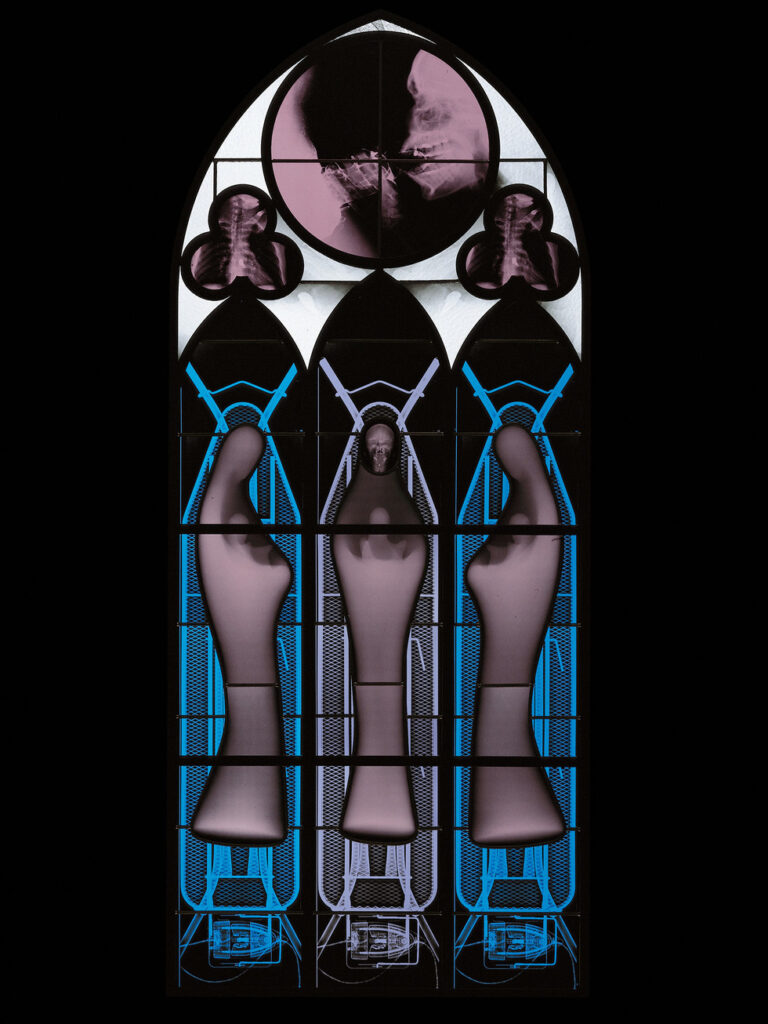
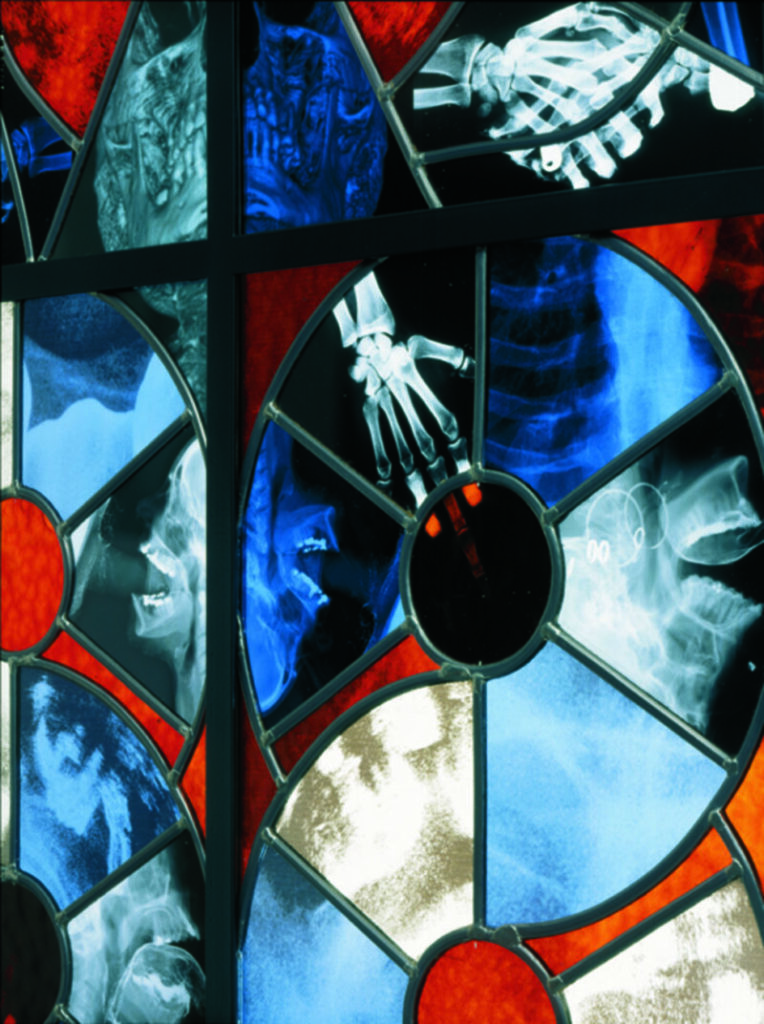
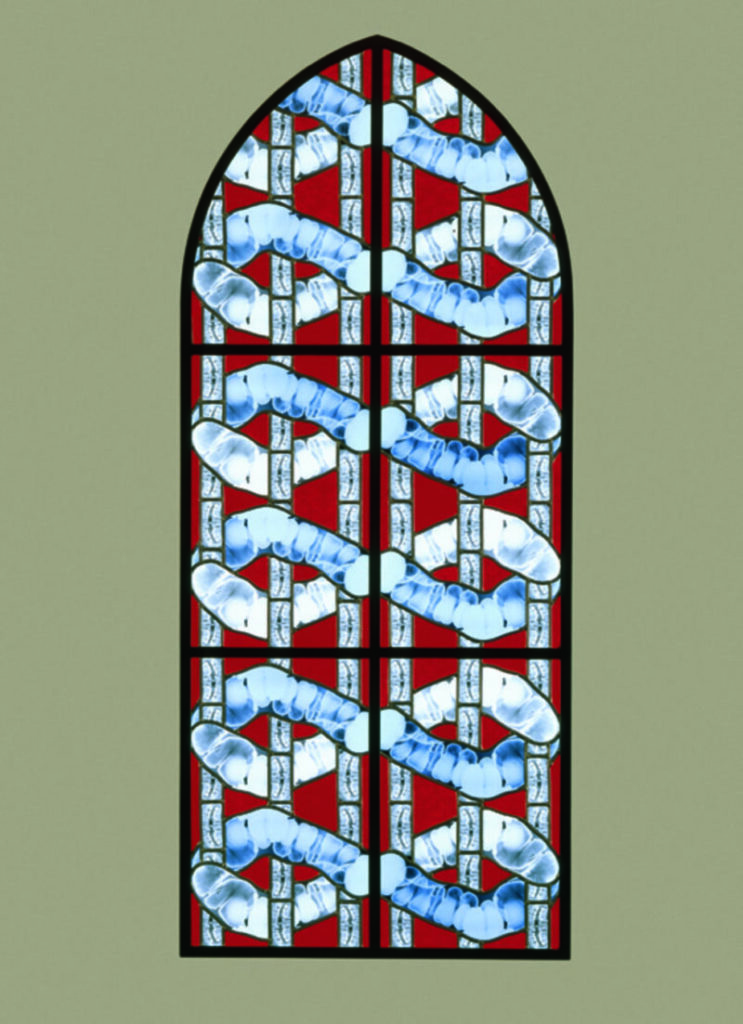
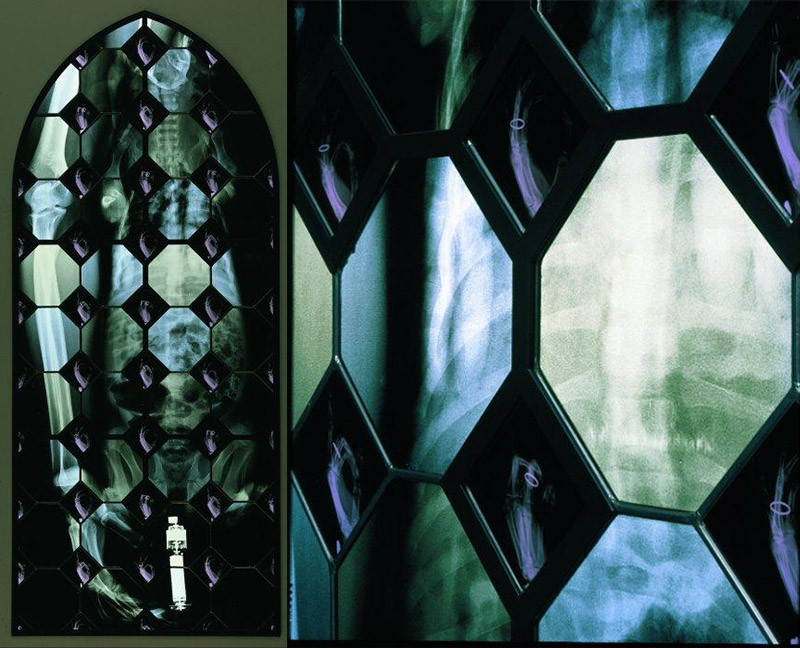
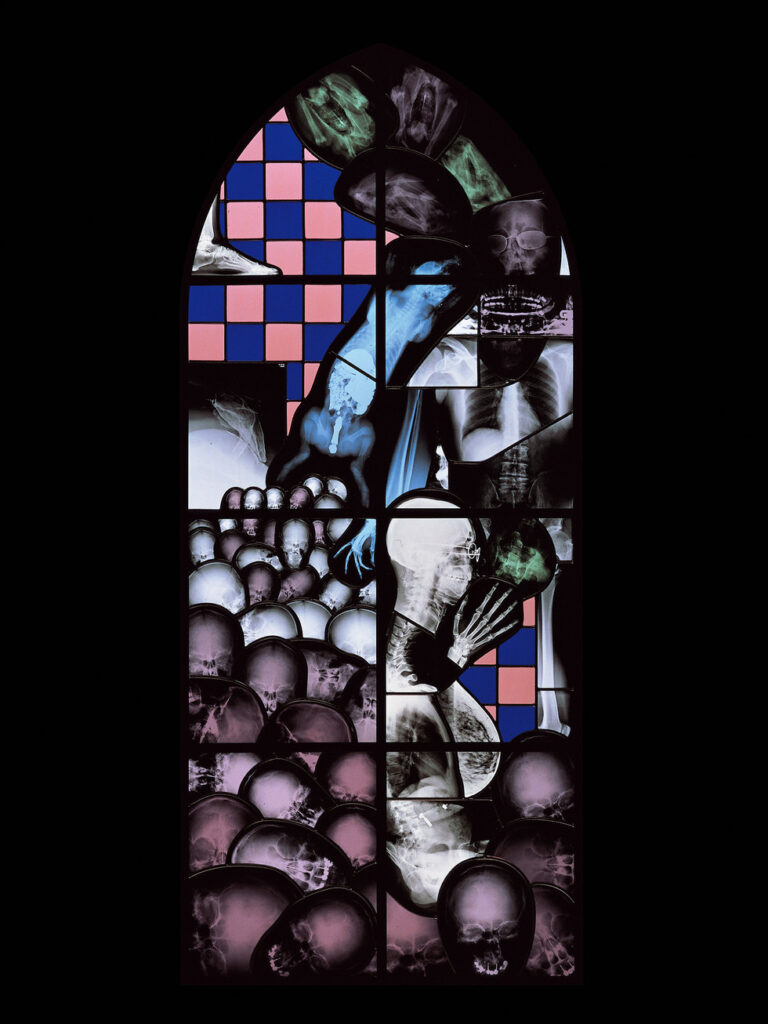
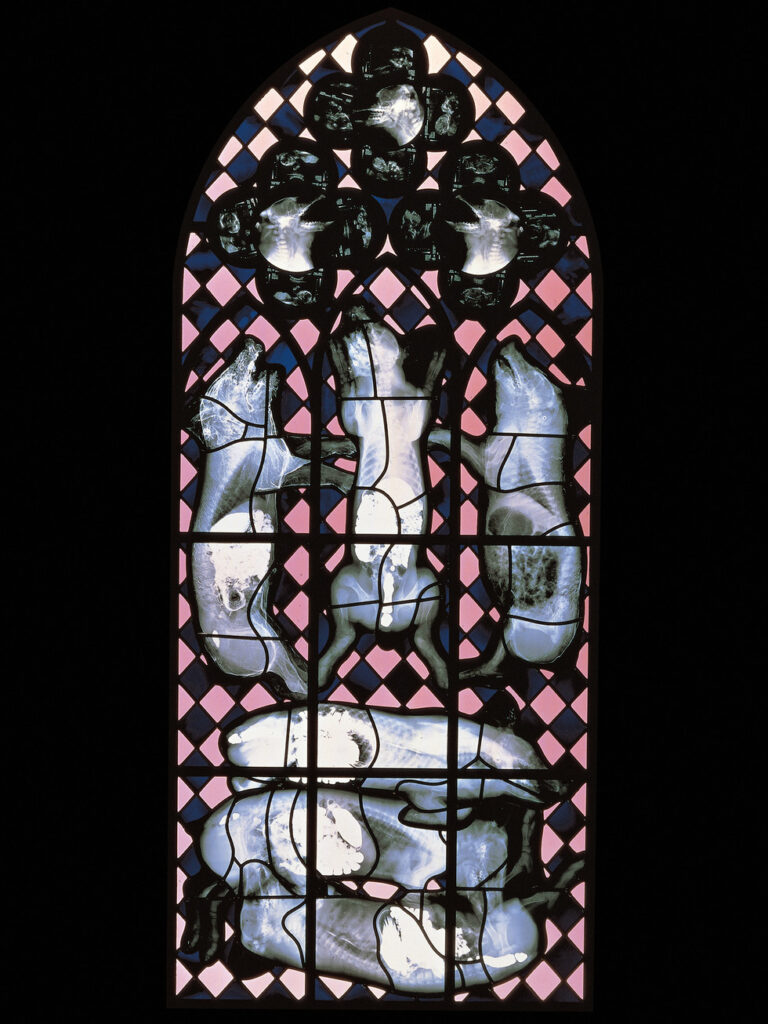
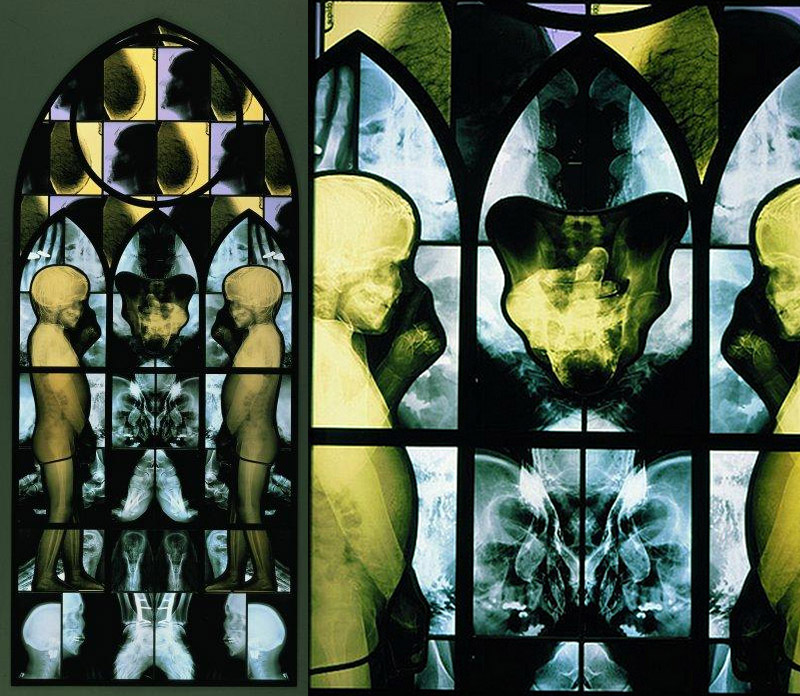
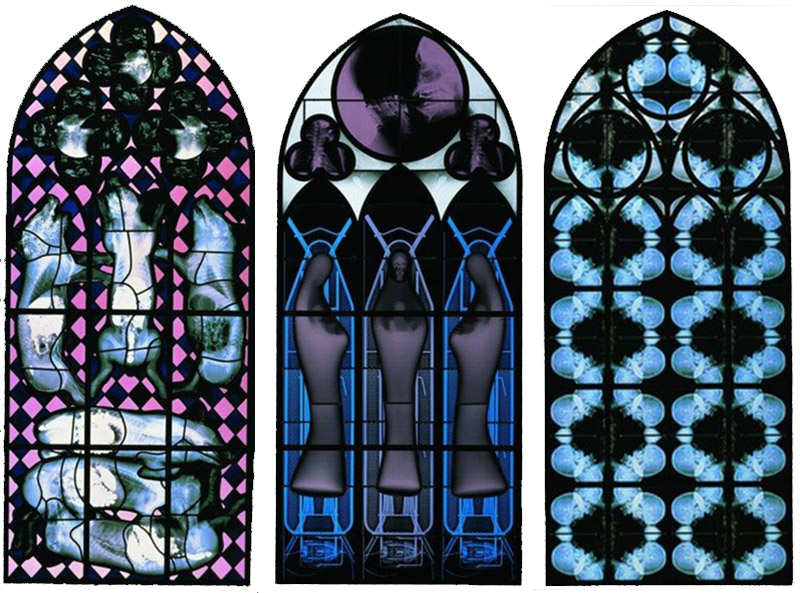
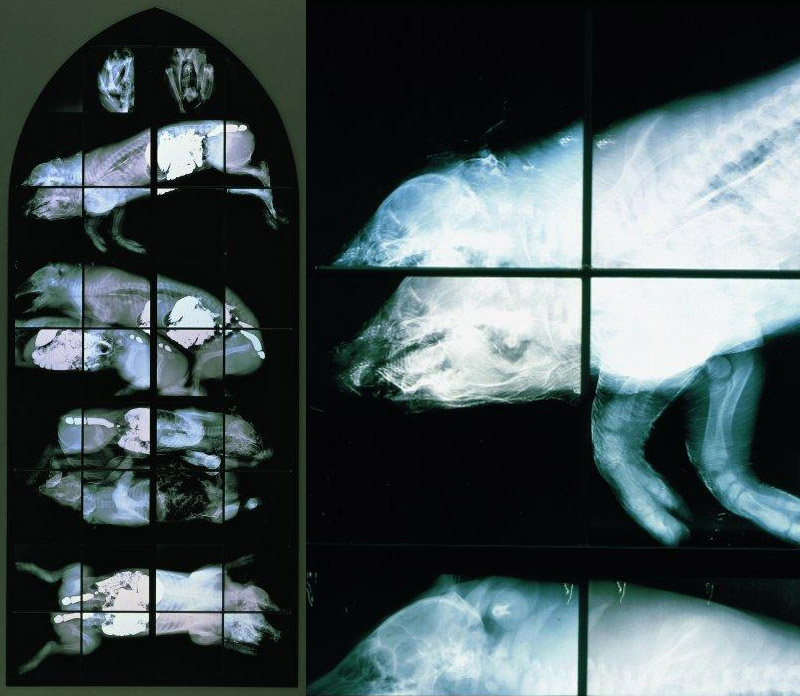
The windows themselves are constructed from authentic medical X‑ray images laminated between panels of glass and assembled within traditional Gothic lead frames. From afar they possess the luminous symmetry of medieval cathedral glass, but the figures revealed in the images are unmistakably skeletal: skulls, bones, and fragments of the human body (and sometimes those of animals) rendered with clinical precision. The sight is simultaneously beautiful and unsettling. These are stained glass windows that could plausibly belong in a church interior, yet their imagery evokes a cold anatomical reality rather than sacred narrative, and that was exactly the intent.
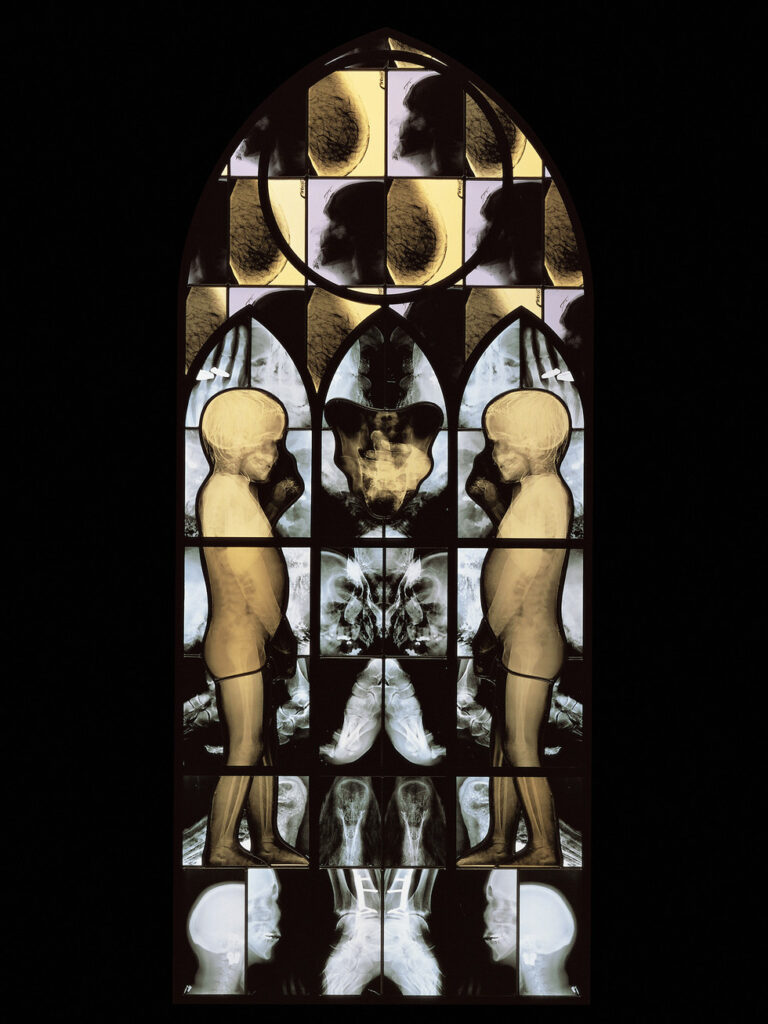
We’ve already written about the creative repurposing of x‑rays in the past, but this is a decidedly more high profile case. Delvoye began producing these stained glass works in 1999 as part of a broader sequence of Gothic-inspired projects. Historically, stained glass had become one of the defining features of Gothic architecture, transforming church interiors into spaces saturated with colored light and biblical imagery. Delvoye adopts this traditional form but replaces saints and apostles with medical imagery, forgoing any distance between the sacred language of religious art and the sterile technologies of contemporary medicine. The gesture continues a lifelong artistic strategy of relocating the profane inside visual systems historically associated with reverence and devotion.
“Don’t fight popular culture; instead grab and chew it,” Delvoye has said. For the Belgian artist, art functions as a method of digesting the global systems that shape contemporary life. His sources range widely. At times he draws inspiration from computer games (he was an avid player of Doom and Quake in his youth); at others he recalls the traditional crafts of the Low Countries Renaissance, or even Belgian comics for their clearly defined linework, which is a main feature of his stained glass works.
Much of Delvoye’s work deliberately challenges established notions of taste and propriety. By pushing materials and imagery into unexpected contexts, he often makes a point of mocking etiquette, tradition, and the stability of cultural symbols. His provocative projects have included tattooing live pigs and later preserving their skin after the animals died of natural causes, a gesture that drew widespread controversy while exemplifying his interest in the uneasy boundary between art, commerce, and spectacle. In doing so, he deliberately tests the limits of what the art world is ready to endure.
Despite the confrontational aspects of his work, Delvoye’s practice is rarely nihilistic. Instead, it is characterized by an almost mischievous intelligence that combines technical virtuosity with a sharp sense of irony. He frequently merges advanced technologies like laser cutting, industrial fabrication, and digital imaging, with craft traditions that date back centuries, leaving a body of work defined by radical transitions between materials, eras, and ideas.
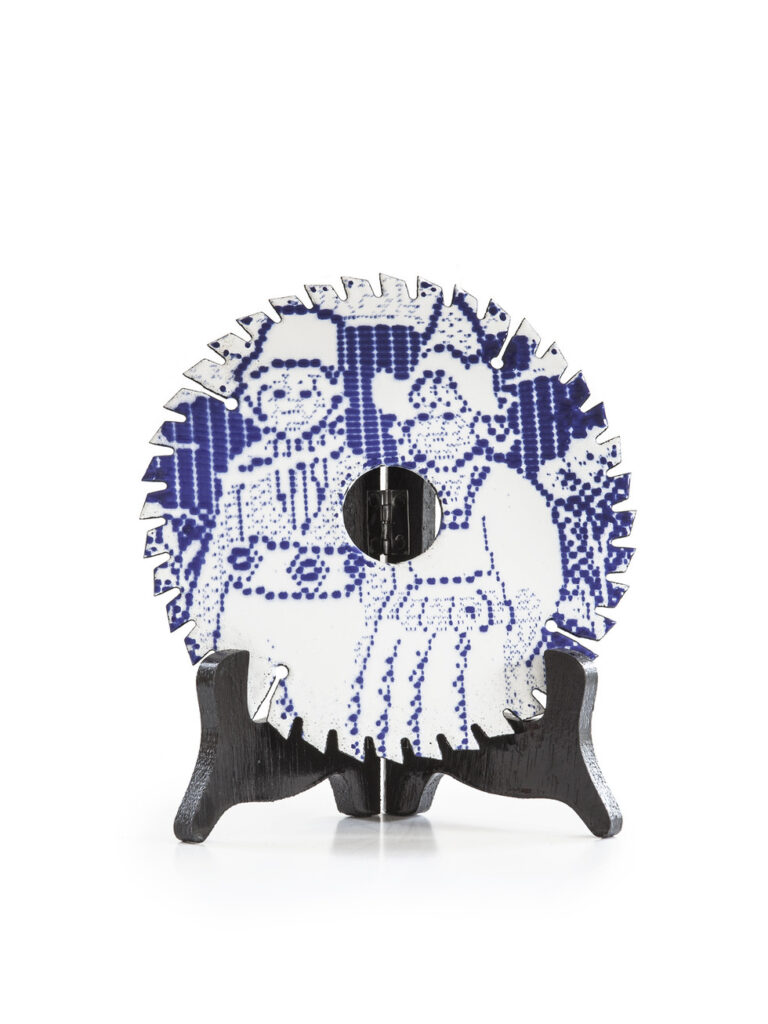
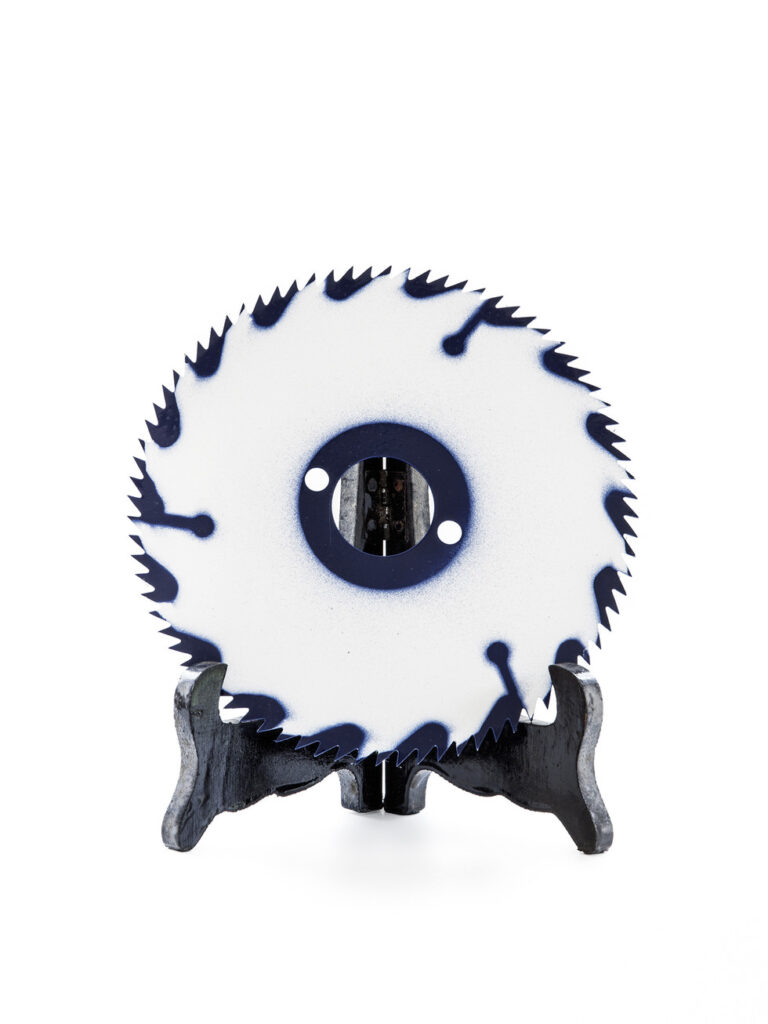
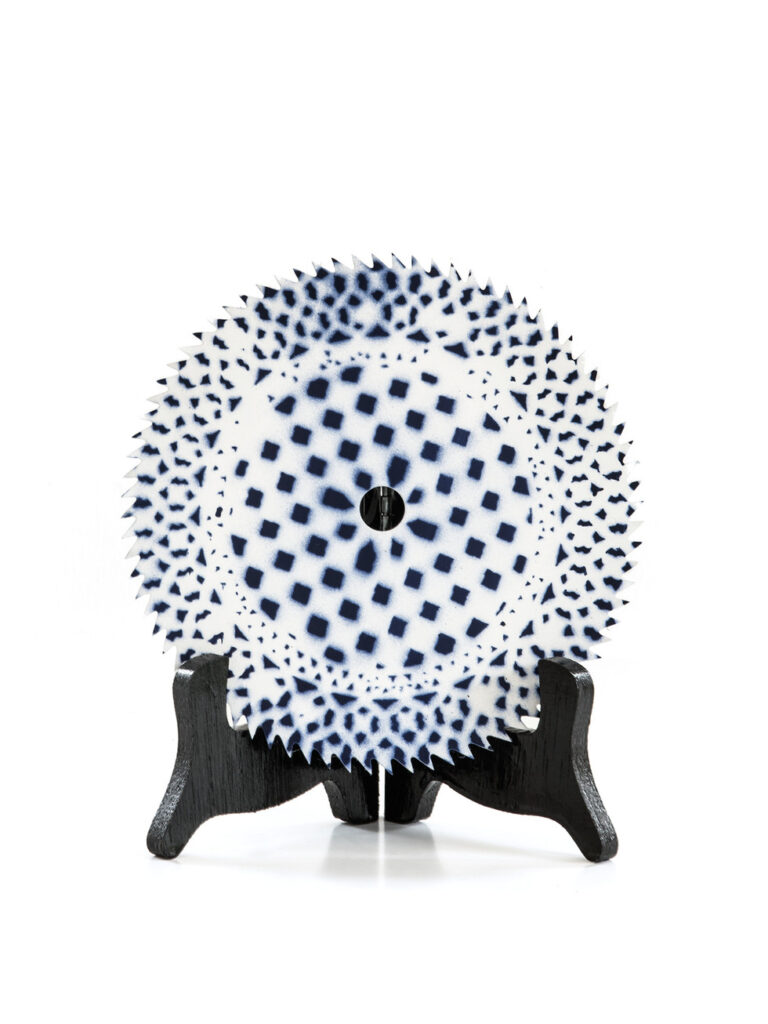
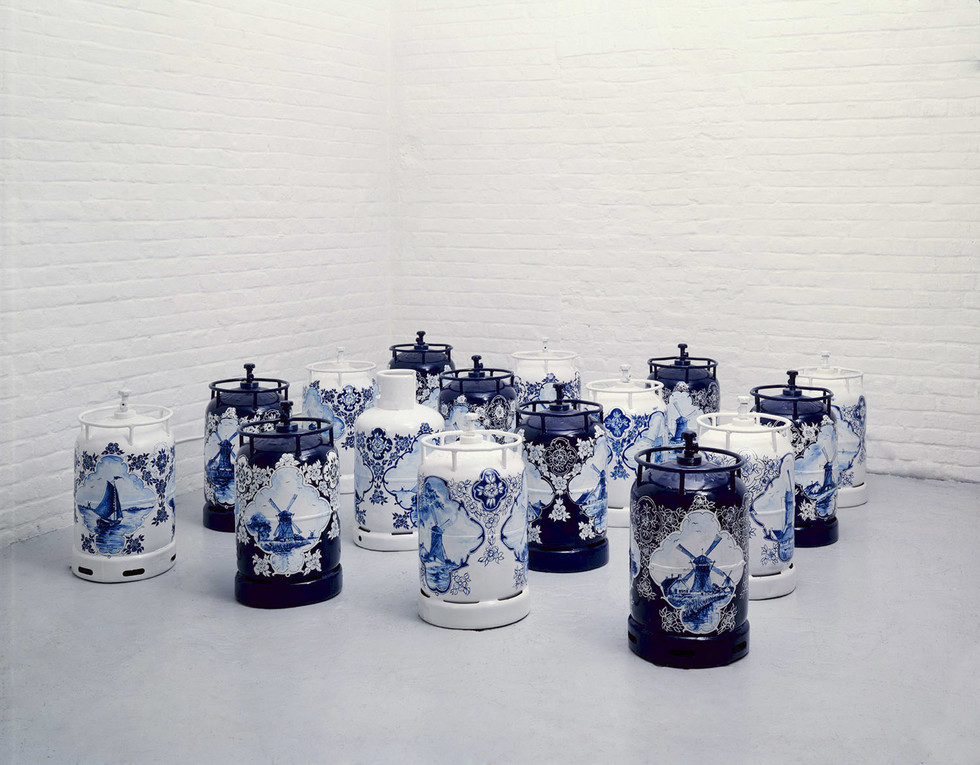
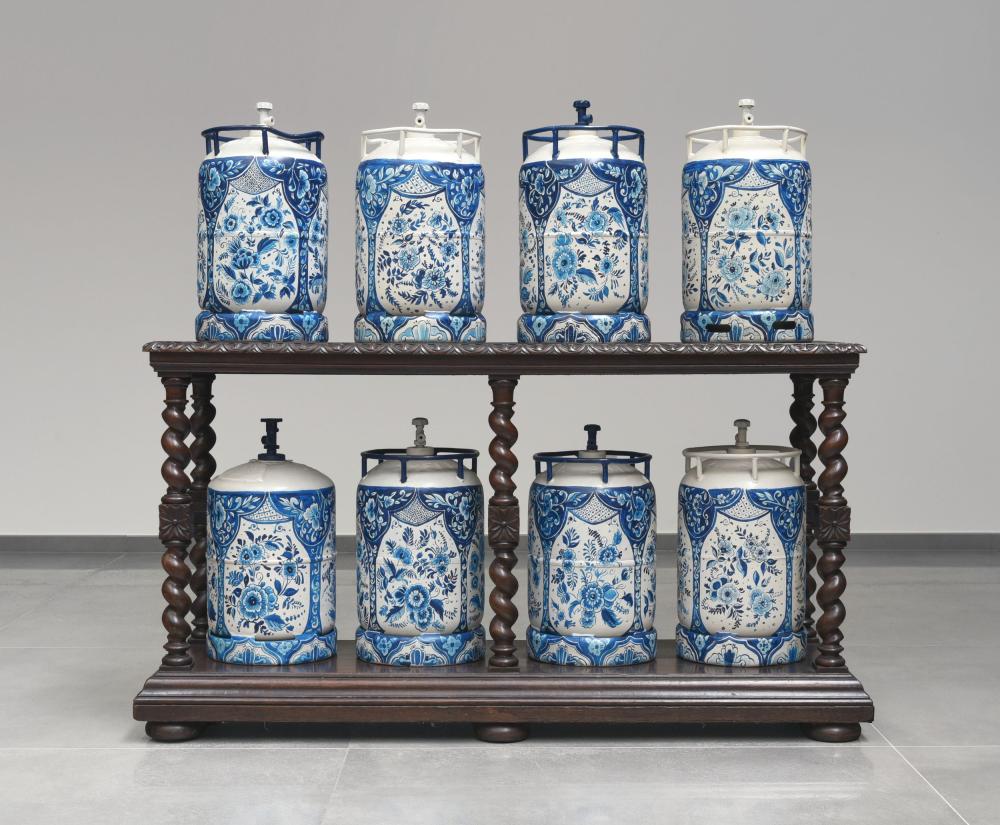
Long before the X‑ray windows and cathedral-like structures, Wim Delvoye was already exploring the middle layer between surface beauty and underlying aggression through a very different visual language. In some of his earliest works he turned to a familiar emblem of European decorative taste: the blue-and-white imagery associated with Delftware. Delft pottery has long carried a nostalgic charm, its windmills, sailing ships, and pastoral scenes functioning as a kind of popular iconography of Dutch identity. Yet even in its original form the imagery is essentially a thin decorative skin, a shallow pictorial layer covering the utilitarian surface of a plate, vase, or cup.
Delvoye seized upon this quality of surface ornament and began transferring the Delft aesthetic onto objects that were unmistakably industrial. Rather than applying the imagery to canvas, a gesture that would situate the work within the traditional hierarchy of painting, he wrapped it around utilitarian machinery. Butane gas cylinders became the support for delicate blue pastoral scenes in Delftse Butaangasflessen (1986–1990), while the rotating blades of circular saws were similarly decorated in Delftse Cirkelzagen (1988–1990). The contrast was immediate, decorative motifs remained charming and recognizable, yet they were applied to objects whose weight, danger, and mechanical purpose could never be fully disguised. The pleasant veneer of Delft painting coexists with the brute reality of the object beneath it, and the tension between the two remains unresolved.
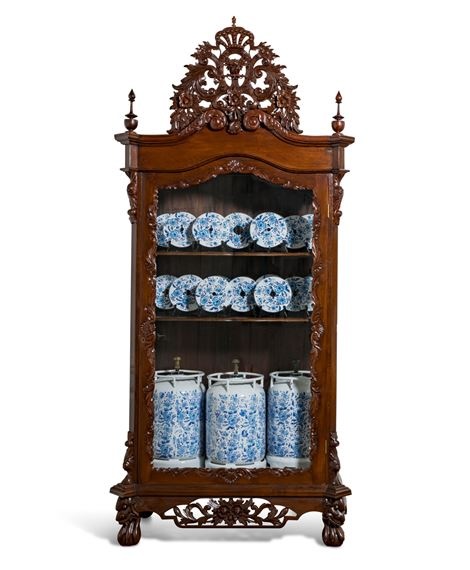
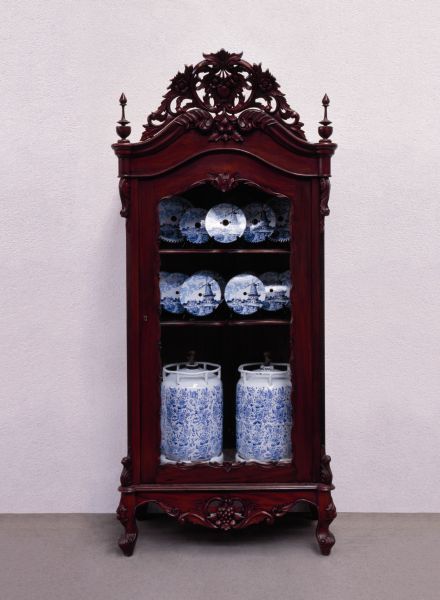
This investigation reached a more complex form in the installation work Jakarta Cabinetten (1988–1990). The work assembles those same painted gas canisters and saw blades inside carefully crafted wooden armoires, hand-carved in Indonesia. The presentation evokes the conventions of domestic display furniture, an environment designed for porcelain, heirlooms, or decorative curiosities. Within this refined setting, however, the objects remain unmistakably industrial.
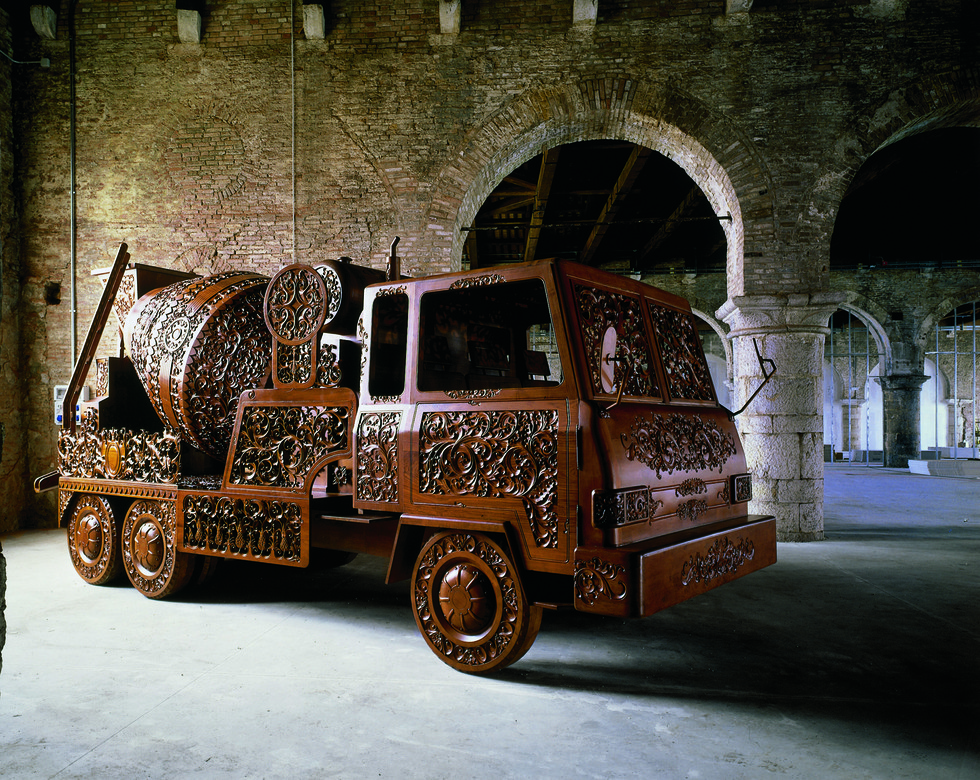
The installation becomes a staging ground for one of Delvoye’s central interests: the unstable boundary between image and object, decoration and function, and so forth. Around the same time, he took this notion further and commissioned a team of Indonesian woodworkers to carve a full-scale cement truck entirely from teak, intricately decorated with elaborate ornamental patterns, produced over the span of nearly a decade.
It is on this fragile “skin” of the object that Delvoye constructs many of his artistic relationships. He treats the exterior of things almost like a body to be dressed, tattooed, or disguised. Images, colors, and motifs are applied to the surface as a kind of pictorial epidermis that simultaneously conceals and reveals the material beneath it. Through this process the object is transformed without ever fully losing its identity. What materializes is a doubled entity in which the painted image and the physical object constantly compete for attention. Each obscures the other while simultaneously making the other more visible.
But the illusion gradually collapses as the viewer approaches. What initially appeared gentle and decorative reveals itself to be attached to tools and machines whose shapes imply force, risk, and mechanical violence. The charm of the imagery becomes a lure. What seemed comforting becomes unsettling once the underlying object is recognized.
In this way the work operates as a subtle visual trap. The viewer’s instinctive pleasure in recognizing familiar images is turned against itself. The deception lies not in any hidden mechanism but in the habits of perception brought by the viewer. Delvoye’s decorative layers function like camouflage, disguising the nature of the object only long enough to expose the assumptions that made the disguise believable. The images of Delftware promise comfort and familiarity, yet that reassurance ultimately proves to be a projection of mass taste, an expectation that Delvoye’s work quietly dismantles.
Born in Wervik, Belgium, in 1965, Wim Delvoye grew up in the rural region of Flanders within a cultural environment shaped strongly by Roman Catholic traditions. Although his own family maintained a largely non-religious household, the visual presence of churches, religious ceremonies, and elaborate ecclesiastical architecture formed a constant backdrop to daily life. The contrast between sacred symbolism and secular reality was therefore present from an early age. ”I have vivid memories of crowds marching behind a single statue as well as of people kneeling in front of painted and carved altarpieces,” he said in a 2002 conversation, ”Although I was barely aware of the ideas lurking behind these types of images, I soon understood that paintings and sculptures were of great importance.”
Delvoye’s willingness to dissolve boundaries between high culture and everyday materials can also be traced to his upbringing. His father occasionally returned from travels to the Congo with inexpensive decorative objects, exposing the young Delvoye to a world of kitsch souvenirs and craft objects before he had encountered canonical European furniture or museum masterpieces. In his own telling, it was through this so-called “low culture” that he first learned to understand the mechanisms of “high culture.”
Delvoye’s parents frequently took him to museums and historic sites, and these visits exposed him to artists whose imagery would leave a lasting impression. Among the figures he encountered were Hieronymus Bosch, Pieter Bruegel the Elder, Marcel Duchamp, and Andy Warhol. The fantastical moral allegories of Bosch and the earthy observations of Bruegel introduced him to a distinctly Flemish visual imagination, while Duchamp’s conceptual provocations and Warhol’s engagement with mass culture suggested that art could operate as commentary on contemporary life. Delvoye would later combine these influences into a practice that mixes craft, satire, and cultural appropriation.
Early on as a student, he displayed a temperament that oscillated between mischievous experimentation and philosophical curiosity. Delvoye has often insisted that art should entertain, yet the humor in his work rarely functions as a straightforward joke. Instead, the works operate through layered meanings that ask viewers to read between the lines. Throughout his career he has shown a tendency to pursue ideas to their logical conclusion, even when doing so generates controversy.
His formal training took place at the Royal Academy of Fine Arts in Ghent, where he studied alongside and under figures associated with the Flemish conceptual art scene, including Jan Fabre. These artists emphasized experimentation with materials and encouraged confrontational approaches that could challenge social conventions. His experience at art school quickly left him disillusioned. There, he said, he was confronted with the reductive paradigms of 20th-century art, while he himself was interested in creating work that could speak more directly to a wider public. The academy’s intellectual climate carried a strong bias against traditional craftsmanship. Technical skill and the use of artisanal techniques were often dismissed as kitsch, something that risked reducing an artist to the status of a mere craftsman.
Delvoye reacted against this hierarchy almost immediately. Rather than abandoning traditional techniques, he embraced them. His early works involving carpet weaving and tapestry deliberately entered the territory of folklore, craft, and decorative art, areas that modernist aesthetics had largely dismissed. By doing so he created works that seemed to violate the unwritten rules of contemporary art, placing elaborate hand-crafted techniques within conceptual frameworks. The gesture positioned his work directly between the worlds of high art and popular culture. This commitment to craftsmanship has remained visible throughout his career.
He was also told that making a living as an artist would be nearly impossible, and that Belgian artists had little chance of gaining international recognition. “This freed me. I had nothing to lose” he recalls. Thus, Delvoye began experimenting with unconventional materials and surfaces. Instead of following the prevailing academic attitudes, he turned toward the visual world he knew growing up in Flanders, shaped by folklore, ornament, and the kinds of kitsch objects often dismissed by the academy.
Delvoye also absorbed the conceptual legacy of Duchamp’s readymades, which demonstrated how ordinary objects could acquire artistic meaning through context and selection. Naturally, his early works from this time were paintings made directly over wallpaper and carpets, where he followed the existing patterns and color schemes of the ready-made designs. The approach ran counter to the dominant idea of spontaneous artistic expression. Delvoye also saw the materials themselves as reflections of shifting class values. A century earlier, he noted, the wealthy filled their homes with wallpaper, carpets, and chandeliers while the poor lived in bare interiors; in contemporary society the situation had reversed, with wealth increasingly associated with minimal, empty spaces. From the beginning, questions of class, taste, and decorum were central to his work.
After graduating in 1988, Delvoye relocated to Amsterdam in order to pursue his work outside the constraints of the academy. The move allowed him to continue developing the strategies that would define his career: appropriating familiar cultural symbols, combining high technology with historical craft traditions, and staging encounters between the sacred and the profane. The Catholic imagery that surrounded his childhood in Flanders would soon reappear in increasingly elaborate forms, from Gothic machines to X‑ray stained glass, forming the conceptual foundation for many of his later projects.
By the early 2000s, Wim Delvoye began expanding his exploration of ornament and utility through a new body of work that transformed heavy industrial machinery into elaborate sculptural objects. Using laser-cut stainless steel and Corten steel, he developed a series of highly intricate sculptures in which construction equipment such as cement mixers, dump trucks, and excavators were reimagined through the decorative language of historical architecture. These works continued Delvoye’s long-standing interest in merging functional objects with ornamental excess, turning machines designed for construction and demolition into objects of painstaking craftsmanship.
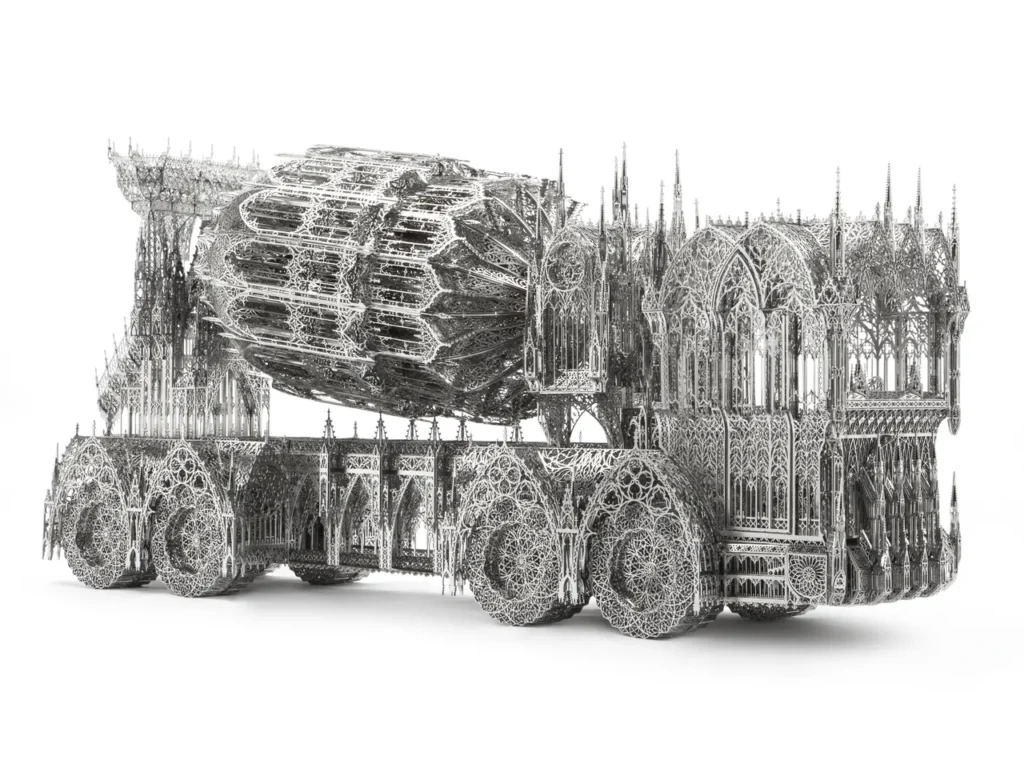
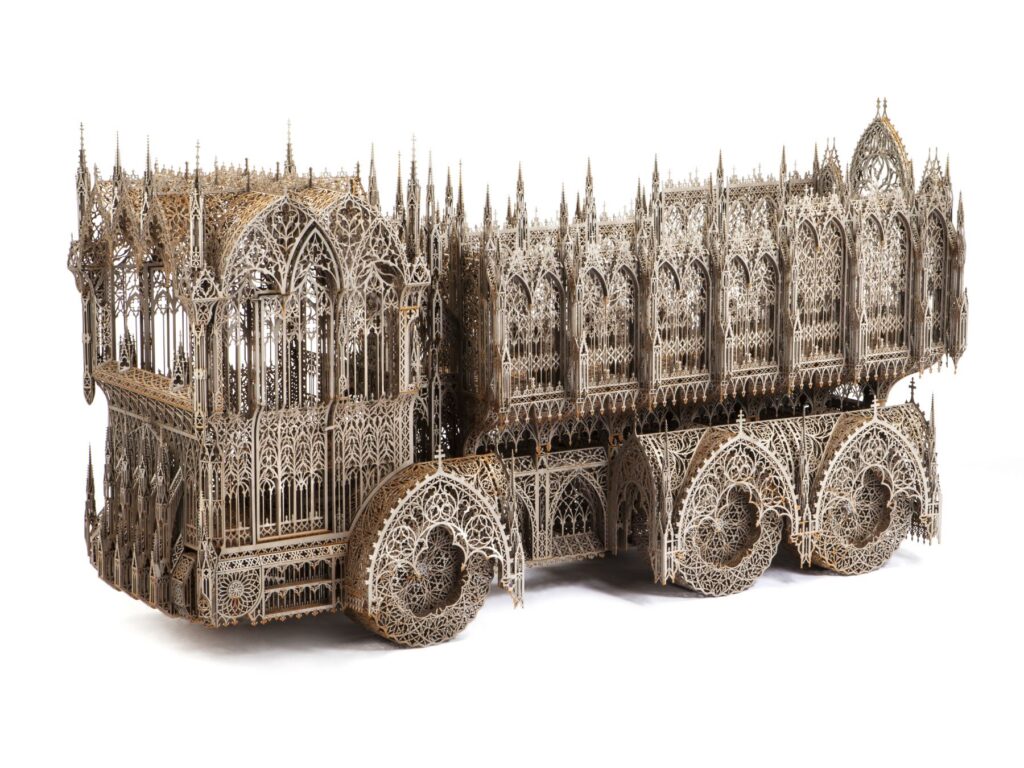
The visual vocabulary of these sculptures draws heavily on Gothic tracery as well as the dense ornamental traditions of Mughal architecture. Floral arabesques, lace-like filigree, and architectural motifs are cut directly into sheets of steel, producing a surface that appears almost textile-like in its delicacy despite the weight and permanence of the material. In works such as Cement Mixer (2007), the ordinary industrial vehicle becomes something closer to a monumental reliquary.
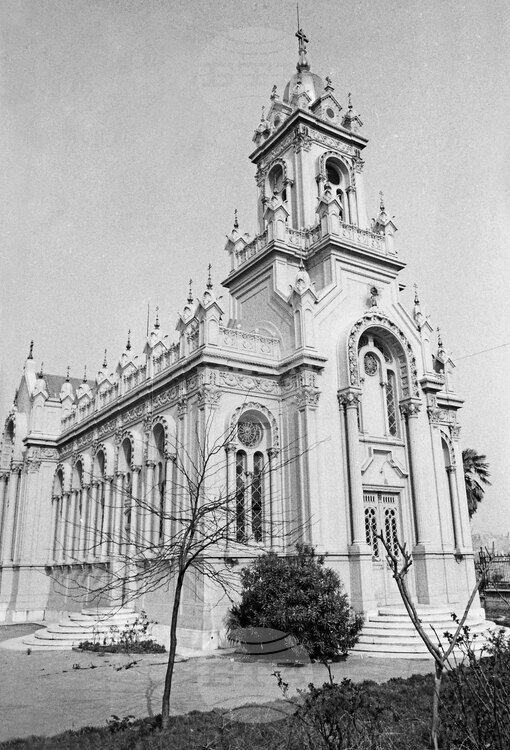
The machine’s cylindrical drum and mechanical frame are covered in swirling vegetal patterns that evoke the decorative exuberance of Baroque ornamentation, transforming a piece of construction equipment into what appears to be an elaborate sculptural artifact. This parallels real-life practical experiments in architecture, notably the 19th century Bulgarian Orthodox Church of St. Stephen in Istanbul, which is constructed entirely of prefabricated iron pieces cast in Austria, shipped overseas and assembled on site.
To realize his own projects, Delvoye collaborated with high-precision fabrication facilities in China capable of executing extremely complex laser-cutting procedures. Using digital design and industrial production methods, sheets of metal are intricately perforated with elaborate patterns before being assembled into fully functioning mechanical forms before similarly being transported over to his studio in Europe. The use of advanced manufacturing technology allows the artist to achieve levels of detail that would have been impossible through traditional metalworking techniques alone. At the same time, the permanence and durability of steel contrast sharply with the disposable nature of the original machines from which the forms are derived.
Although the resulting sculptures are obviously mechanically inoperable, the accuracy of their form effectively gives the sense that their original purpose was preserved. In pieces such as Dump Truck (2013), Gothic motifs spread across the body of the vehicle like architectural lacework, creating a strange hybrid between medieval cathedral ornament and modern industrial design. In this way Delvoye stages a dialogue between contemporary industry and historical craftsmanship, allowing the language of Gothic architecture to overtake objects normally associated with brute force and practicality.
The scale of the series varies widely. Some works are relatively modest in size, such as Caterpillar V (2004), measuring roughly 100 by 62.5 by 200 centimeters. Others expand to monumental dimensions, including excavators and transport vehicles that exceed five meters in length. This range allows Delvoye to explore how ornamental density operates across different physical scales, demonstrating that the same decorative logic can transform both small mechanical objects and massive industrial machines.
These sculptures have also achieved notable commercial success within the contemporary art market. A work such as Caterpillar V sold for approximately $63,000 at a 2022 auction held by Christie’s, while other large-scale works, including Twisted Dump Truck (2013), have been valued at around €250,000 through European gallery sales. The market reception underscores how Delvoye’s unusual fusion of craftsmanship, conceptual provocation, and industrial imagery resonates with collectors.
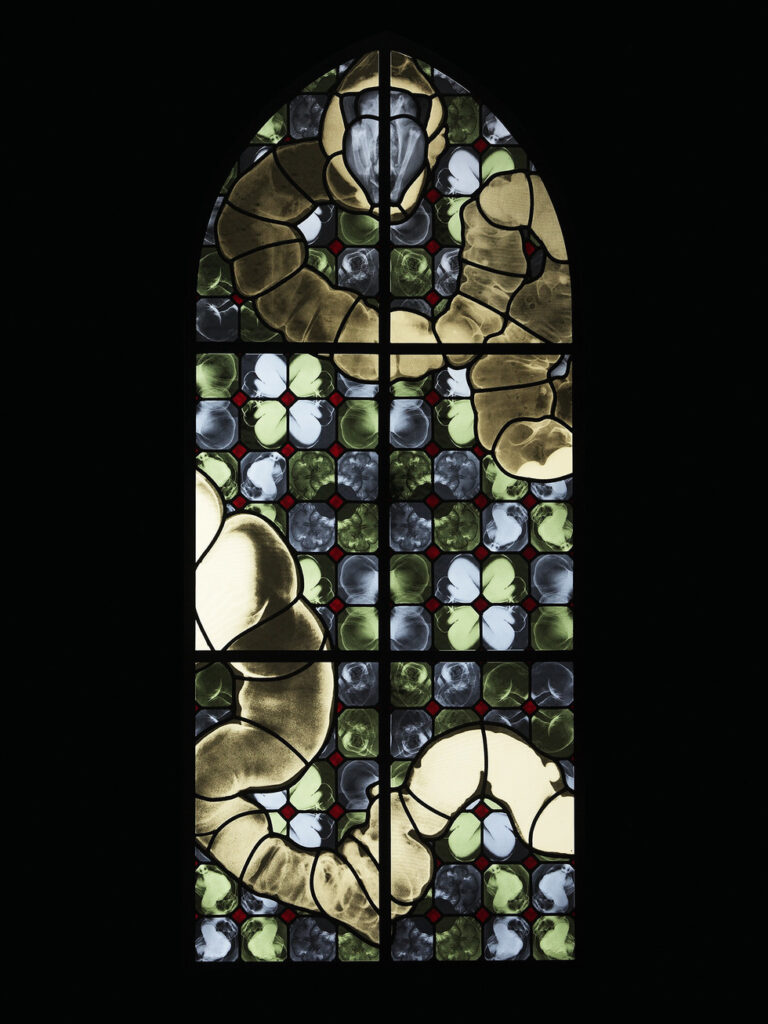
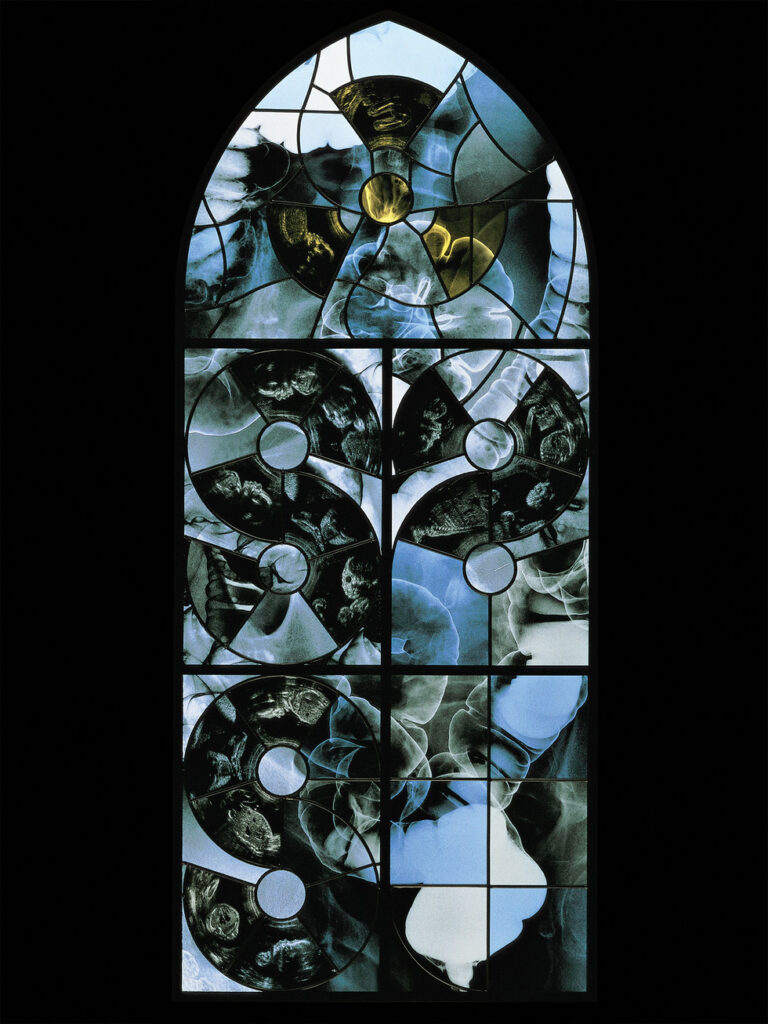
Alongside these machines, Delvoye has also produced large-scale laser-cut steel structures that resemble abstract architectural forms rather than vehicles. These sculptures often echo the elaborate vocabulary of seventeenth-century Flemish Baroque churches while maintaining the skeletal, perforated surfaces produced through laser cutting. The effect is a fusion of monumental architecture and industrial fabrication: cathedral-like frameworks constructed with the precision of modern engineering.
This architectural tendency became particularly visible in exhibitions during the early 2010s. In a 2013 presentation in New York, Delvoye displayed a number of intricate laser-cut sculptures that combined architectural structures with abstract and figurative references. Some works incorporated forms reminiscent of Möbius strips, while others echoed the symmetrical patterns of Hermann Rorschach’s inkblot tests. The resulting objects appeared simultaneously mechanical, architectural, and psychological, structures in which medieval ornament, modern fabrication, and symbolic imagery converged. Even religious institutions, the owners of the forms Delvoye references, have taken notice and have themselves courted his talents on more than one occasion.
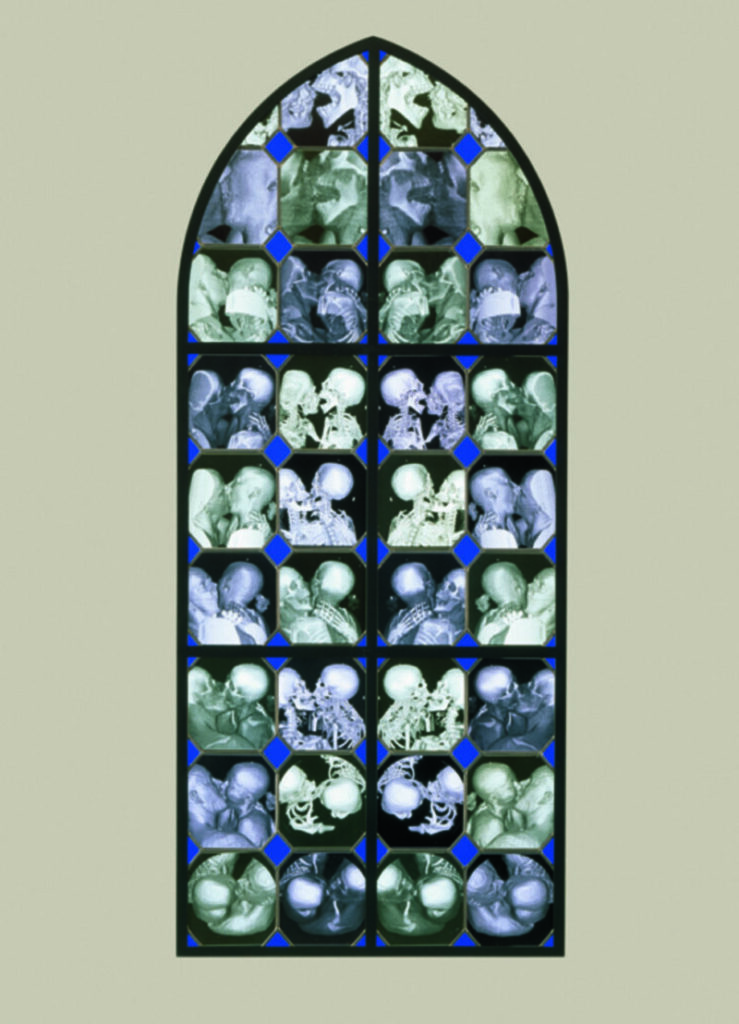
It was within this broader investigation of Gothic form and industrial material that Delvoye’s stained-glass X‑ray works would also find their architectural setting. The same technologies used to transform machinery into lace-like metal structures would eventually be applied to chapel-like constructions, creating elaborate frameworks in which his unsettling radiographic windows could be installed.
Around the same period that Wim Delvoye began developing his laser-cut Gothic machinery, he also turned his attention toward another technological domain that would become central to one of his most controversial bodies of work: medical imaging. Technology has consistently functioned as a structural element within Delvoye’s practice, particularly in the way it creates dialogue between contemporary systems and historical visual languages. In this case, he began exploring the visual possibilities of radiography, an imaging technology that is clinical, objective, and devoid of emotional interpretation. This cold factuality stood in deliberate contrast to the emotional symbolism and spiritual narratives traditionally associated with religious art.
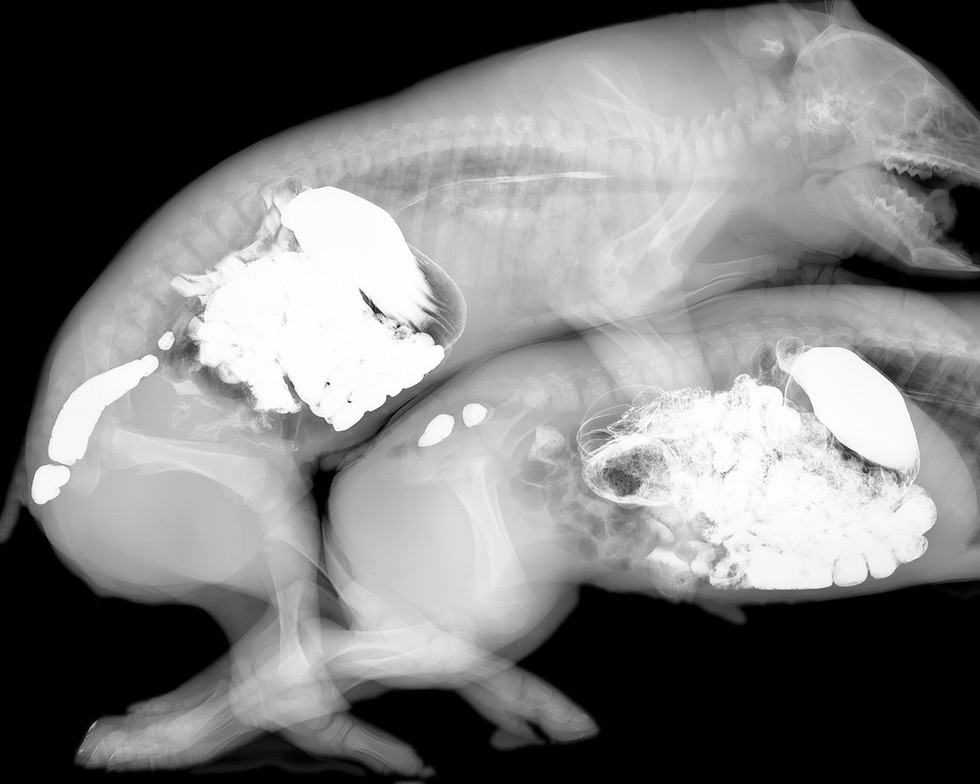
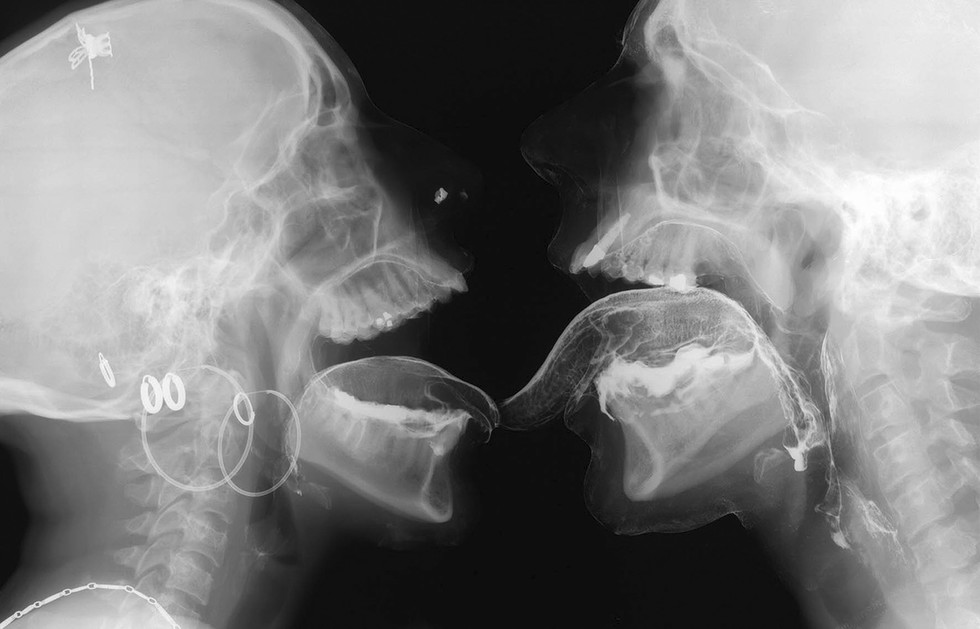
Beginning around 2001, Delvoye initiated Sexrays, a project that involved his first major foray into contemporary radiological imagery. Working with a cooperating radiologist, he arranged for a group of friends to participate in X‑ray sessions inside medical imaging facilities. The participants applied small quantities of barium, commonly used as a contrast agent in radiology, to make certain parts of the body visible during scanning. They then performed intimate physical interactions while being recorded by X‑ray machines. Delvoye observed the process remotely on a computer monitor in another room, allowing the participants enough distance and privacy to behave naturally.
He later described the atmosphere of the procedure as “very medical, very antiseptic.” The project, shot in America, also highlighted the challenges of access to medical services and attitudes to sexuality in the country. “This country is so religious. Doctors are so worried about being sued. There’s a certainly prudent attitude in the United States.” he recalls in an interview, “For example, I needed doctors, and the doctor I found was so adamant to participate. He was astonished that he’d never thought to do that. He happened to be in his midlife crisis. And it was also funny – I put my penis in the mammography machine, and he said, “Look, I’ve been here for years and never thought to put my penis in this machine.” I thought, that’s the first thing I think of. I opened his eyes to his own clinic!”
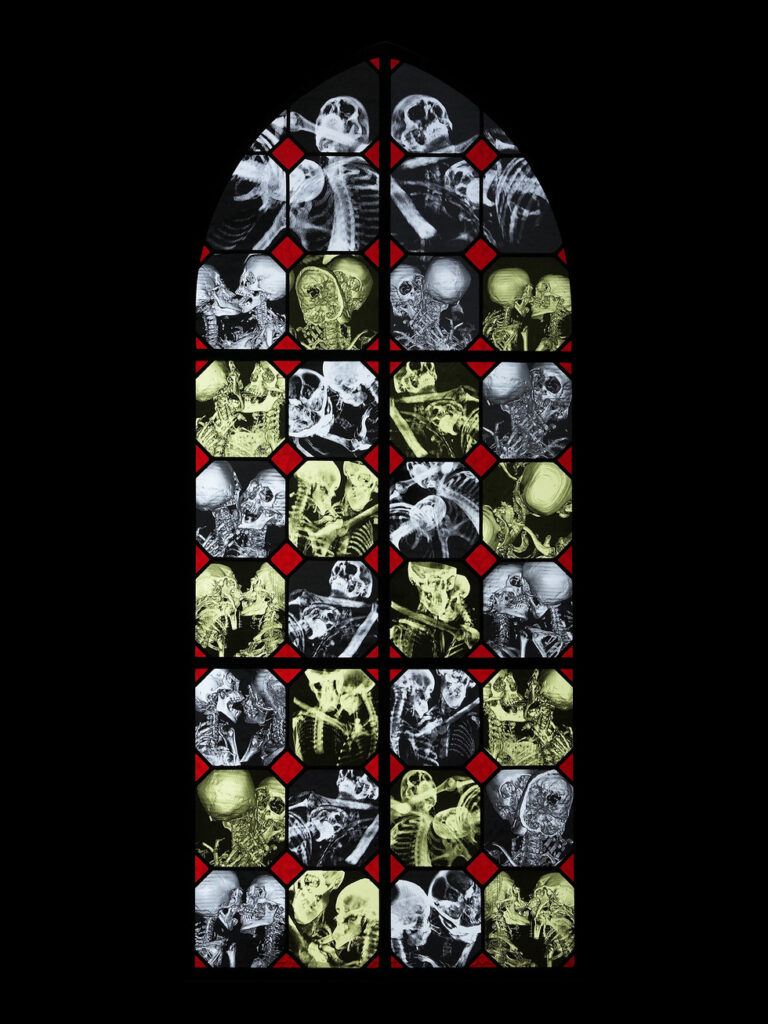
It was at this stage that Wim Delvoye decided to combine his experiments with radiographic imagery with another craft he had already been exploring for years: stained glass. Although the X‑ray stained glass windows would eventually become one of the most recognizable aspects of his work, Delvoye’s engagement with stained glass actually began much earlier, in the late 1980s. From the outset of his professional career as an artist, he was interested in the historical weight of the medium and its strong association with religious architecture, while also recognizing its potential as a fragile decorative surface that could be applied to unexpected objects.
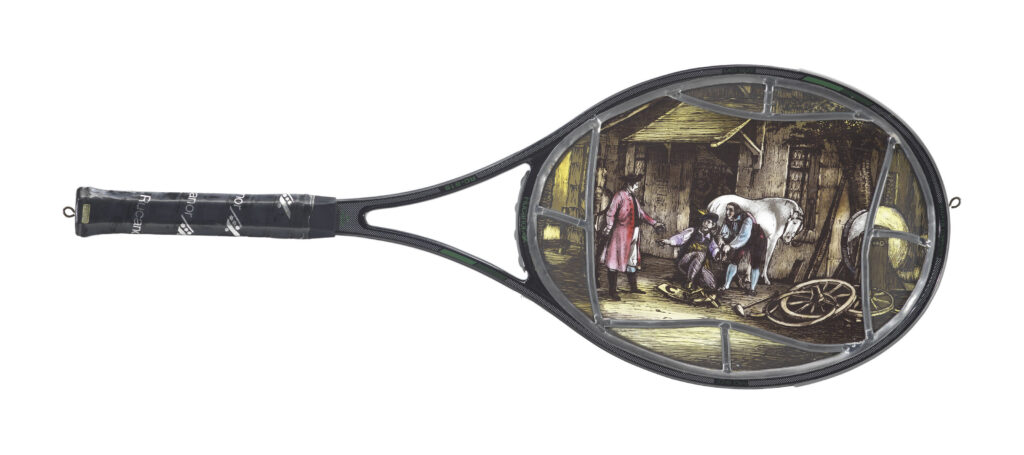
One of his earliest experiments involved incorporating stained glass directly into sports equipment. Between 1988 and 1989 he produced a series of tennis rackets in which the usual stringing was replaced with carefully constructed glass panels. The rackets were often presented together with their original sleeves, for example those bearing the name of the British sports brand Slazenger, so that the object retained its identity as a mass-produced item of sporting equipment. Rather than reusing existing glass fragments, Delvoye fabricated the stained glass himself, allowing him to control both the imagery and the visual composition.
Inside these miniature glass panels he recreated scenes reminiscent of seventeenth- and eighteenth-century Dutch domestic painting. The imagery often depicted ordinary household situations: families gathered around dinner tables or ale drinkers in modest interiors. These compositions echoed the quiet narrative scenes found in Flemish genre painting while appearing within an object normally associated with fast, high-impact athletic movement. The contrast between the delicate glass imagery and the physical violence implied by the racket’s intended use produced an immediate sense of visual dissonance.
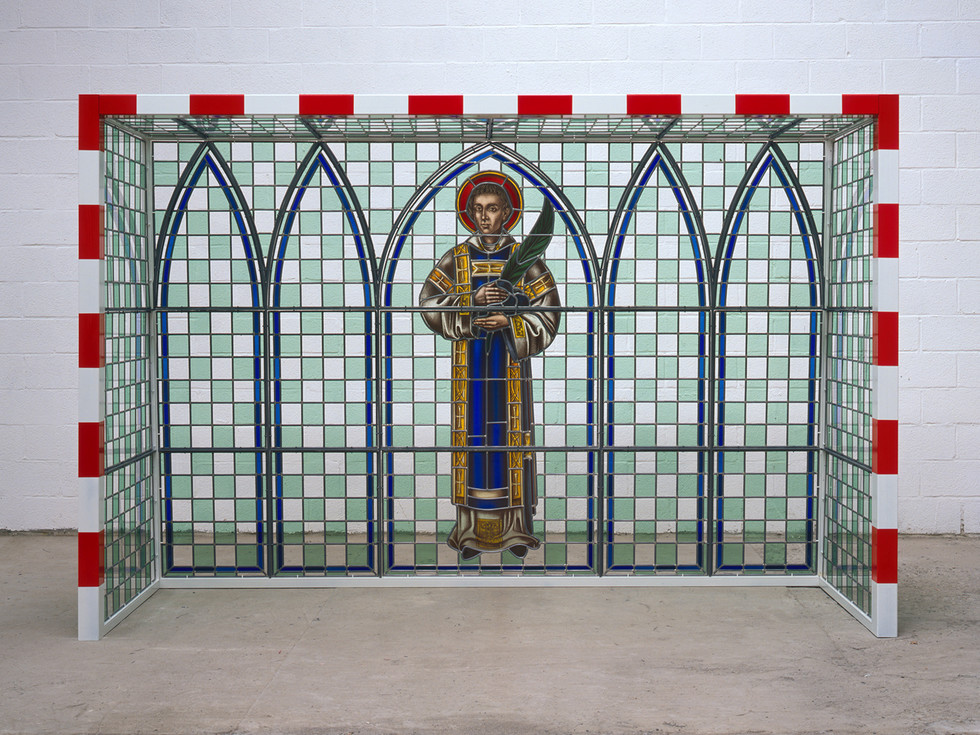
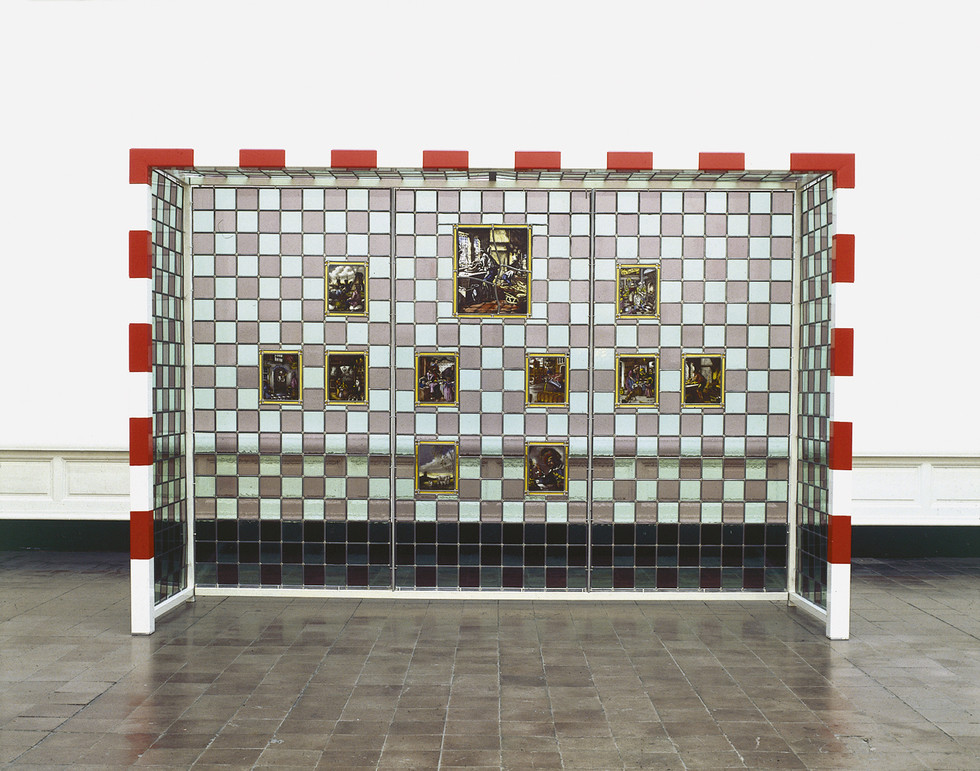
After completing the tennis racket works, Delvoye extended the same conceptual strategy to larger and more architectural objects. Between 1989 and 1991 he created a series known as Goals, replacing the netting of indoor football goals with elaborate stained-glass panels. The resulting objects appear immediately strange: the rigid frame of a sports goal remains intact, but the open space where a net would normally stretch is filled with fragile panes of colored glass. What would ordinarily be a robust piece of athletic equipment becomes something closer to a devotional object.
The Soccergoals series places sacred and profane imagery within the same structure. In some panels Delvoye used scenes inspired by the compositions of Pieter Bruegel the Elder and other Flemish genre painters, depicting everyday activities rendered in a deliberately flat, historicizing style. In the work Panem et Circenses (1989–1990), the Latin phrase meaning “bread and circuses”, the stained glass shows a medieval bakery shop. While the image evokes historical craft traditions, it simultaneously recalls the visual strategies of modern advertising, where ideas of freshness and artisanal authenticity are often emphasized in the marketing of bread and baked goods.
Within the context of a soccer goal, however, these images take on additional meanings. The football field becomes a metaphorical stage for spectacle, recalling the Roman concept of mass entertainment suggested by the title. Delvoye draws parallels between the collective excitement of professional sport and the rituals surrounding art institutions. The museum and gallery become arenas where symbolic “goals” are scored, not in athletic competition, but in financial value and cultural prestige.
The material fragility of the works intensifies this metaphor. A soccer goal is designed to absorb powerful impacts from balls and players, yet the stained glass that fills Delvoye’s versions would shatter instantly if used in an actual game. Their delicate surfaces therefore contradict the function of the object itself. In several of the works the glass panels even depict the biblical story of Saint Stephen, who according to tradition was executed by being stoned by a crowd. These images reinforce the theme of collective violence and mass spectatorship that runs through the series, positioning the anonymous crowd as an invisible but powerful presence.
The tennis rackets and soccer goals share the same fundamental tension. Both are objects designed for high-impact physical activity, yet Delvoye replaces their functional components with one of the most fragile mediums in the history of religious art. The viewer immediately experiences a conflict between the object’s intended use and the vulnerability of its materials.
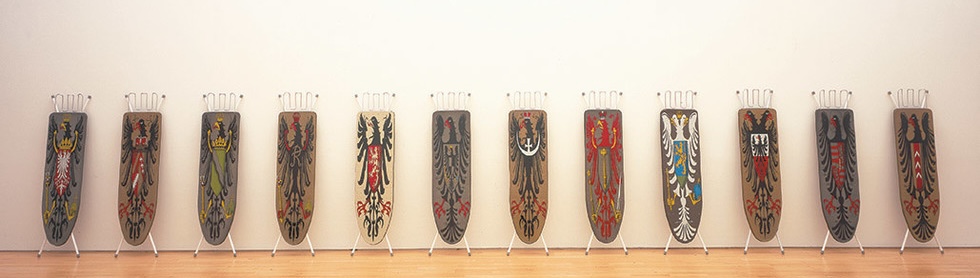
Around the same time Delvoye produced another group of works that further explored the collision between domestic objects and symbolic imagery. In his series Ironing Boards (1988–90), he placed heraldic emblems onto a set of twelve ironing boards. The boards themselves resemble the elongated shape of medieval shields, and the addition of heraldic symbols emphasizes this resemblance, transforming a mundane household tool into something that evokes medieval coats of arms.
Across these early works, the logic that would later define his X‑ray windows was already visible. Delvoye repeatedly took objects associated with ordinary life and overlaid them with the visual language of history, religion, or heraldry. Naturally, combining his radiographic compositions within monumental stained-glass windows was an inevitable act.
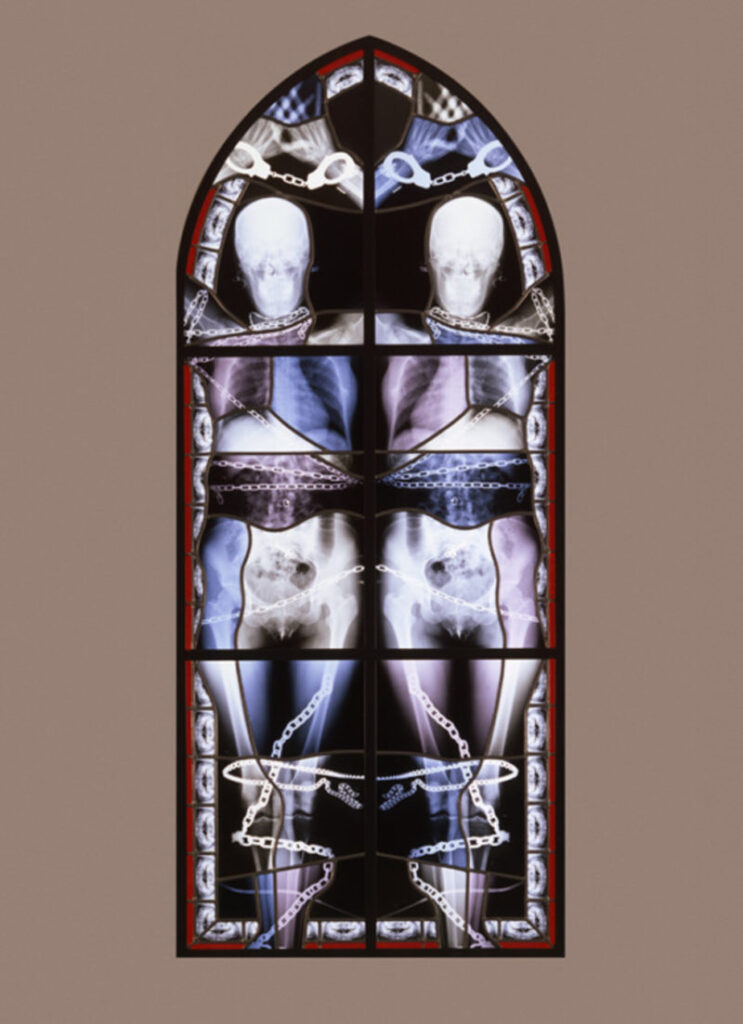
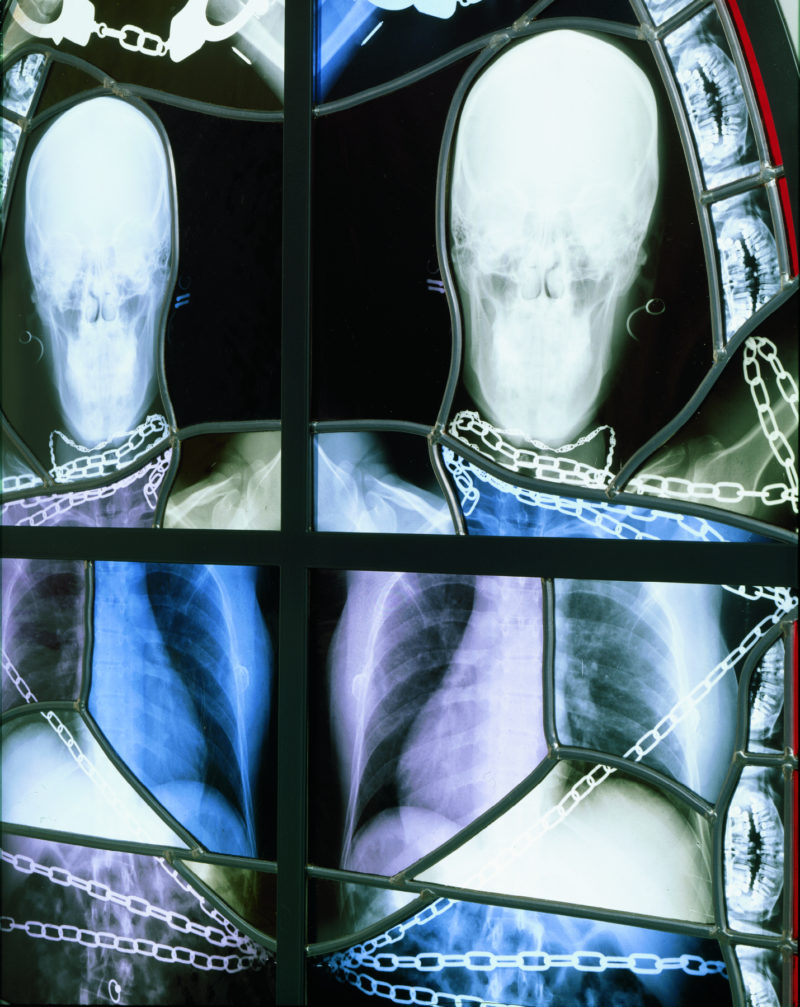
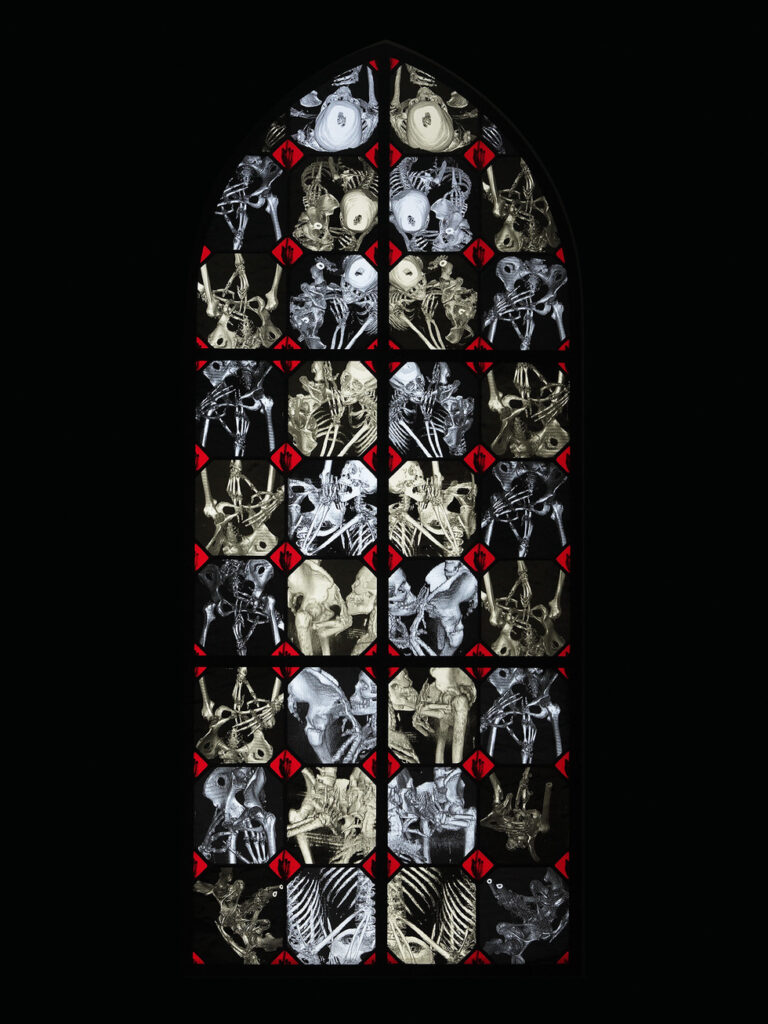
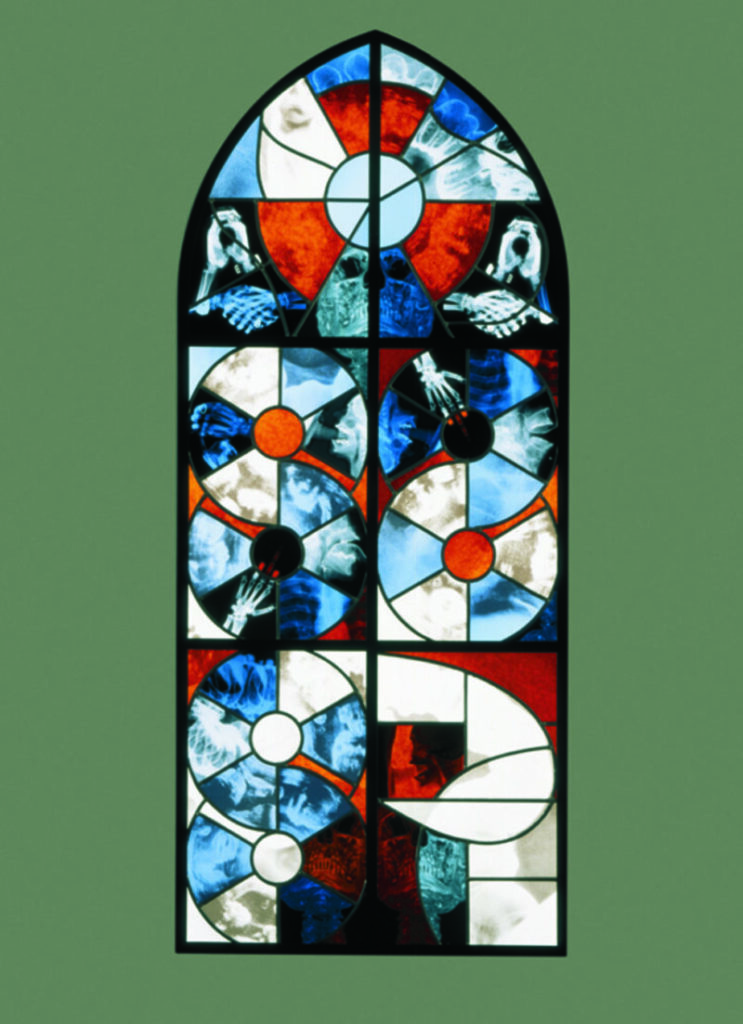
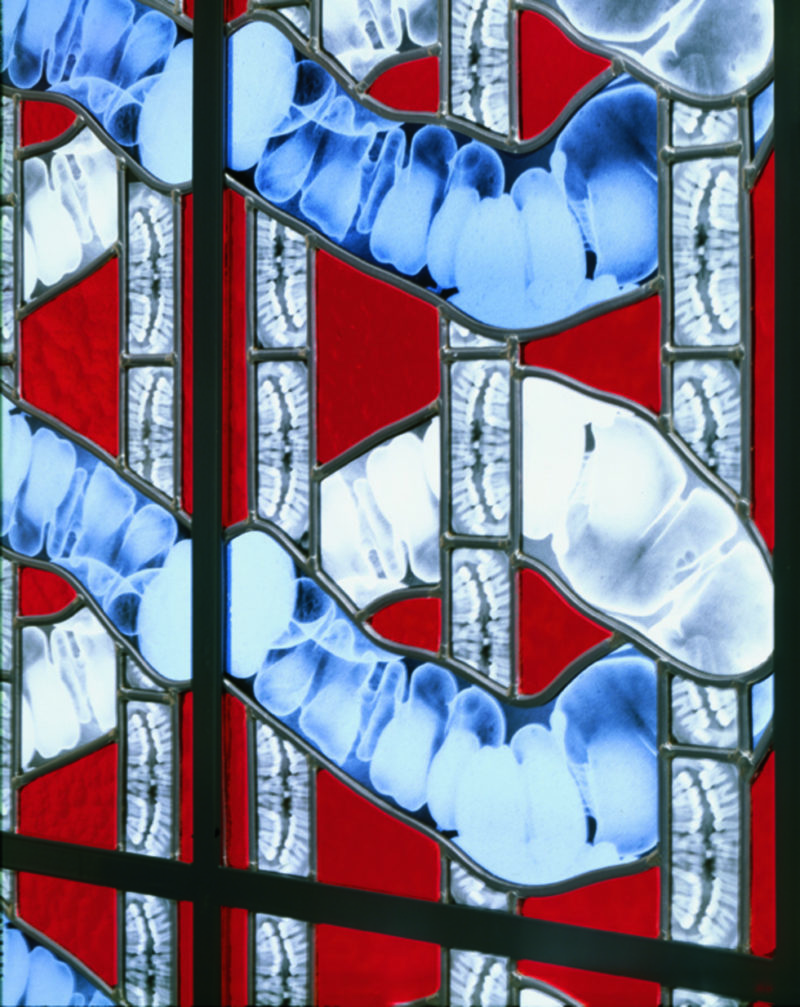
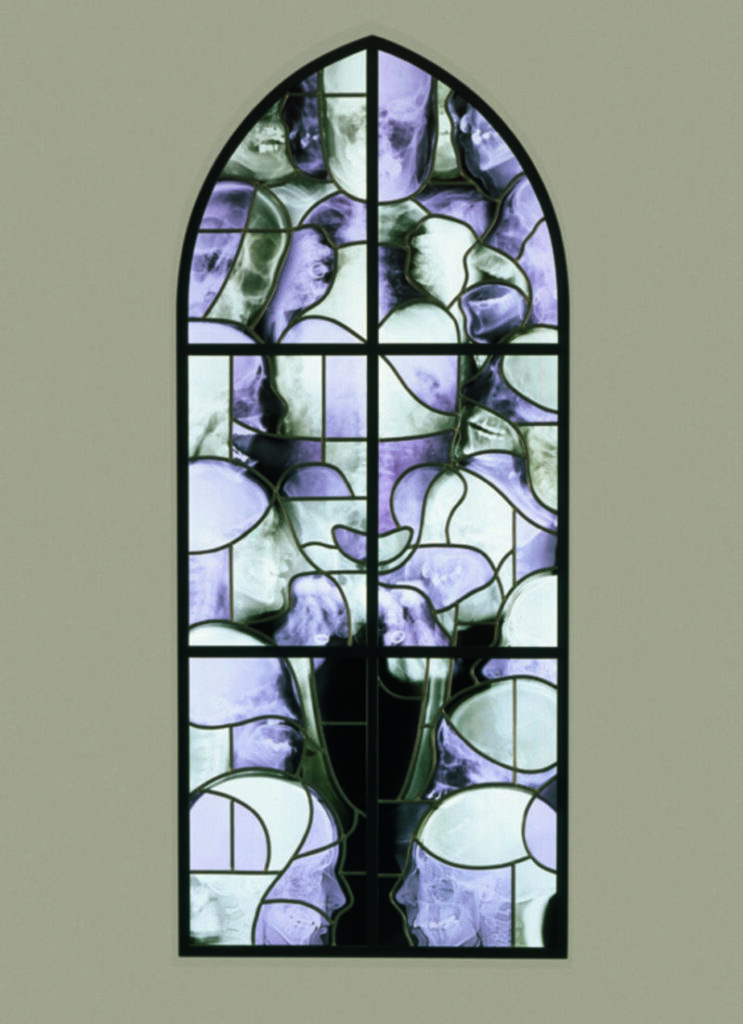
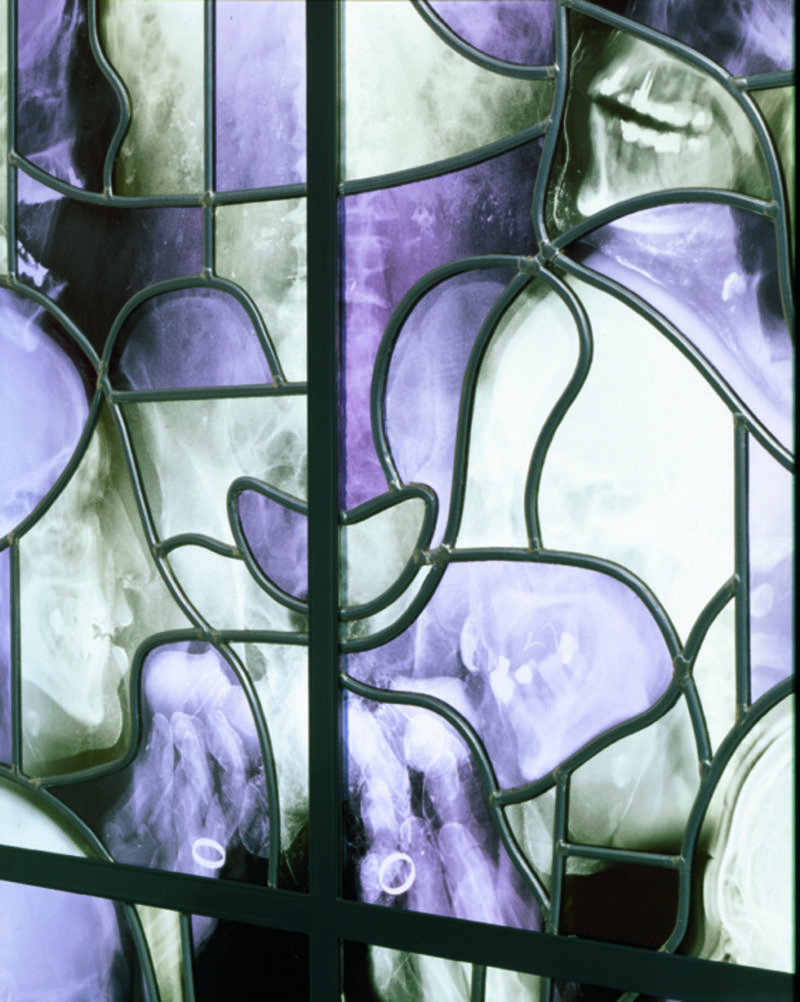
For the stained glass window works, Delvoye used X‑ray images taken during intimate encounters between two friends. The skeletal images produced by the radiographs were incorporated directly into stained-glass compositions and placed within Gothic-style window frames. From a distance the windows appear abstract, their luminous shapes resembling decorative patterns of light and color. Only when viewed closely do the anatomical elements emerge: skulls, teeth, spinal columns, and ribs forming intricate visual arrangements. In some panels the figures are clearly interacting, even kissing.
Rather than presenting his x‑ray images as one would if they were simple medical documents, Delvoye now incorporated them into elaborate stained-glass compositions modeled on the window structures of Gothic cathedrals. X‑ray films were mounted between panes of glass and framed with leaded tracery and laser-cut steel structures that echoed the intricate forms of seventeenth-century Flemish Baroque church windows. From a distance the panels resemble traditional ecclesiastical stained glass, glowing with the luminous qualities associated with historic cathedral interiors.
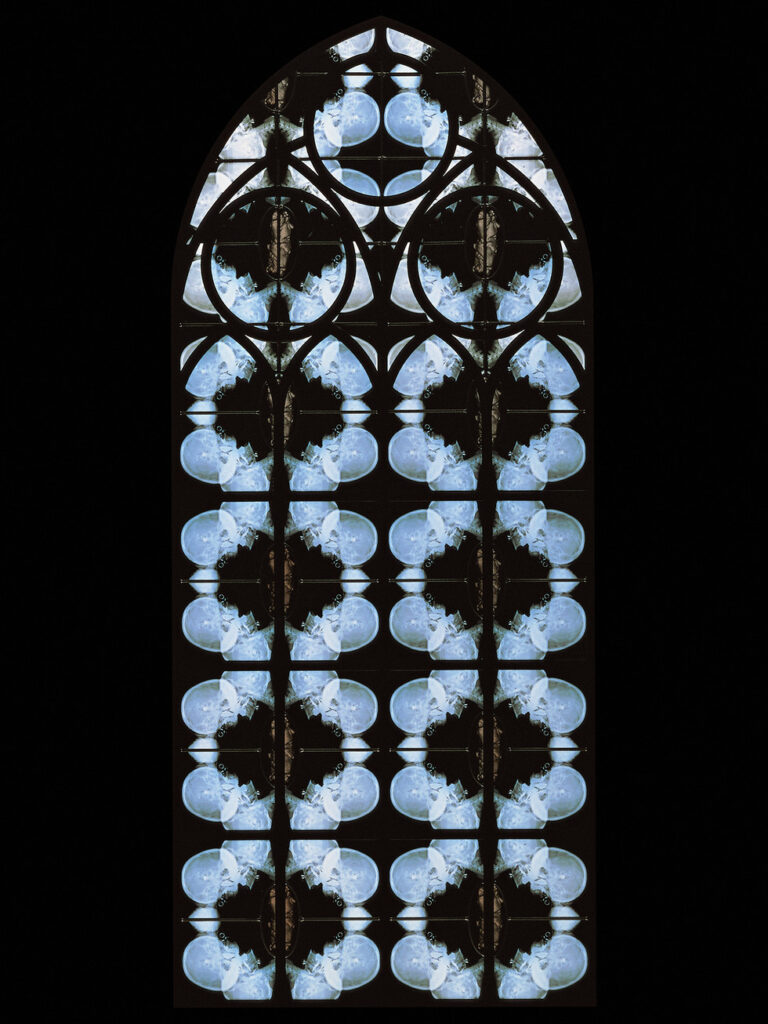
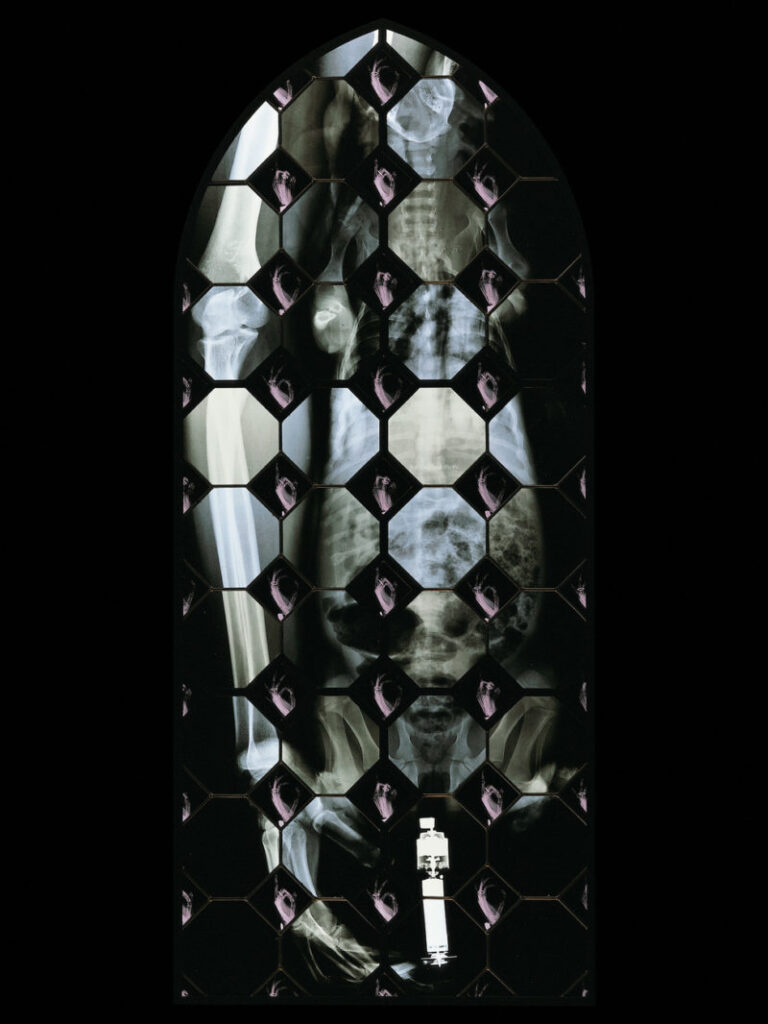
Delvoye initially experimented with embedding the X‑ray film between layers of glass. Later he refined the process in order to integrate the imagery more completely into the architecture of the windows. “In the beginning, I asked a stained glass window maker to do double glass, and in between the glass we did the x‑ray. Which is in itself transparent,” he explains, “Then, I thought if I really wanted to integrate them into something a bit architectural – because I got a bit more ambitious afterwards – then I have to put the x‑ray image on the glass itself. It’s a pigment we burn into the glass, and that pigment I apply with silk screen. They’re very beautiful because the pigment is a very interesting material, it’s a medieval material.”
The imagery itself consists primarily of thousands of individual radiographic frames depicting skeletal structures, spinal columns, skulls, teeth, lungs, and various bodily gestures. In place of saints or biblical scenes, Delvoye created panels so that they would depict skeletal figures embracing, kissing, and interacting within the architectural frameworks of typical Gothic church windows. Yet the images reveal very little of the emotional dimension of human intimacy. Instead, the bodies appear as mechanical structures, bones and joints moving through space, suggesting that radiography reduces the human body to a kind of biological machine.
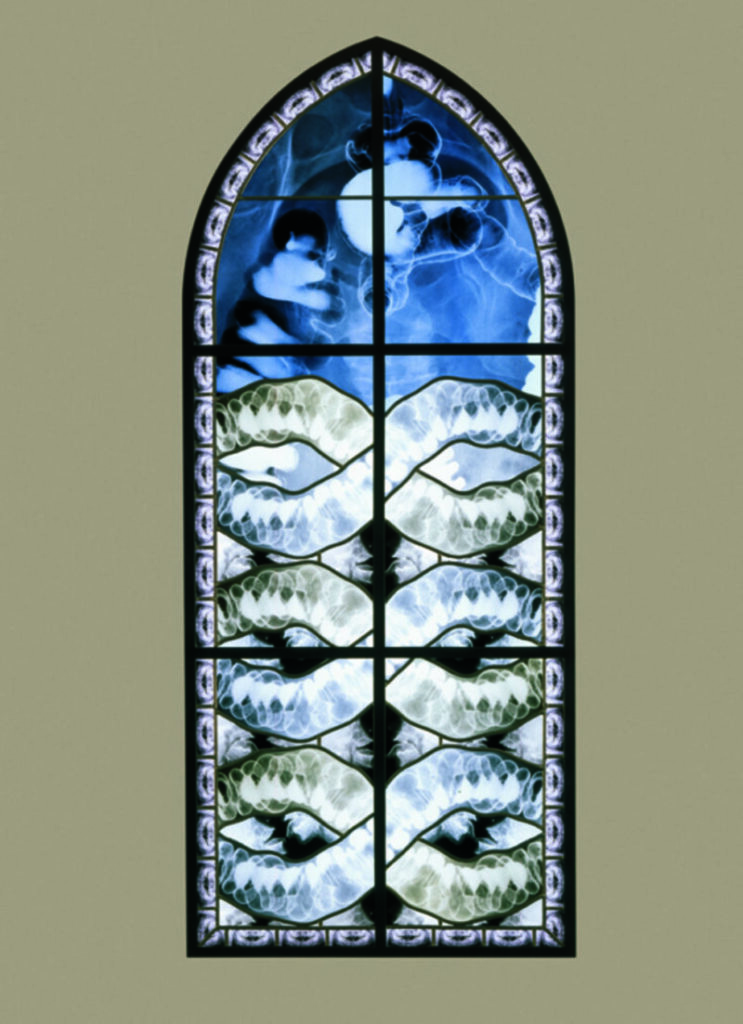
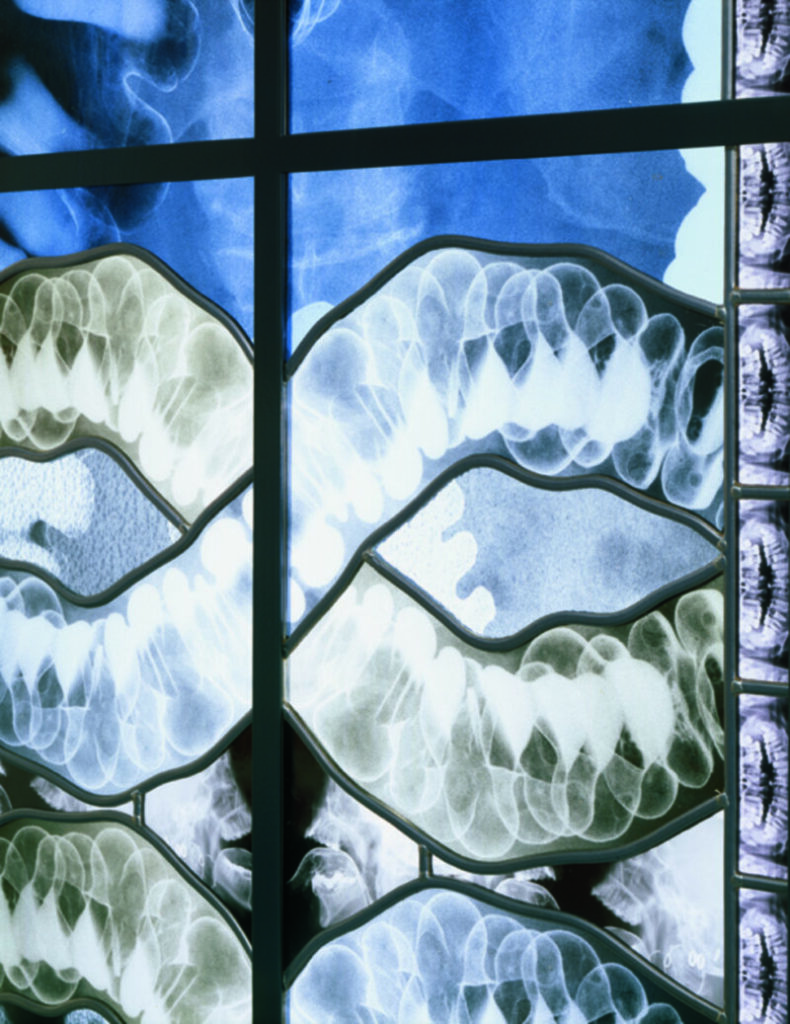
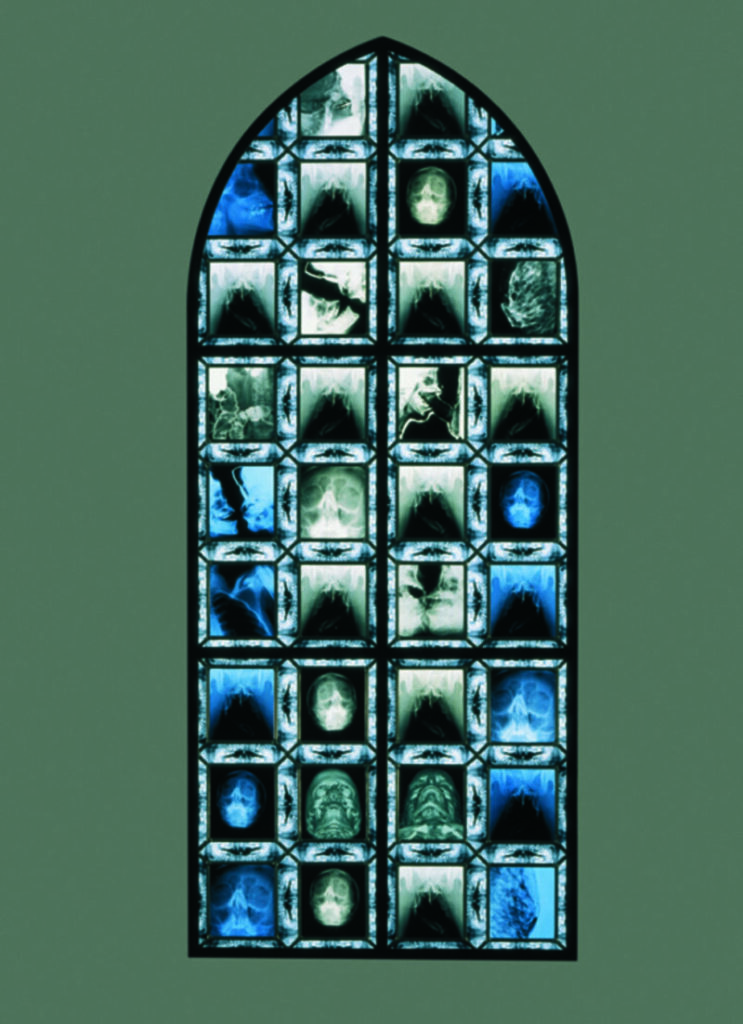
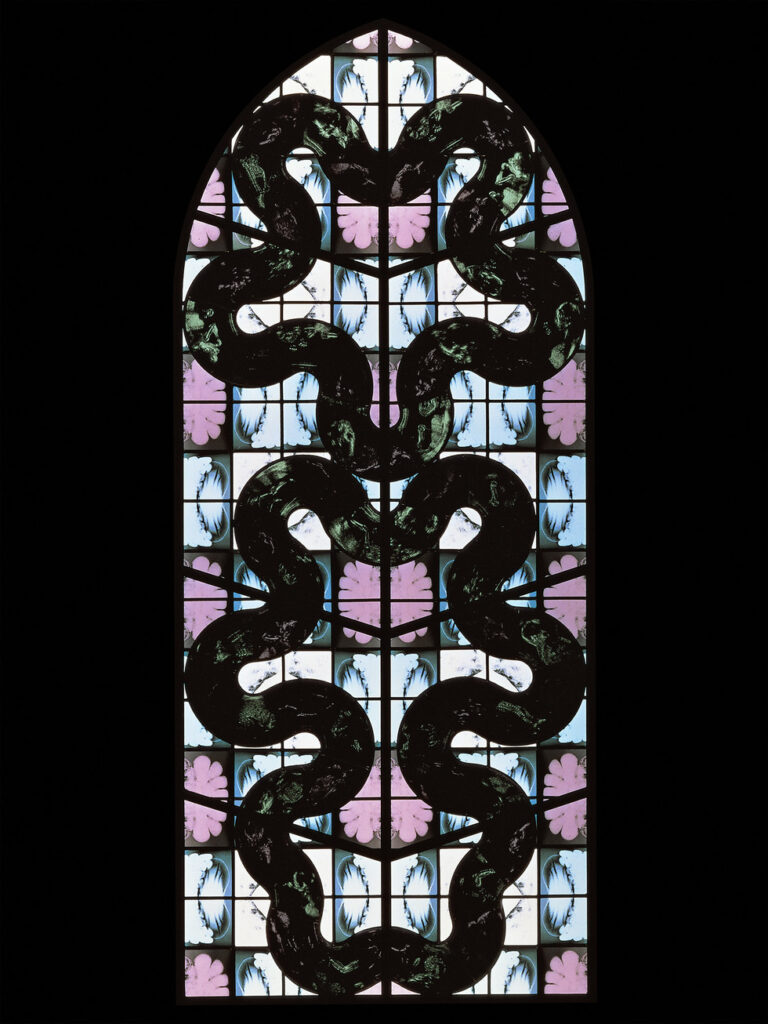
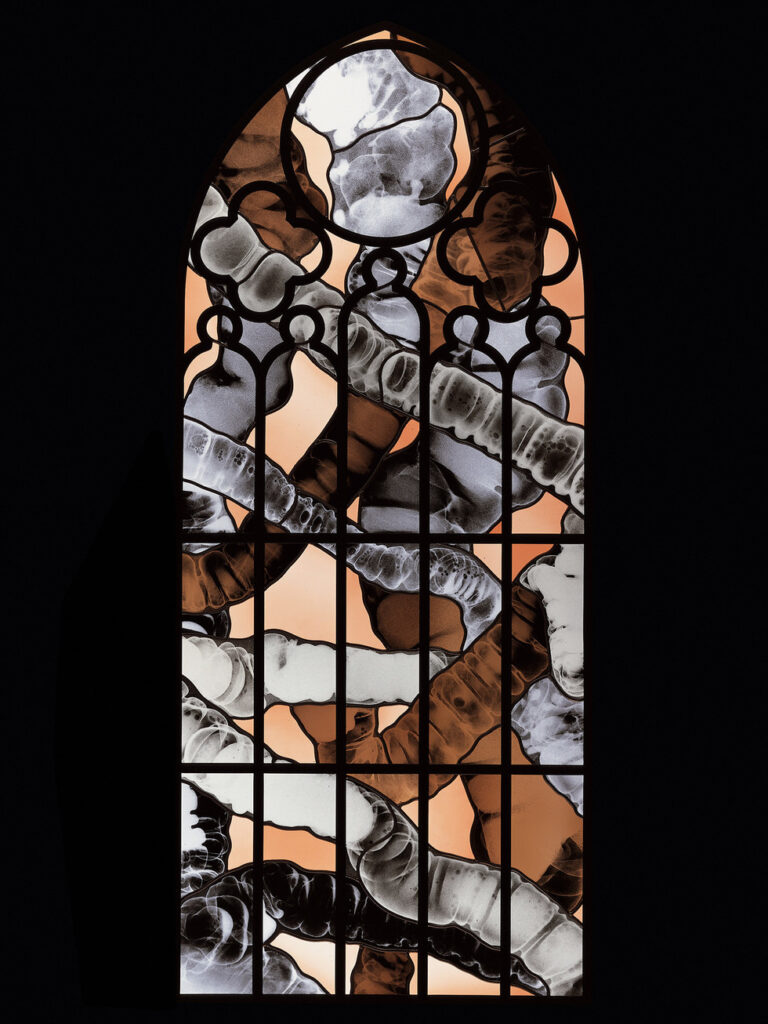
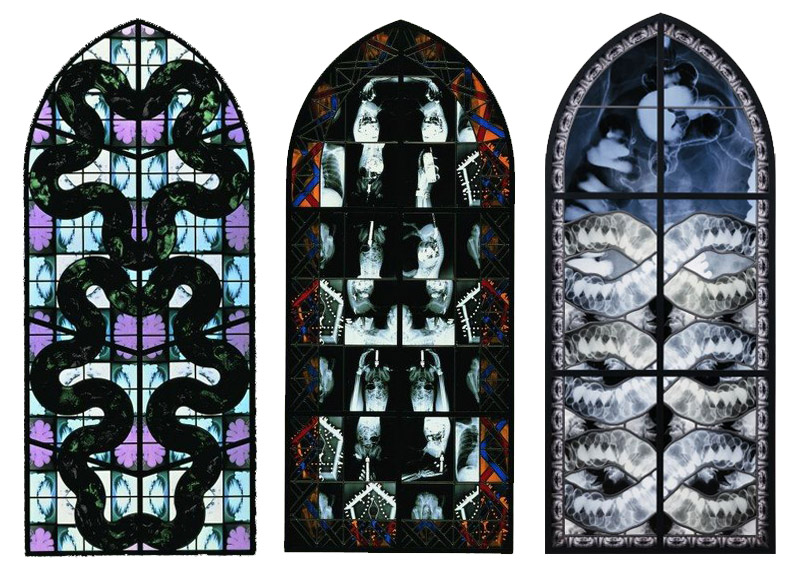
Delvoye also extended the project beyond human subjects. The series came to include X‑rays of animals such as pigs and snakes, along with scans of organic materials including intestines and sliced meats. Other panels move further toward abstraction, using swirling patterns of spinal columns or rows of teeth layered against backgrounds of deep red glass. The imagery oscillates between anatomical diagram and ornamental pattern, echoing the decorative rhythms of traditional stained-glass windows while simultaneously confronting viewers with the internal structures of the body.
These additions broadened the scope of the project, shifting it from a study of human anatomy to a larger investigation of organic structures and biological matter. The presence of anatomical embraces where viewers might expect saints or biblical figures intensified the work’s dialogue with ecclesiastical tradition and invited questions regarding artistic freedom and irreverence.
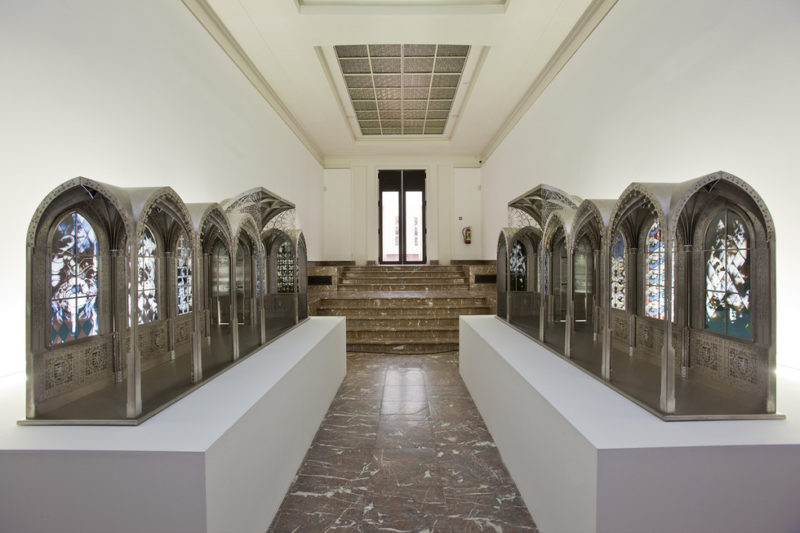
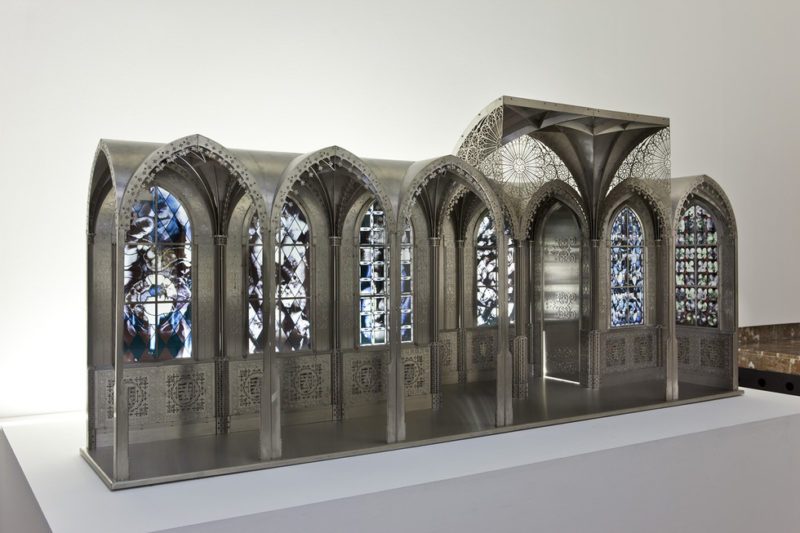
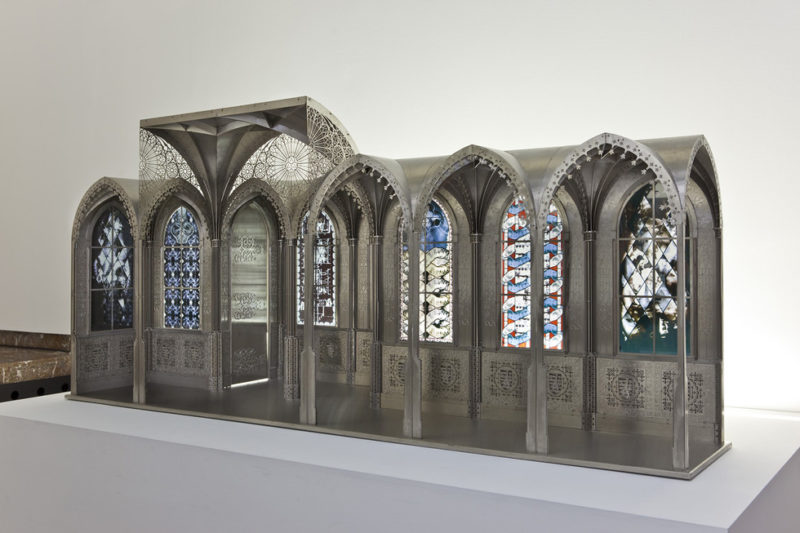
The windows were organized into several thematic groups. Some panels represented classical muses, others referenced the months of the year, while a third group was designed specifically for architectural installations inside chapel-like structures fabricated from laser-cut steel. These chapels ranged from smaller architectural models to full-scale structures resembling miniature cathedrals.
When installed within chapel-like environments, constructed from his experience working with architectural iron forms, these figures function as anatomical ornaments, decorative elements replacing traditional sacred narratives. The visual language of religious architecture remains intact, but its iconography has been replaced by a meditation on bodily existence.
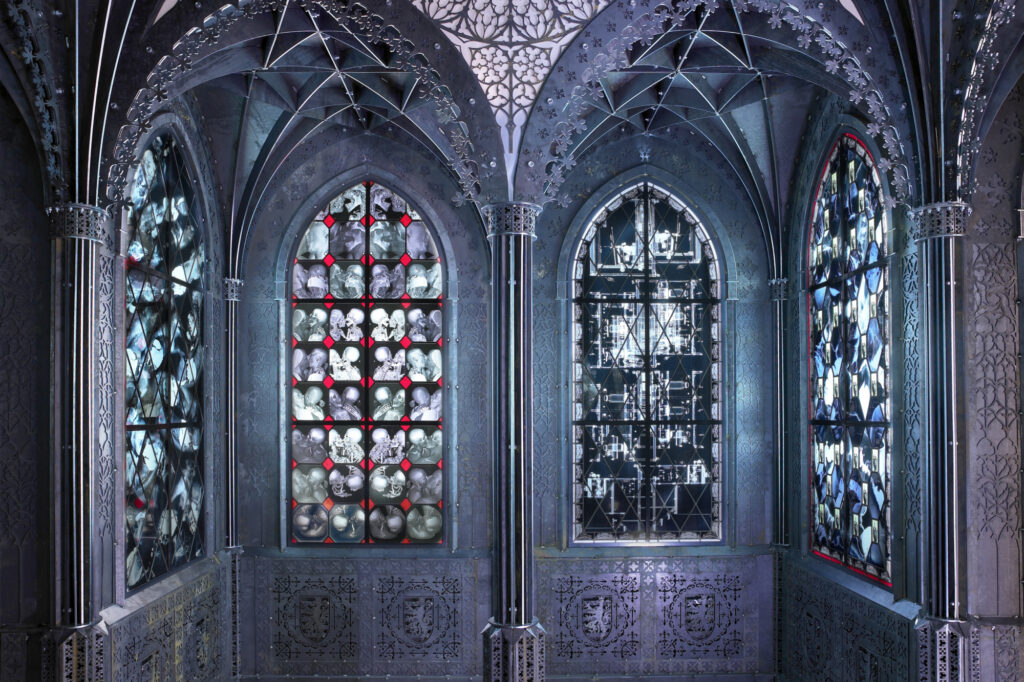
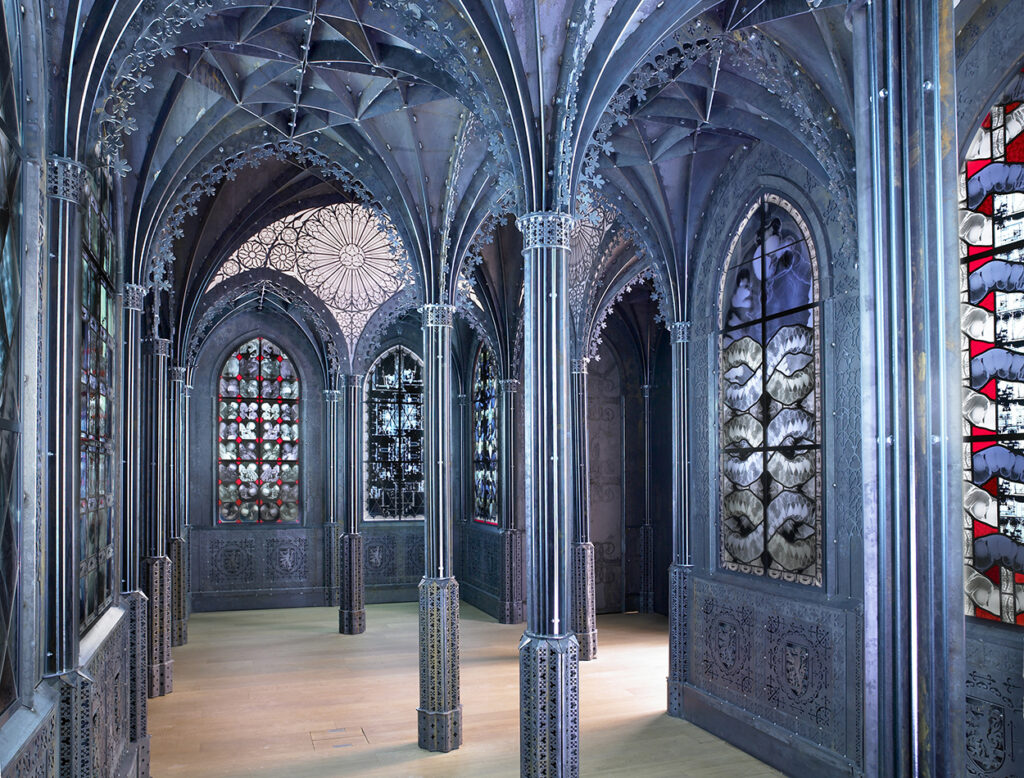
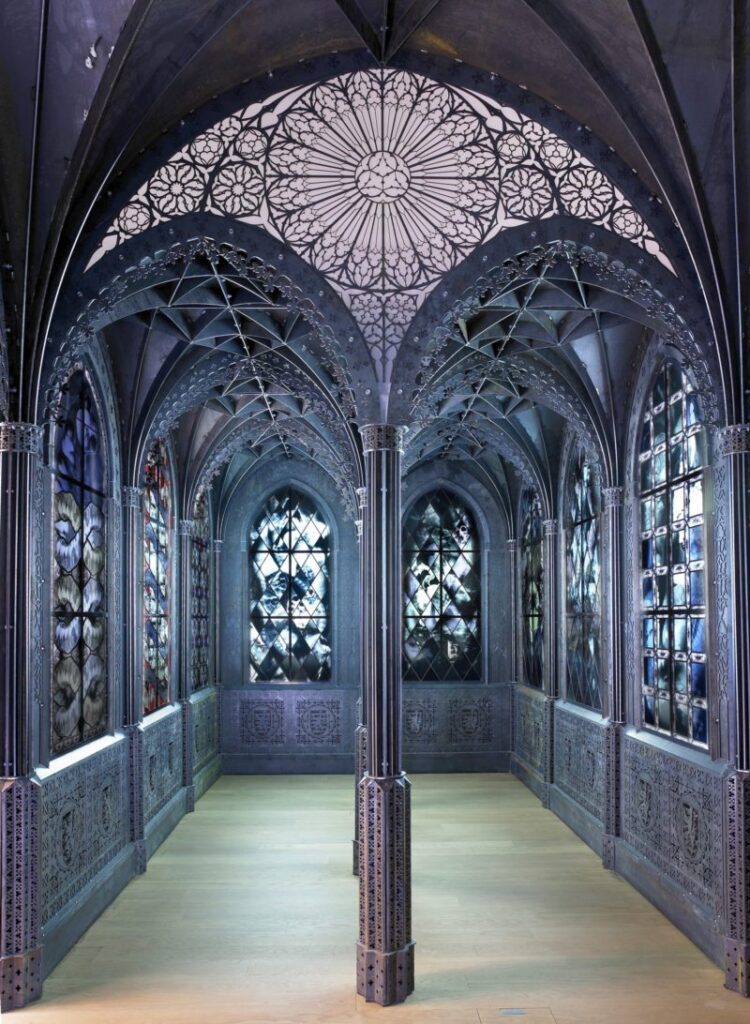
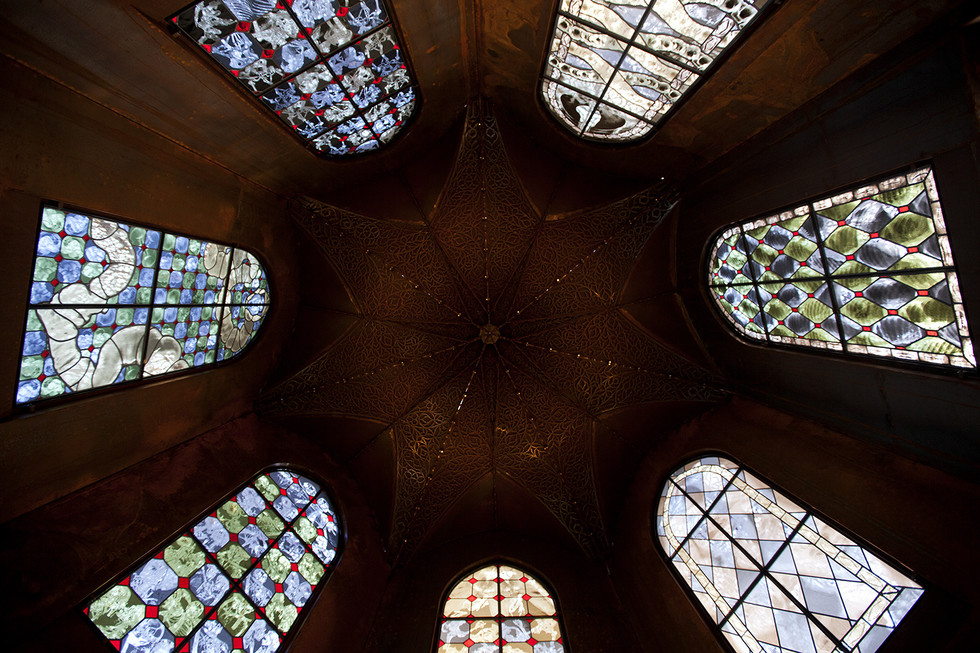
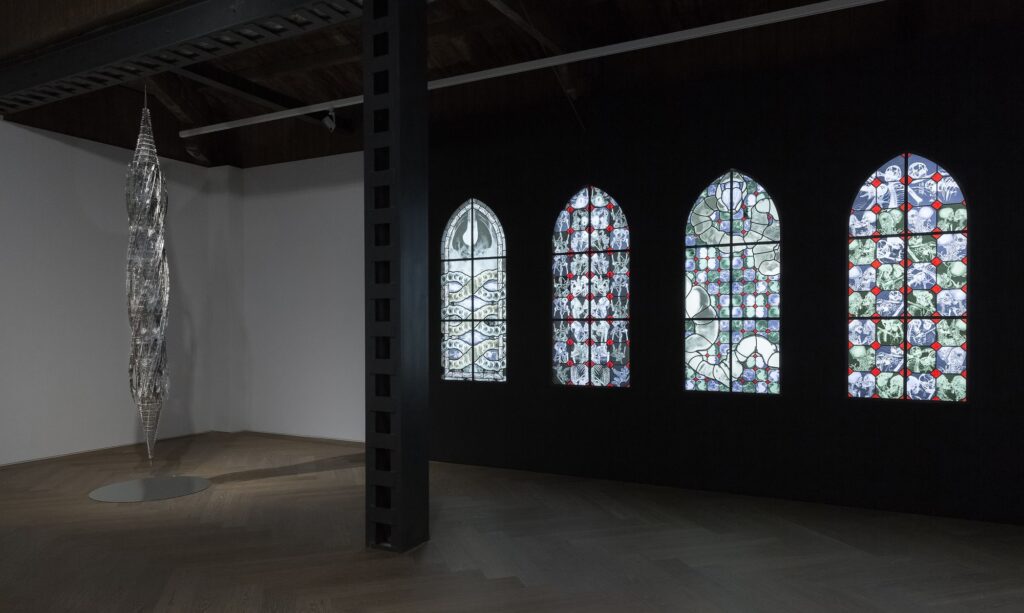
A key example of this approach appeared in the form of the work Chapelle from 2006. These installations were designed to be viewed inside of a fully realized architectural space, intensifying the spiritual dimension of the works. Visitors step into an enclosed space, built to resemble a chapel, containing the glowing radiographic panels, a viewing experience that mirrors the hidden, observational nature of medical imaging itself. By integrating colored glass with the radiographic material, Delvoye preserved the transparency of the X‑rays while recreating the atmospheric light effects associated with historical stained glass.
Delvoye himself has framed the work through a deliberately materialist perspective. “I only believe in what I can see. In my universe there is no soul and there is no love. I’ve never seen the soul and I’ve never seen love. I’ve seen skeletons, teeth, penises, lungs with X‑rays. I’ve never seen love.” The statement captures the conceptual tension underlying the project: the contrast between the invisible emotional meanings normally associated with human relationships and the stark physical evidence produced by medical technology. Despite the nihilistic impression it may convey at first, the works are meant to truly elicit a sense of contemplation.
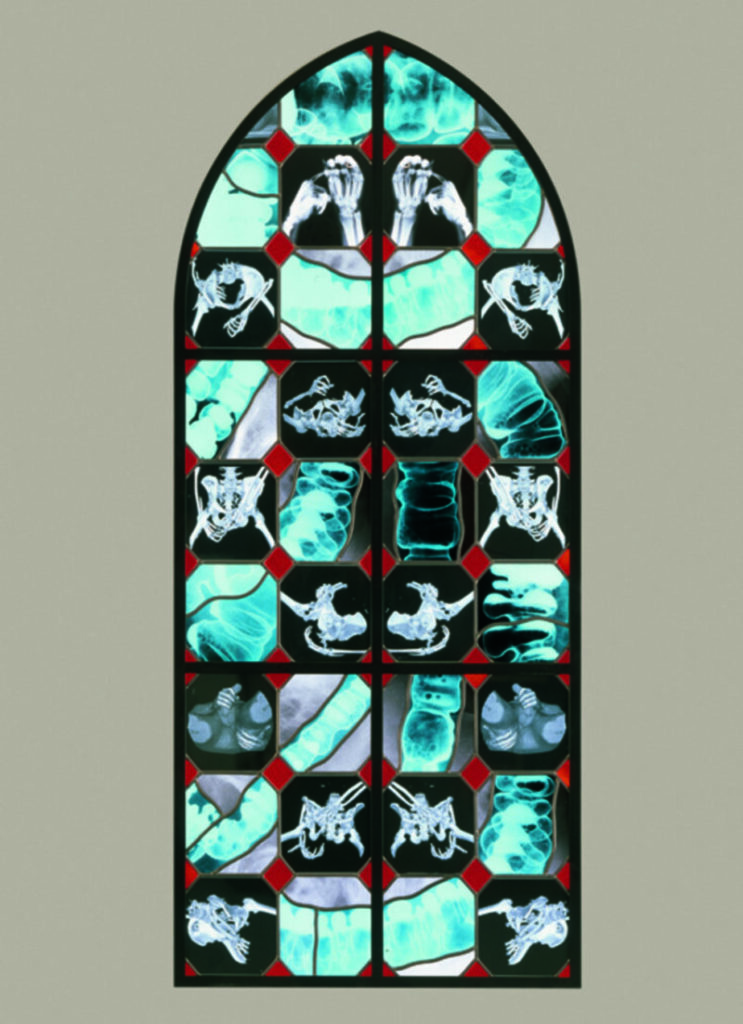
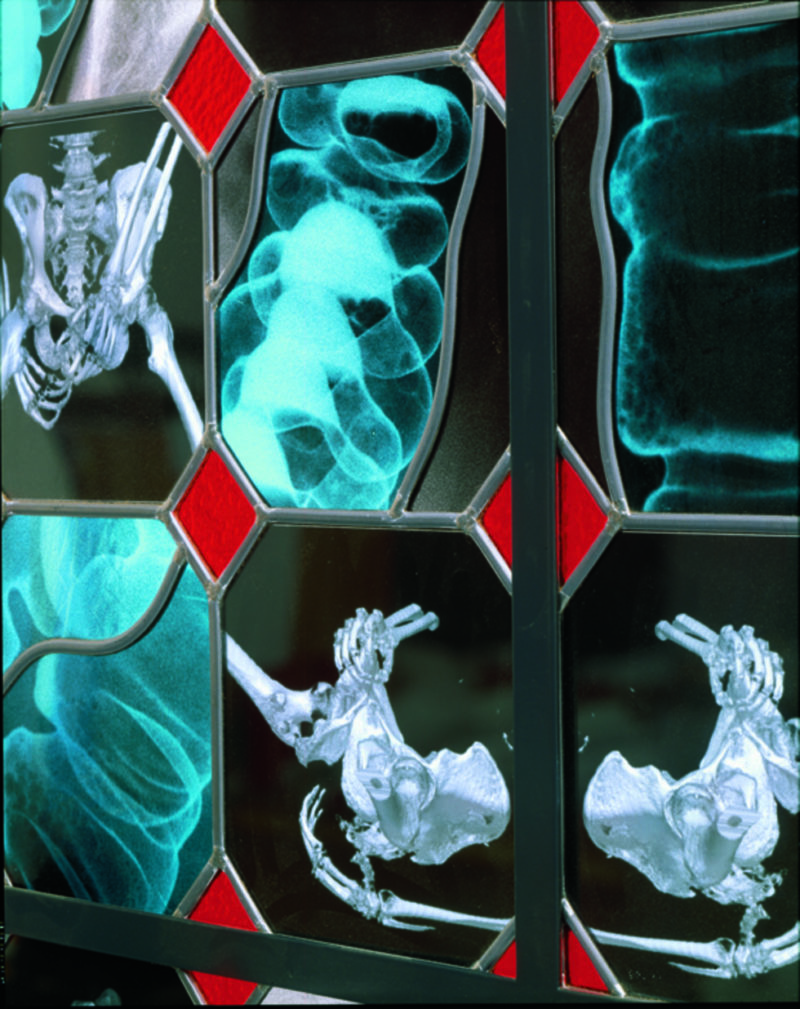
Within this context the images function almost like contemporary vanitas compositions. In the tradition of seventeenth-century European art, vanitas imagery often used skulls and skeletal motifs to remind viewers of mortality. Delvoye’s X‑rays similarly confront the viewer with skeletal forms that appear simultaneously ghostlike and mechanical. Rather than revealing hidden emotions, the radiographs emphasize the connection between physical desire and mortality, linking sex and death within a single visual structure.
Provocation has always been part of Delvoye’s strategy. His works frequently thrive on placing audiences in situations that feel simultaneously fascinating and uncomfortable, forcing viewers to reconsider their own expectations about beauty, propriety, and the limits of artistic expression. Yet despite the explicit imagery in the X‑ray series, Delvoye has repeatedly insisted that sexuality itself is not the central subject. As he has remarked, “When I was in school there were lots of penises in the art world, lots of sexual organs—it was so fashionable. But sex was not so interesting in proportion to religion, shit, the market, the economy—these are actually much more taboo.”
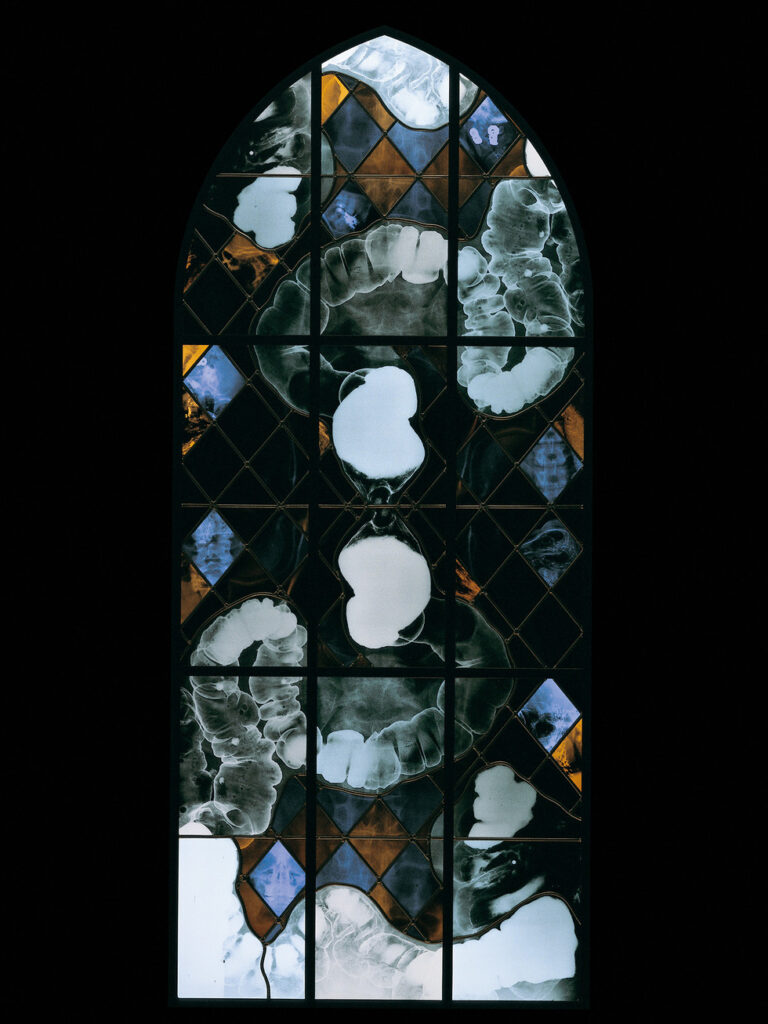
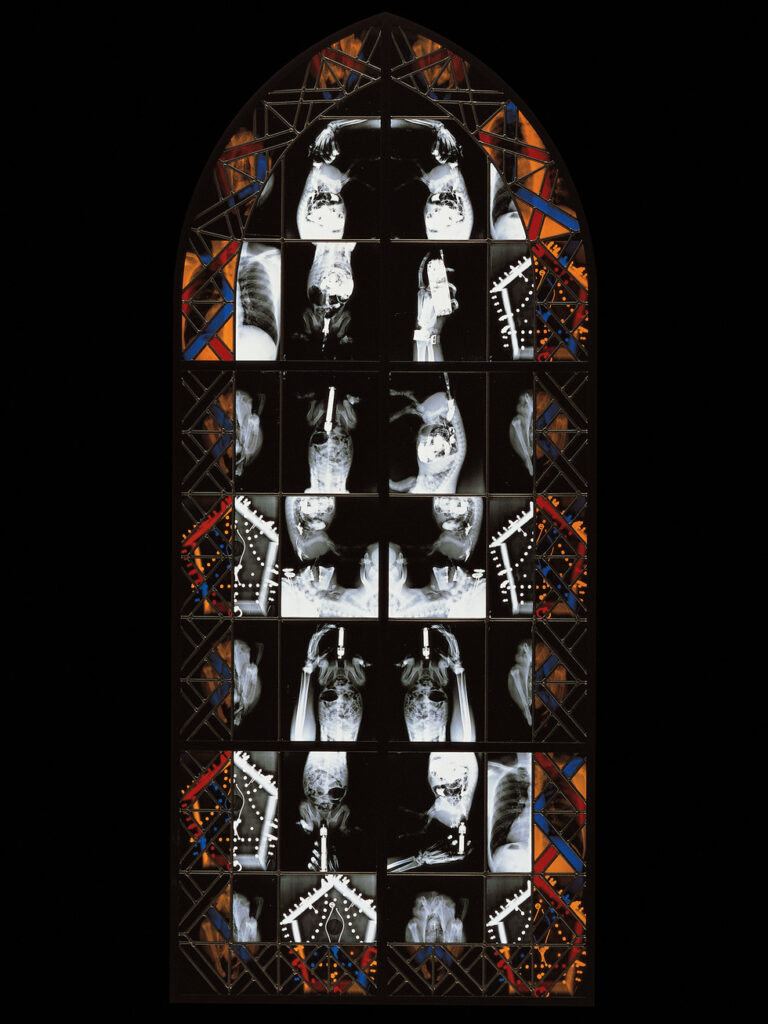
In this sense the X‑ray windows are less about eroticism than about exposing the mechanisms through which society constructs meaning around the body. By placing skeletal imagery inside structures associated with sacred art, Delvoye shortens the distance between devotion, mortality, and physical existence, reframing the cathedral window as a site where biology, technology, and symbolism intersect.
The dialogue with historical and cultural symbols has remained a consistent thread throughout the work of Wim Delvoye. Whether through stained glass, heraldry, Gothic architecture, or industrial machinery transformed by ornamental patterns, Delvoye repeatedly returns to the visual systems that societies use to organize meaning. His installations, drawings, murals, and sculptures are therefore immediately recognizable, often combining traditional craft techniques with unexpected materials or imagery. These constructions frequently appear utopian or even absurd, yet they function as a form of observation: a commentary on the ways contemporary society consumes symbols, objects, and images.
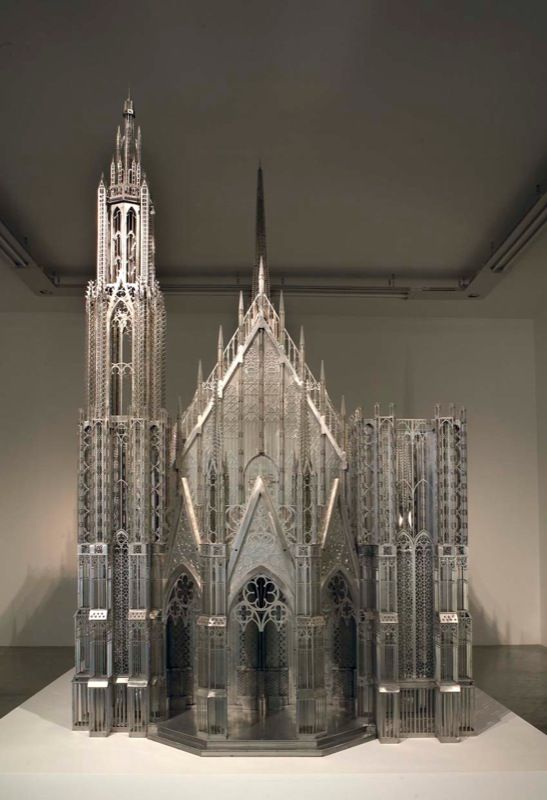
Over the course of his career, the scale and complexity of Delvoye’s projects have expanded significantly. Many of his later works required teams of engineers, fabricators, scientists, and highly specialized craftspeople to bring them into existence. Monumental steel sculptures, laser-cut architectural structures, and technically complex installations demand levels of expertise that go far beyond the capabilities of a single studio practice. As a result, Delvoye’s work increasingly resembles a hybrid between traditional artistic production and large-scale industrial collaboration.
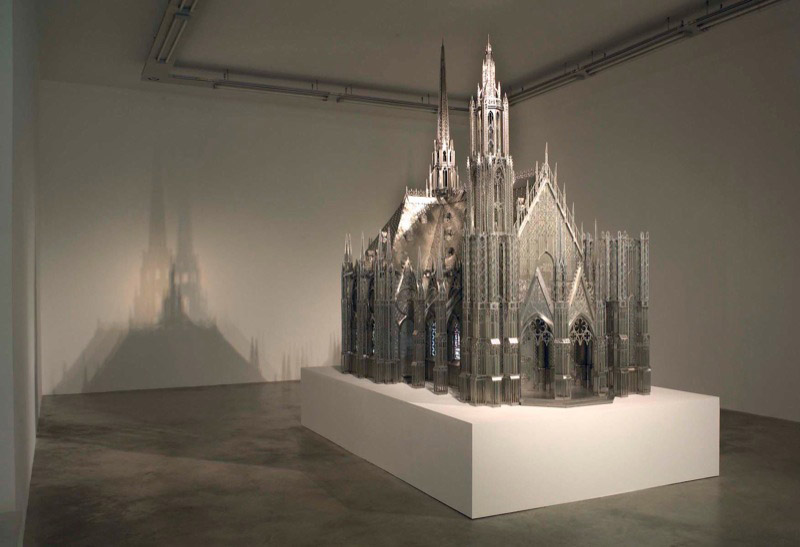
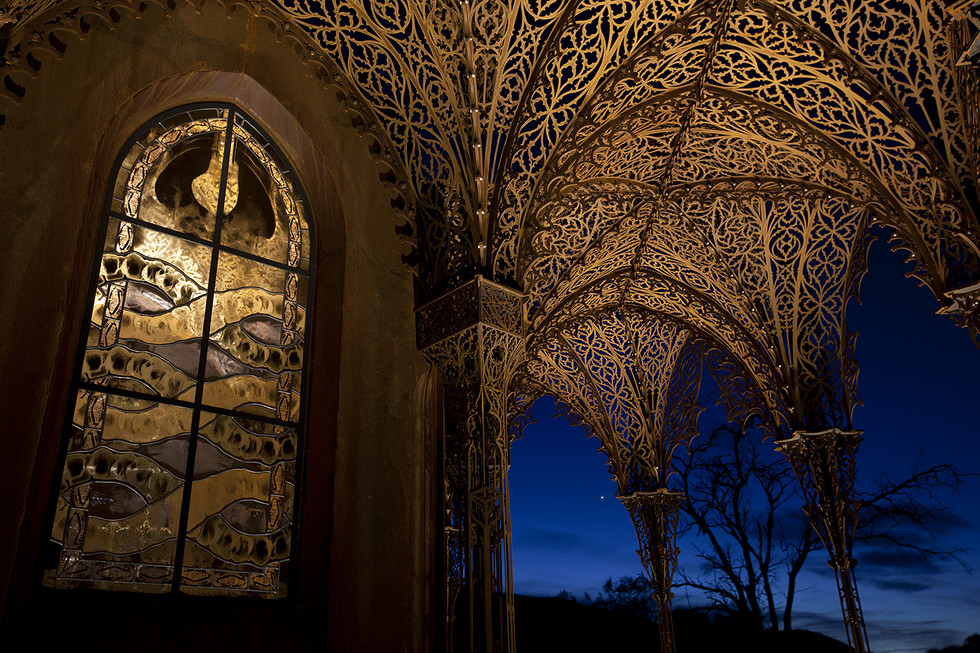
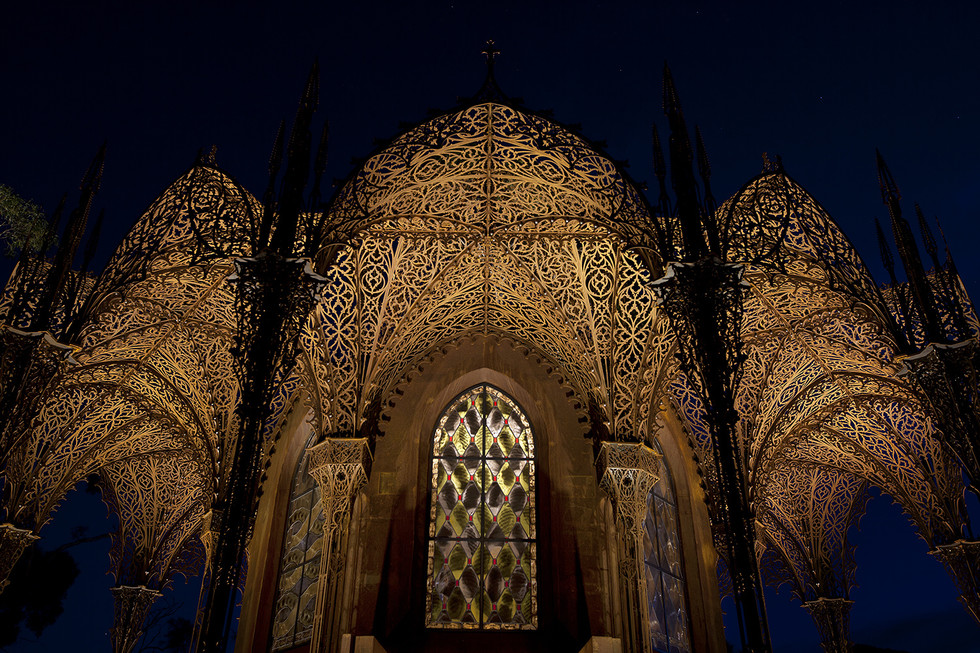
As mentioned earlier, several of Delvoye’s stained-glass panels were incorporated into architectural structures purpose-built to house them, in the form of laser-cut steel constructions that resemble the skeleton of a Gothic sanctuary and produced at varying scales. Within the chapel the luminous windows transform the skeletal imagery into a glowing architectural environment.
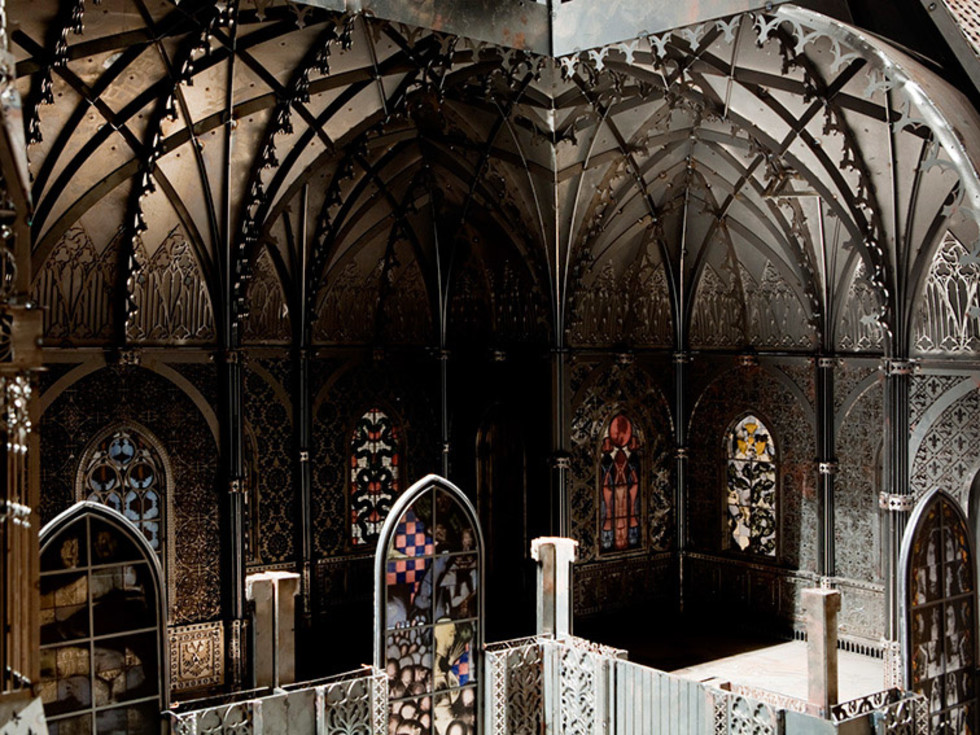
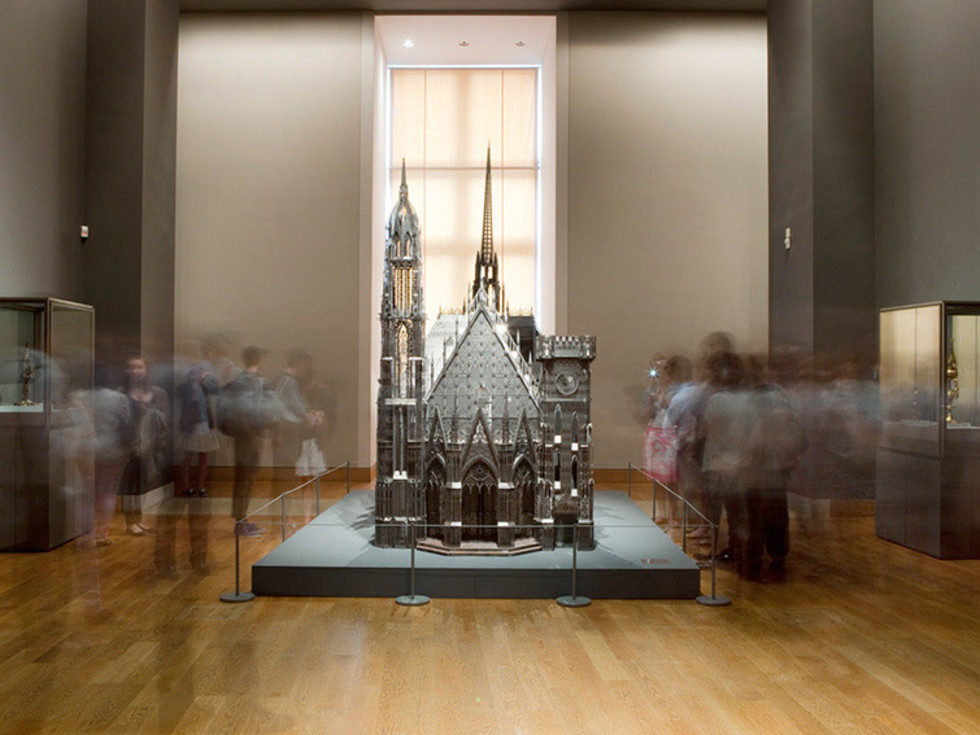
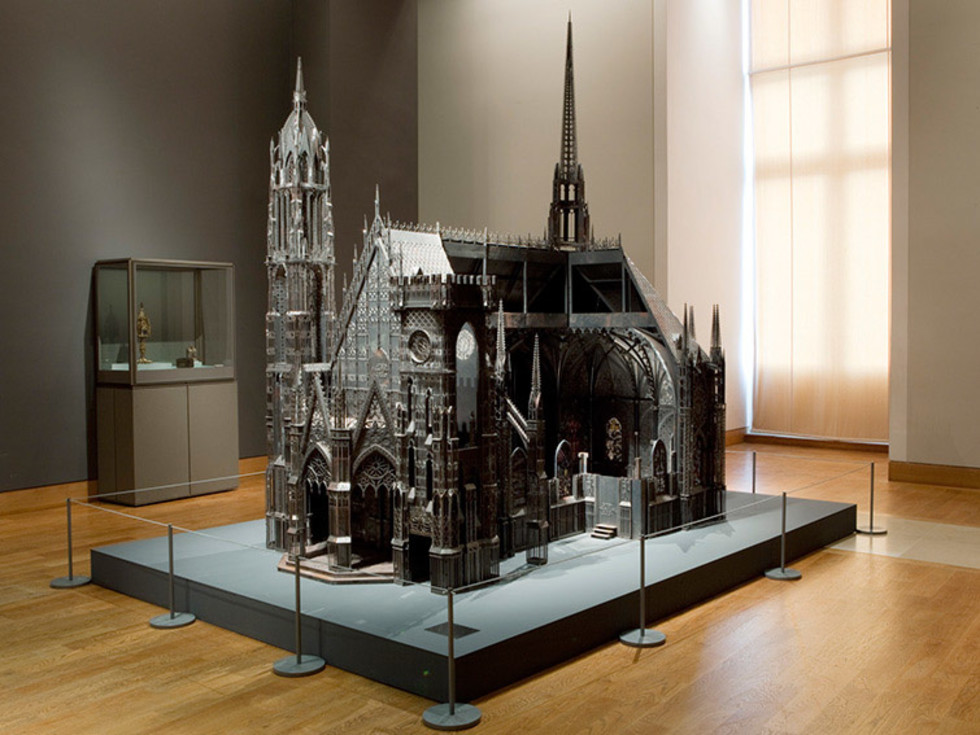
The structures themselves were fabricated using laser-cut Corten steel, drawing on the decorative vocabulary of seventeenth-century Flemish Baroque church architecture. The initial work was the aforementioned example exhibited in 2006 at MUDAM Luxembourg, measuring approximately nine meters in length and combining laser-cut steel with stained-glass windows. A year later, a smaller architectural model, also titled Chapelle (2007) as well as a scale model of the initial space, were produced and displayed during the exhibition Knocking on Heaven’s Door at Bozar (Centre for Fine Arts) in Brussels. Another version appeared during Delvoye’s 2012 exhibition at the Louvre.
Chapel MONA, An outdoor structure was later constructed in 2012 at the Museum of Old and New Art in Hobart, Tasmania. Standing over nine meters wide, the structure extends Delvoye’s architectural experiments into the landscape, allowing the stained-glass windows to interact with natural light throughout the day.
Given the provocative nature of many of his projects, controversy has often accompanied his exhibitions. Delvoye himself has rarely attempted to soften the confrontational aspects of his work or his public statements. His outspoken criticism of Western cultural institutions and political narratives has sometimes drawn sharp responses. In discussing legal disputes in Belgium, including multiple court cases over the span of a decade over unauthorized changes to the historical castle property in which Delvoye lives (which he describes as simple cleaning and renovation jobs), he once remarked: “They think I’m a dangerous man just because I speak and they don’t agree with what I say. Even my mother and sister don’t agree with me. I’m alone.”
These attitudes have also shaped the geography of his exhibitions. Rather than focusing exclusively on traditional Western art centers, Delvoye has exhibited widely in places that many contemporary artists approach more cautiously. Cities such as Tehran, Beijing, and Moscow have hosted significant presentations of his work.
“[My work is less accepted in] the West because there’s an enormous freedom in the East now, with the ‘why not’ attitude,” Delvoye explains. “People just don’t have discussions about what is art or not. They’re just open-minded, they’re there, they enjoy things and they’re not so into the taxonomy of things. I think it’s much fresher, freer and open-minded than in Europe where people here are stuck with old ideas. They’re fossilized, petrified and cannot have a new idea anymore. Some people are finished, other people will take their place – it’s the nature of things. I don’t think Europeans are going to tell a great story this century. And I hope I will one day be accepted as an Asian artist.”
Delvoye’s international presence has expanded steadily over the years. In 2016 he made history when he became the first non-Iranian artist to receive a retrospective exhibition at the Tehran Museum of Contemporary Art since the Iranian Revolution. The exhibition represented a notable moment in the institution’s history and underscored the global reach of his work.
Delvoye’s works are now held in dozens of museum collections worldwide, and his reputation has placed him among the more prominent contemporary artists of his generation. Yet the logistical realities behind many of his works reveal how dependent they are on global networks of craft and production. In several projects he has collaborated with master artisans outside Europe whose expertise in traditional techniques remains difficult to find in the West.
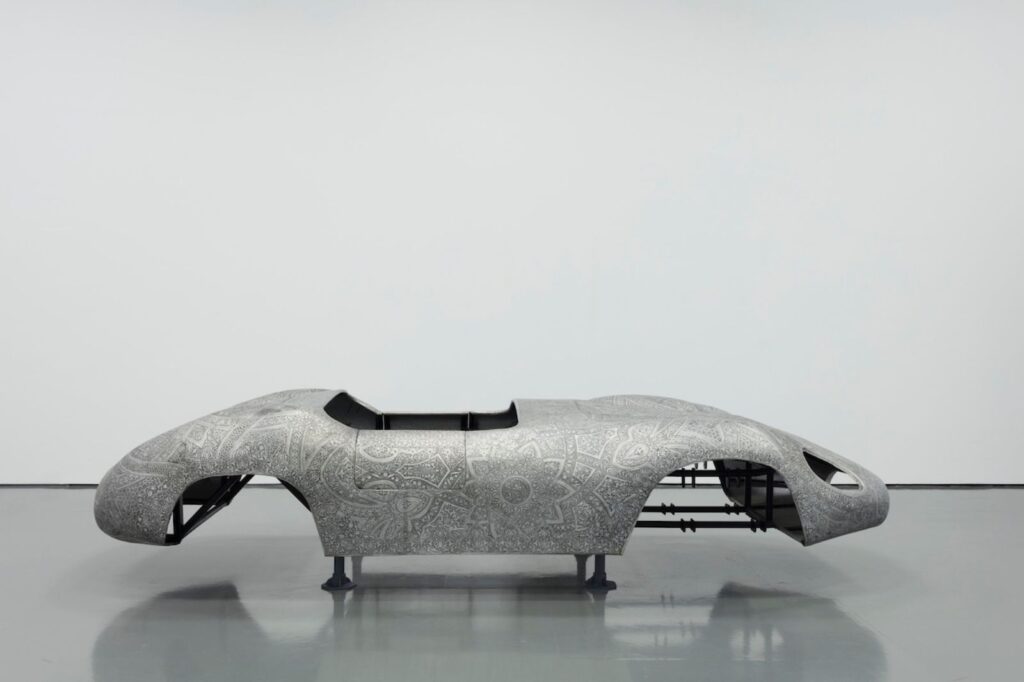
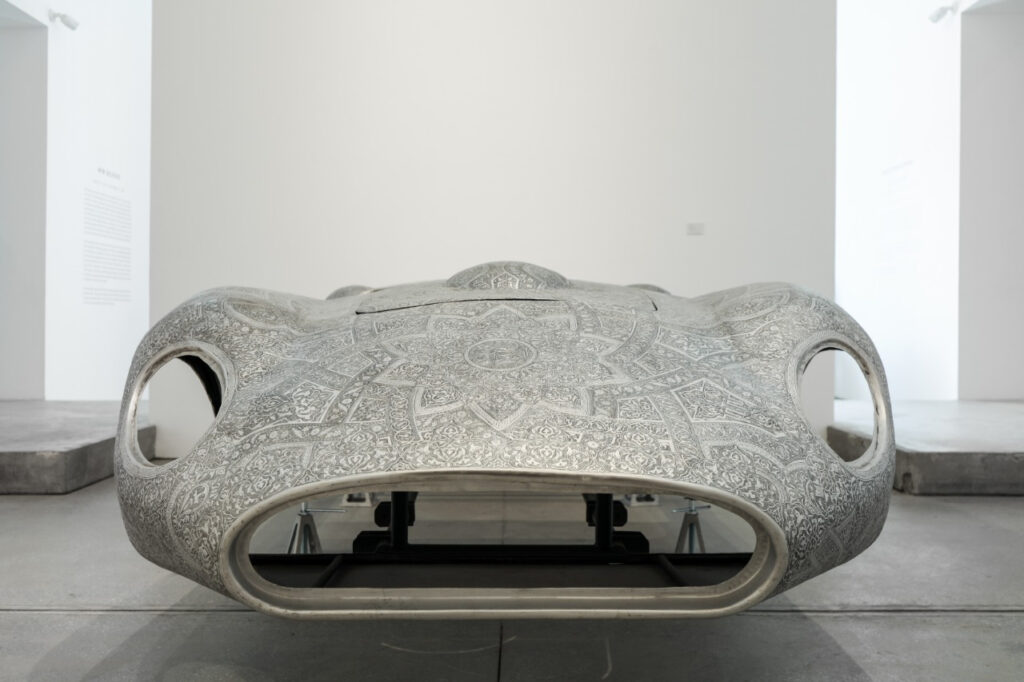
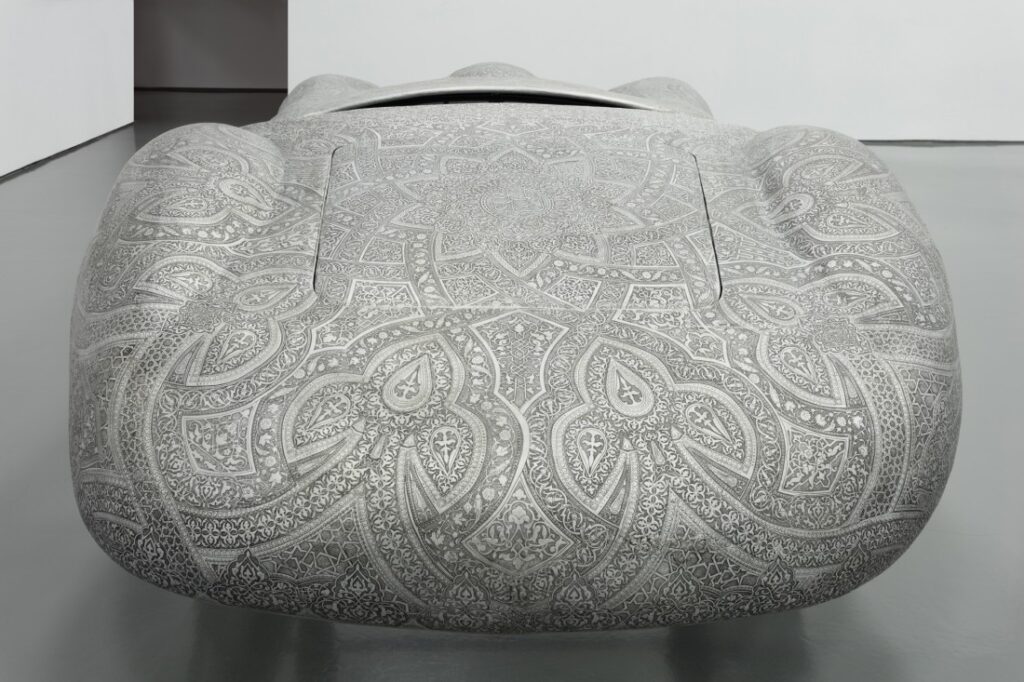
For Delvoye, the decision to work with such artisans is both practical and conceptual. One example involves modifications done to aluminum car bodies, including that of a late-1950s Maserati 450S, and suitcases produced by the German luggage manufacturer Rimowa. These objects were embossed with intricate Islamic decorative motifs created by Iranian metalworkers, drawing on craft traditions that remain highly developed in cities such as Isfahan.
“I look for the best people wherever they are,” he says, “I went to Isfahan in Iran because they are the best in embossing, so I go wherever the best are. Making these suitcases in Iran could take six months, but it could be nine months, as transport could be a few weeks or months depending on the geopolitical situation. I use other people because they’re better than me in a certain craft, not because it saves me time.”
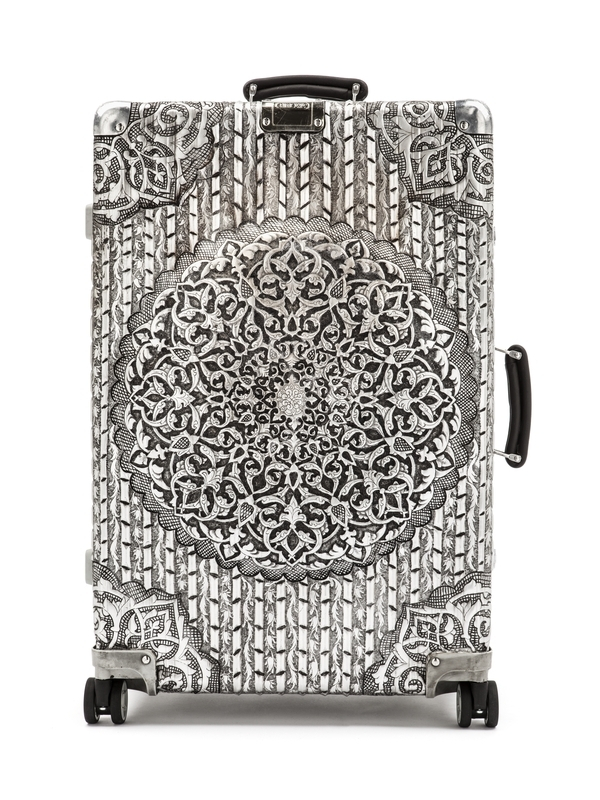
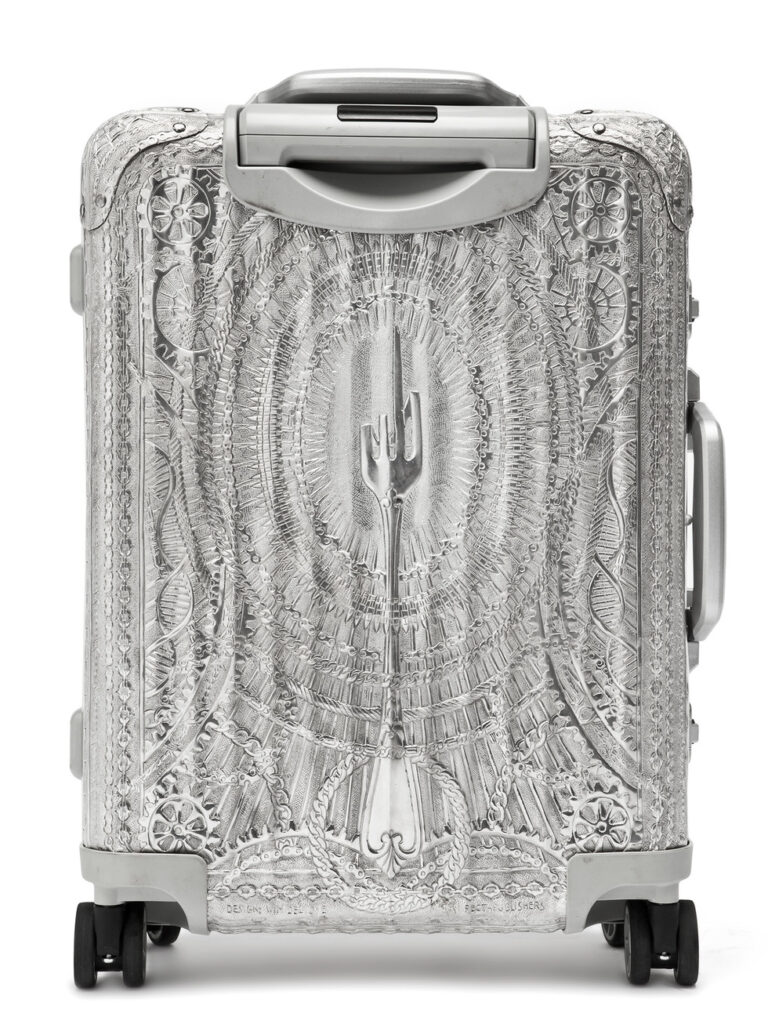
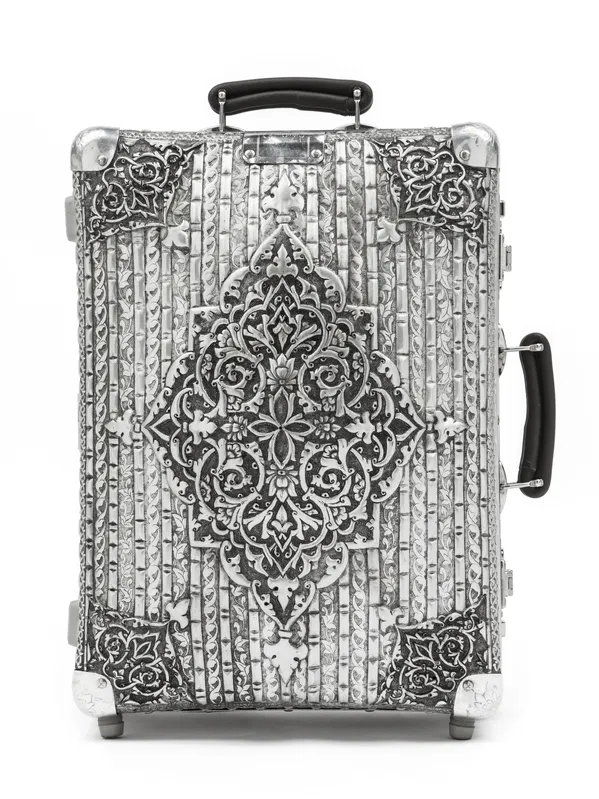
His projects have also appeared regularly in Russia. Between November 2018 and February 2019, the Gary Tatintsian Gallery presented an exhibition featuring a range of Delvoye’s embossed, twisted, and cut-metal works incorporating neo-Gothic tracery and Middle Eastern decorative motifs. Among the pieces shown was one of the aluminum car bodies embossed in Iran. The exhibition also included one of his tattooed and taxidermied pigs, Sylvie (2006), displayed inside a glass case, along with sculptural works made from bicycle tires twisted into Möbius-strip forms.
He has also expressed skepticism toward political narratives presented in Western media. Reflecting on questions of freedom and public discourse, Delvoye once remarked: “They say Europe is a good project, the Euro is a good currency and Putin is a bad man every day in the newspaper. And we think we are the free world. We are not a free world. I think Singapore is a much freer world. Belgium is the Italy of northern Europe. It’s a very corrupt country … It’s a big job for an artist to see through the lies, to select lie from truth, and every day you have to do this job, about Russia, Syria, Iraq, Singapore and China – we have to read between the lines because our newspapers are not so free.” These views, along with the provocative nature of many of his artworks, have reinforced Delvoye’s reputation as an artist who operates outside conventional cultural boundaries.
For Delvoye, the friction between historical imagery and contemporary technology on top of their appearance in unexpected geographical locations is not simply a stylistic gesture but a strategy for reactivating older art. He has often suggested that placing contemporary works alongside historical masterpieces in unexpected places can renew interest in the past by forcing viewers to look again at what has become overly familiar. This idea has shaped the way his works are frequently exhibited within museum collections traditionally devoted to historical painting.
Several of his projects have been installed directly within galleries dedicated to Old Masters, creating deliberate contrasts between contemporary provocation and canonical works of European art. His installations have appeared in spaces associated with institutions such as the Louvre in Paris and the Pushkin Museum of Fine Arts in Moscow, where his sculptures and installations were presented alongside paintings by artists like Peter Paul Rubens.
When asked how he expected audiences to react to encountering his tattooed pigs or other unconventional works in rooms filled with historical paintings, Delvoye responded: “I hope it makes them look at Rubens anew. These days it’s not old art that consecrates the contemporary; it’s contemporary art that seduces people into going into the galleries of old art. You would think it’s a little bit opportunist to show your contemporary art in such a consecrated room, but it’s not. It’s just another form of presentation. It’s more the museum that’s being opportunist now, because apart from some Chinese and Japanese tourists, very few people care about these works anymore. However, as you know, I sincerely love these historical paintings, and I’ve gotten quite good at these types of presentations. I know how to play in these rooms. After the Pushkin Museum and the Louvre, I feel comfortable creating these sorts of dialogues.”
Regarding the controversies specifically aimed towards his stained glass works, Delvoye has emphasized the contemplative atmosphere they create. He has often compared the behavior of viewers in museums to that of visitors in religious spaces: “People are silent when they look seriously at art in museums and galleries, just like they act in places of worship. I see it as a new form of worship, but it’s also entertaining. You could equally ask where is love when looking at these x‑rays. Each x‑ray gives you a very materialistic view of life.”
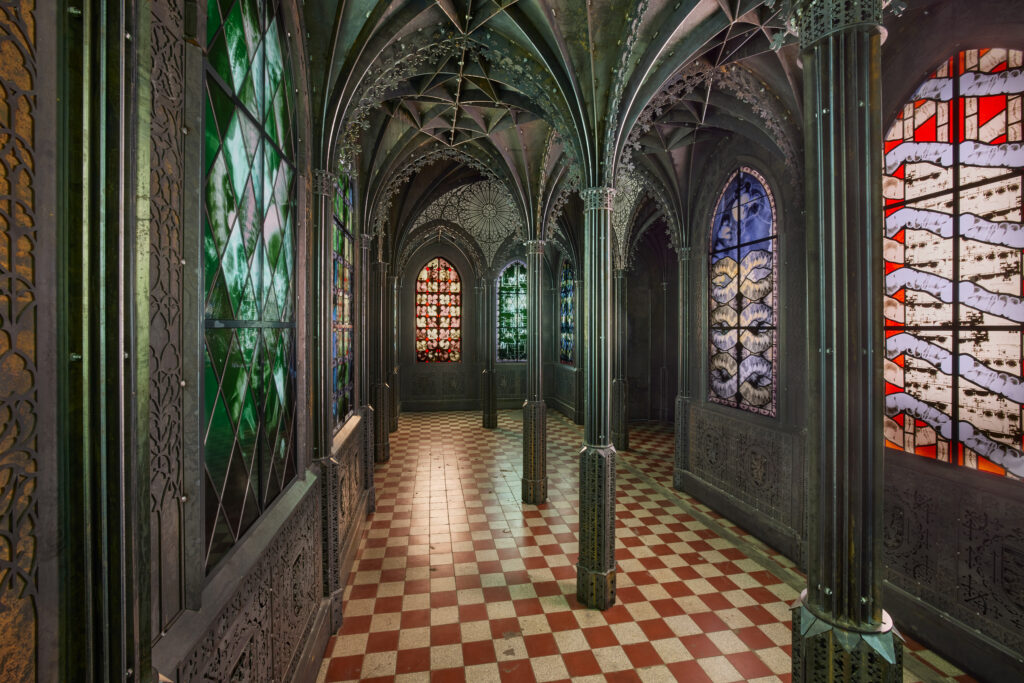
Inside the chapels the luminous panels produce a striking visual effect. Radiographic images of hips, skulls, ribs, and spines intertwine to form compositions that glow like traditional stained glass. Because X‑rays transmit light in much the same way as colored glass, the panels illuminate easily, producing a glittering yet macabre atmosphere. The resulting environment is both beautiful and unsettling.
It is this physicality that has remained central to the work of Wim Delvoye. Much of his practice revolves around the intimate relationship between the body, ownership, and display, particularly when it involves parts of the body that are normally concealed or socially regulated. By bringing these hidden elements into public view, Delvoye introduces an additional layer of discomfort to his work, one that intensifies the tension already present in his recontextualization of sacred aesthetics. In several projects, the body itself becomes a literal surface for artistic intervention, with human and animal skin used as living canvases.
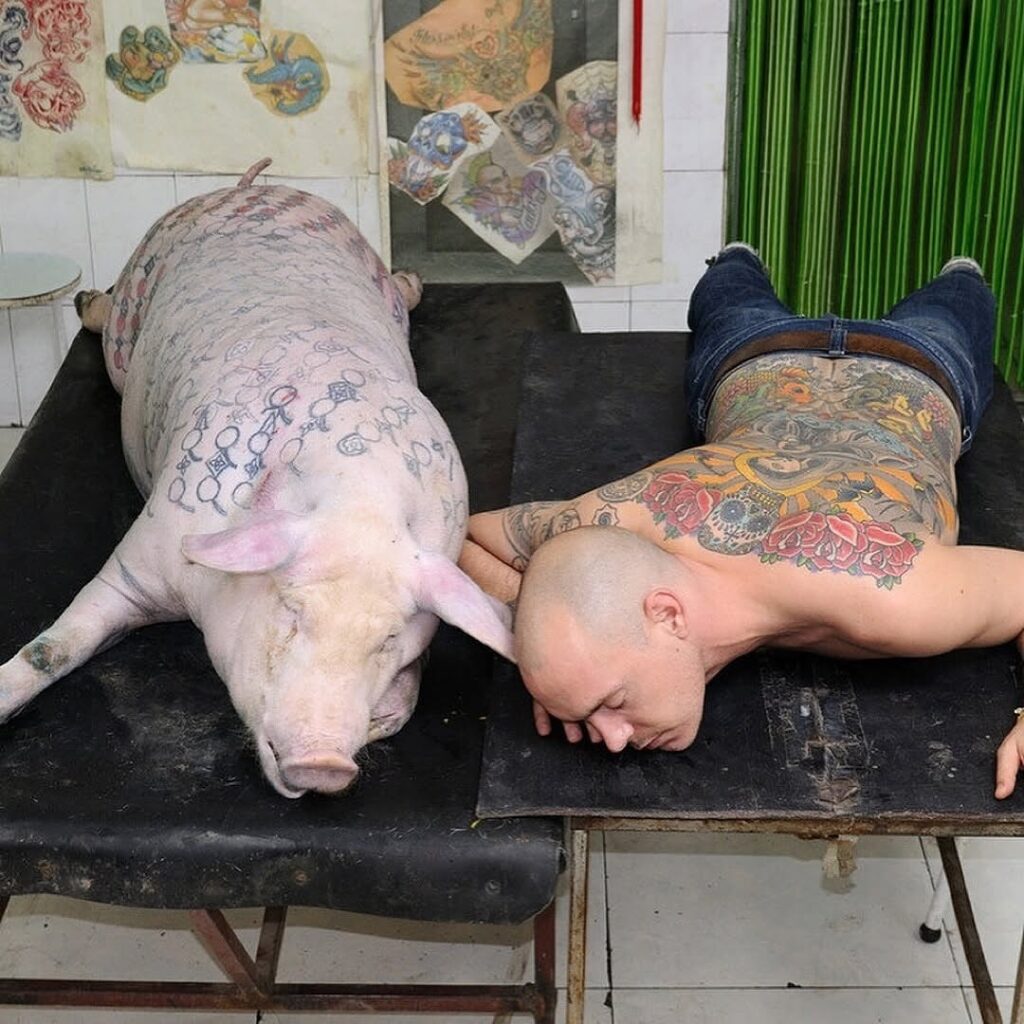
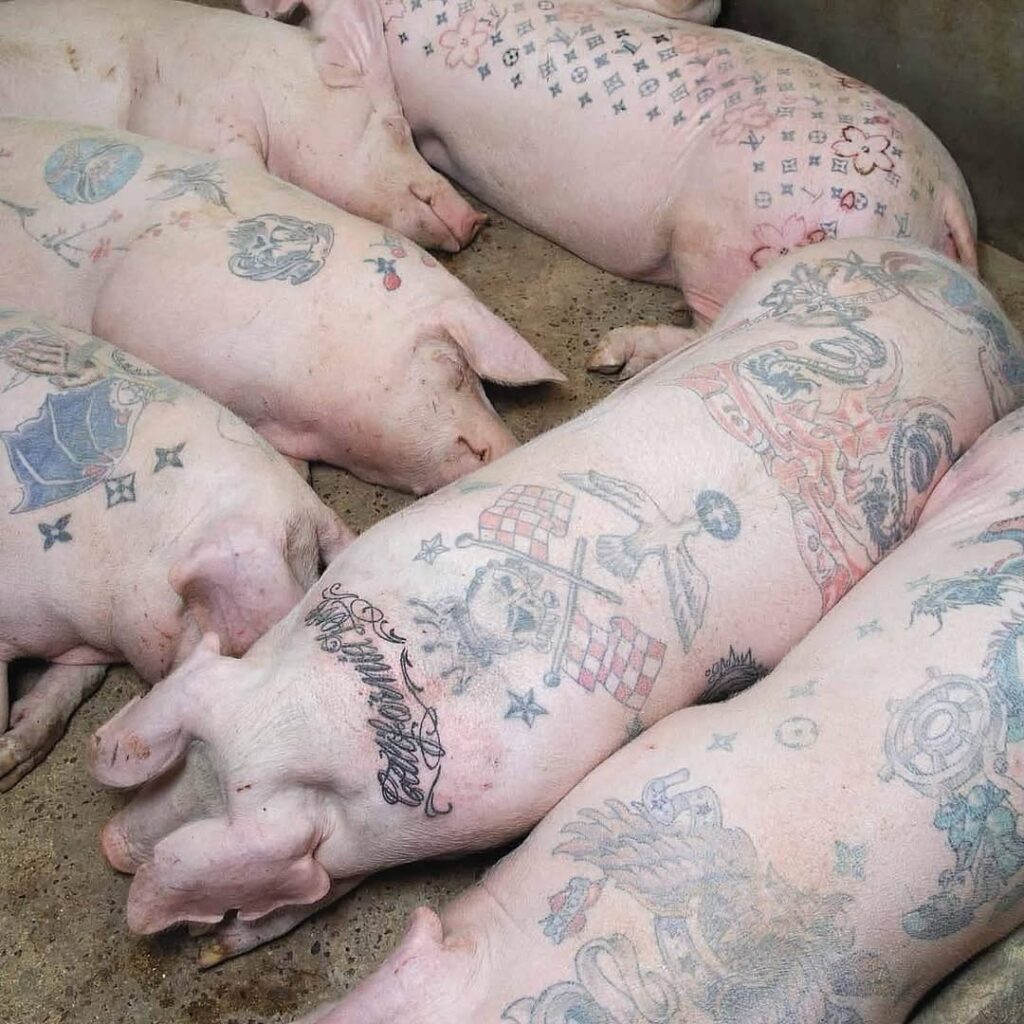
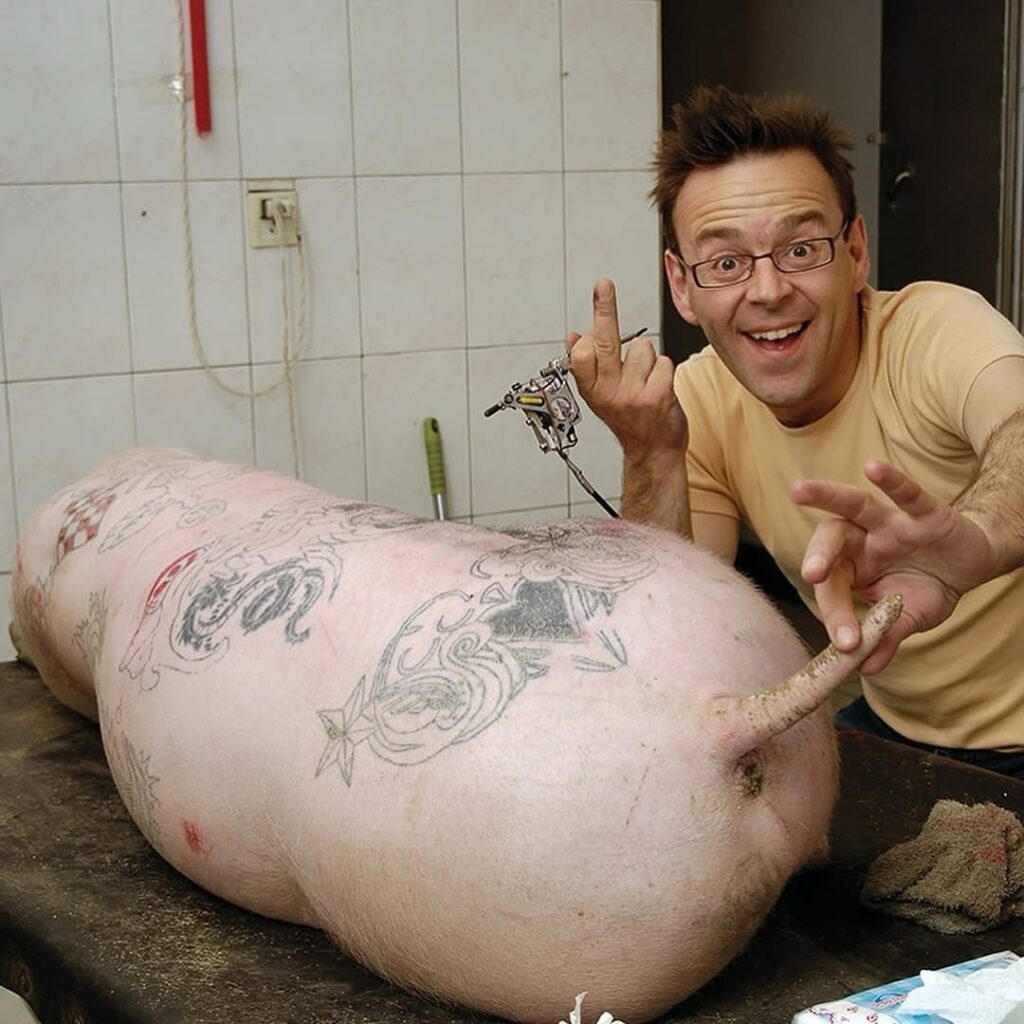
One of the most controversial manifestations of this idea emerged in the early 2000s when Delvoye established an “art farm” in China devoted to tattooed pigs. Following the attacks of the September 11 attacks, Delvoye sold his residence in New York and shifted his attention toward Asia, where he believed cultural energy and openness were expanding while the opposite was beginning to happen in the West in an atmosphere of post‑9/11 paranoia. Arriving in a rural village near Beijing, he purchased a pig farm and began raising animals that would become part of an ongoing artistic project.
At this facility, he tattooed his pigs with imagery ranging from hearts and skulls to fairy-tale characters such as Snow White, luxury brand logos including the Louis Vuitton monogram, and various religious symbols. The animals were sedated during the tattooing process and then allowed to return to their regular lives, occasionally presented to visitors as living works of art.
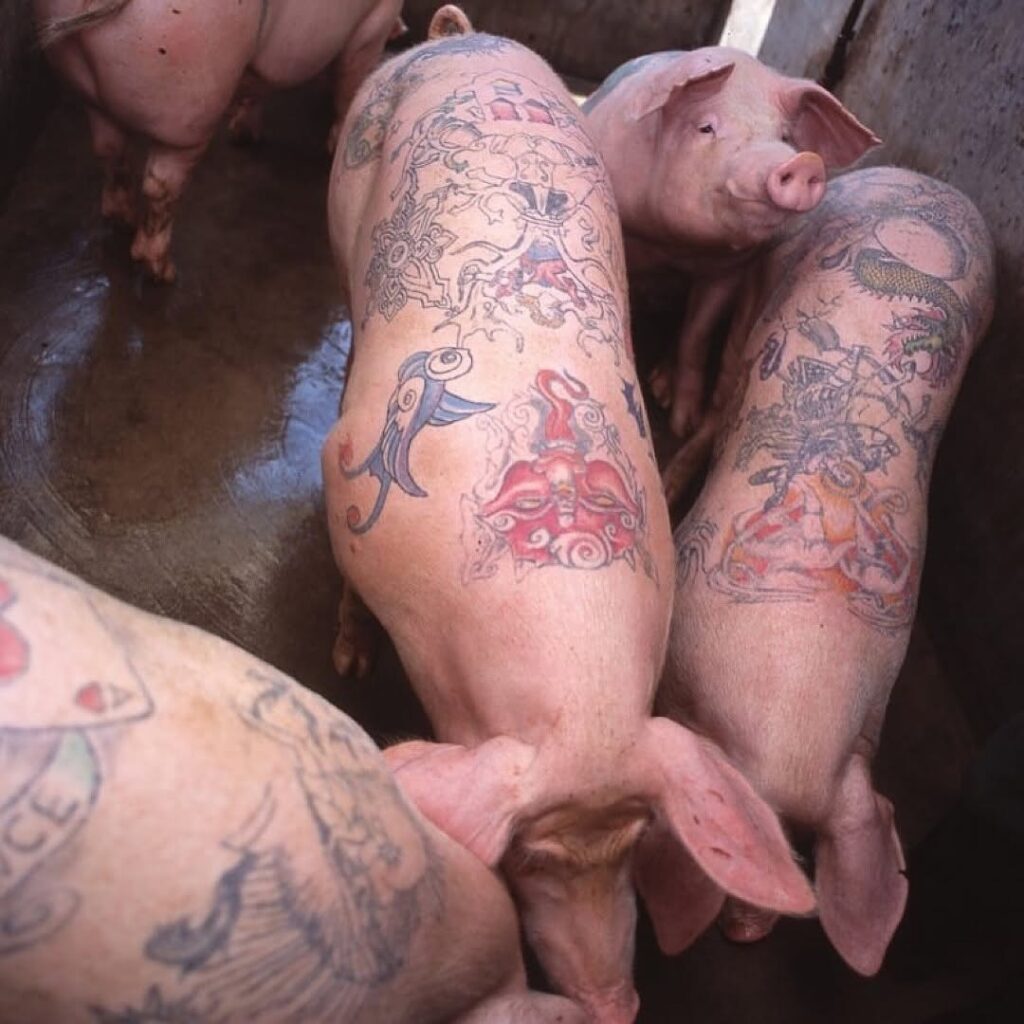
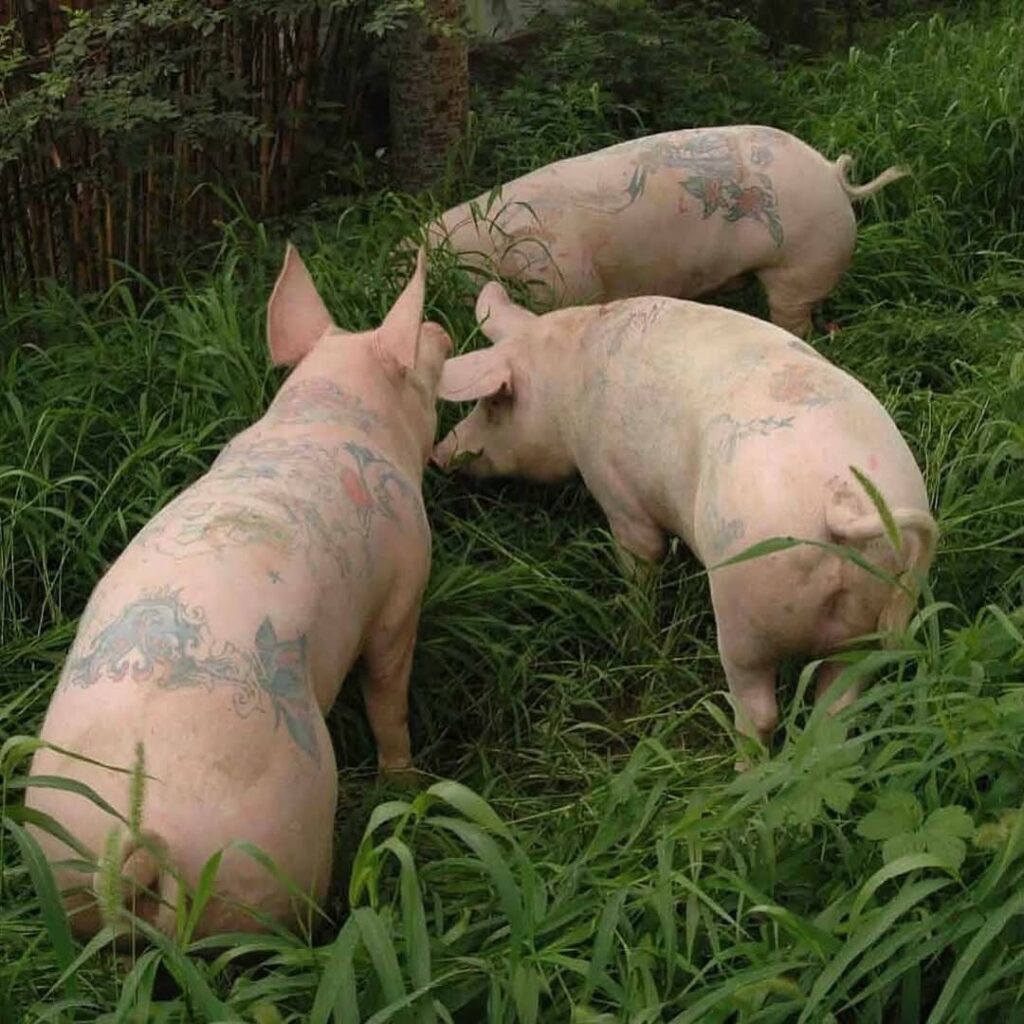
Delvoye preferred exhibiting the pigs while they were still alive, despite the practical difficulties this created for galleries and museums. As he explained, the animals themselves were integral to the work: “I prefer showing them that way as a dead pig skin is a big compromise.” The pigs were allowed to live out their natural lives, and only after their death would their tattooed hides be removed and delivered to collectors who had purchased them years earlier.
The project functioned as a pointed commentary on the commodification of art within a global market. By tattooing small drawings on young pigs and waiting for them to grow, Delvoye effectively allowed the image to expand over time. What began as a modest design would eventually become a large composition once the animal reached maturity. The work only became a commodifiable artwork after the pig’s death, transforming biological growth and time itself into elements of artistic production while also creating a speculative system in which the value of the work increased as the animal aged.
The project raised difficult questions about the commodification of art and the transformation of living beings into collectible objects. Collectors who acquired the tattooed skins effectively purchased a future artwork, waiting for the animal to age before the piece could exist in its final form. The pigs thus became speculative assets whose value grew over time, mirroring the financial mechanisms of the global art market.
One particularly contentious episode involved a pig tattooed with the monogram of the luxury brand Louis Vuitton. The company, well known for vigorously protecting its trademarks, pursued legal action against Delvoye and attempted to confiscate the animal hides. Representatives of the corporation even tracked the artist to Shanghai in an effort to challenge the use of the brand imagery. Delvoye later recalled the situation with some irony: “The museum was quite primitive (in China) — and meanwhile I had these expensive suits visiting, trying to get at me, which was quite ridiculous. For a while they had big folders with my name on them, trying to sue me. It was scary. So, we were once archenemies!”
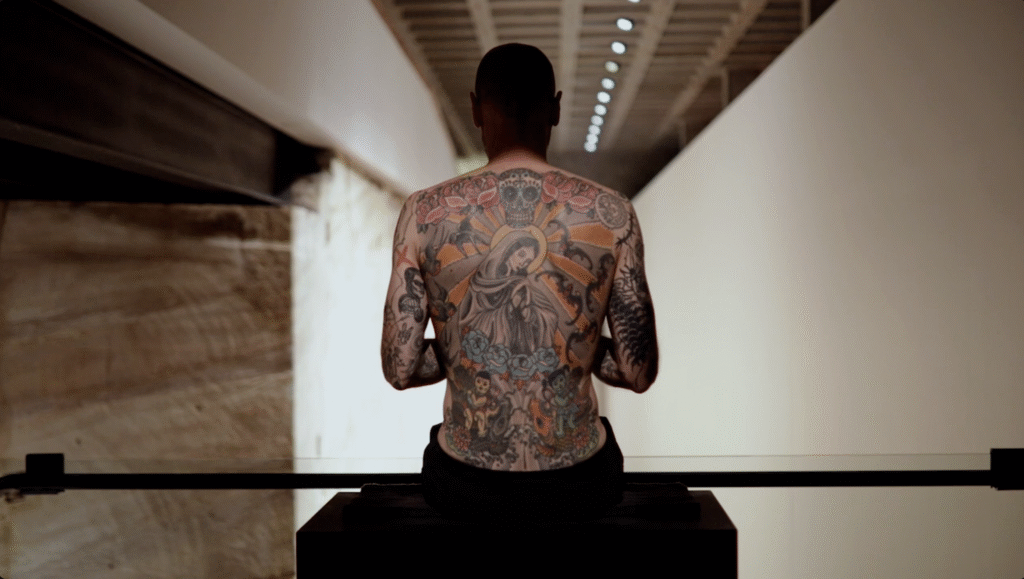
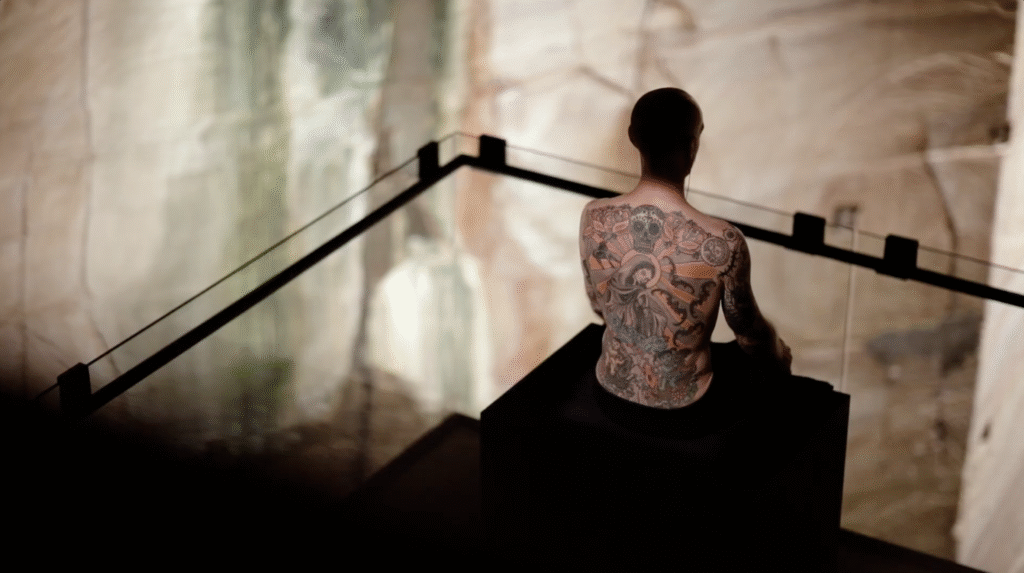
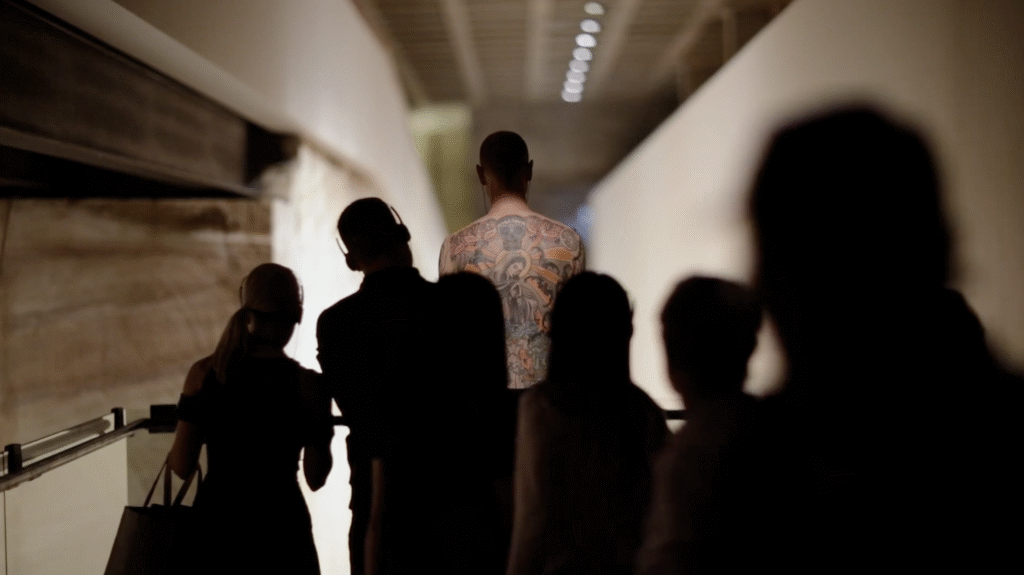
Delvoye’s interest in tattooing as an artistic medium extended beyond animals. In one of his most unusual projects he collaborated with a Swiss man from Zürich named Tim Steiner, who agreed to have his back tattooed by the artist. Steiner subsequently sold the tattooed skin on his back to a collector for €150,000 under the condition that it would only be removed and framed after his death. In the meantime, Steiner periodically appears in museums as a living artwork, sitting with his back exposed so visitors can observe the tattoo that will eventually become a collectible object.
These works also appeared in exhibitions at major institutions. During one presentation at the Louvre, Delvoye staged an installation in the historic apartments of Napoleon III. In this opulent environment, filled with crystal chandeliers and lavish imperial décor, he displayed taxidermied pigs whose bodies were covered in decorative carpets. The juxtaposition between the ornate nineteenth-century interior and the altered animal bodies reinforced Delvoye’s recurring interest in combining luxury, spectacle, and provocation.
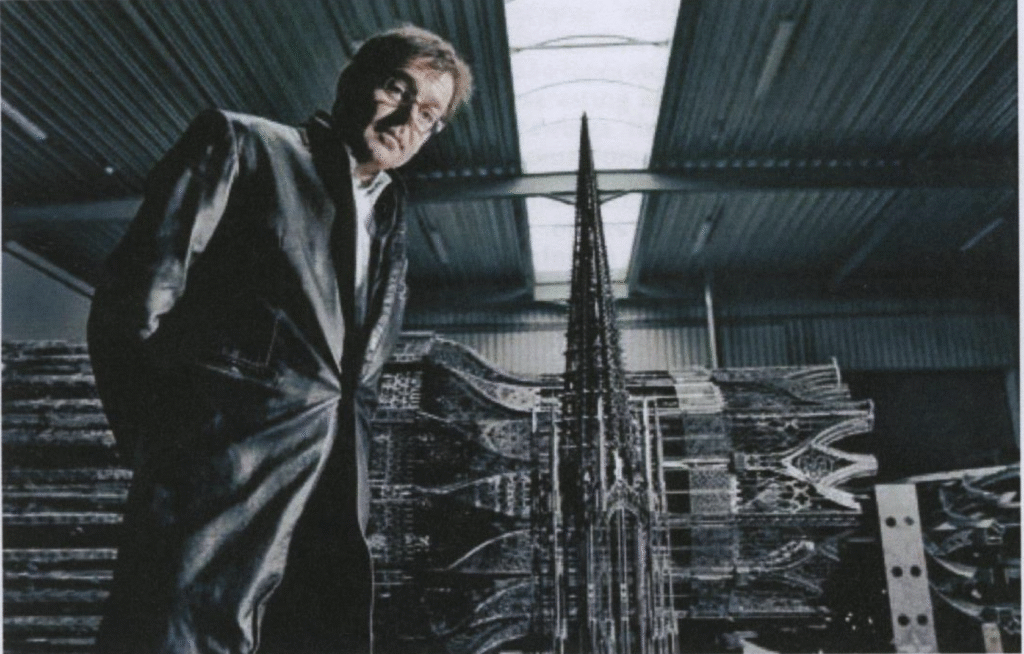
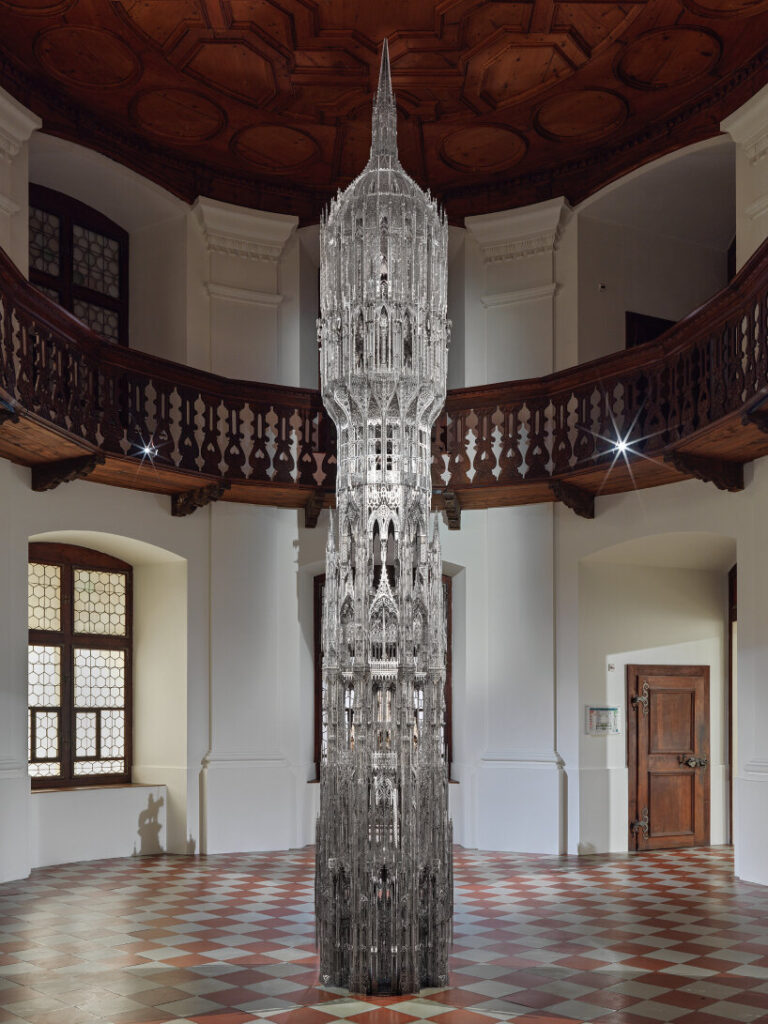
The exhibition also included the monumental sculpture Suppo, an eleven-meter-tall Gothic spire made from spiraling steel elements that resemble a gigantic corkscrew-shaped suppository. Installed beneath the glass pyramid designed by I. M. Pei, the sculpture combined architectural ornament with bodily reference, extending Delvoye’s fascination with the collision between sacred form and biological function.
Through living art projects such as the tattooed pigs and Tim Steiner, as well as documenting of human sexuality through his X‑ray stained-glass chapels, Delvoye repeatedly returns to the same underlying question: how bodies, human or animal, are transformed into objects within systems of spectacle, analysis, and commerce. By treating skin, bones, and living organisms as artistic materials, he highlights the space between reverence and exploitation that lies at the heart of both religious iconography and the contemporary art market, similar to how the relics of saints, former body parts belonging to holy individuals of the Church, are displayed and venerated by the faithful.
For all the shock and spectacle that surrounds his work, Wim Delvoye remains an artist of contradictions, and he appears comfortable keeping it that way. Although much of his visual vocabulary is rooted in the cultural traditions of his native Belgium, particularly Gothic architecture and Catholic iconography, Delvoye frequently emphasizes that he prefers to think globally rather than regionally. He has often argued that strictly local cultural identity can restrict artistic experimentation. Yet despite this professed rejection of regionalism, many of his works are closely tied to specific places and histories, carefully designed for the architectural or cultural context in which they appear.
One such example is Opus, a permanent installation inside Saint Bavo’s Cathedral. The sculpture forms part of a long dialogue between Delvoye and the city of Ghent. According to Ludo Collin of the Ghent Diocese, the goal of installing the work inside the cathedral was to create a direct encounter between contemporary art and the historic works already housed within the building. For Collin, the piece also carries a symbolic reference to a missing architectural element in the cathedral itself.
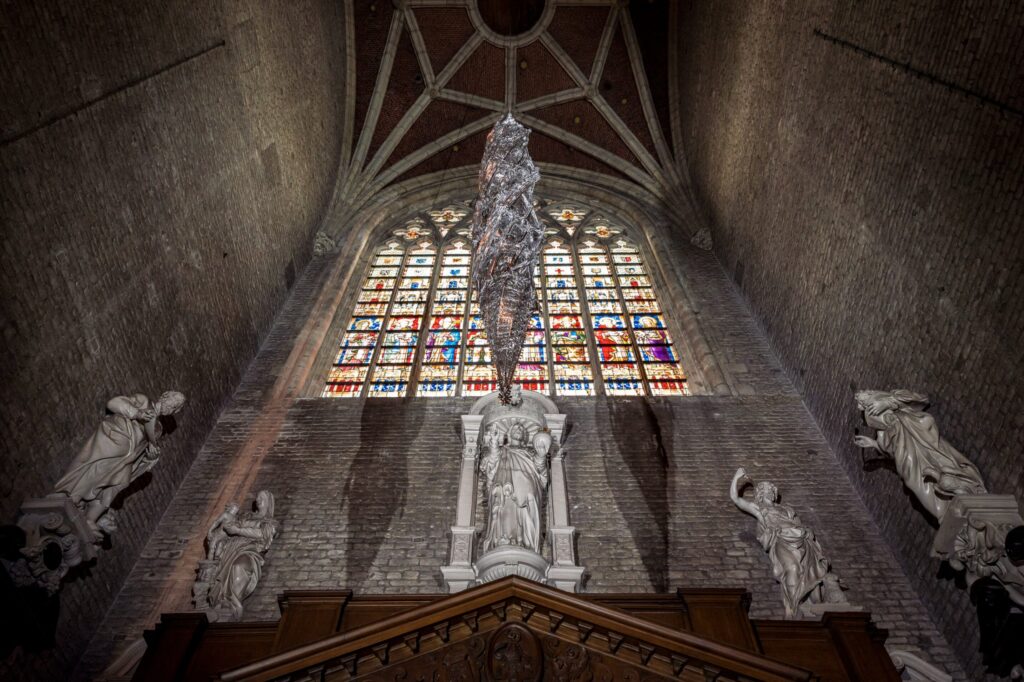
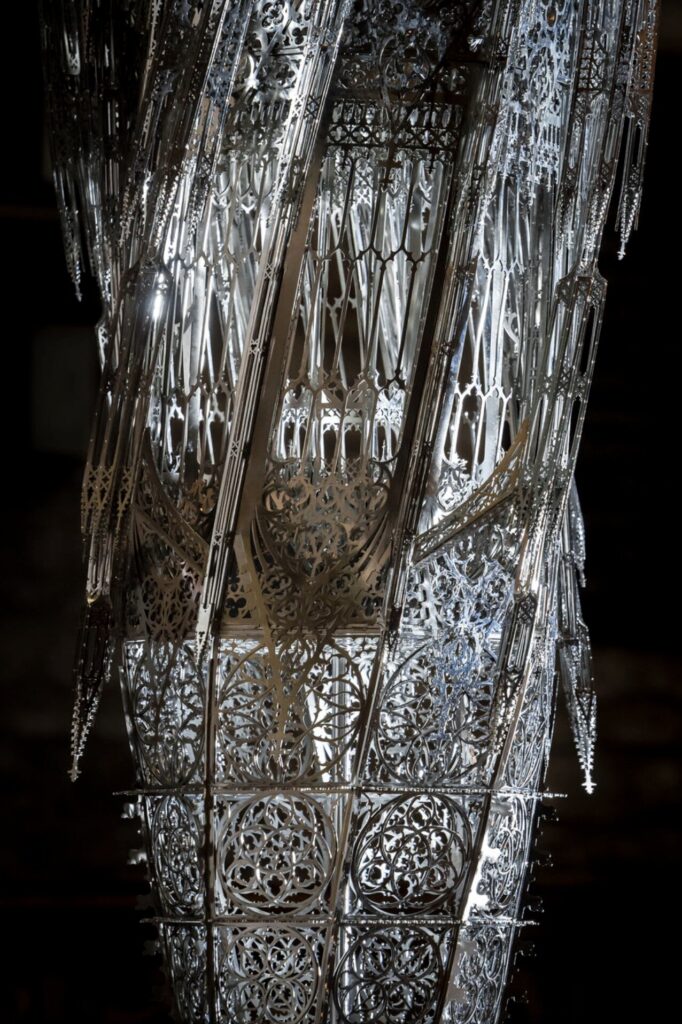
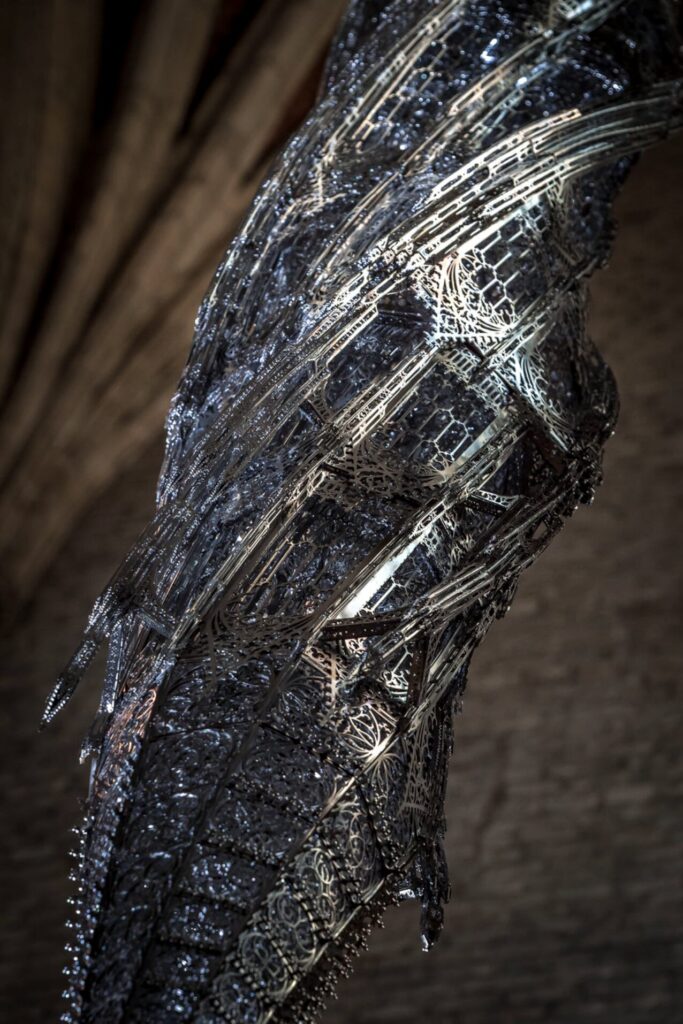
“When the cathedral tower was completed in 1538 there was a spire,” Collin explained. “Decades later it was destroyed by lightning and never replaced.” Delvoye’s sculpture echoes this lost feature. The structure resembles two spires, one pointing upward toward the heavens and the other directed downward toward the earth. For Collin, this dual orientation offers a metaphor for Christian life: believers look upward toward the divine while remaining responsible for their actions and compassion toward others in the world placed on the ground beneath them.
The installation also concludes a long administrative and artistic process between Delvoye and the city of Ghent. Nearly two decades earlier, Ghent had commissioned the artist with a €248,000 contract to produce several stained-glass works. Various proposed locations for the project failed to materialize, and negotiations stretched on for nineteen years before a final resolution was reached. Opus, a variation of his earlier monumental work Suppo, ultimately became the concluding work of that agreement and now remains permanently installed inside the cathedral.
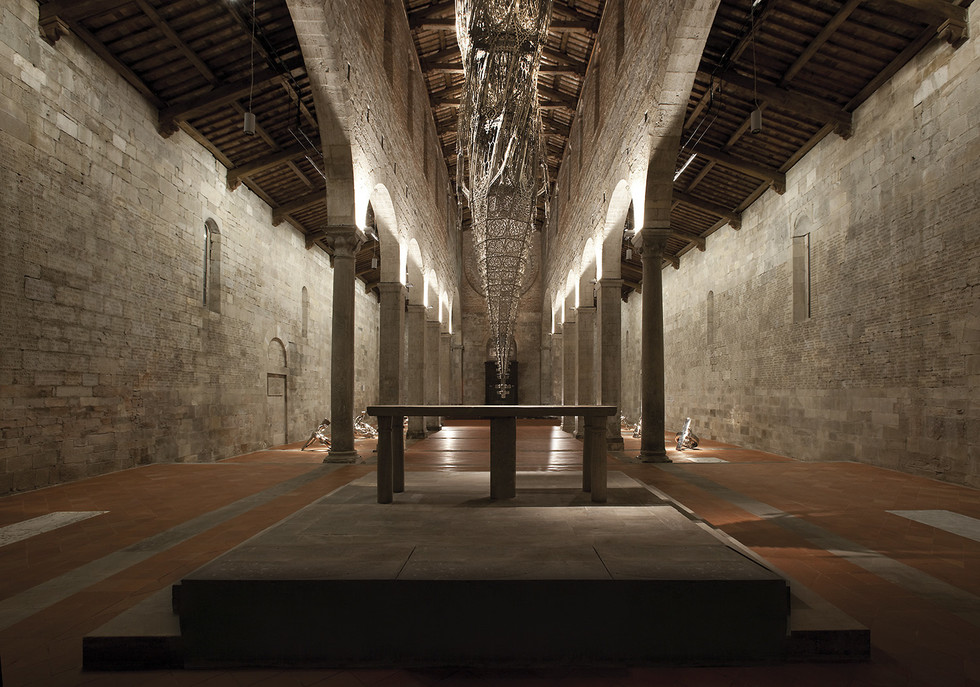
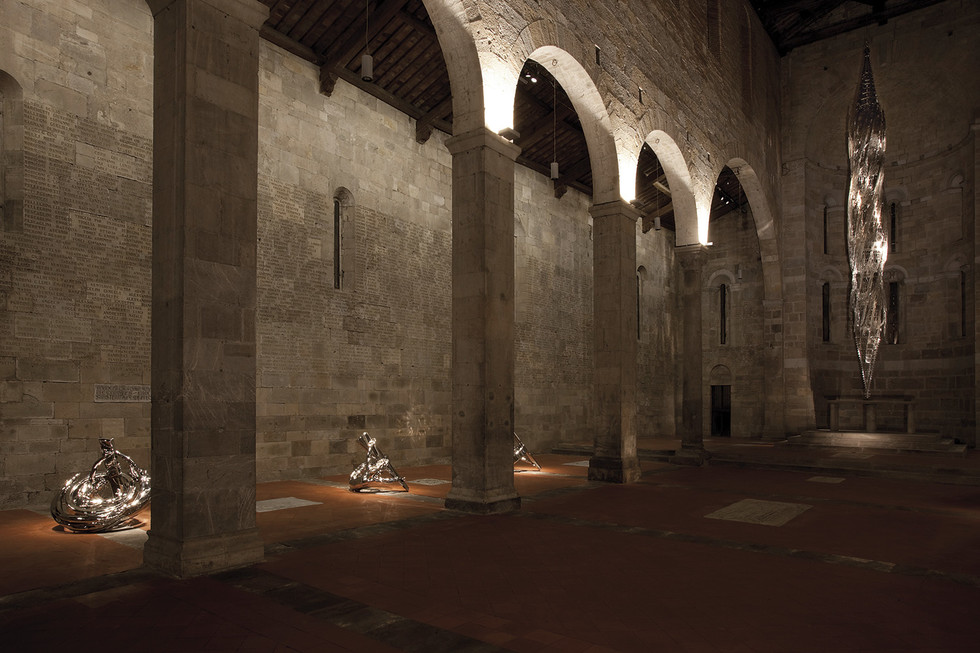
A similar dialogue between contemporary sculpture and historic architecture can be found in another exhibition in Lucca, Italy, staged within the 11th-century Church of San Cristoforo. Conceived specifically for the interior of the Romanesque building, the exhibition assembled several works by Delvoye that engage with the nave, altar, and apse of the church. Among the pieces presented was once again the monumental eleven-meter Gothic tower Suppo, suspended in the air, along with a group of bronze sculptures and a work carved from marble quarried in the Apuan Alps.
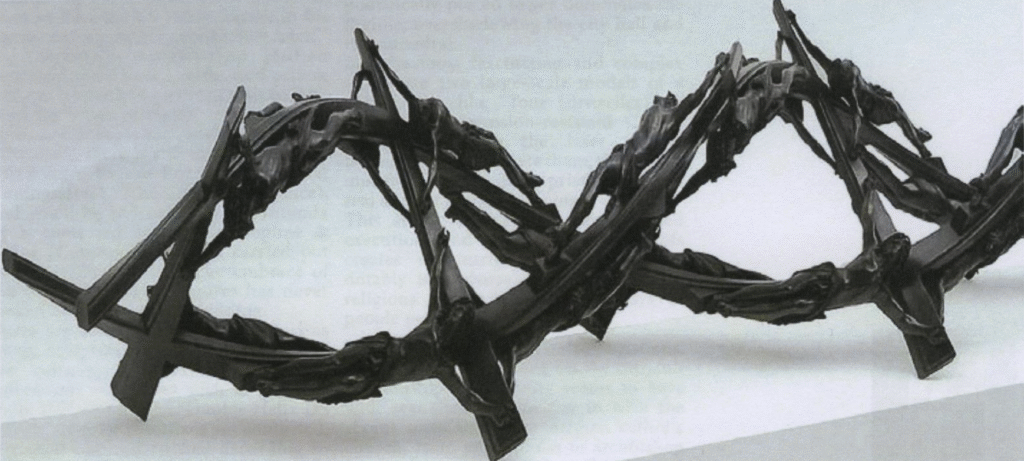
Installed within the historic church, these works created a layered visual conversation between architectural styles and periods. The Gothic lattice of the central tower interacts with the Romanesque structure of the building itself, while sculptures from Delvoye’s Holy Family series echo the dramatic forms of Baroque crucifixes. The exhibition deliberately attempts to remove distinctions between past and present, sacred architecture and contemporary sculpture, producing a surreal contrast of styles and materials that invites reflection on the evolving relationship between religion and modern art.
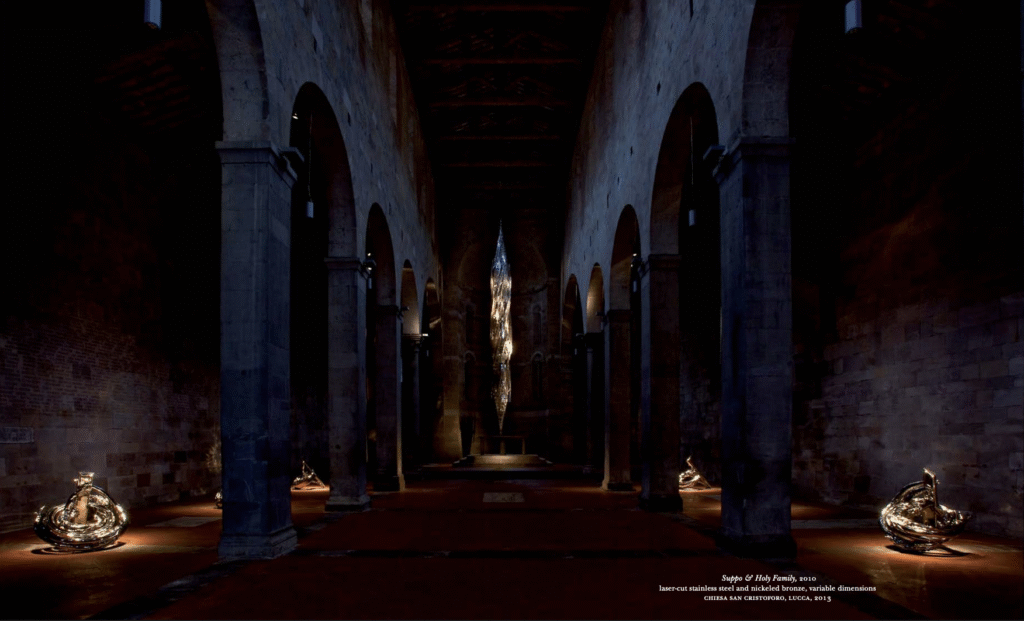
For Delvoye, the location itself was a crucial element of the project. “I liked the fact that San Cristoforo was a church,” he explained. “It’s a beautiful building, constructed with good materials, of a nice size, steeped in history and full of symbolic meaning. I like the idea of entering into a direct relationship with the territory through the use of its materials in my work.”
Across these projects, Delvoye continues to operate within a carefully maintained tension: between reverence and provocation, sacred architecture and bodily imagery, local history and global artistic ambition. It is precisely this friction, between the solemn authority of tradition and the disruptive force of contemporary art that defines the peculiar and often unsettling power of his work.
Despite the provocative nature of his work, Wim Delvoye insists that he has little interest in forcing it upon anyone, another one of his contradictions. Much of his practice, he says, involves adapting to the cultural and religious expectations of the places in which he exhibits. “For me, it’s OK because I adapt to each country. I usually take people’s views into account, however I sometimes make mistakes. In Iran, I wanted to respect Islamist faith and not show pictures of Jesus, yet they asked me why I wasn’t showing the work, and that I was in fact allowed to show it. If people say they don’t like it, I’ll take it away.”
Delvoye also often presents himself as largely unconcerned with financial incentives. Although many of his works have become highly sought after in the contemporary art market, he has frequently resisted producing copies of successful pieces simply to satisfy demand. Yet while he claims indifference to profit, economic systems themselves have long fascinated him and have become a recurring subject in his thinking.
“Looking inside the guts of the economy has, in fact, been a focus,” he explained. “Economics is more fundamental to our culture than the aspiration towards art, as many ancient ten-thousand-year-old clay tablets tell us: they are usually invoices. Love poems are a recent development. Charles Darwin borrowed the idea of evolution as an analogy—a term mostly used in economics at his time.”
In contrast to some of the visceral imagery found in his work, Delvoye also describes himself as a vegetarian, though he rarely foregrounds the fact publicly. “I’m not making a big noise about it,” he said. “People in paradise will be judged by some Holy Lord. He will look in his book and he will see that I’m close to a Buddhist. I am not responsible for the death of many animals. I wouldn’t kill an ant in front of me. I will go out of the way for an ant, even a spider.” However, as critics note, his claim of ethics while creating work that involves tattooing live animals is spurious at best. At the same time, the artist has also admitted to performing sex acts on a pig as part of one of his projects involving animals.
Outside of these controversies, Delvoye has often kept his political and religious views deliberately ambiguous. Rather than presenting a consistent ideological position, he tends to frame his work as a response to what he sees as the contemporary art world’s reluctance to engage with ideas that fall outside prevailing cultural norms.
In that sense, Delvoye’s work operates less as a direct political statement than as a field of contradictions, between reverence and satire, the sacred and the bodily, the traditional and the industrial. Rather than resolving those tensions through explanation, the artist leaves them suspended within the artwork itself, as much as the artwork is itself suspended in the air.
“The art world is like a religion, so I have to change my views every day, but my interests are very broad,” He explains. “My views are a bit different from most people, a bit sicker. They say I have a twisted mind, but I feel I have a free mind. I’m not very afraid. I want to make fearless art. Most artists are afraid. You have to overcome your fears.” Art, as with x‑rays, it seems, becomes the place where these imperfections can be observed directly, without the need to argue them at all.