Jo Brocklehurst moved through London’s underground as both a witness and accomplice of life on the fringes of culture, sketching punks, goths, club kids, and clubbers with uncompromising empathy. Decades later, her drawings are scattered, nearly unseen, and uncannily ahead of their time.
For more than forty years, a single artist produced an extraordinary record of life at the edges of mainstream society in a manner and scale no other artist attempted. Punks, fetishists, dancers, actors, drag performers, musicians, club kids, anarchists, and night creatures of every description passed through her line. Yet despite the prolific nature and originality of the work, Jo Brocklehurst never became a household name.
Her drawings surface sporadically in galleries and auction rooms, while much of her output remains scattered in private hands, storage boxes, and unresolved estates. None are on permanent museum display. Those who knew her insist she was years ahead of her time.
Jo Brocklehurst moved through London like a phantom. In nightclubs thick with smoke and strobe light, in Soho strip joints, in the Blitz Club at the height of New Romantic excess, in anarchist punk squats, in fetish balls where latex and steel flashed under ultraviolet lamps, a tall woman in a blonde wig and stacked dark glasses stood quietly in the corner drawing, her paper barely visible in the dark recesses of the clubs.
People remember the disguise before they remember the face. They remember the huge sheets of paper, the pastels, the speed of her hand. Often they did not realize they had been seen until weeks later, when someone produced a drawing in which they appeared sharper, stranger, and more essential than they had ever looked in a mirror. “I don’t analyze my reasons for painting my subjects,” she said. “I just feel instinctively that I want to paint a particular person; it is a compulsion.”
The compulsion stemmed from a lifelong interest in people and their appearances. Not content to merely present herself in an unconventional way, she sought to bring out the overlooked beauty of others at the edges of mainstream society through her lifelong career as an artist. However, she herself was infamously secretive about her life, opting to present herself through her outward appearance rather than her background.
What is generally accepted is that Jo (Josephine) Blanche Brocklehurst was born on August 6, 1935 and died on January 29, 2006. She entered the world under circumstances she would spend a lifetime obscuring. Her mother was a London housekeeper. Her birth certificate named no father. It later became known that she was the illegitimate child of an English mother and an unknown senior Sri Lankan political figure “who had his face on a stamp.” Even close friends remained unaware of her mixed heritage. She never revealed her exact age, her specific ancestry, and treated questions about her past as irrelevant. What mattered was the work.
Known as Josie to her family, she grew up in Dorset with her mother and aunt and was evacuated to relatives in Cheshire during the Second World War. Though born and later dying in Hampstead, she guarded the facts of her early life with remarkable consistency. Friends later recalled that she never felt entirely English and experienced prejudice from an early age. Artist Patricia Buckley described a walk up Piccadilly during which she commented on how English Brocklehurst looked. Brocklehurst replied, “Oh, I like to pretend.” She spoke in a refined accent often compared to Joanna Lumley.
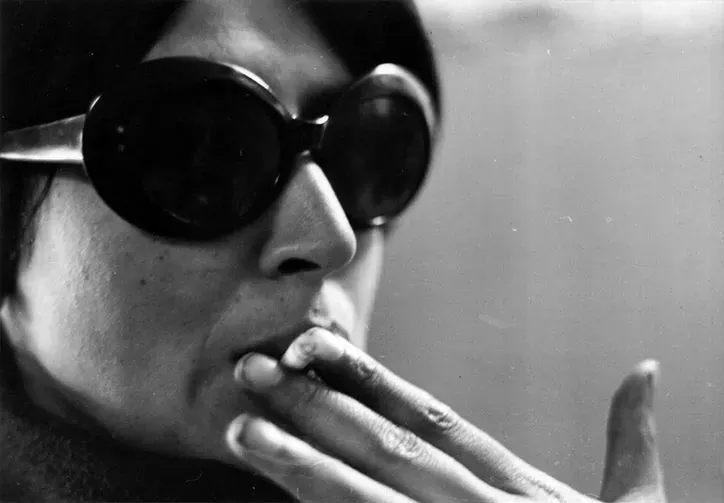
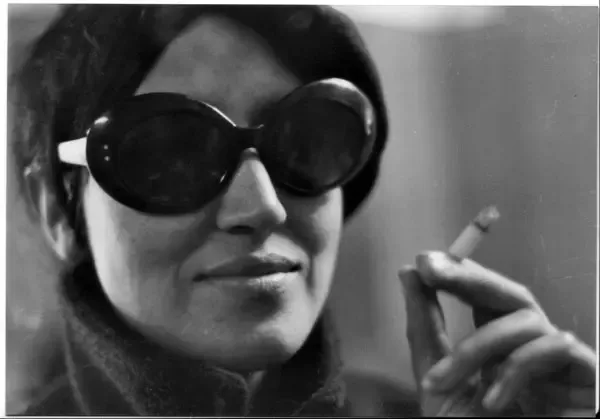
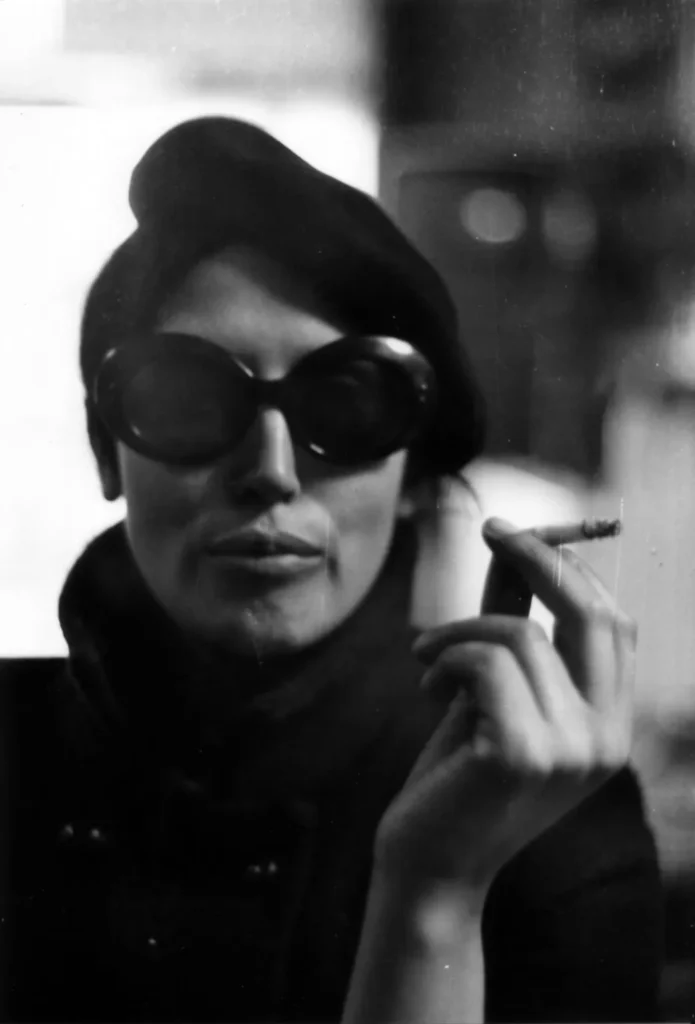
In life she was considered strikingly beautiful, a fact that complicated her relationship with the world. Tall, poised, and intensely self conscious, she often concealed her appearance beneath wigs, hats, and sunglasses, often worn in multiple pairs at once. Friends believed the disguise was partly a reaction to the prejudice she had faced both as a young woman and as a person of mixed British and Sri Lankan heritage. It also created distance. Brocklehurst could observe without being observed.
Her artistic precocity was evident early. Following years spent at Woolwich Polytechnic School for Girls in London (believed to have been funded by her absent father), she entered St Martin’s School of Art shortly before her fourteenth birthday on a junior scholarship scheme, an experimental program that recognized exceptional talent at a young age.
At St Martin’s she learned to draw with extraordinary speed and precision, studying under tutors including Freddie Gore, John Minton, Elizabeth Suter, and Muriel Pemberton. Suter’s life drawing classes were particularly influential. She hired unconventional performers, dressed in eccentric outfits, to pose as drawing models. The theatricality of these figures resonated deeply with Brocklehurst’s sensibilities. It was here where she honed her eye for proportions and anatomy, learning to produce work at a pace considered nothing less than remarkable for her level.
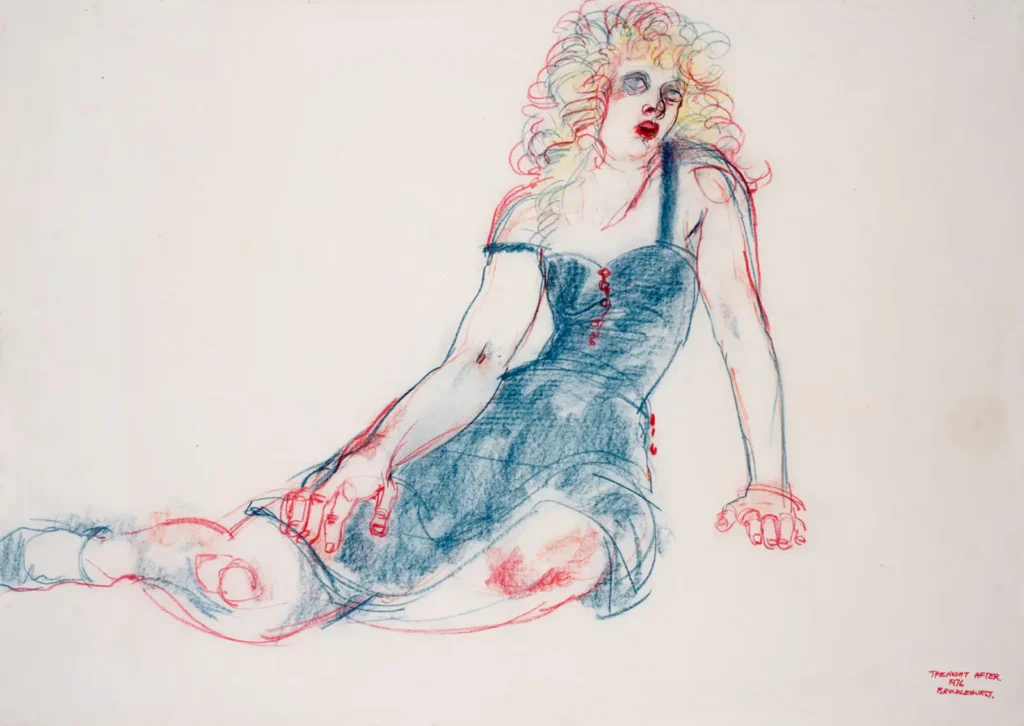
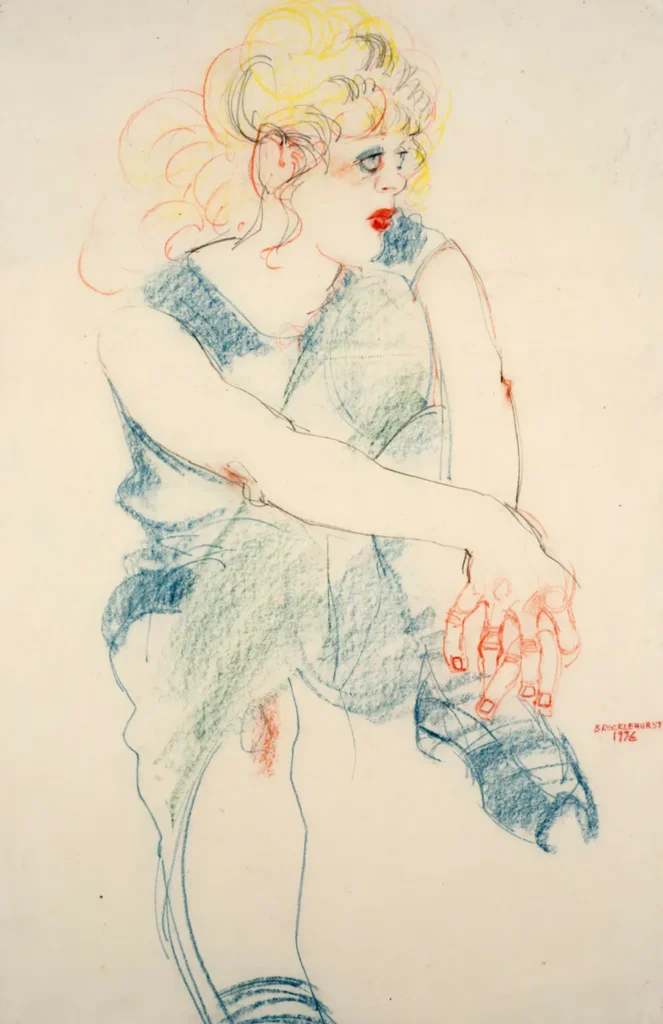
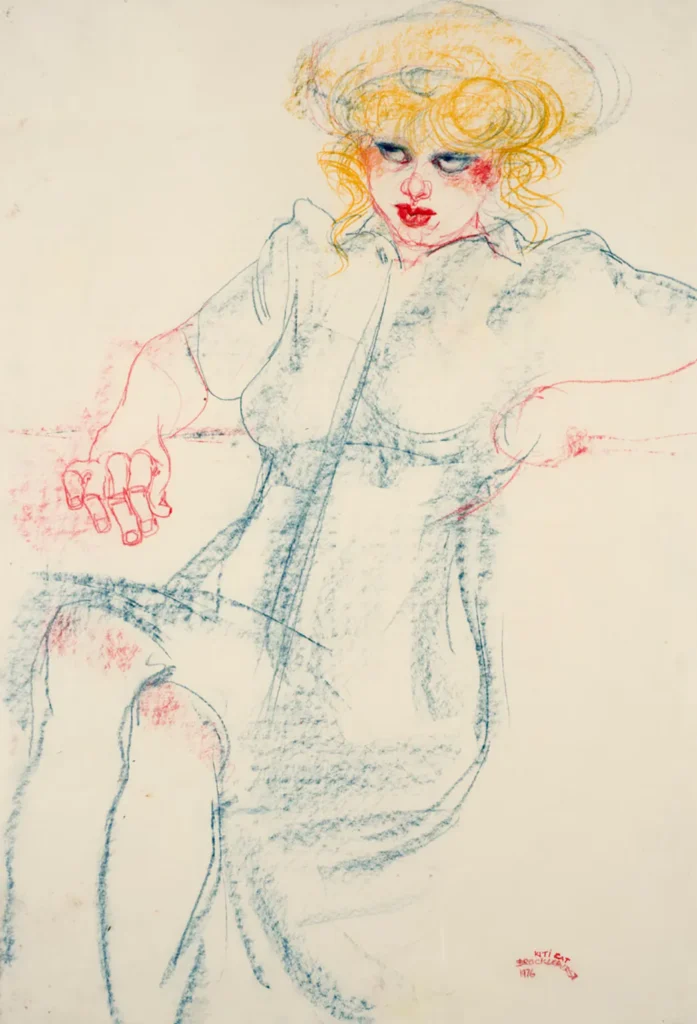
Those that knew her recalled she arrived at St Martin’s already possessing a highly individual style. She could appear in outfits extreme even by art school standards. One tutor recalled her attending class wearing two pairs of Wellington boots at the same time, with one pair worn inside the other.
She attracted attention upon entering a room, then retreated into silence, hiding her eyes behind dark, oversized sunglasses (sometimes up to three pairs at a time, even while drawing), long jet-black hair or a blonde wig, and wide-brimmed hat pulled over her head, her beauty revealed only for a moment whenever she raised her head to glance at the model she was drawing. Fellow students gathered around her drawings, while Brocklehurst continued to remain shy and unassuming. When she left the studio, they whispered her name in hushed admiration.
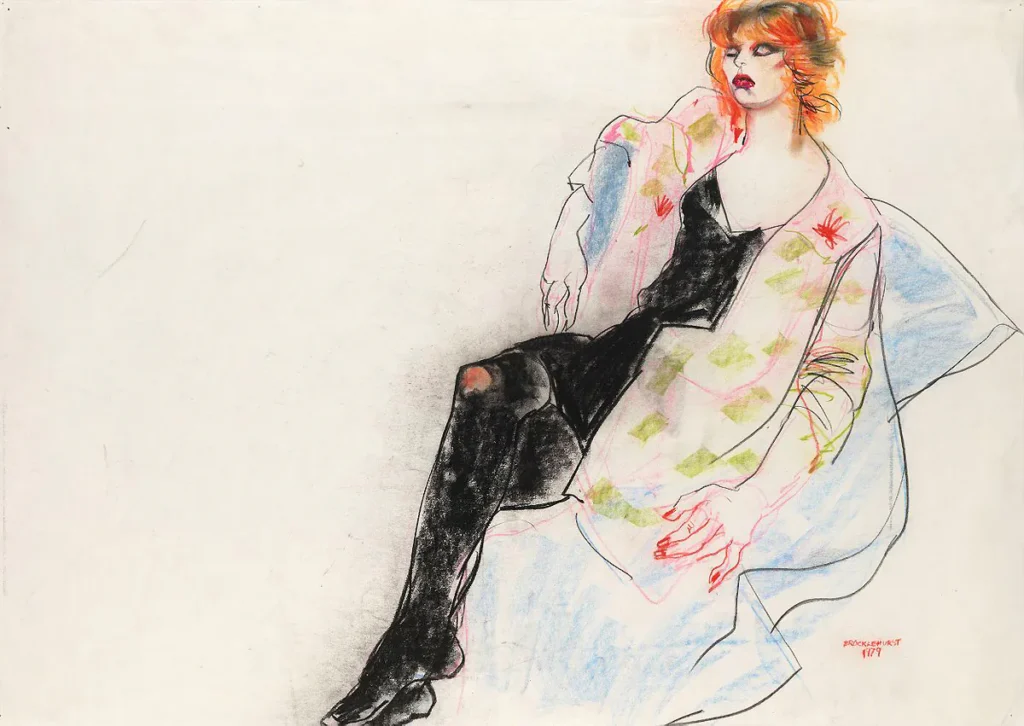
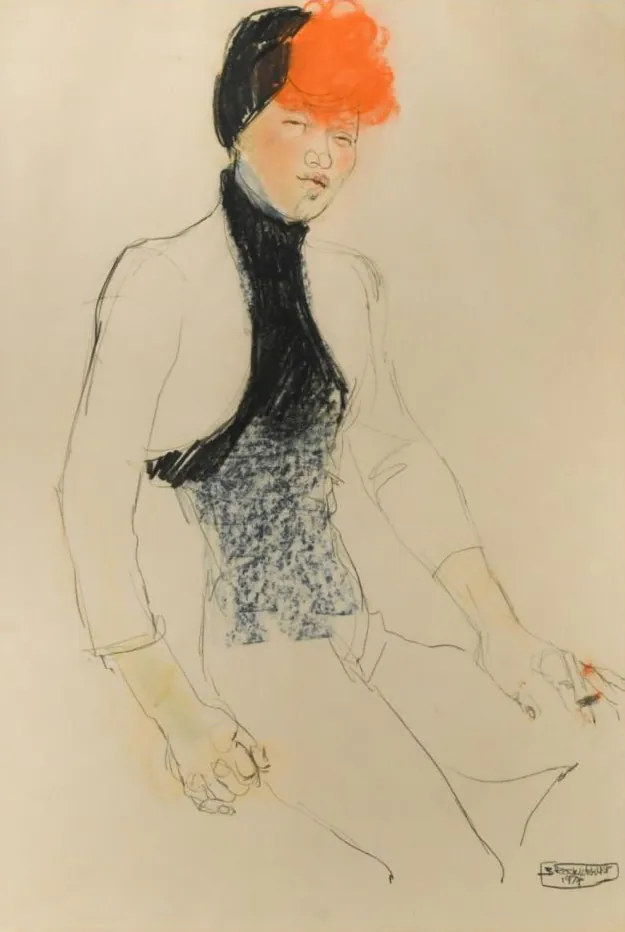
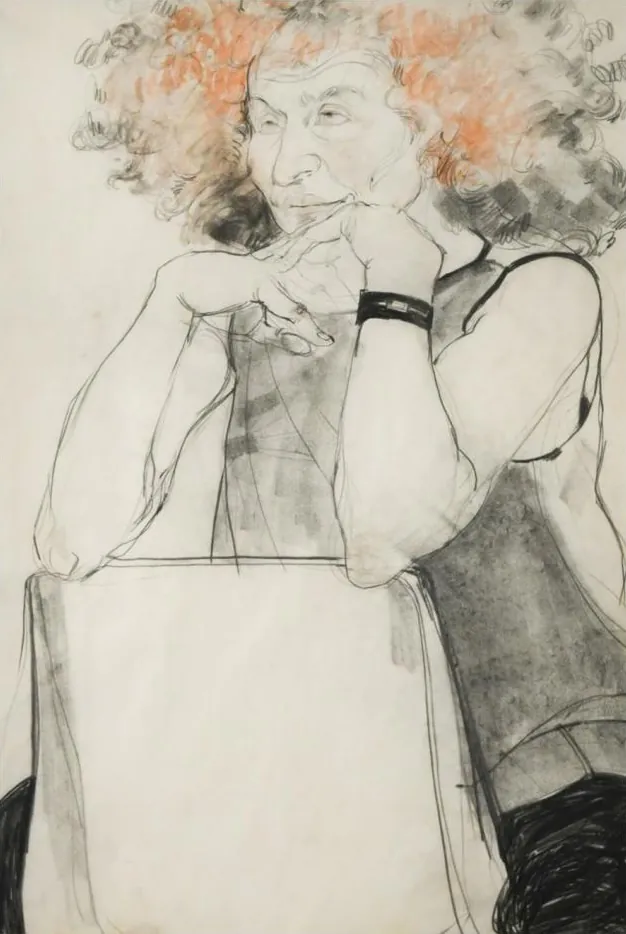
Her childhood talent was not confined to drawing. She was an exceptional athlete, a member of the Selsonia Ladies Athletic Club and the Highgate Harriers, where she played at the national level in shot put and represented England in discus throwing. Relatives later said Olympic competition would have been within reach had she pursued sport. Instead she chose art, though she retained an athletic lifestyle throughout her life and cycled daily through the hills of Hampstead.
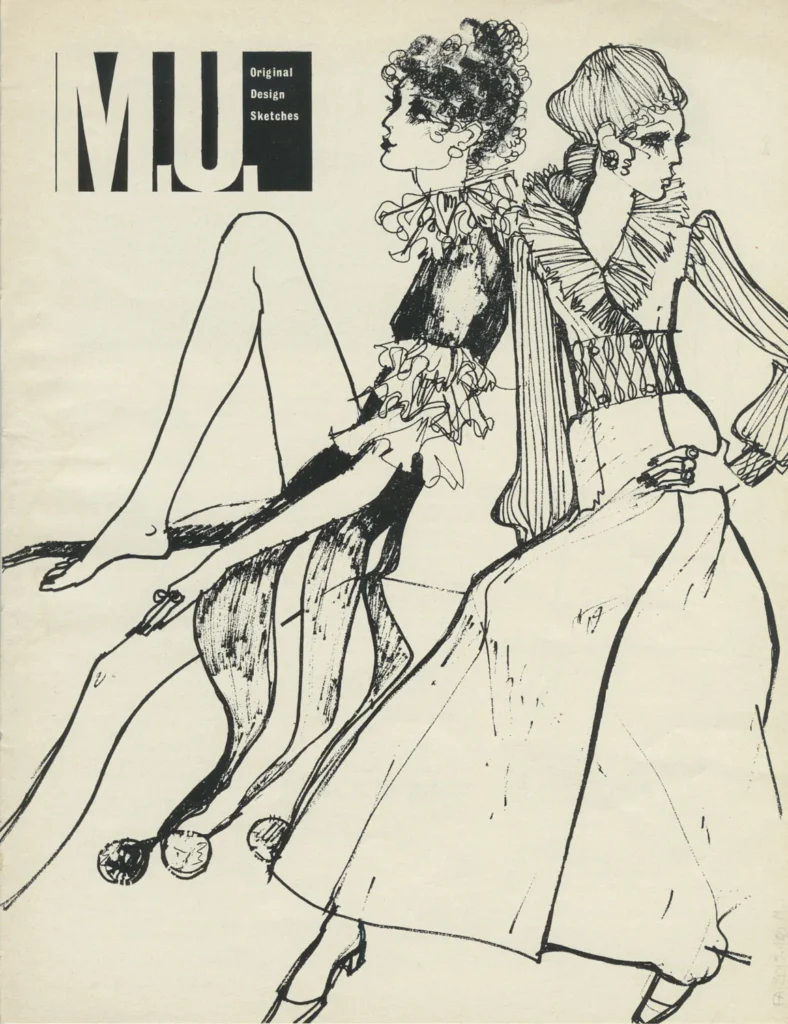
She began her career as an illustrator for various fashion magazines and was briefly involved within bohemian London circles. This brush with the lives of unconventional artists coupled with her exposure to the methods of Suter implanted in her a passion to drawing people from unconventional walks of life, without regard for whether it would affect her reputation as an artist or her prospects in the commercial world, her position as a woman artist in the field of art was uninhibited by fears of how she would be perceived, which formed a core part of her character as both a creative and an individual.
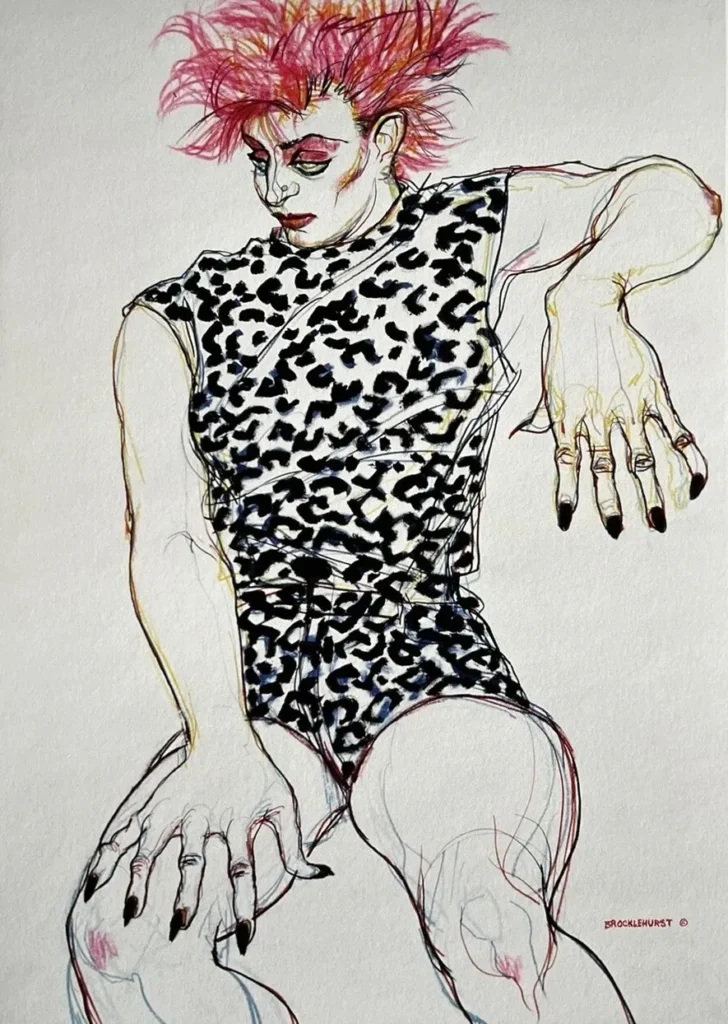
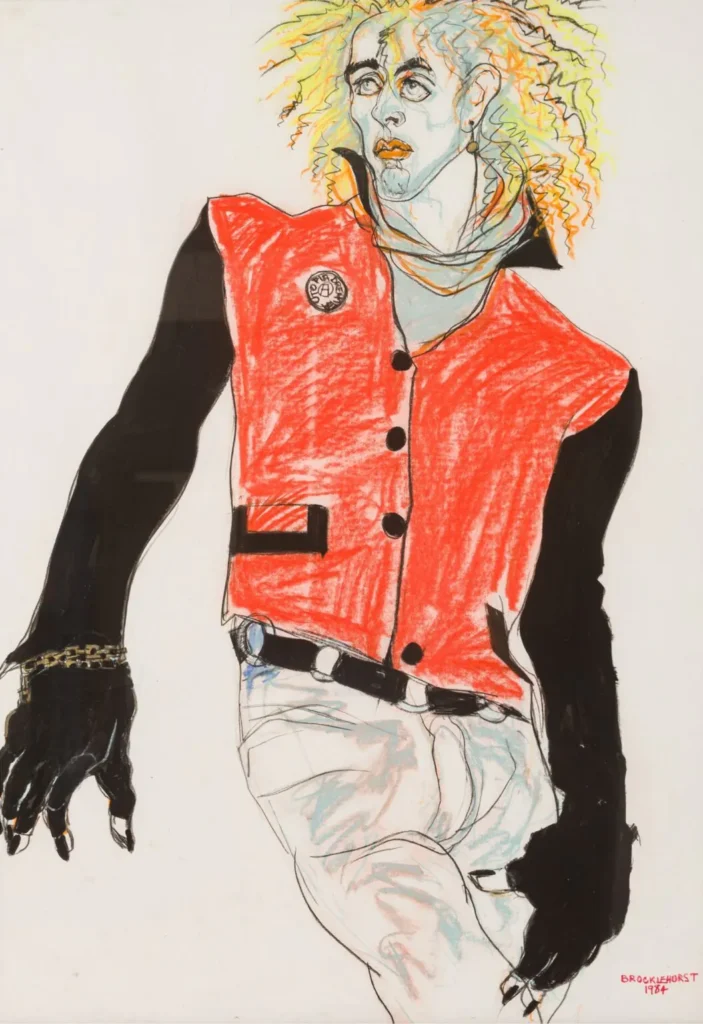
Leaving fashion behind, she later rejected the label “illustrator,” preferring painter or draughtsperson. After finishing her education at St Martin’s, she continued attending costume life drawing classes in the fashion department and maintained close ties to the school for decades, later teaching and guest lecturing to future generations of designers, still in her flamboyant ensembles.
Sue Dray, now a course leader of BA Fashion Illustration at the London College of Fashion, was once a student that was a member of the classes taught by Brocklehurst in the 70s, recalling her as “a small woman behind huge drawings … getting exactly what she wanted from the model. She was very much a feminist” she continues, “with a strong opinion about women’s roles as artists and how we were recognized. I think that’s why the drawings were so brutal. We weren’t going to romanticize anything about the models. It was about extracting character. She was working in a period when the subculture was still the subculture.”
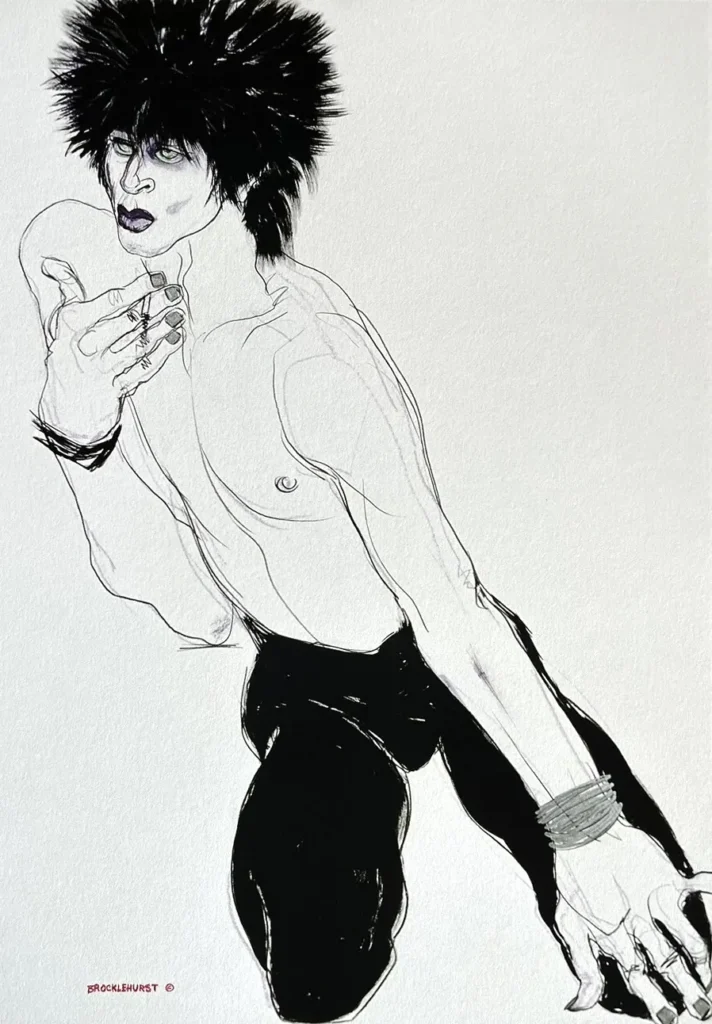
Still, as fascinated as people were in how she looked, Brocklehurst was equally fascinated by how others looked. “The streets are full of marvellous people, you’ve only got to look.”, Brocklehurst once said. Naturally, she drew constantly and treated delay, boredom, and transit as opportunities rather than inconveniences. She did not mind sitting for hours on a stalled bus because she always carried paper and pens, using the time to sketch whoever and whatever unfolded around her. She captured places, fleeting situations, and the faces of strangers with a rapid, decisive line that conveyed movement and character in seconds. Each day she left home with the specific intention of drawing, often with a subject already in mind, moving through the city with the quiet focus of someone working rather than merely observing.
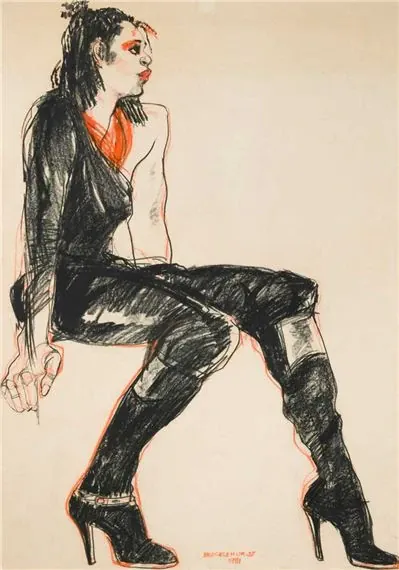
From the 1950s onward she drew in clubs and music venues. In the 1960s she sketched jazz musicians including George Melly. During these years her interest in fashion illustration gave way to a fascination with nightlife and subculture. Dressed in black, face hidden behind Cutler and Gross sunglasses, she worked in Soho strip clubs and jazz dives, creating all of her portraits on site mainly using crayons or pastels on large sheets of paper.
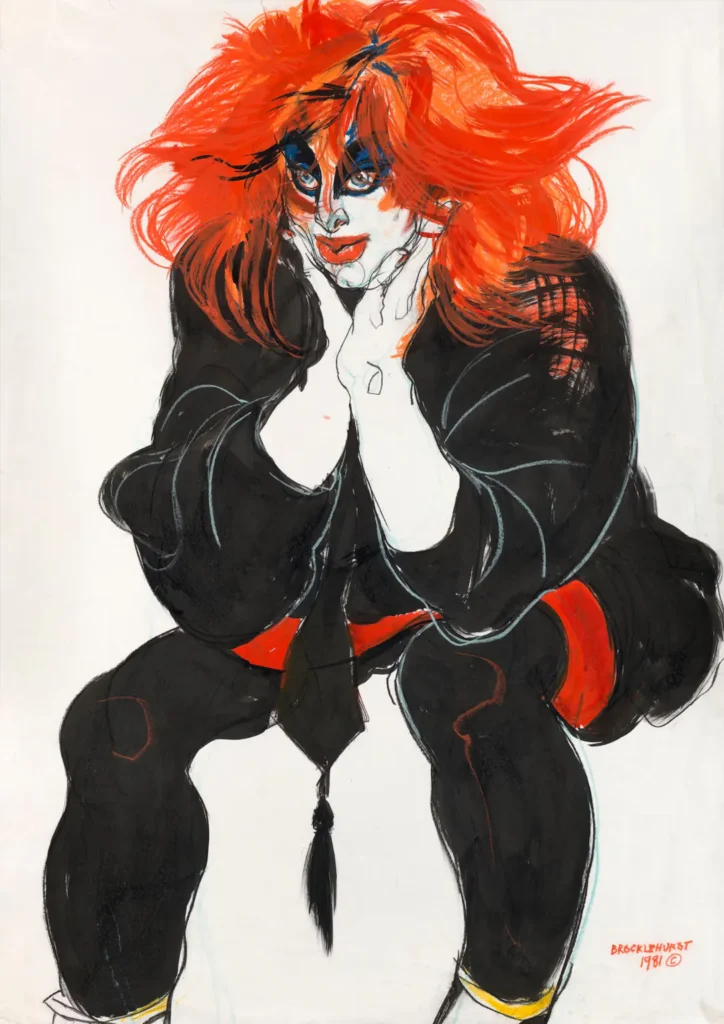
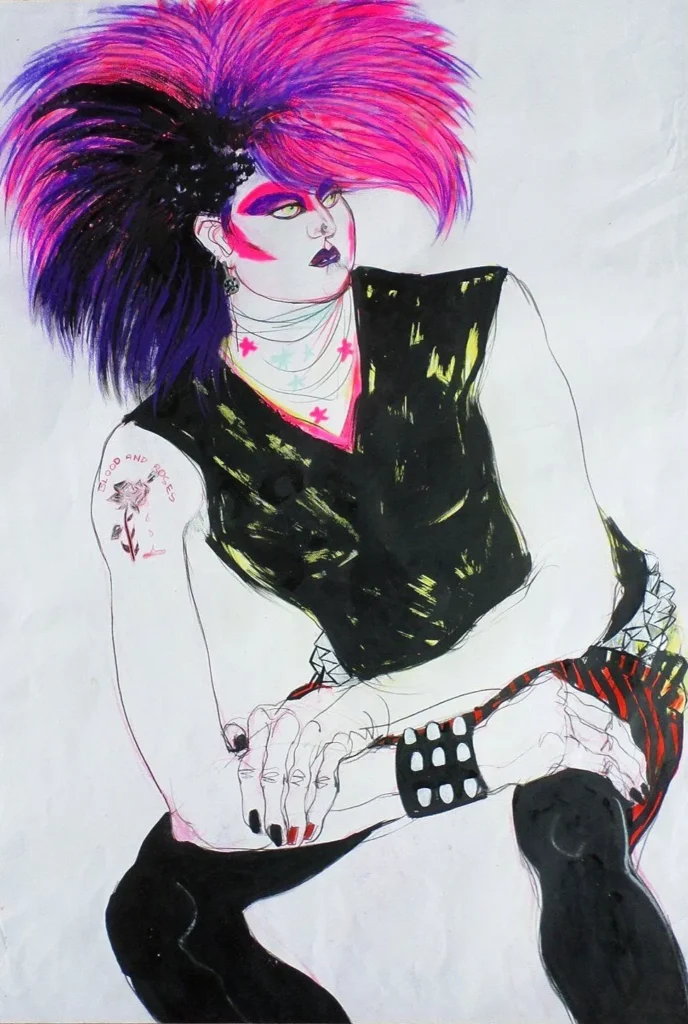
By the late 1970s she began the work that would go on to cement her reputation as a truly groundbreaking illustrator. Brocklehurst had become a familiar but discreet presence at the Blitz Club in Covent Garden, epicenter of the New Romantic movement. The Blitz Kids competed in extravagance, gender fluid styling, and theatrical self invention, often competing to see who would show up in the most outlandish or intricate outfits. “She said it wasn’t just the clothes,” according to curator Olivia Ahmad, “It was more than anthropological. She had an empathy with outsiders. It was a feeling out of humanity.”
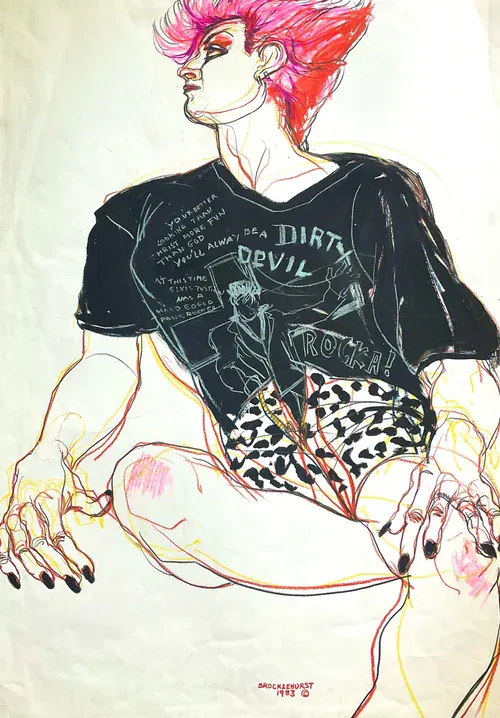
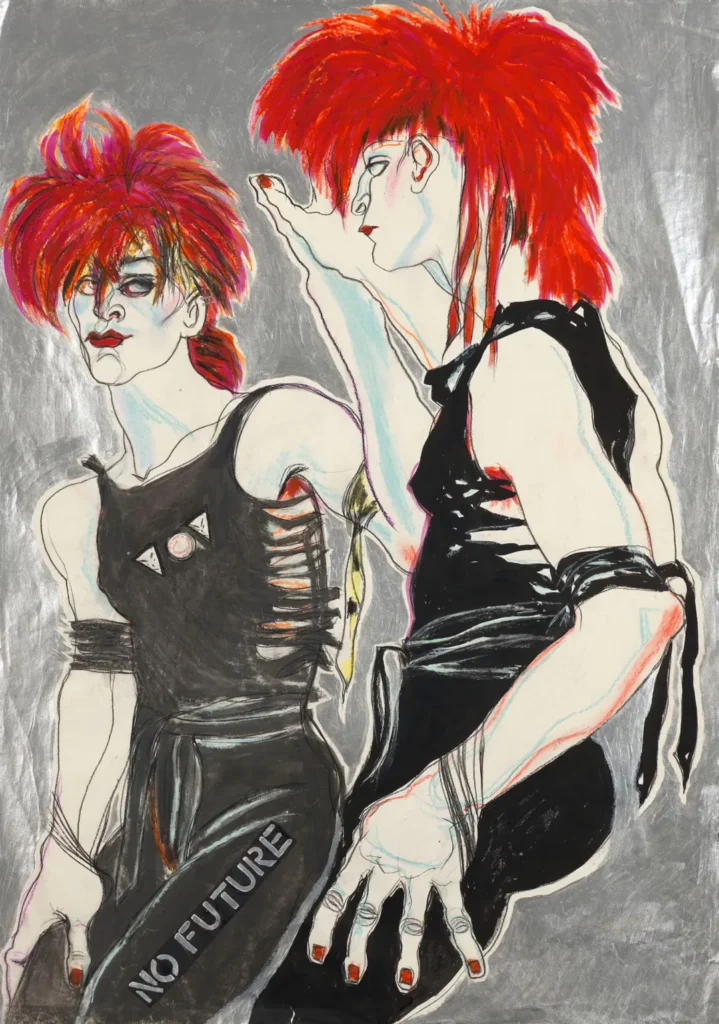
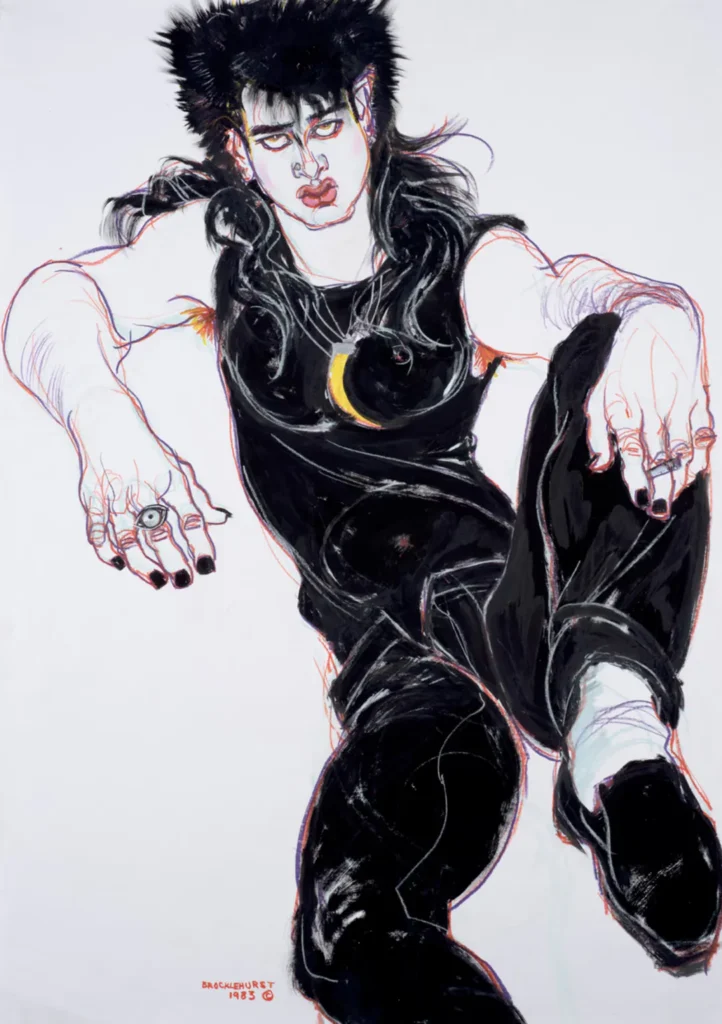
Although she was often confined to the dark corners of the Blitz Club, she was immediately recognizable to her 70s style black velvet jacket, wig, and shades worn inside. If that wasn’t enough, Brocklehurst was said to have made her entrance to the clubs by rolling in shopping carts full of sketchbooks, rolls of paper, and drawing materials, capturing elaborate costumes, metallic fabrics, animal prints, neon makeup, spiky hair, and most importantly, their carefully staged poses. “I drew these characters because I saw them around the streets near where I live and I thought they looked wonderful,” Brocklehurst said. “I felt that they understood very well what was going on in the world, what was in it for them.”
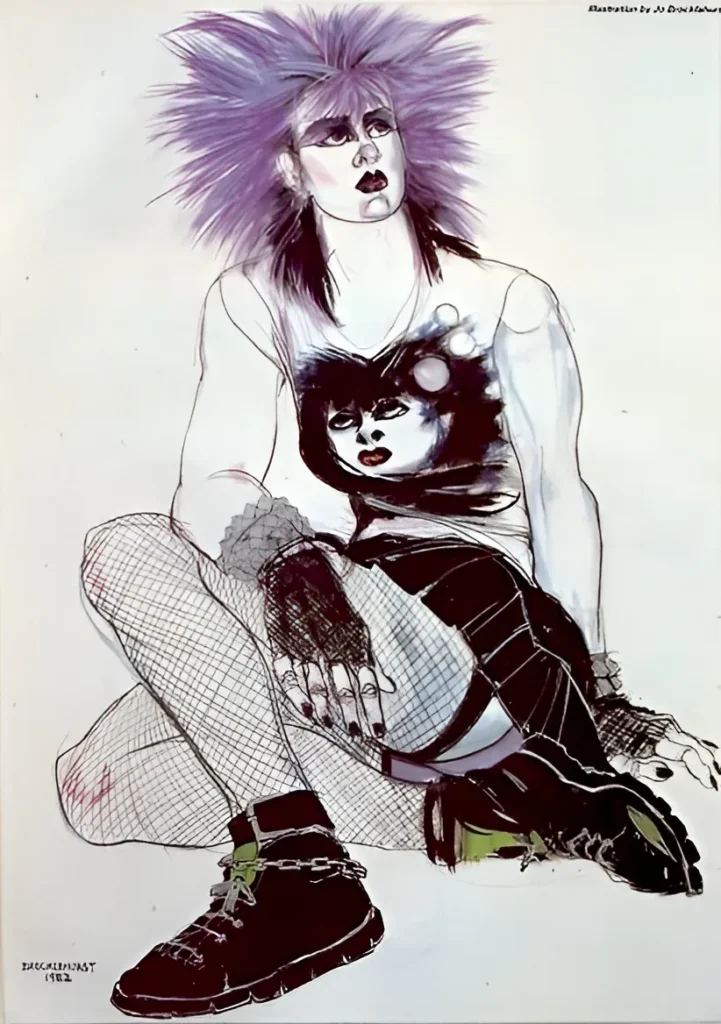
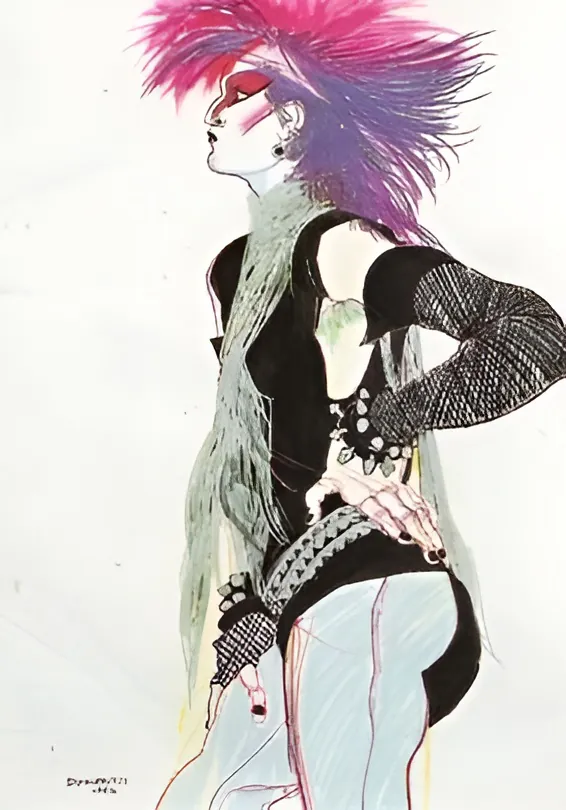
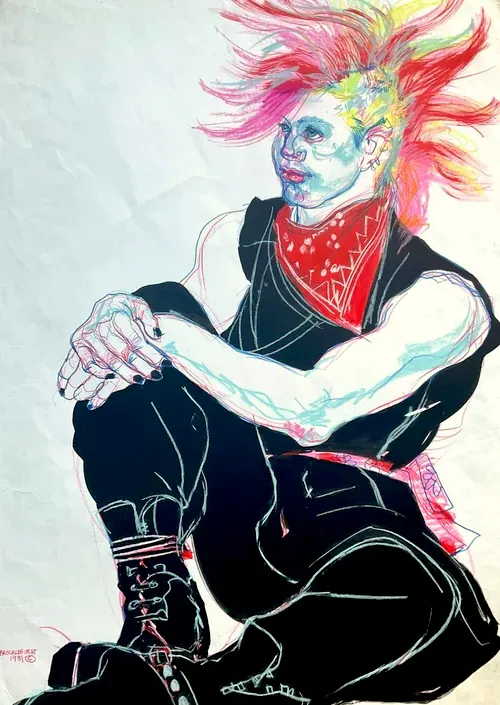
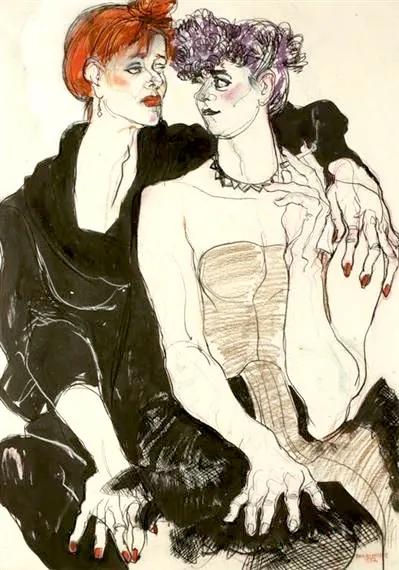
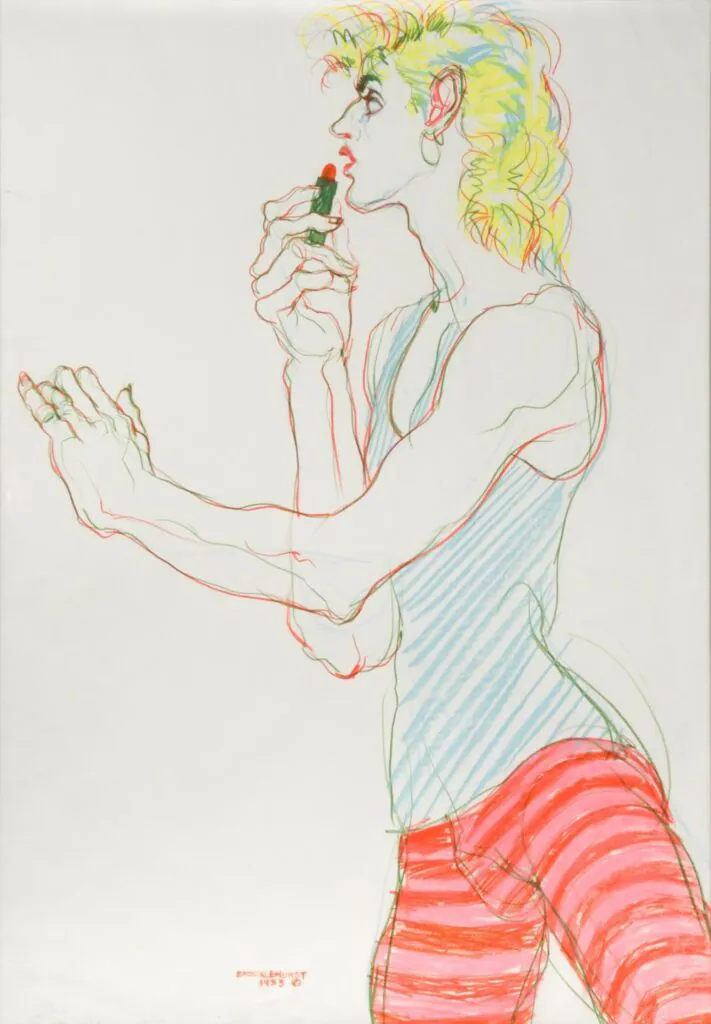
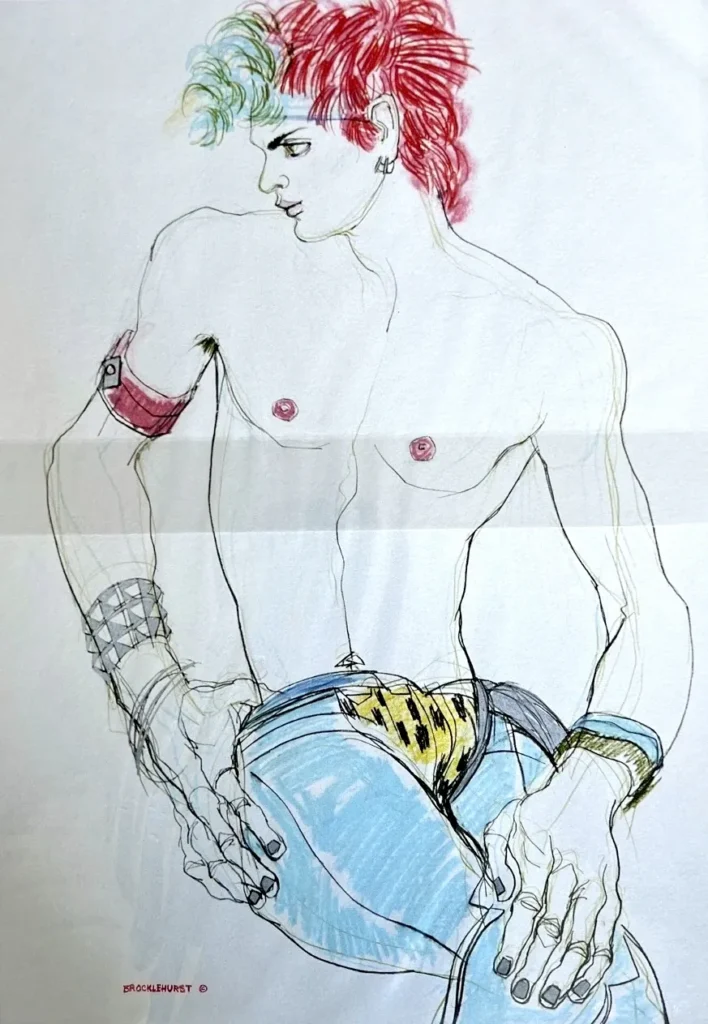
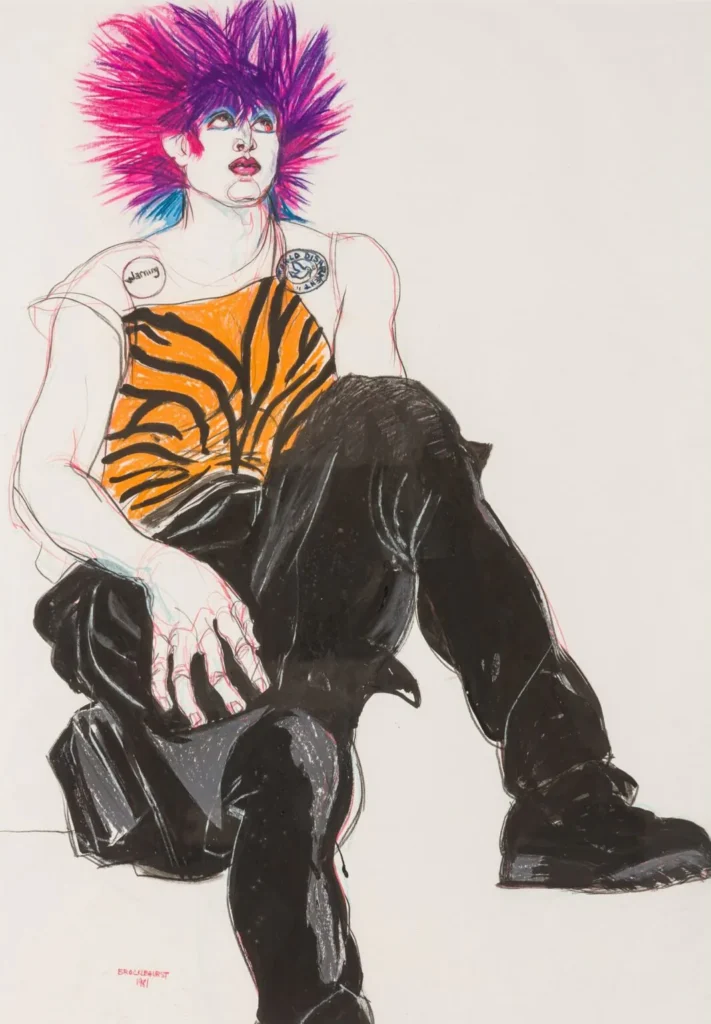
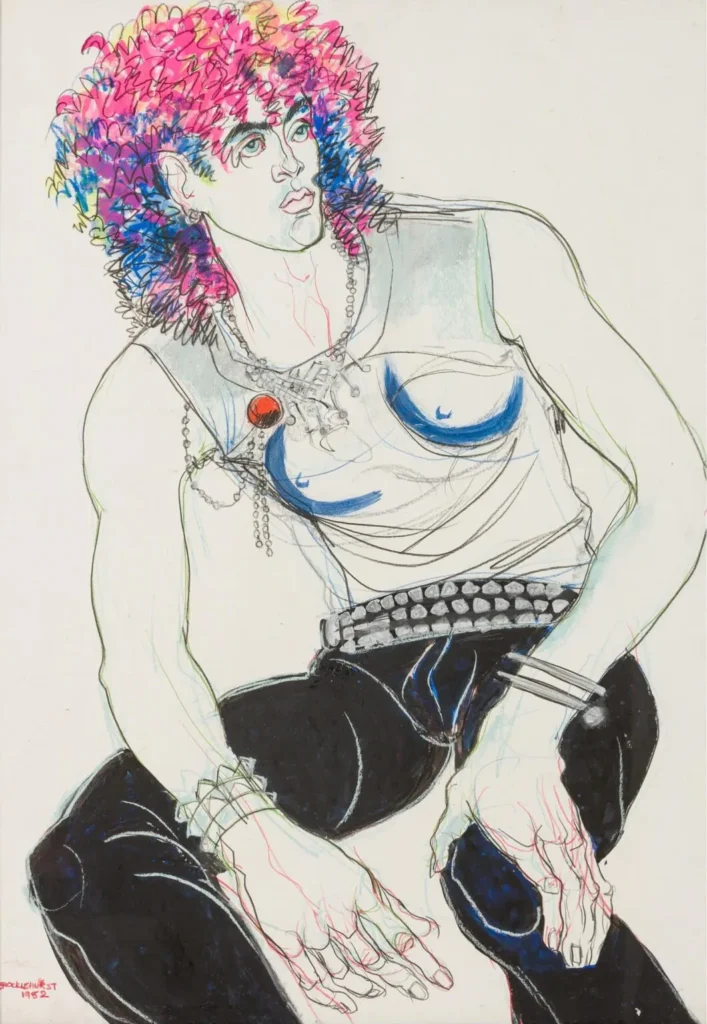
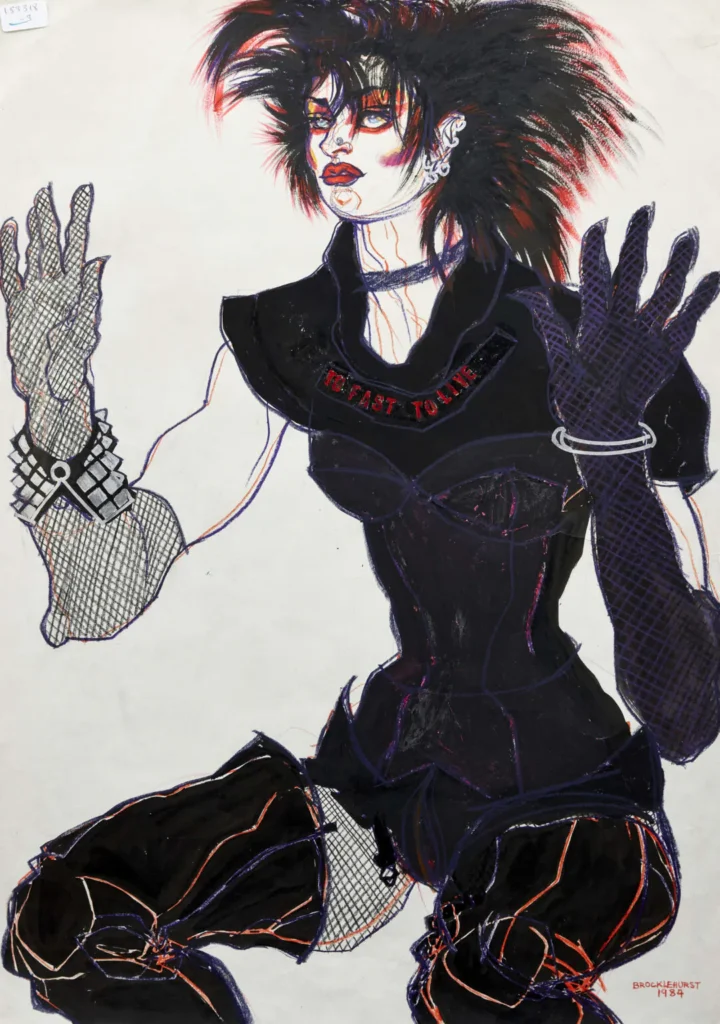
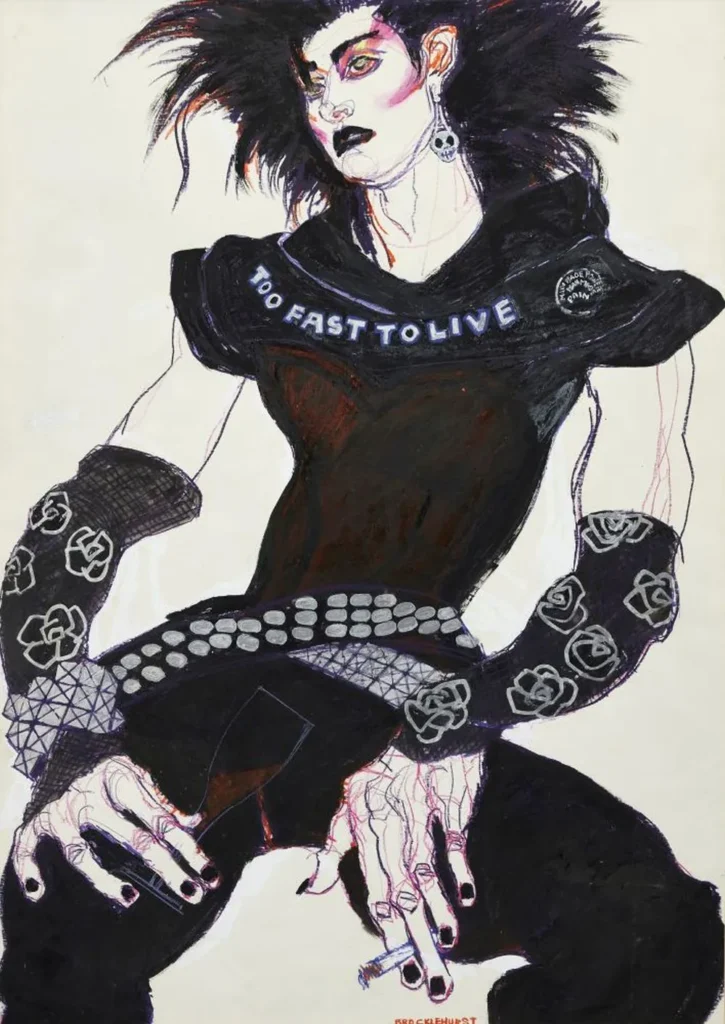
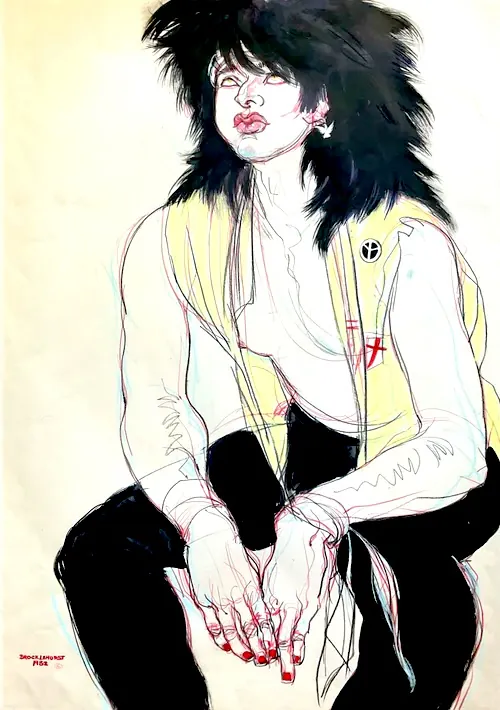
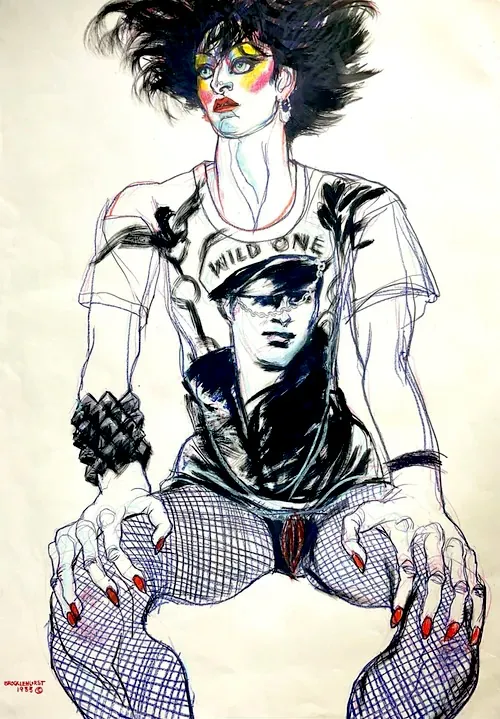
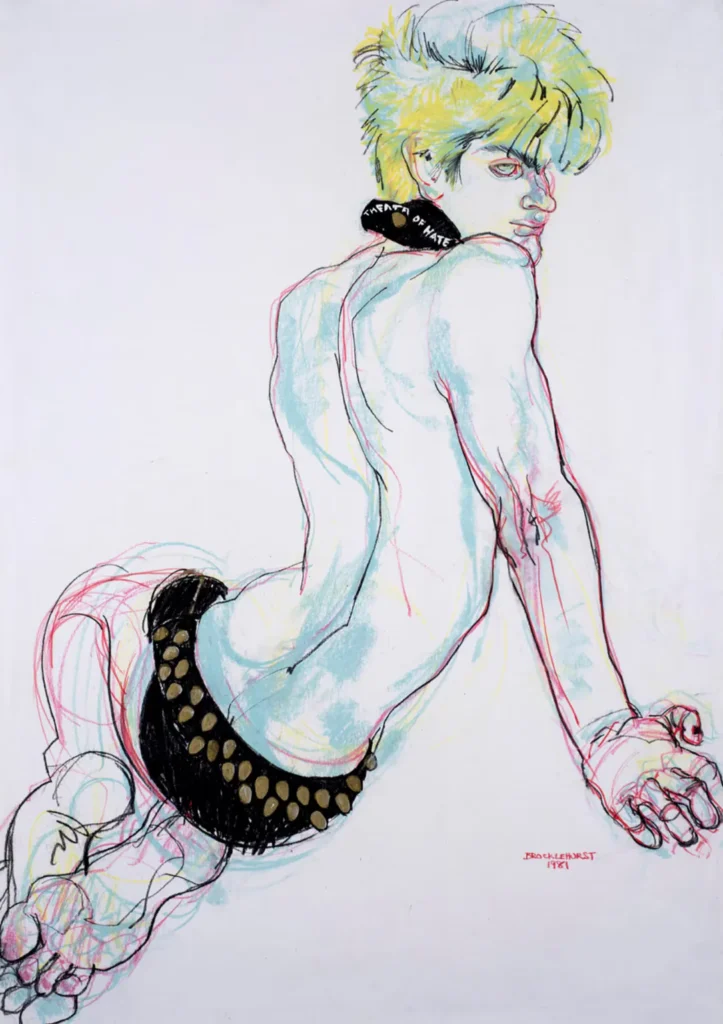
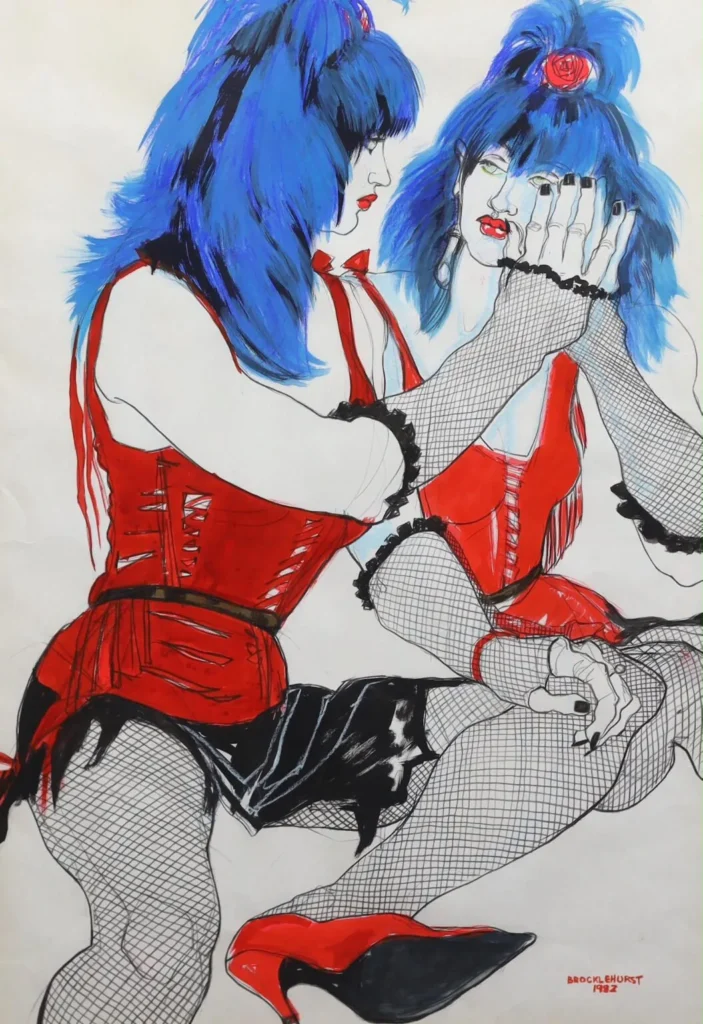
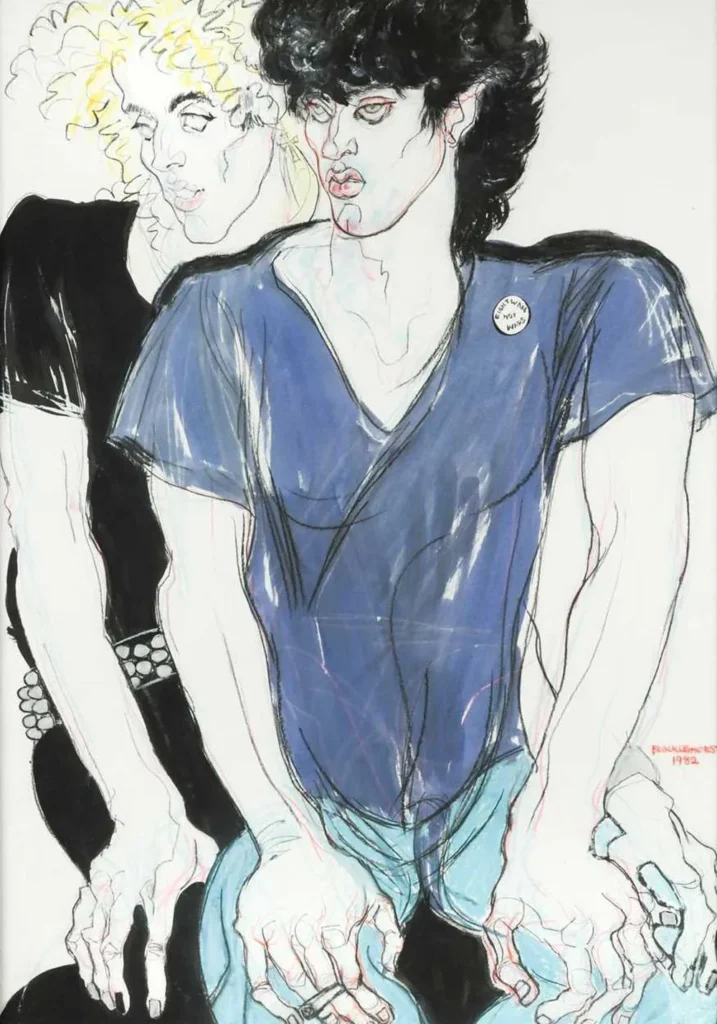
Brocklehurst encouraged her subjects to adopt provocative poses, unashamed and eager to be seen. Her drawings register their confidence as they moved beyond social expectations, experimenting with sexuality and gender presentation in ways that defied convention. Their styling and posture reflect deliberate, inventive choices that turned alienation into self-definition within a culture and time that often met difference with suspicion.
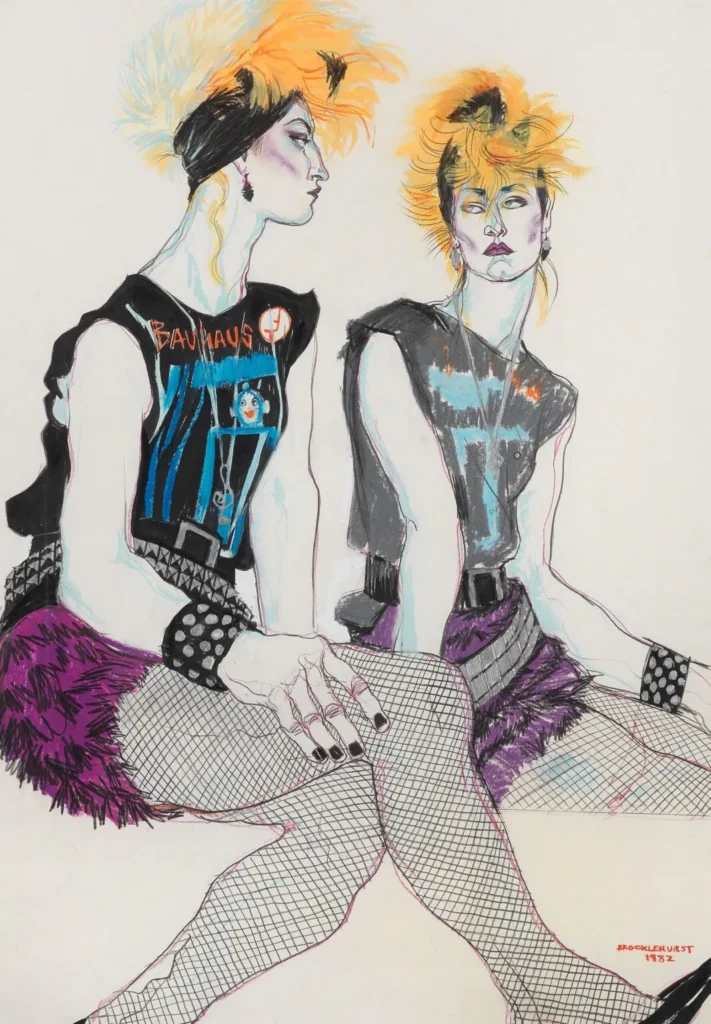
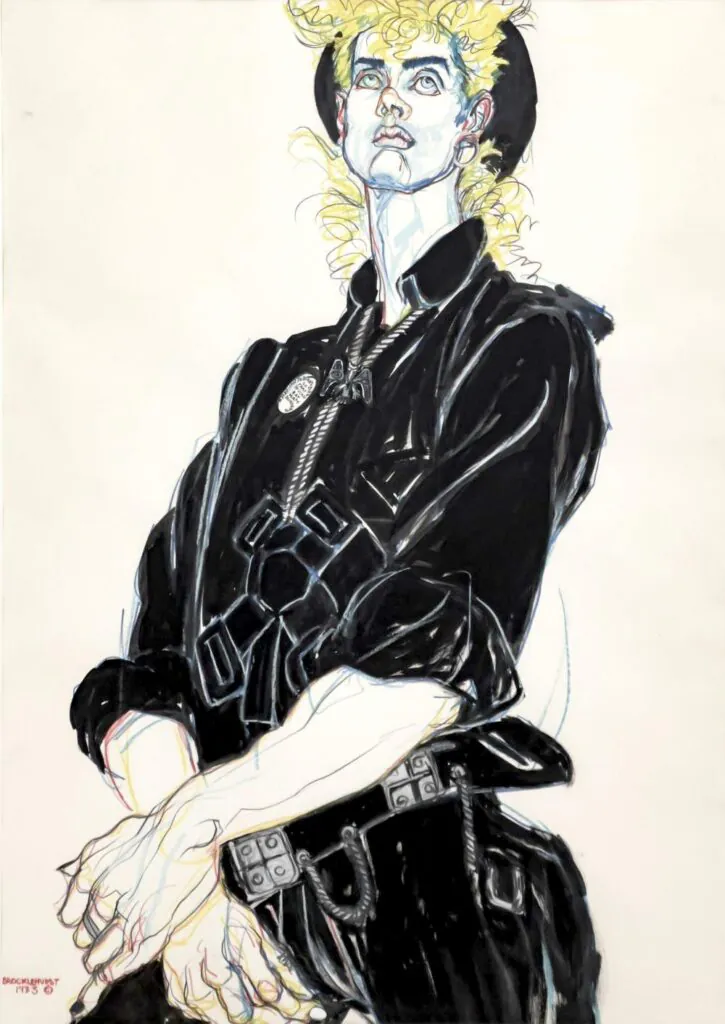
Her drawings from the late 1970s and early 1980s remain her most recognized works. During this period, her subjects included local celebrities such as Blitz Club cabaret and New Romantic duo James Biddlecombe and Eve Ferret to globally-recognized figures such as Siouxsie Sioux, Boy George, Marc Almond, the performance impresario Philip Salon, and dancers from the company of famous choreographer Pina Bausch in Berlin. Notably, many of her portraits were of Isabelle Bricknall, her lifelong friend, muse, and collaborator.
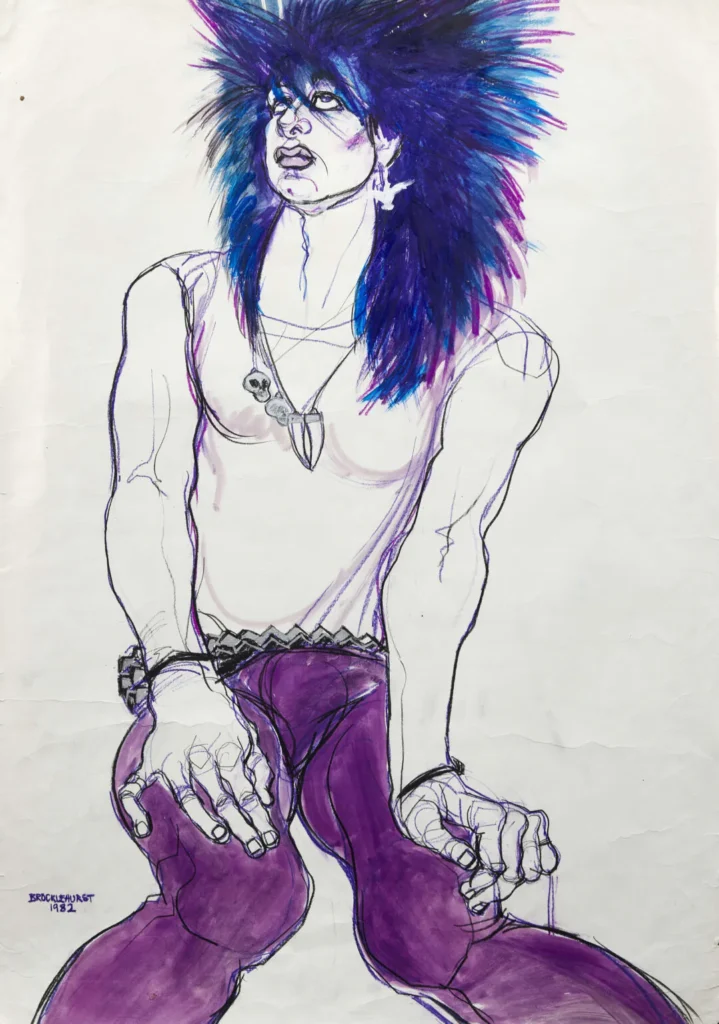
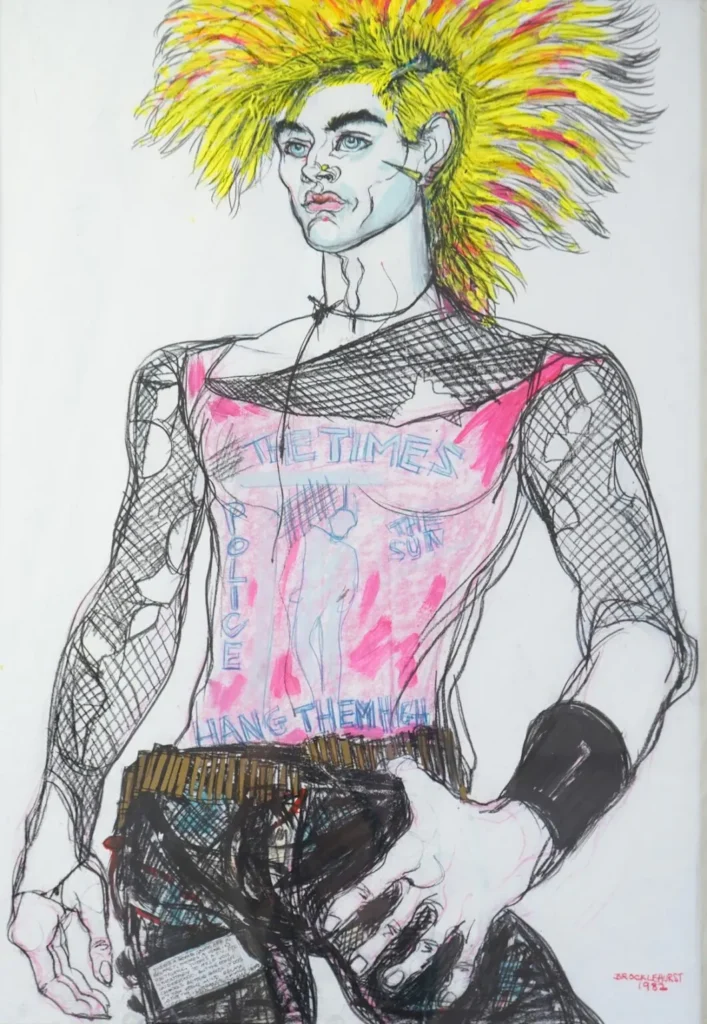
The most revealing insight into Brocklehurst’s life and working methods comes from Bricknall, but Brocklehurst would not reveal her age even to her throughout their relationship. “She saw herself as timeless and ageless,” Bricknall recalls. Before they officially met, Bricknall was at Nottingham Trent studying her MA in fashion and textiles, with the intent on becoming a designer, where she encountered Brocklehurst as a visiting teacher of fashion illustration.
Bricknall also remembered Brocklehurst as an imposing presence in the classroom: tall, beautiful, with an intense gaze, strict about discipline and silence, and insisting students learn the power of concentration. She discouraged small sketchpads, urging students to use wallpaper lining paper so their drawings could expand physically and energetically.
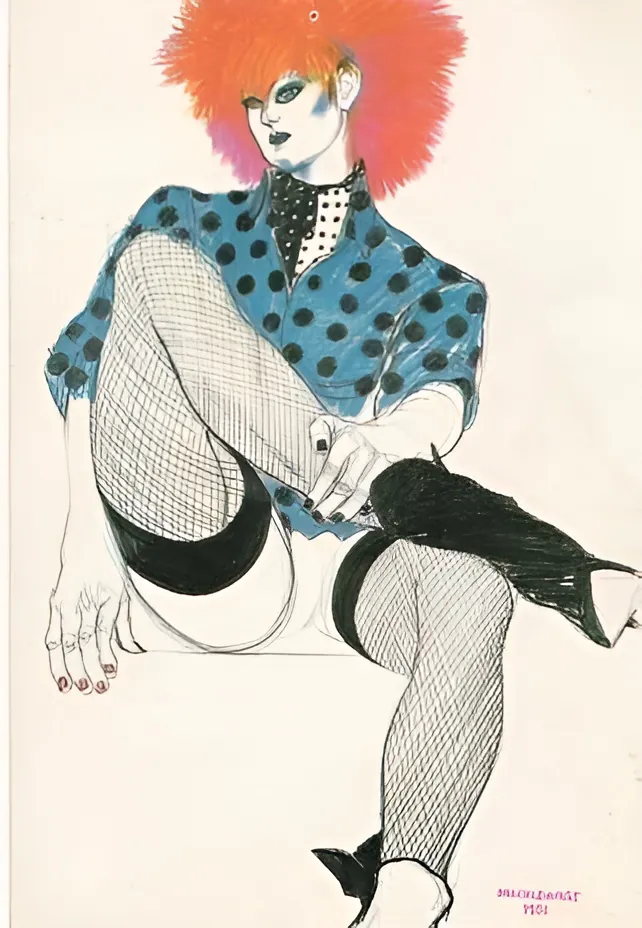
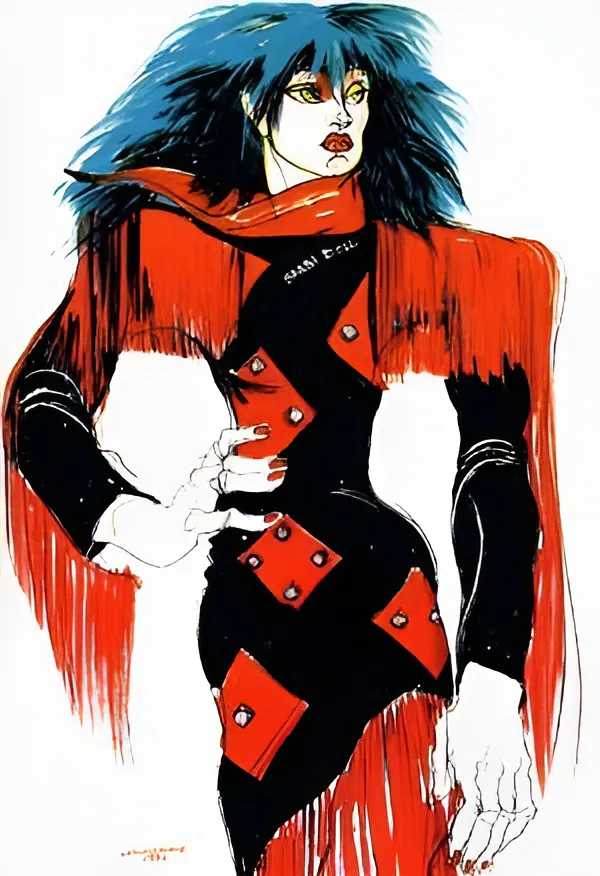
The two first interacted at length in the early 1980s through their mutual friend, the teacher and fashion illustrator Colin Barnes, who would do work for couture shows. The strong-featured Bricknall was modelling in an extravagant Christian Lacroix tweed couture outfit when Brocklehurst arrived for tea and, captivated by her appearance, insisted on drawing her, telling him “he had to share”.
Barnes, slightly frustrated, proposed they sketch her simultaneously. According to Bricknall, Barnes’ rendering made her look like “the epitome of grace and elegance”, while Brocklehurst’s captured something more volatile and psychological, “like I’d just escaped from an asylum.” Bricknall loved both images, noting that Brocklehurst seemed intent on revealing the woman within the clothes rather than the garments themselves.
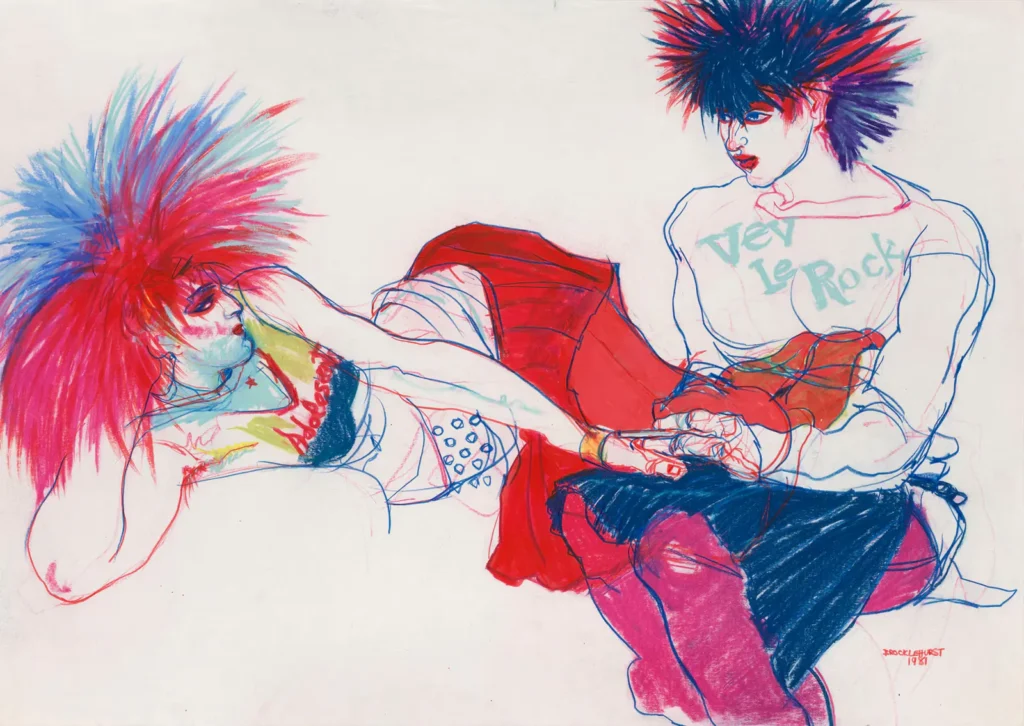
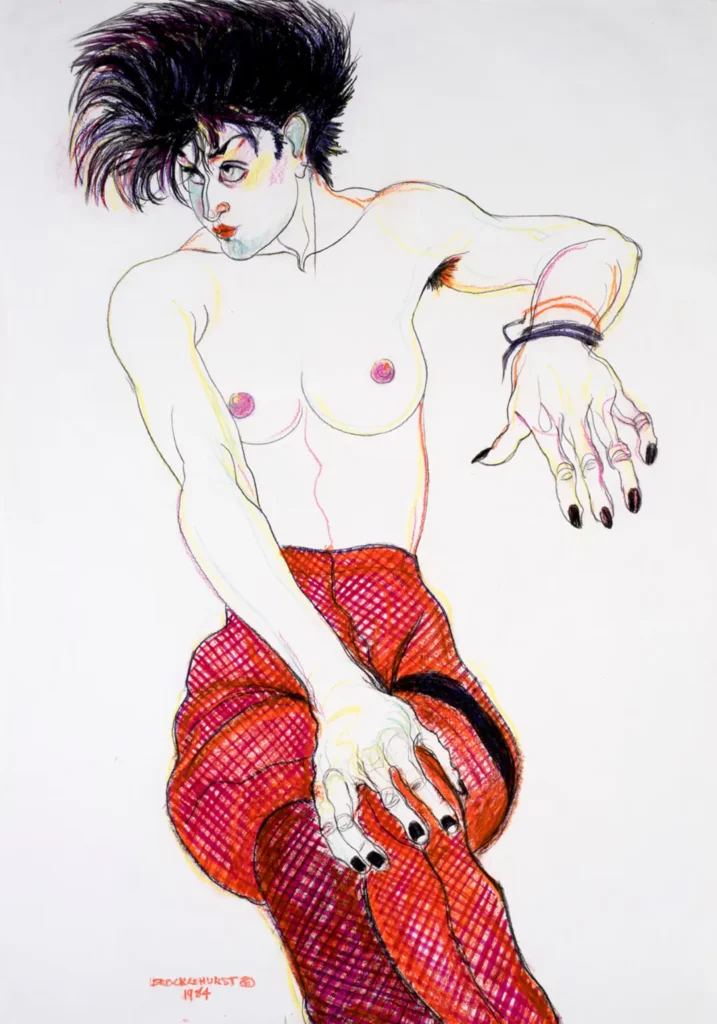
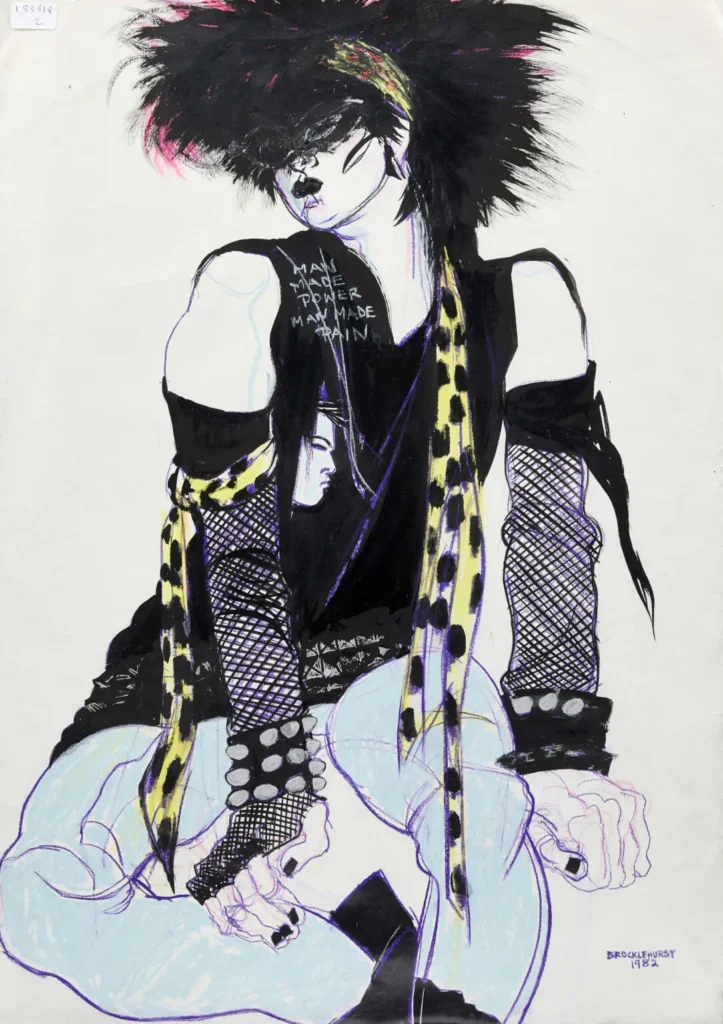
Barnes, a lecturer at the Royal College of Arts, St Martins, and Nottingham Trent, worked together with Brocklehurst while she was involved in the fashion illustration department. Their connection deepened when Bricknall moved to London after completing her studies in Nottingham, where Barnes lectured and Brocklehurst occasionally covered classes.
Bricknall went on to work in the fashion industry with designers including Zandra Rhodes and developed a multidisciplinary practice spanning textiles, glass, steel, film, photography, and performance. This shared creative range drew the two together. Bricknall modelled her own experimental designs while Brocklehurst drew them; they collaborated on exhibitions and art projects; Bricknall later assisted in archiving Brocklehurst’s work. They visited clubs together and maintained a creative partnership that lasted until Brocklehurst’s death. “It was so great to meet someone who you could really trust, especially another woman; she became something of a mentor. She had so much energy and drive and was just so much fun to be around. We’d go on lots of adventures and get into lots of trouble together.” she recalls of Brocklehurst.
Bricknall emphasized Brocklehurst’s relentless drive, compelled to create rather than to cultivate a market. She sold work only when necessary, often to finance travel. “She didn’t give a shit about impressing people,” Bricknall said. “Her sketchbooks were like her diaries. She drew every single day. She was driven to create. I think there are a lot of great artists that can slip through the net because they’re not all about the cash. The only time she’d sell stuff would be because she needed the money to facilitate a trip. She was the real deal. She was extraordinary.”
One of the few who could keep up with Brocklehurst’s relentless output, she followed her to the places where she produced much of her most famous work. Brocklehurst’s non-judgemental and empathetic attitude won her an audience with many different people on the alternative side of culture and nightlife. “She was drawing every kind of scene,” Isabelle Bricknall recalls.
In the 1960s, Jo Brocklehurst occurred after she moved into an artist’s studio at 12 Westbere Road in West Hampstead where she would remain until the end of her life. It was here where she would pivot to capturing one of the most memorable scenes of her career. The modest North London address and its surroundings became both a working space and a point of quiet convergence for subcultures moving through the city. By the early 1980s the street had become an unlikely overlap between Hampstead domestic calm and DIY disorder, in the form of an anarcho-punk squatter scene quietly developing on the same street.
One of the figures orbiting this scene was zine editor Tony Drayton, who arrived in London from Cumbernauld, Scotland in April 1977 after editing the early punk publication Ripped and Torn. His life moved between London, Paris, and Amsterdam and included jobs as varied as fire eating. After a period spent living in various squats, in the fall of 1979 Tony and his sister Val, who had joined him in the city a year before, met a group of punks in West Hampstead, including Eve (Carol Mills), former partner of Adam Ant (Stuart Goddard), and bassist Kevin Mooney, later of Adam and the Ants.
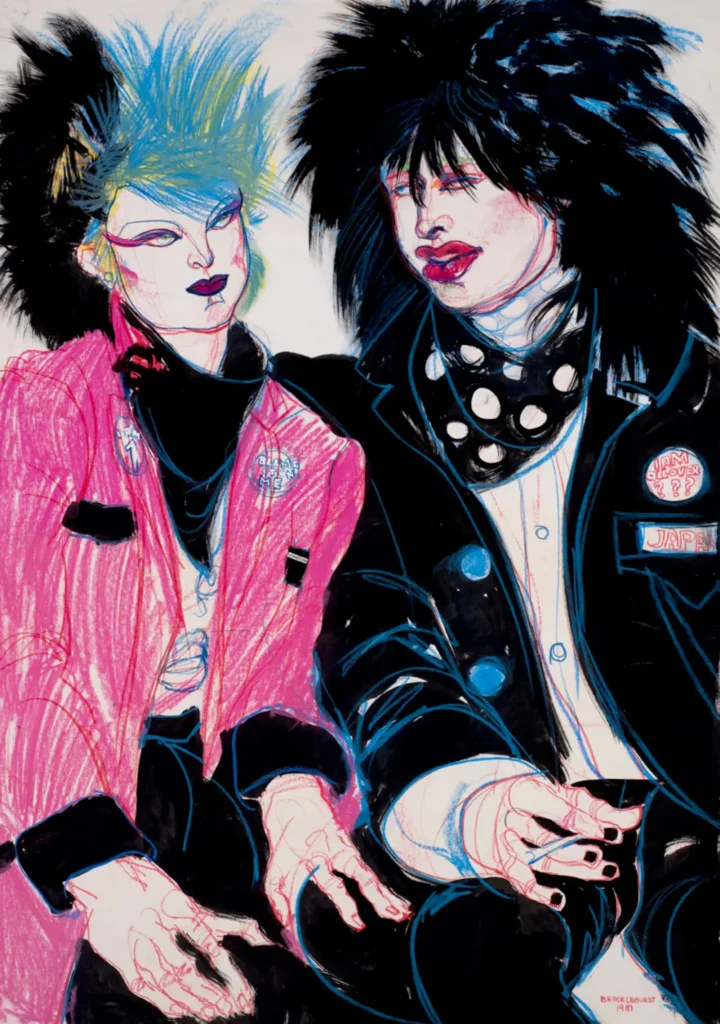
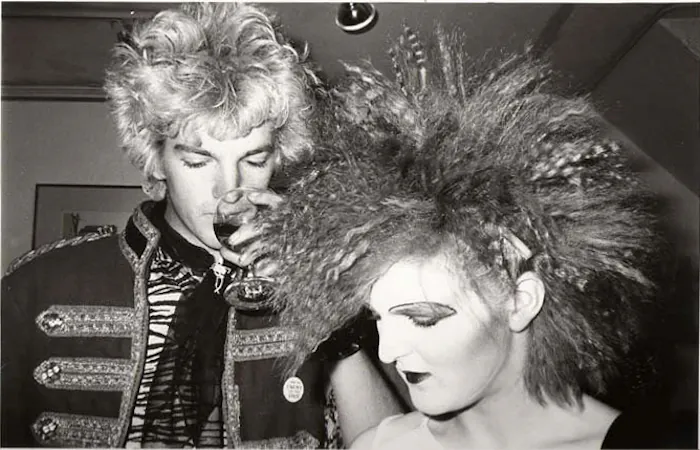
They were offered an empty flat at 33 Sherriff Road, part of a house run by the West Hampstead Housing Association. The household included Andi and Ross, musicians from Australian bands The Urban Guerrillas, along with Dave Roberts, later of Sex Gang Children, as well as Andy Groome and Malcolm Baxter of Australian punk band The Last Words. Money was scarce. They earned about £6 a day delivering leaflets and spent much of it drinking at the nearby Railway pub or attending shows at the Moonlight Club.
Drayton began editing a new zine, titled Kill Your Pet Puppy, with the first issue produced for Adam and the Ants’ New Year’s Day 1980 show at the Electric Ballroom in Camden. 500 copies sold out that night and were reprinted. Now calling themselves the Puppy Collective, the group produced six issues through 1983 while Drayton also wrote for Record Mirror, New Musical Express, and Zigzag.
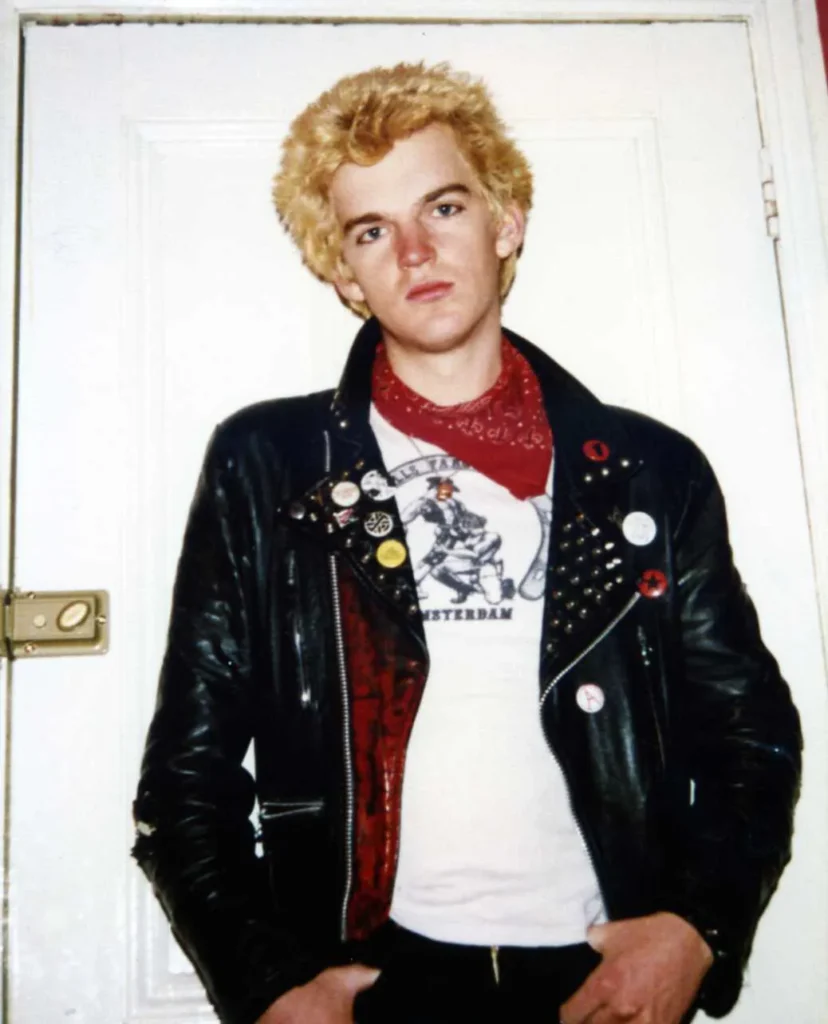
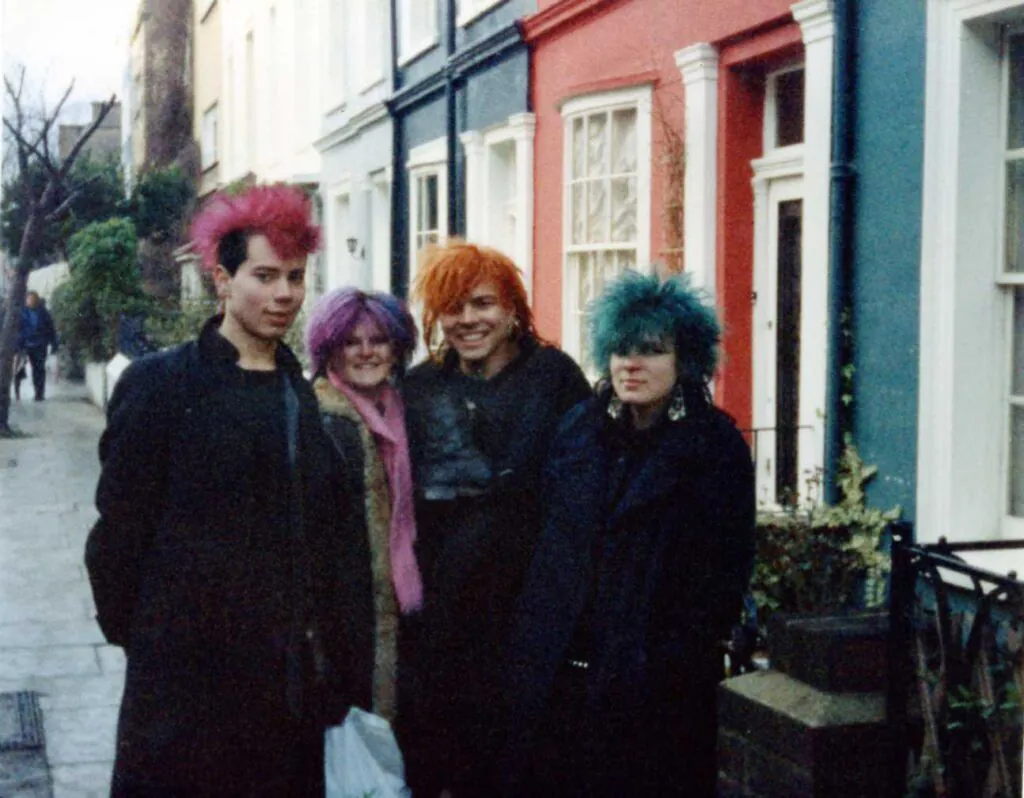
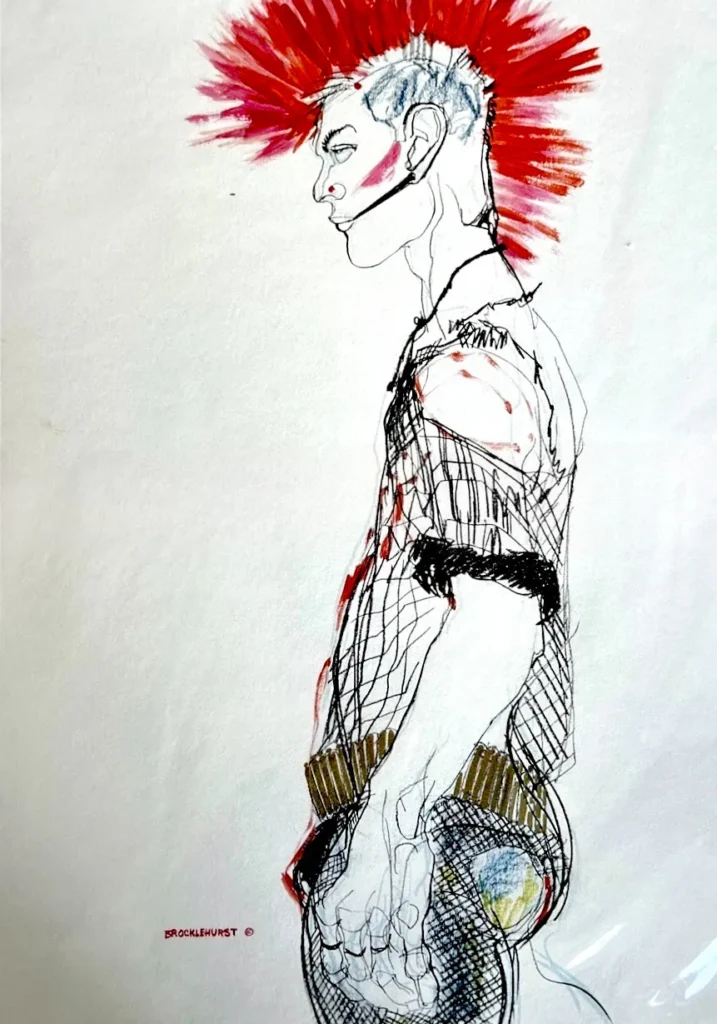
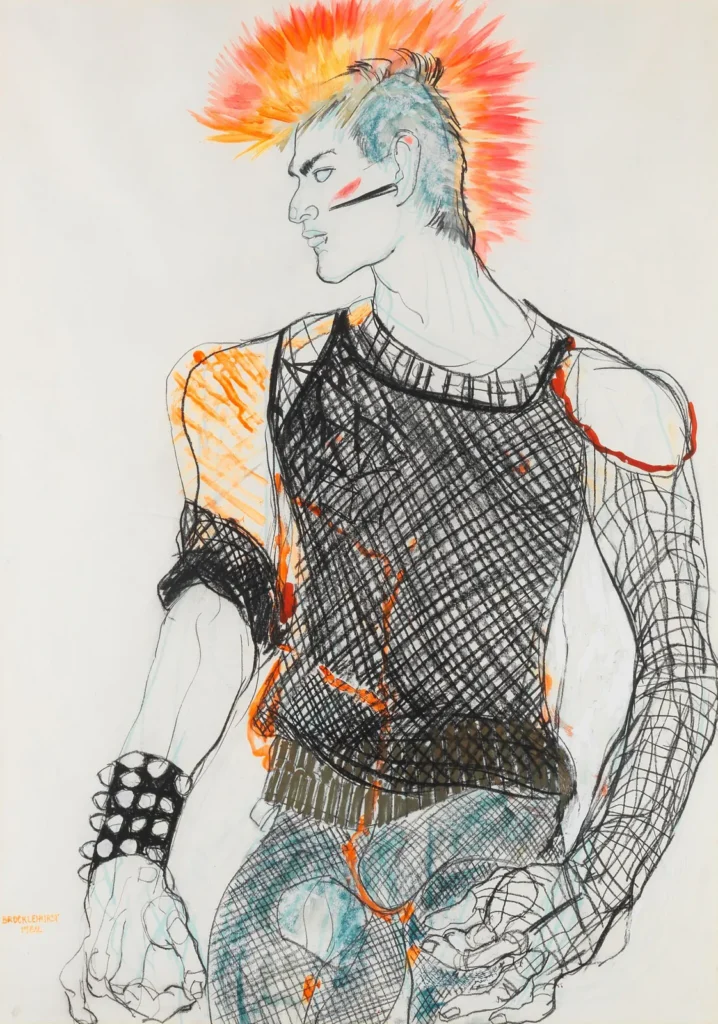
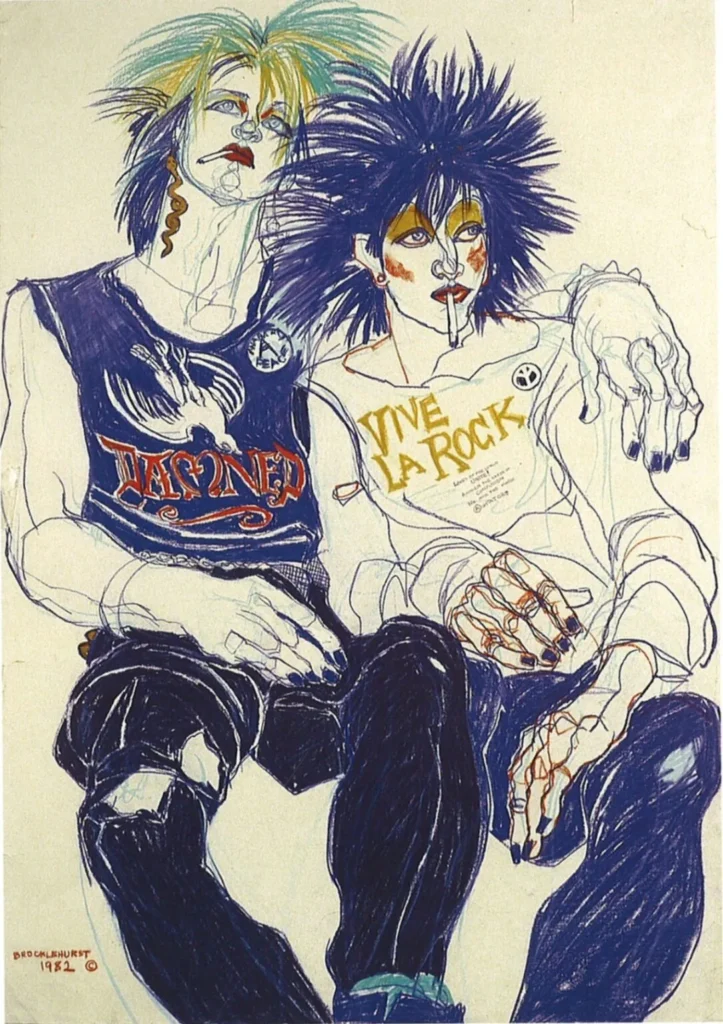
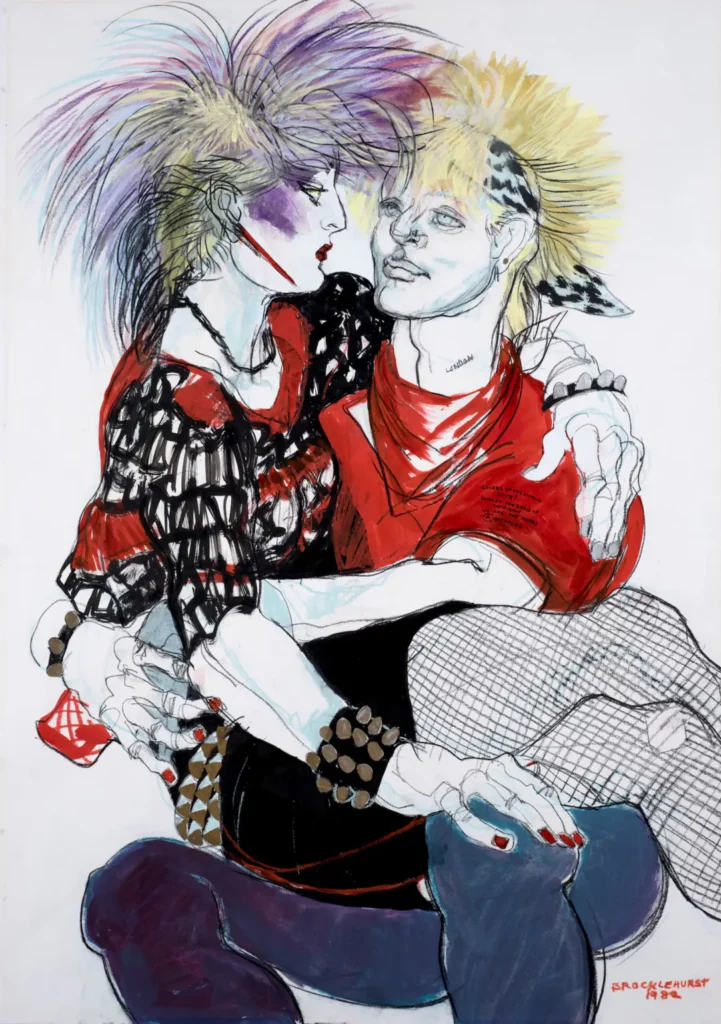
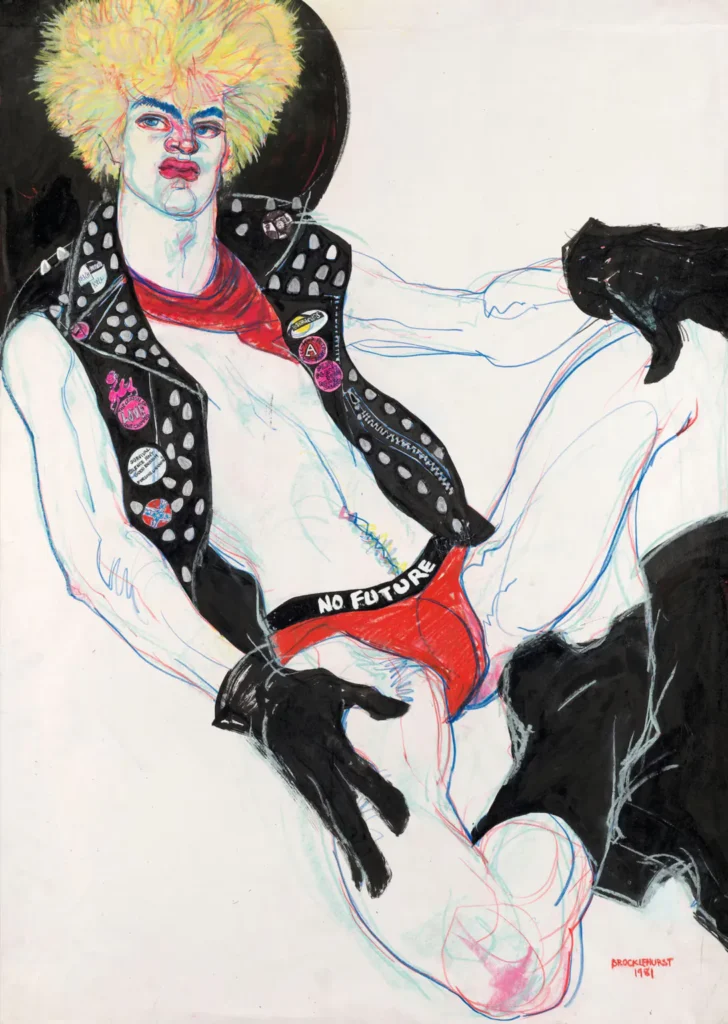
In the summer of 1980 Tony and Val moved into another WHHA property at 39 Westbere Road and this is where their world collided with that of Jo Brocklehurst. One day, Brocklehurst saw the punks passing her window and was struck by their appearance. She invited them into her studio and began making the drawings that would become one of the most vivid visual records of the scene. Soon, the collective, which included squatters from the Centro Iberico squat in Notting Hill and the Wapping Autonomy Centre, became regular visitors and models.
Inside the small studio, the atmosphere was incongruous and oddly ceremonial. Punks in full regalia sprawled across sofas and chairs, drinking tea from fine china while waiting to be drawn. One sitter remained motionless, eyes fixed on the ceiling, bemused but quietly pleased that the artist down the street wanted to draw her and her friends, lured in by the promise of bottomless Earl Grey. This mixture of domestic calm, ritual hospitality, and radical self-presentation became a recurring tableau in Brocklehurst’s West Hampstead studio, where subcultural defiance briefly paused, posed, and was transformed into art.
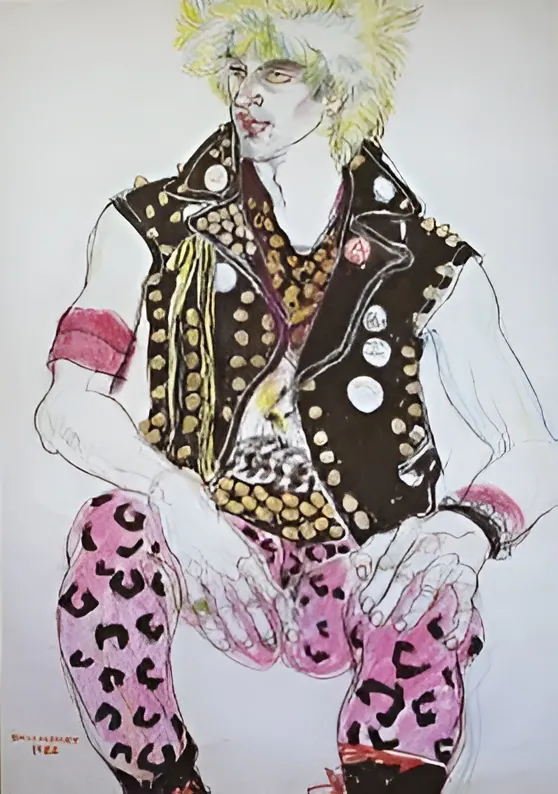
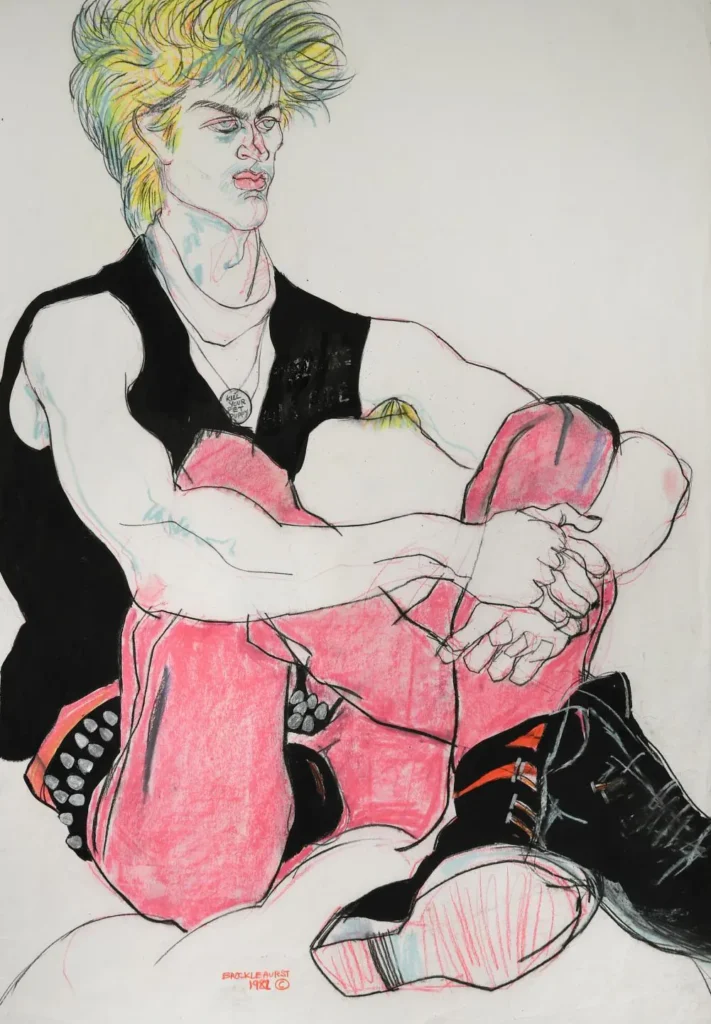
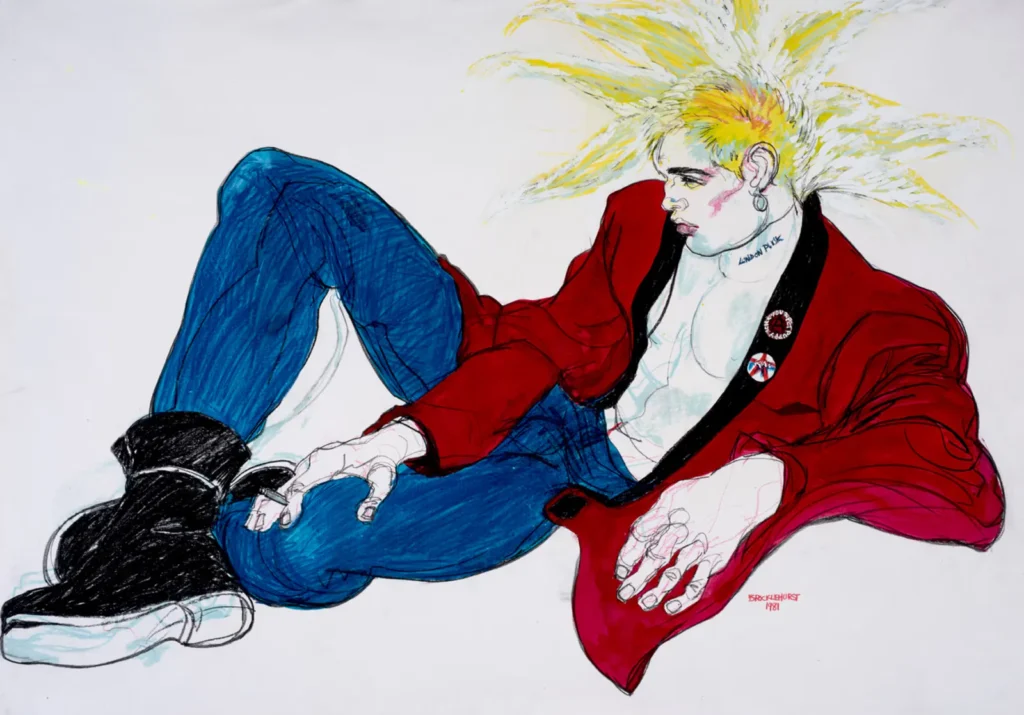
They later said her drawings transformed them into “warriors,” amplifying presence and intent rather than simply recording appearance. Brocklehurst’s contribution was certainly welcomed by them, in a time when being punk was often a label whose meanings were decided others. Lifestyle and image, and presenting the latter on their terms and in a way that made sense to them was central to the collective.
“The way we live and the way we portray ourselves makes the world a better place, gives it a better atmosphere, a more free and sensual atmosphere.” Tony Drayton once said. Brocklehurst, all too happy to oblige, also believed in the power of sharing new perspectives. “For me, the pleasure in being an artist is not to build up a reputation for doing the same thing, but to comment on different kinds of lives.”
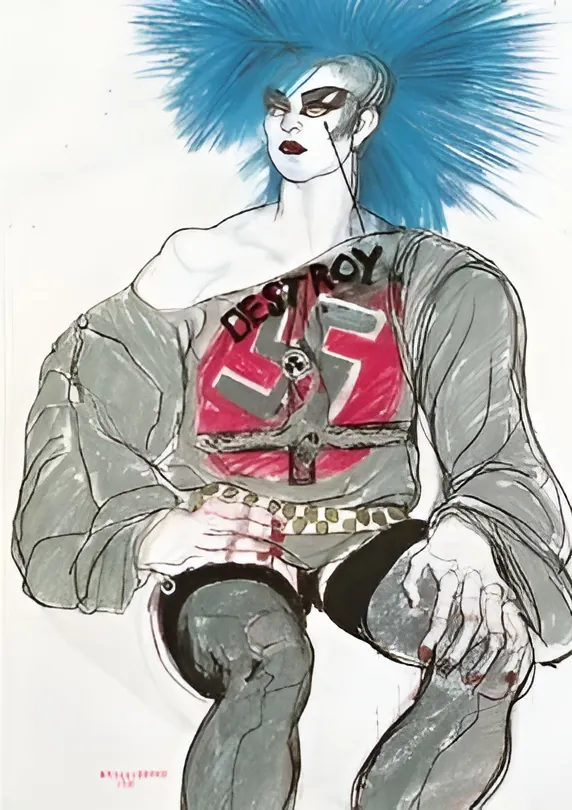
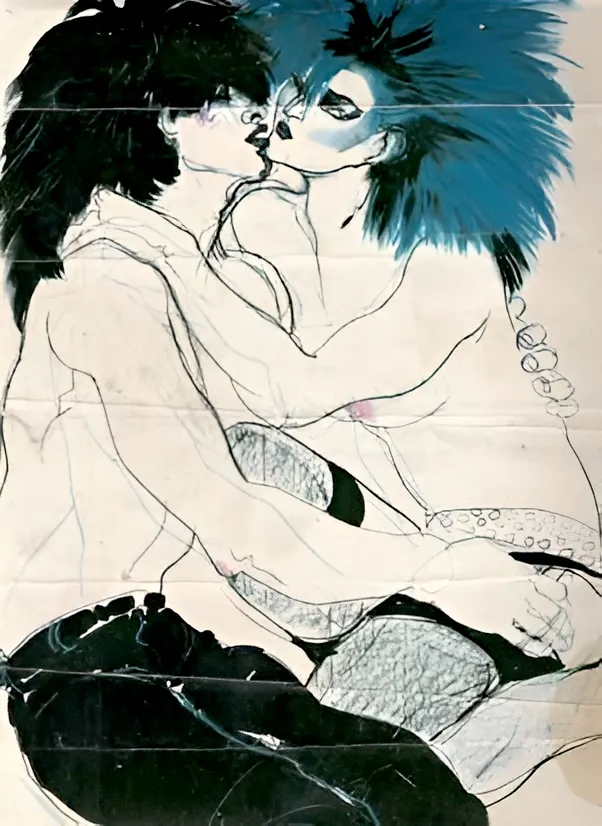
Just a few years before her encounters with the Puppy Collective, Jo Brocklehurst was already moving into the spotlight. Her first solo exhibition took place in Amsterdam in 1979, introducing audiences to her sharply observed figurative drawings. The real breakthrough came in October of the following year with the inclusion of four of her works at an exhibition titled Women’s Images of Men at the Institute of Contemporary Arts, a politically charged event that challenged masculine stereotypes and foregrounded feminist perspectives in contemporary art, the culmination of a movement several years in the making in response to an exhibition of works by Allen Jones, whose art was criticized as depicting women in a demeaning light. The artist, in response, ironically cast himself as a feminist, due to his focus on depicting the female form.
The show averaged some 1,000 visitors a day, breaking all previous attendance records, with a line that ran from the ICA building to Trafalgar Square. Critics noted the way Brocklehurst’s work in particular combined psychological intensity with wit, and more than one drew comparisons to Egon Schiele, an association that would remain with the artist throughout her lifetime and beyond.
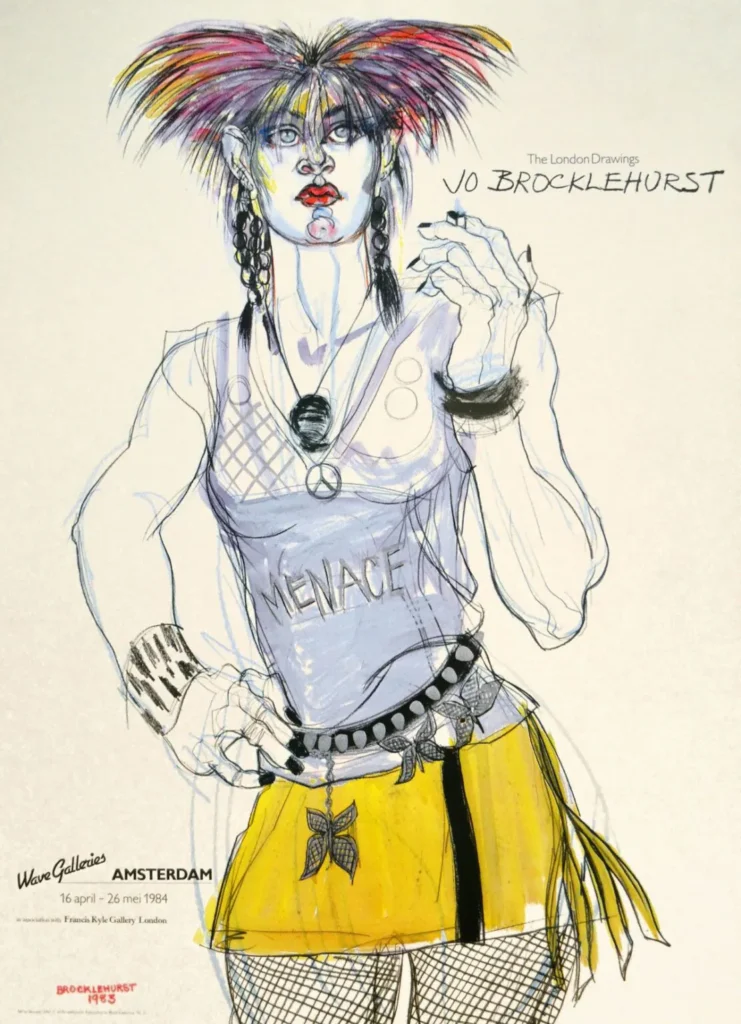
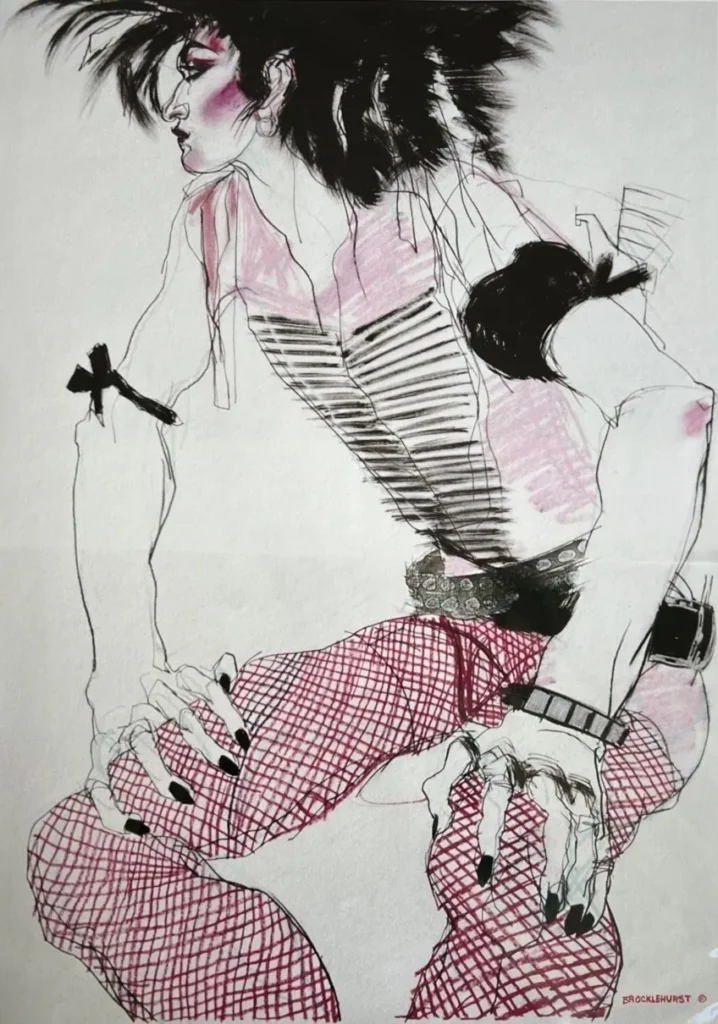
The ICA show rapidly elevated her profile. Alongside her skills as an artist, Brocklehurst developed a strong affinity with women artists and feminist networks, and her drawings gained attention for their ability to dismantle masculine expectations while retaining empathy and humor. Riding this momentum, Brocklehurst exhibited at the Francis Kyle Gallery in London in 1981 and 1982, followed by shows in New York with Leo Castelli and at Connecticut State University a year later. The subjects of these exhibitions, punks, goths, New Romantics, and other subcultural figures, felt urgent and contemporary, capturing the body as both armor and performance.
According to Bricknall, the punk-era exhibitions with Francis Kyle, despite selling well, left Brocklehurst with a lingering sense of dissatisfaction. The income allowed her to clear a modest mortgage, yet she felt the work had been undervalued and, to an extent, misunderstood. Asked why their collaboration ended, Kyle offers a simple explanation: she told him she had new statements she wanted to make.
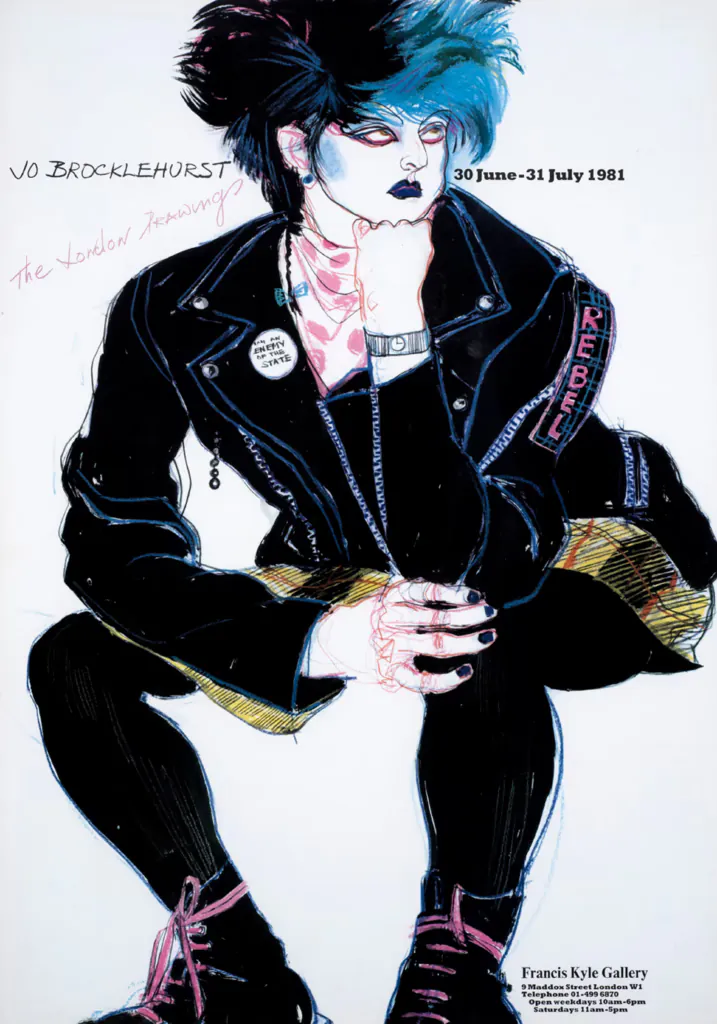
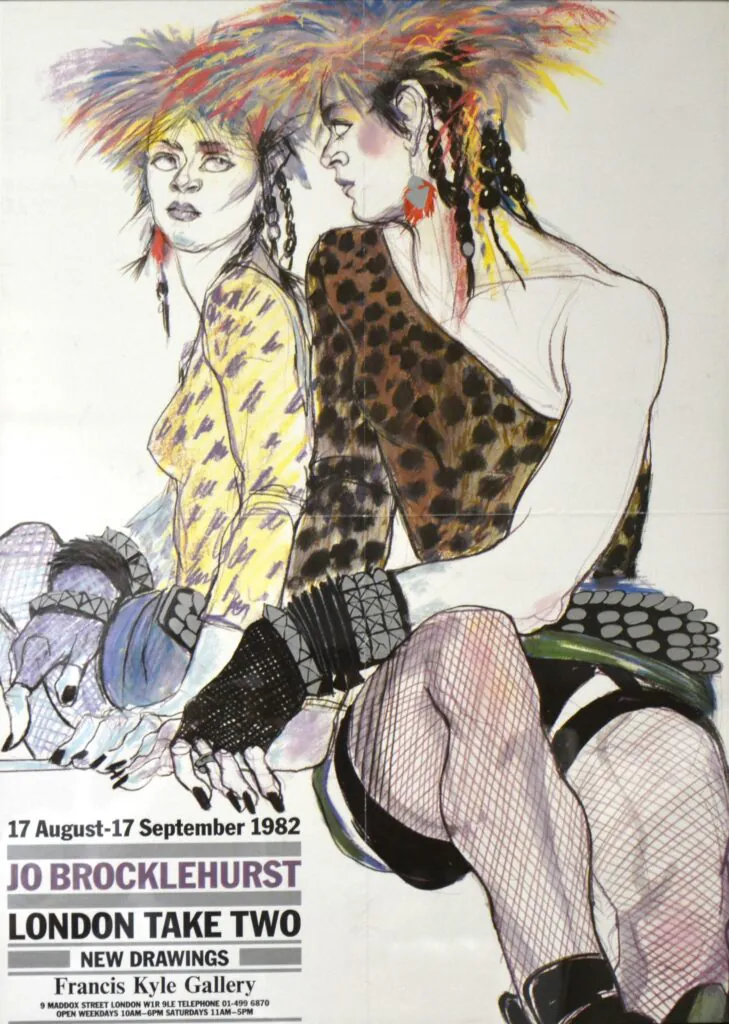
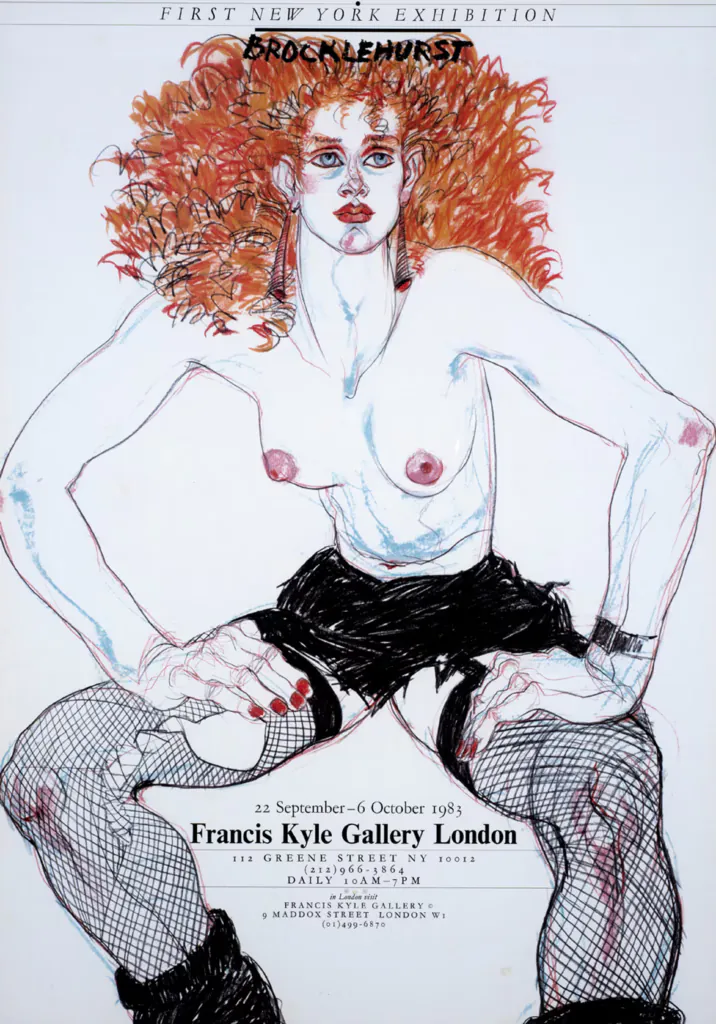
This was no surprise, as Brocklehurst resisted being boxed in and constantly sought to tell new stories through her portraits. She lived the artist’s life in the old sense, selling work sporadically to finance travel and materials. At a time when the art establishment kept its distance from acknowledging subcultures, she was drawn instead to them, treating them as vital subjects worth traveling the world for rather than curiosities to be panned by a bewildered press. She began traveling extensively, the New York exhibition in 1983 marked the beginning of regular stays in the city as well as regular trips to Berlin, Amsterdam, Rome, and Paris, all while keeping detailed visual diaries, experimenting with materials and environments, and refusing to simply reproduce the punk portraits collectors expected.
In New York, she sketched in the neon-lit gay clubs of the Meatpacking District, sometimes incorporating spray paint and ultraviolet pigments, a creative choice as well as a practical one, as the latter medium was more readily visible under club lighting. During this period she is believed to have intersected with the feminist collective Guerrilla Girls, a group established in 1985 in response to an atmosphere of sexism in the art world. The group assisted her with getting her work shown, in a time when it was still difficult for many women to get shown in galleries. Additionally, Brocklehurst formed a friendship with Keith Haring.
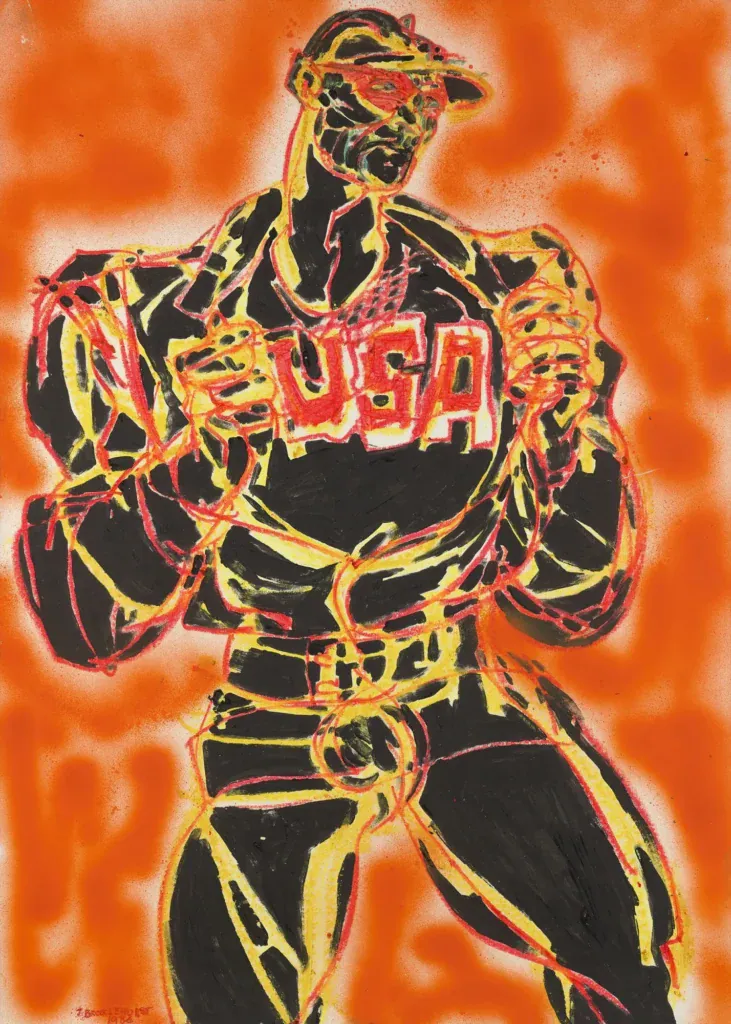
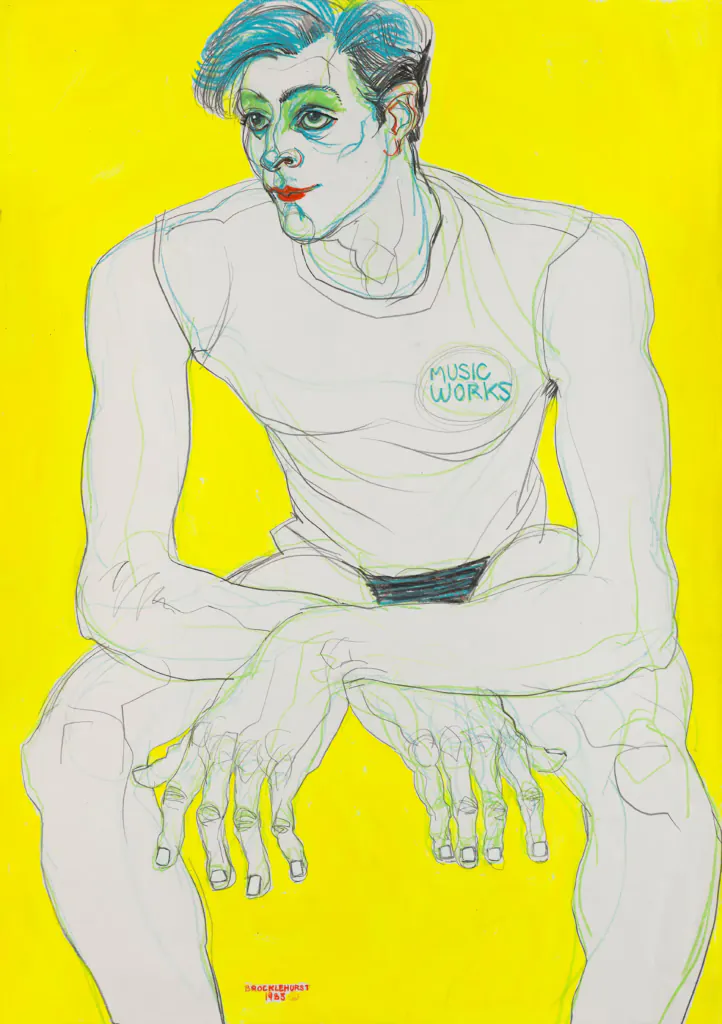
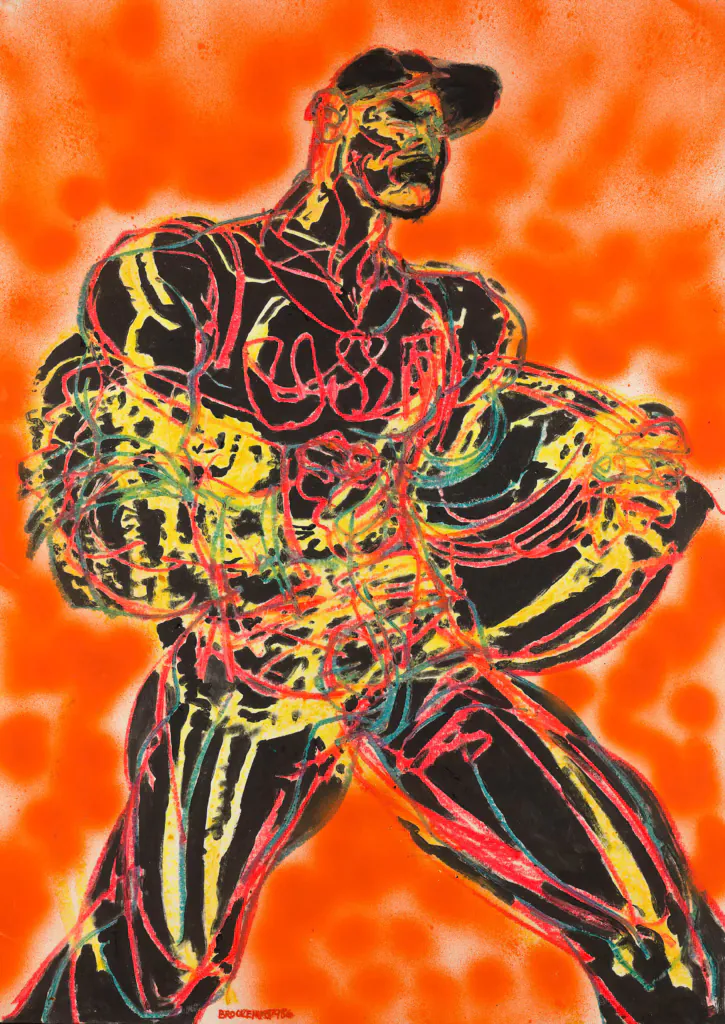
Wherever she went, she worked easily in heat and darkness, whether it was sketching in airless Berlin basements or the dim interiors of Amsterdam’s seedy venues. She drew dancers, performers, and club kids in seconds, reducing gesture to a decisive line while absorbing the atmosphere around her. More than one observer throughout her life has described her ability to draw in darkness, while also wearing multiple pairs of dark shades, specifically describing it as something akin to a superpower. “I used to think, ‘How the hell can she draw in a dark club?’ But she could. Later down the line I realized she had a gift.” Bricknall said.
Over the following decades Brocklehurst became enmeshed in the inventive fetish underground that blossomed in London during the 1990s, frequenting nights such as Torture Garden and the Skin Two Rubber Ball at Stallions in Soho, which served as a meeting point for experimental fashion, performance, and music that also attracted both established designers as well as budding fashion students from Brocklehurst’s alma mater of Central Saint Martins, who would come to debut their latest creations on the dance floor, their extreme silhouettes dancing alongside devotees of leather and latex. She continued to refuse to be pinned down by age or expectation, guarding herself through her persona, and often visiting together with Isabelle Bricknall, now a full-time designer, and her other friend, American anthropologist Ted Polhemus.
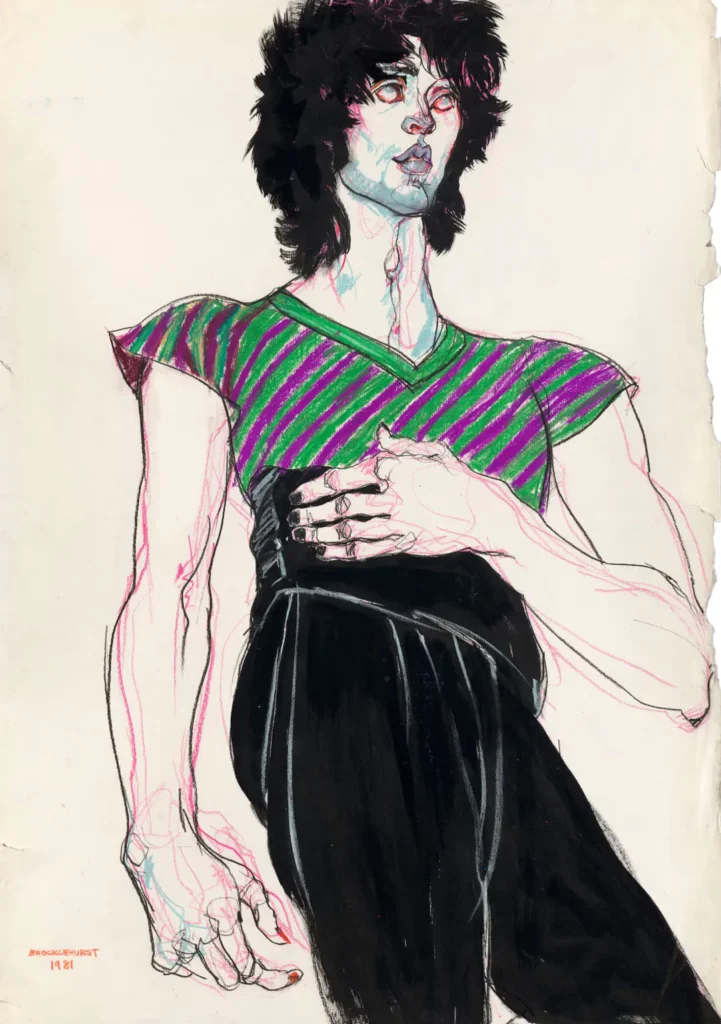
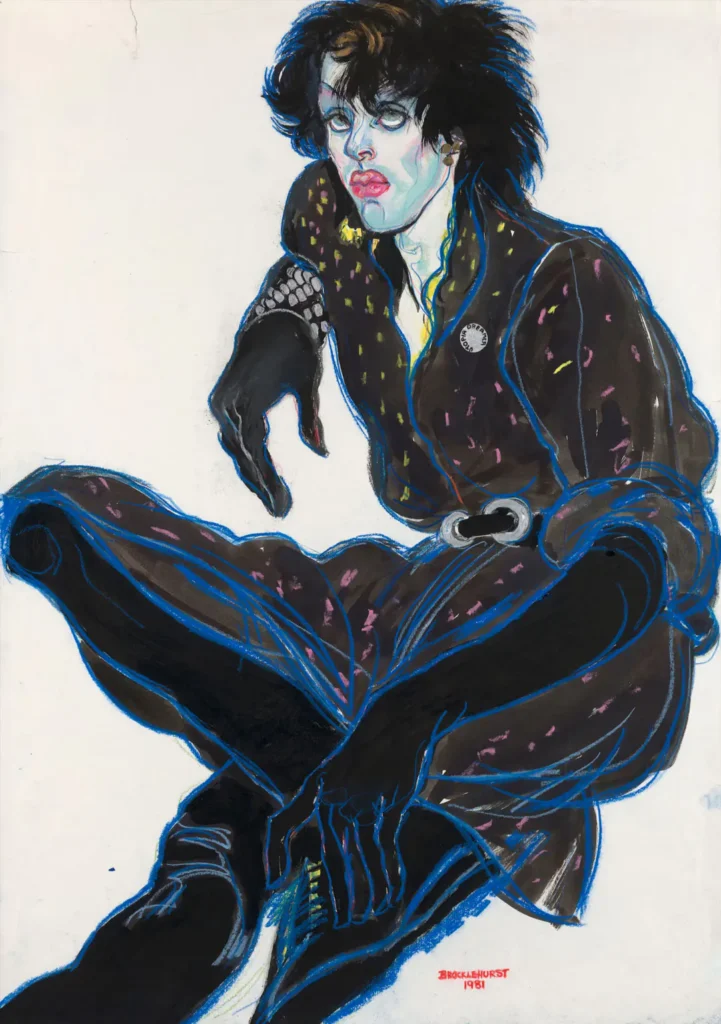
Brocklehurst accompanied Bricknall regularly to underground gatherings that, before becoming diluted by popularity, drew London’s most inventive figures. As Bricknall recalls, “People were experimenting with clothes, music; there were performers like Empress Stah and the likes of Leigh Bowery, Rachel Auburn, Thierry Mugler and Jean Paul Gaultier; they couldn’t get enough of it! Jo would float around with her sketchpads and her crayons and draw all the characters there, from the sublime to the ridiculous and I mean ridiculous! Of course she had her dark glasses and her blonde wig, which acted as a sort of barrier, as she didn’t want people to engage with her, although if someone did bother her she’d just raise an eyebrow and speak in her posh, Joanna-Lumley-like voice, which meant it was time to sod off. It would often be my job to go off and find out who it was she’d actually drawn.”
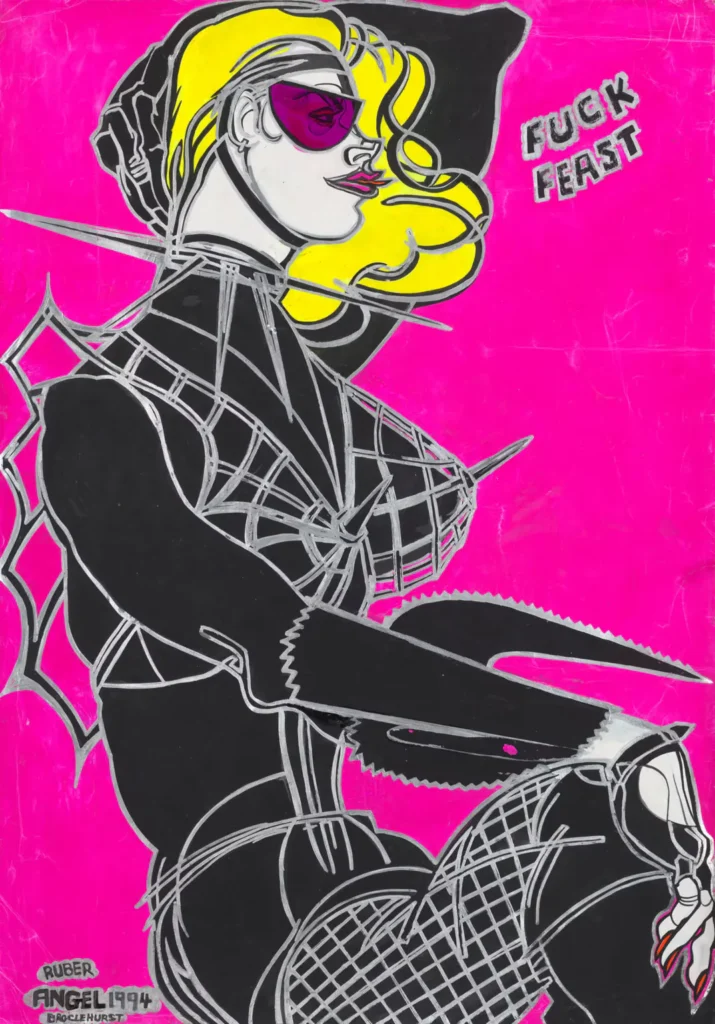
Isabelle Bricknall, depicted by Brocklehurst during this period as the “Rubber Angel,” had also shown off her work at the clubs. As one of her works, she designed futuristic steel body armour with her boyfriend at the time, metalworker Anthony Gregory, as ‘protection’ for women out on nights in the scene. Each piece was made specifically with its intended wearer in mind, a group composed of creatives whose work spanned design, dance, and music.
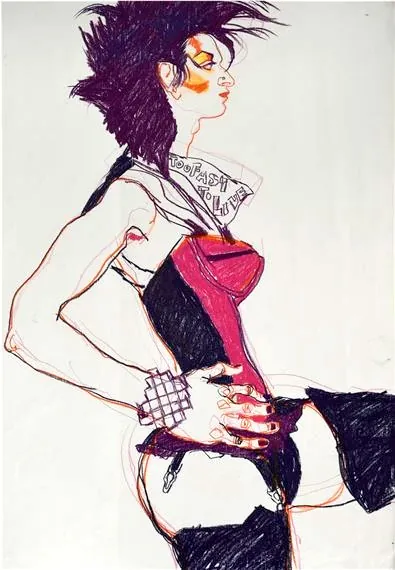
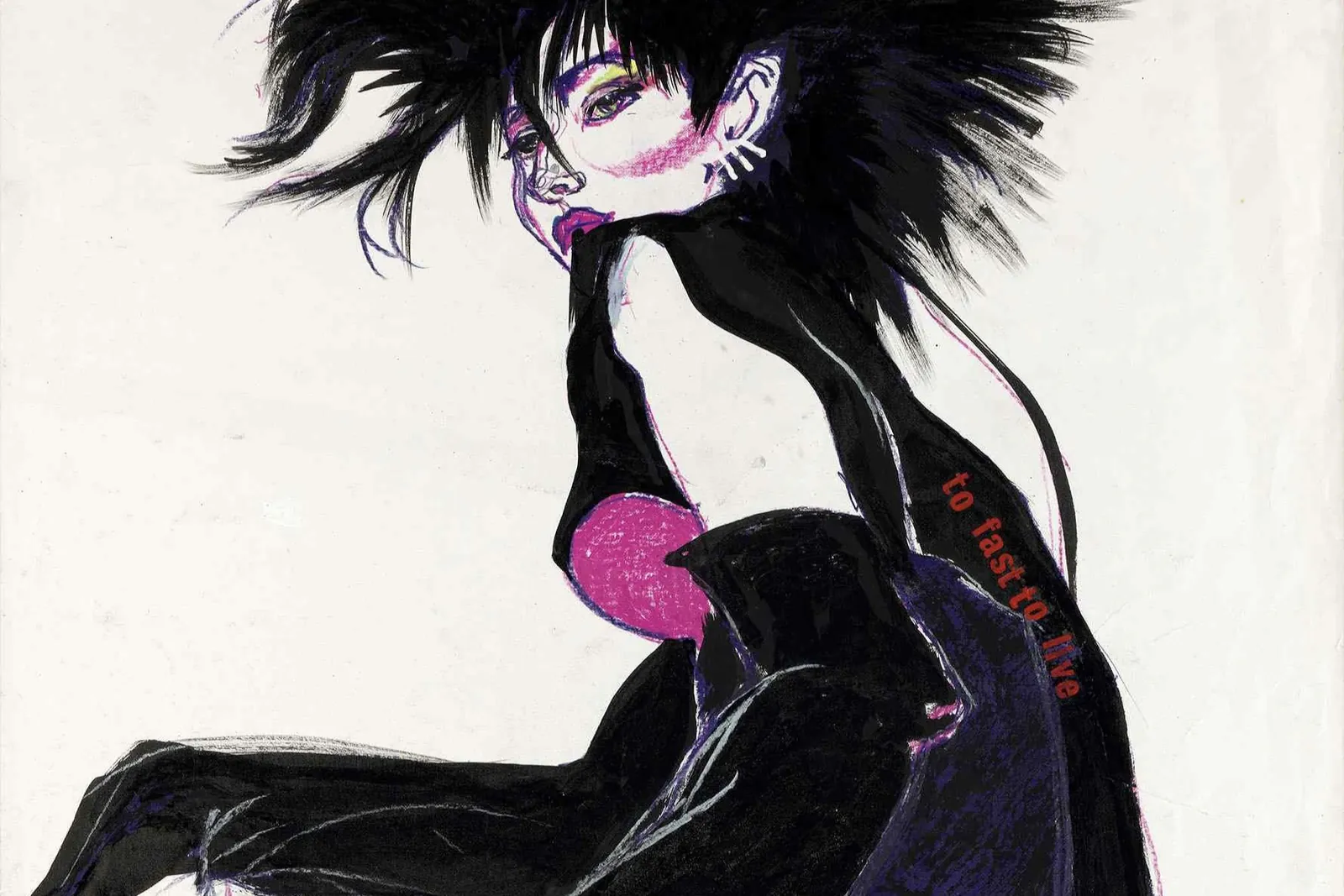
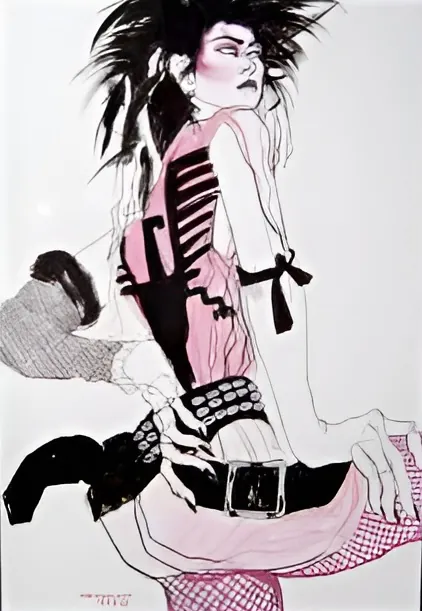
Brocklehurst asked Bricknall to model the works and produced luminous drawings of her and other club-goers in the armor using reflective neons and metallic inks, including a particular shade of pink so harsh that she insisted male artists were anxious to employ in their own work, transforming her subjects into figures others have compared to classic comic book superheroes. She was especially proud of her portraits of women, insisting, “I regard myself as a feminist and for this reason I have been very concerned to paint women to appear strong and confident.” In another moment she has spoken about her female portraits: “My women have an aura about them that puts them on the plane of a goddess,” speaking in such religious terms was no accident of speech.
While seldom discussed to anyone, Brocklehurst’s work also maintained a spiritual dimension. Bricknall recalled watching her begin drawings in vibrant color while wearing dark glasses; when asked how she worked so intuitively, Bricknall explained that Brocklehurst “saw auras around people. On the fetish scene, she saw people as either angelic or demonic, and she’d represent that.” This suggested her work was always about reaching the deepest levels of an individual, and presenting the subject in their truest form.
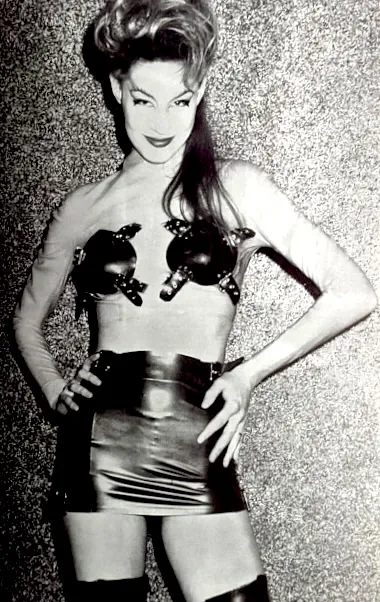
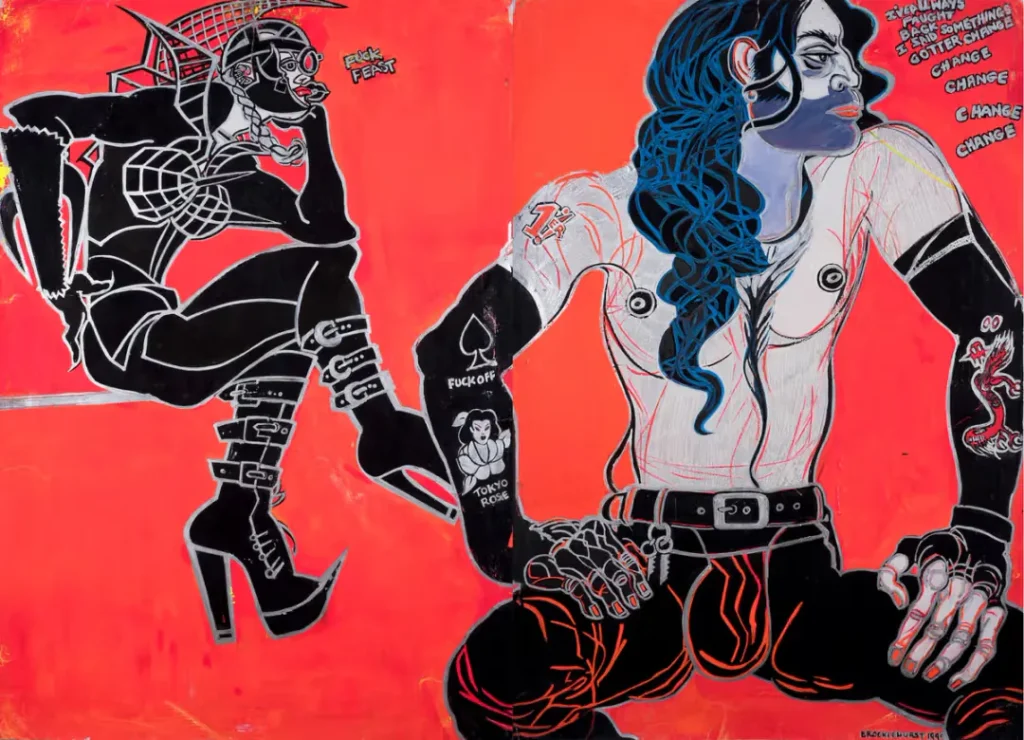
The “Rubber Angel” and the armor she designed appeared at club events and at the Ministry of Sound for the launch of Wired Magazine, accompanied by Brocklehurst’s paintings as part of a digital experimental presentation. Bricknall recalled wearing the first piece to the 1992 Skin Two Rubber Ball, admirers rushed forward assuming it was plastic, only to discover cold steel beneath their hands, a shock that became woven into the night’s theatrical awe.
Her engagement with the scene culminated in wider institutional recognition. In 1994 the Victoria and Albert Museum included a series of her figure drawings in Street Style, acknowledging the cultural significance of subcultural dress and performance. By then she was spending increasing amounts of time in Europe, particularly Amsterdam and Berlin, continuing to carry her sketchbooks through any new clubs and night venues she could find where fashion, ritual, and performance converged. Across these nocturnal studies runs a consistent vision: figures rendered with luminous intensity, suspended between sacred icon and underground archetype, their bodies armored, adorned, and reimagined as vehicles of power and self-invention.
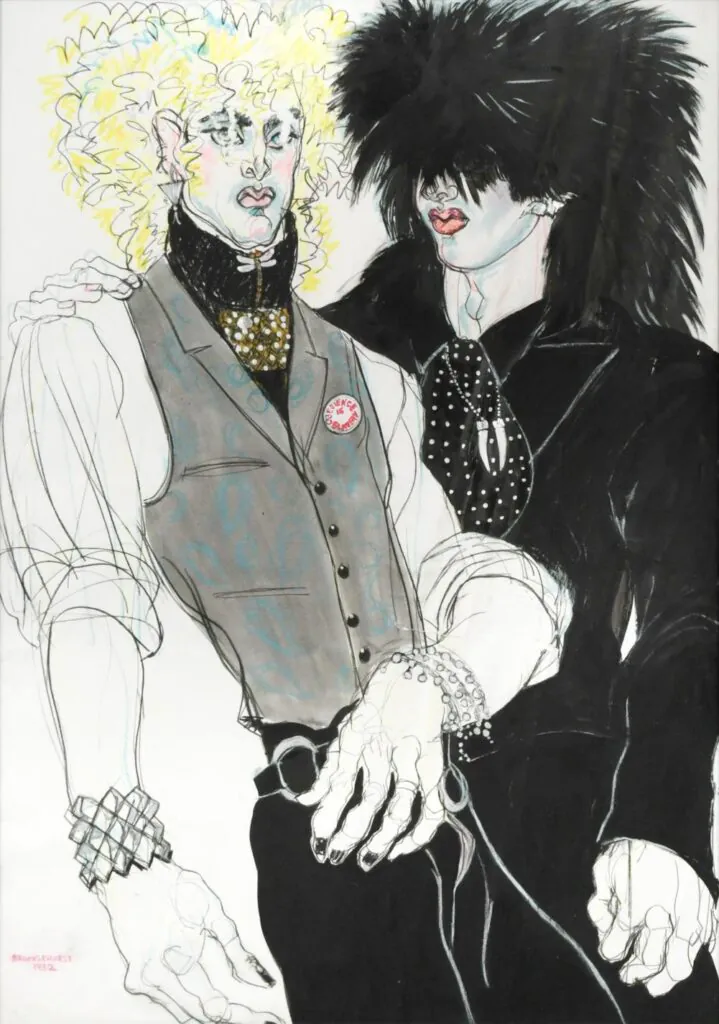
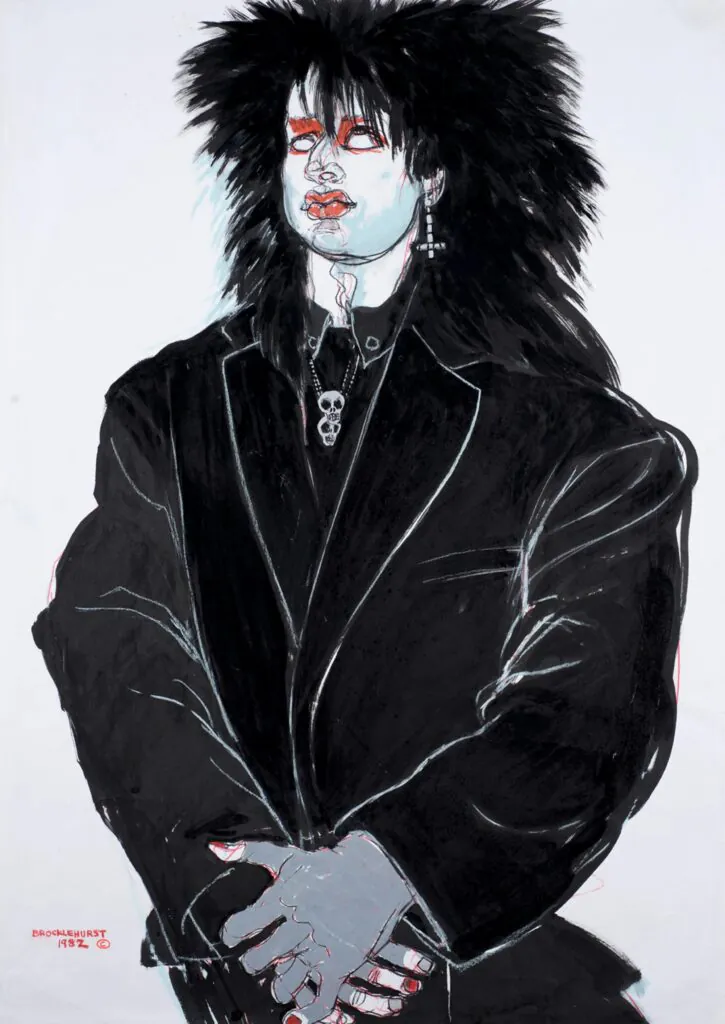
As London’s fetish underground matured, its visual language began migrating into the mainstream. By the late 1980s and early 1990s, the runways were echoing the club floor: corsetry, rubber, metallic finishes, and fetish silhouettes appeared in the collections of Jean Paul Gaultier and Thierry Mugler, confirming that what had once been coded, nocturnal, and subcultural now possessed commercial and aesthetic power. Brocklehurst, a member of the industry herself, once again turned her attention to the broader fashion world as well.
From the late 1990s onward, her connection to fashion education deepened through her friendship with Howard Tangye, then head of womenswear at Central Saint Martins. Tangye invited her to teach life drawing to his students, introducing a generation of young designers to her uncompromising eye and emphasis on gesture, presence, and character. In his Hornsey home studio, Brocklehurst’s works reportedly hang beside his own.
“She’d had a lot of hard bumps,” He recalls, “She wasn’t quite the pure English rose, and I think she copped quite a bit of prejudice.” He echoed other people in that she “extremely beautiful, mesmerizing, but incredibly self-conscious about it. She would do anything to make herself not beautiful.” Though she had relationships, she never married, and later expressed regret at not having children. Teaching, however, suited her. Students responded to her intensity and clarity of vision, according to Tangye.
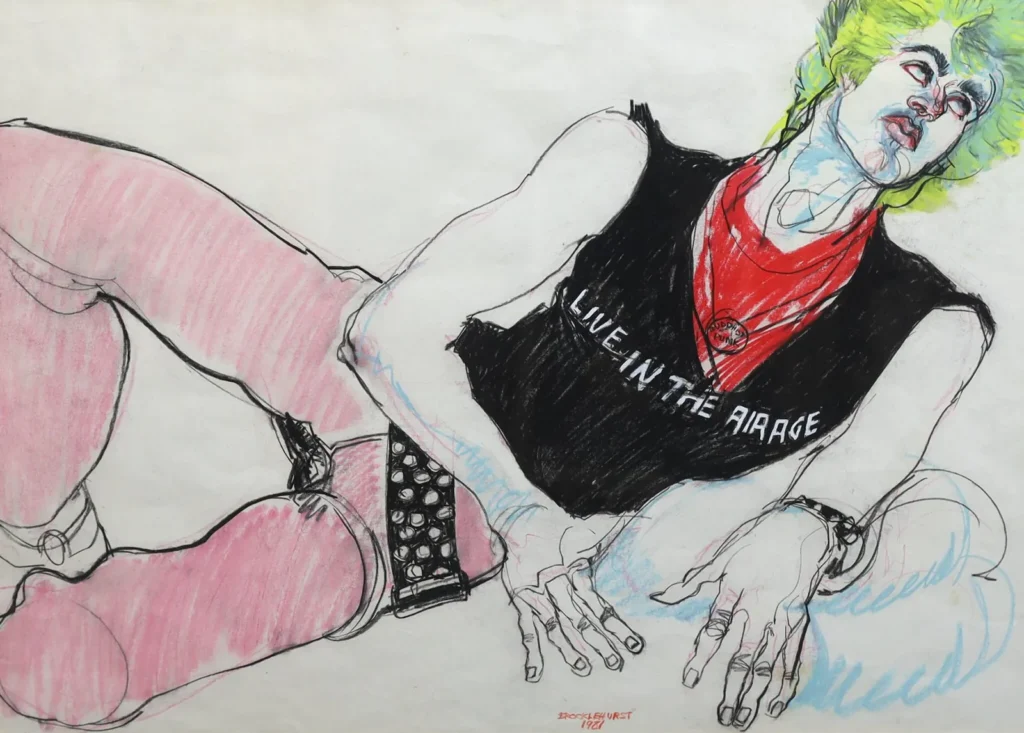
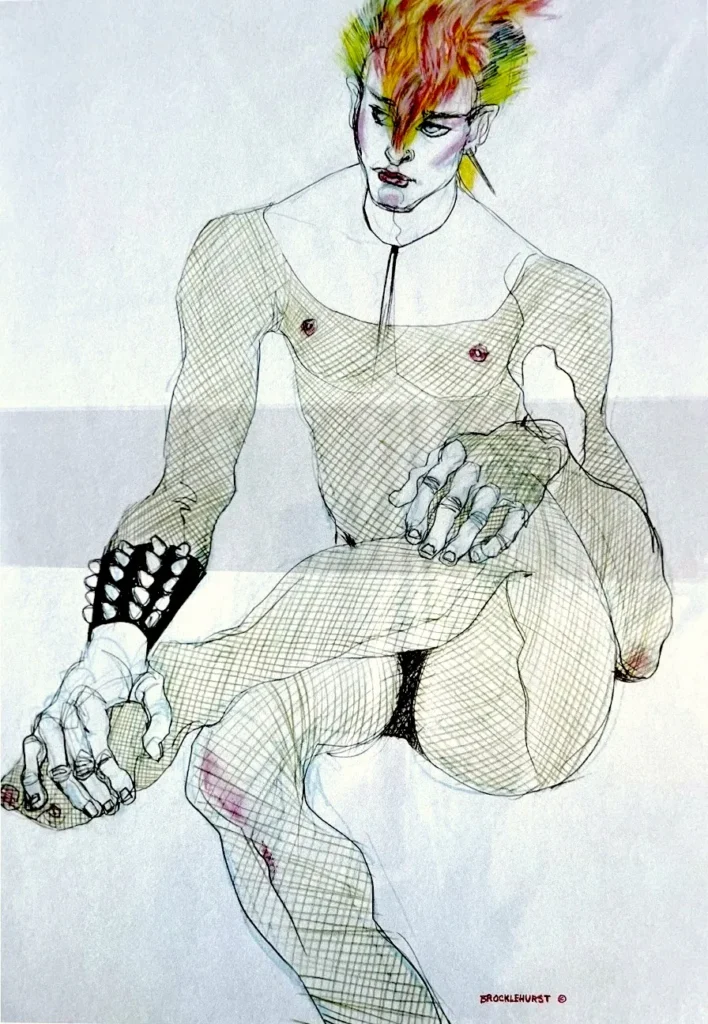
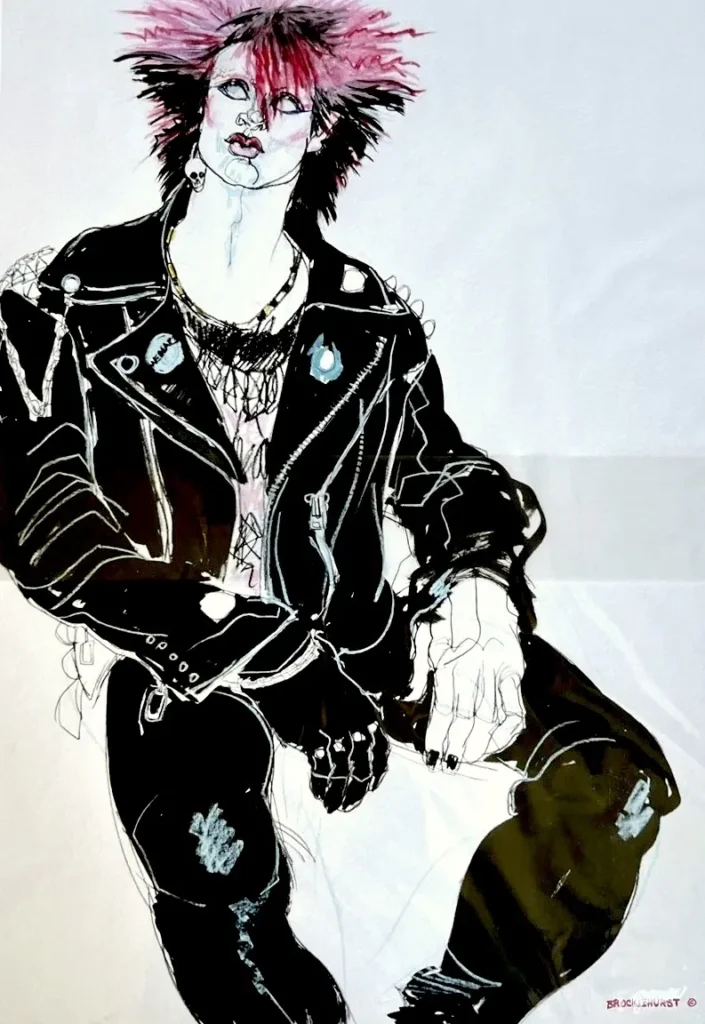
Despite her growing influence, she remained immune to fame. Bricknall recalled that people “would try and jump in front of her and get their picture drawn in the clubs. Even with the following generations, people like Alexander McQueen and John Galliano, who were around when Jo was a septuagenarian. She became one of fashion’s best-kept secrets. If you were really hip and happening, Jo would draw you.” Ironically, she rarely knew who her subjects were; identification was often left to Bricknall or other friends.
Brocklehurst’s continued time in continental Europe led her to find a more receptive audience. “If you’re going to succeed in the arts in any shape or form, sometimes going abroad is easier, because you’re an unknown quantity and you’re celebrated much more than in your country of origin,” Bricknall observed. According to her, Brocklehurst relished Berlin’s atmosphere before the fall of the Wall, which she considered punk in spirit. In Germany and Poland she was widely recognized at arts festivals even as she remained obscure at home. She developed very close friendships within Berlin’s avant-garde circles, “some really out there types of people.” according to Bricknall, and immersed herself in theatre, performance, and nightlife.
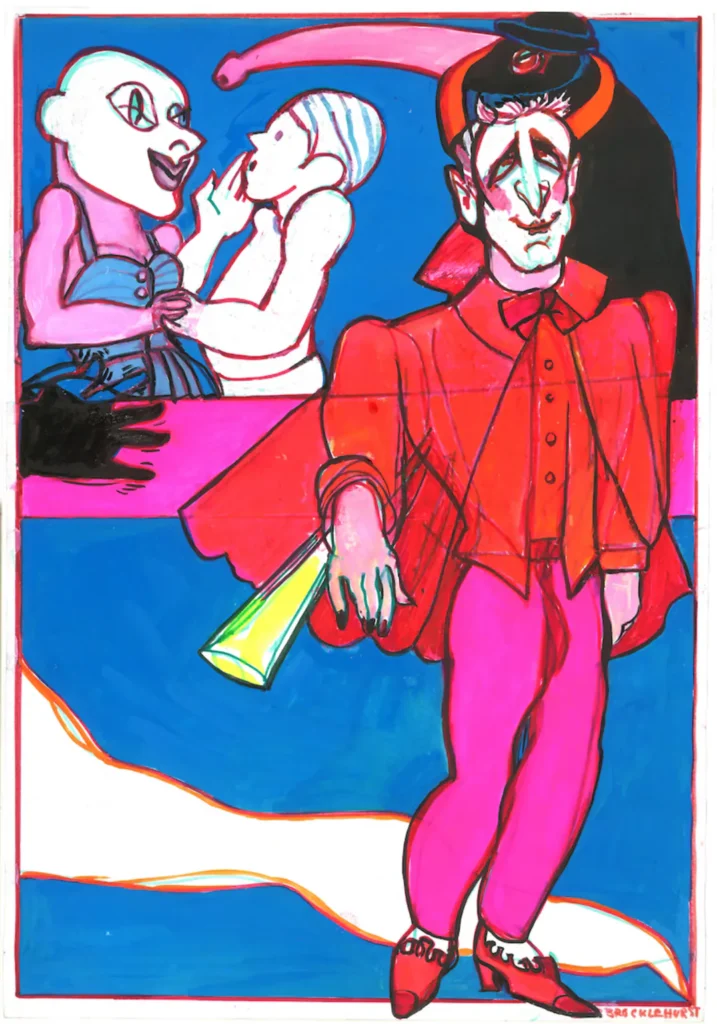
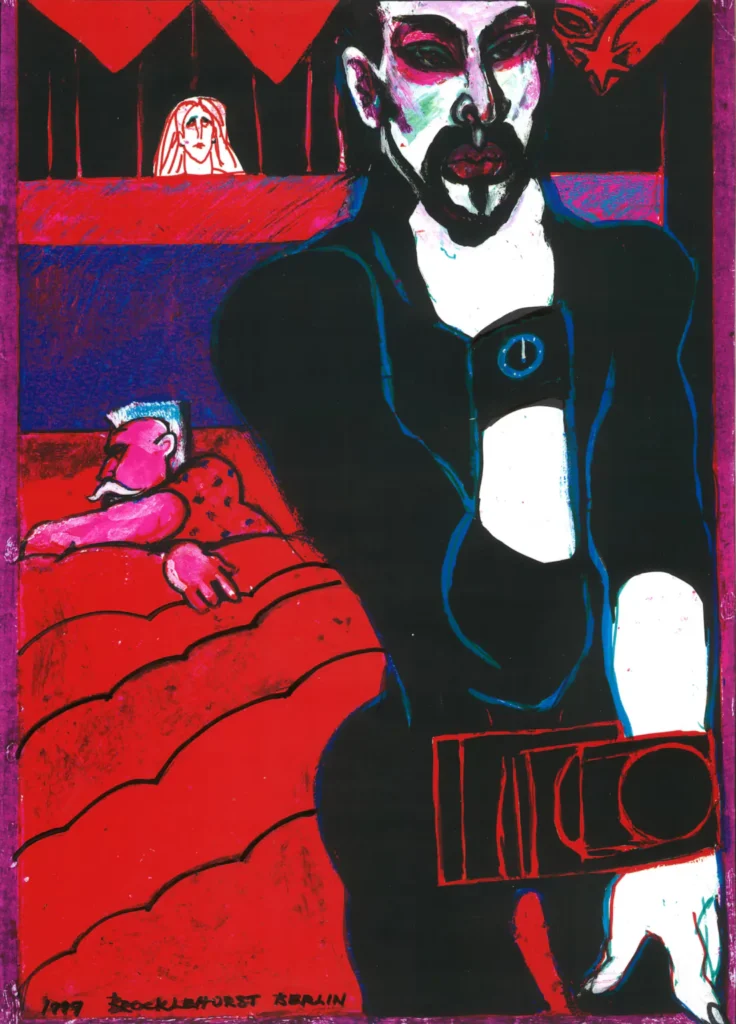
Her relationship with the city culminated in work for Berliner Zeitung, where she served as artist-in-residence during the 1999 Berliner Theatertreffen. The newspaper sought to revive a Weimar-era tradition in which theatre reviews were accompanied by illustrations rather than photographs. Each evening Brocklehurst attended premieres, sketching from her seat in the dark as actors moved across the stage.
She then worked through the night producing large, vividly colored drawings, visibly recalling the visual language of classic expressionism, often up to A1 in size. She would then wake up to her works on the newsstands the next morning, printed alongside reviews. Some images, including a macabre rendering of a production of Maria Lazar’s Die Eingeborene (The Natives), a surreal fusion of live theatre and puppetry, never made it to print but survives as evidence of her nocturnal discipline and expressive reach.
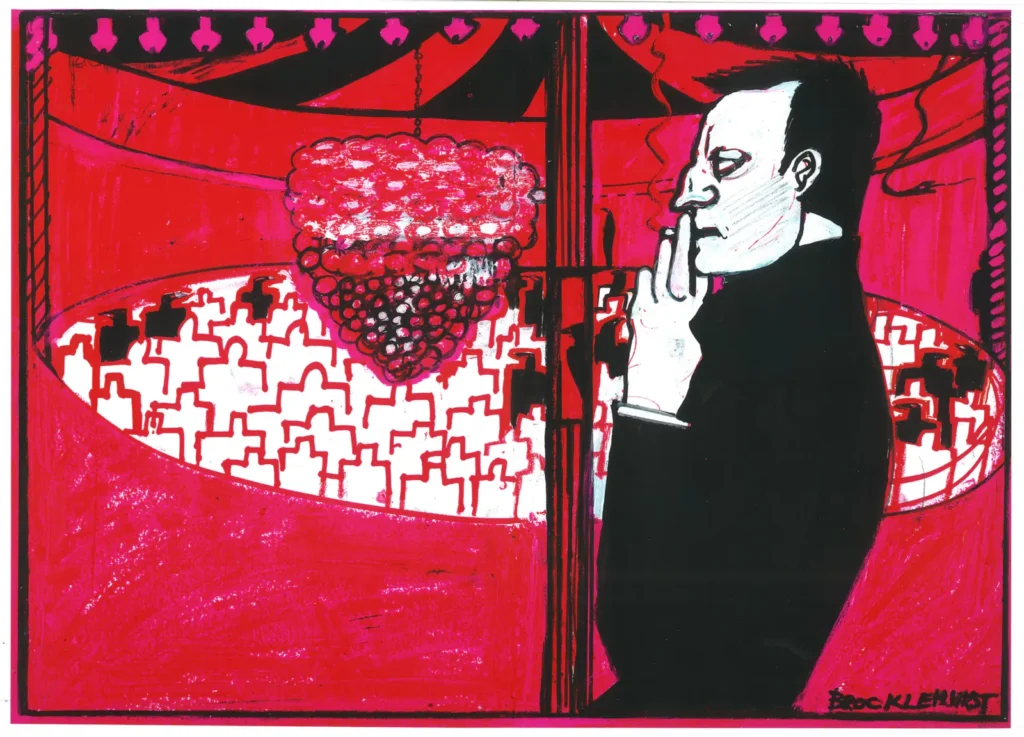
Brocklehurst excelled at capturing the body in motion. Beyond Berlin she documented ballet and theatre across Europe, from Poland to Turin, distilling gesture, tension, and rhythm into electric line and color. Whether in a fetish club or a theatre premiere hours later, she pursued the same objective: to seize movement at the instant it becomes character, and to render bodies not as static forms but as charged presences.
Toward the end of her life, Brocklehurst began turning her house at Westbere Road into a kind of private museum, filling the rooms with her own work and arranging it as an immersive environment rather than a static archive. Although she owned the property and was not in a desperate position financially, she lived with striking frugality, giving freely to friends while using minimal heating and handling repairs on her own.
Howard Tangye recalls one such moment: “Once, she’d built a little extra bit on to the back of the house, and there was a huge hole in the roof. When it rained it was like someone had a shower in there. I bought this big tarpaulin and we secured it on the roof, to at least keep out the water. She wasn’t bothered about it. I was up there and we were trying to fix this tarpaulin, and this great wind blew up. We had enormous fun trying to fix this thing on the roof. Then I convinced her—I said, ‘Jo, I want to buy a couple of your drawings.’ I bought two of her drawings, and with the money she got the roof fixed.” Saving money, he noted, was never the point of her life.
In her later years she developed a quiet devotion to landscape, folding it into her lifelong secondary passion of physical fitness by cycling regularly to Hampstead Heath. In all weathers she walked and sketched there, treating the heath as her countryside despite being, at heart, a city person. These works are strikingly different from her large, kinetic punk portraits: small in scale, atmospheric, and restrained, they trade electric line for mood and air. She continued the ritual until the cold finally drove her indoors.
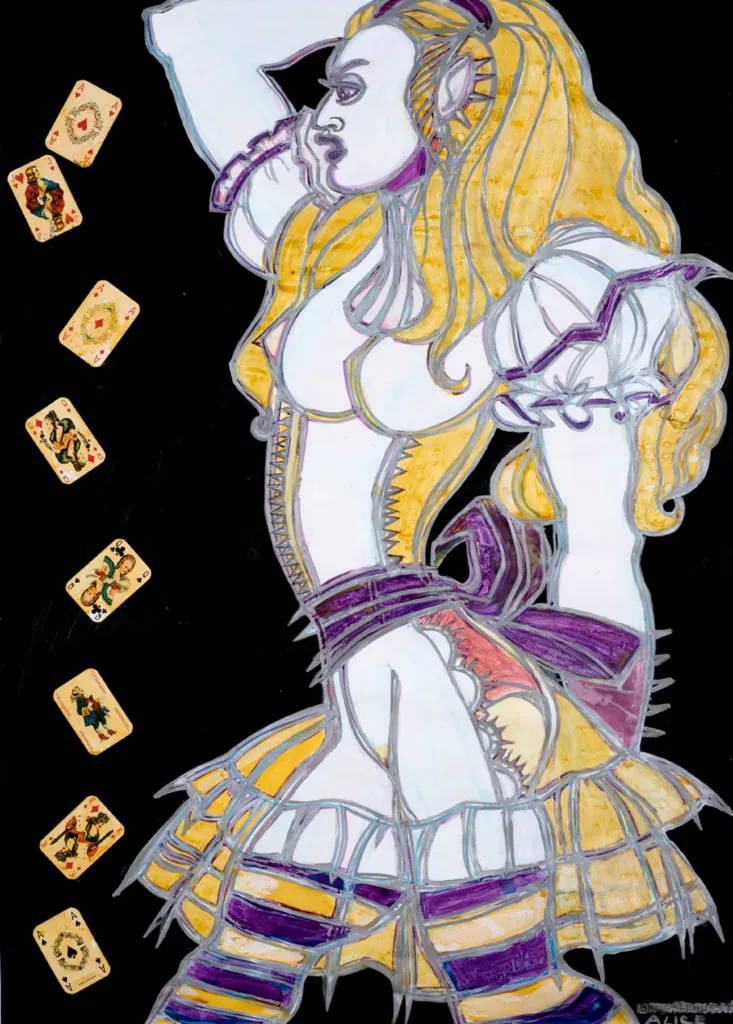
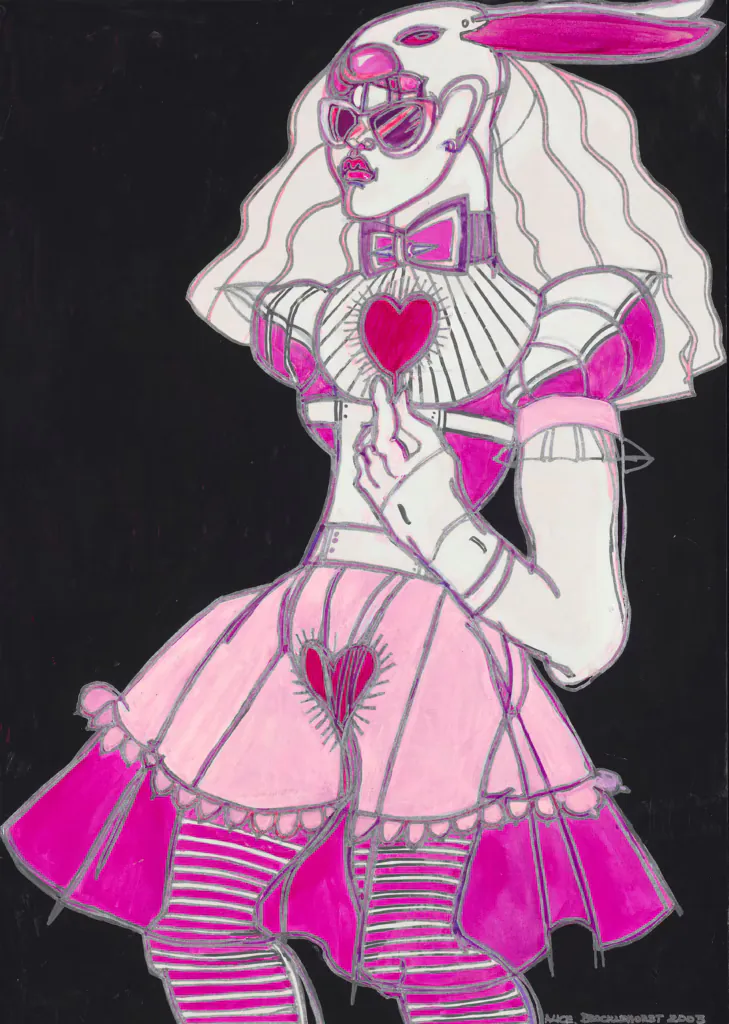
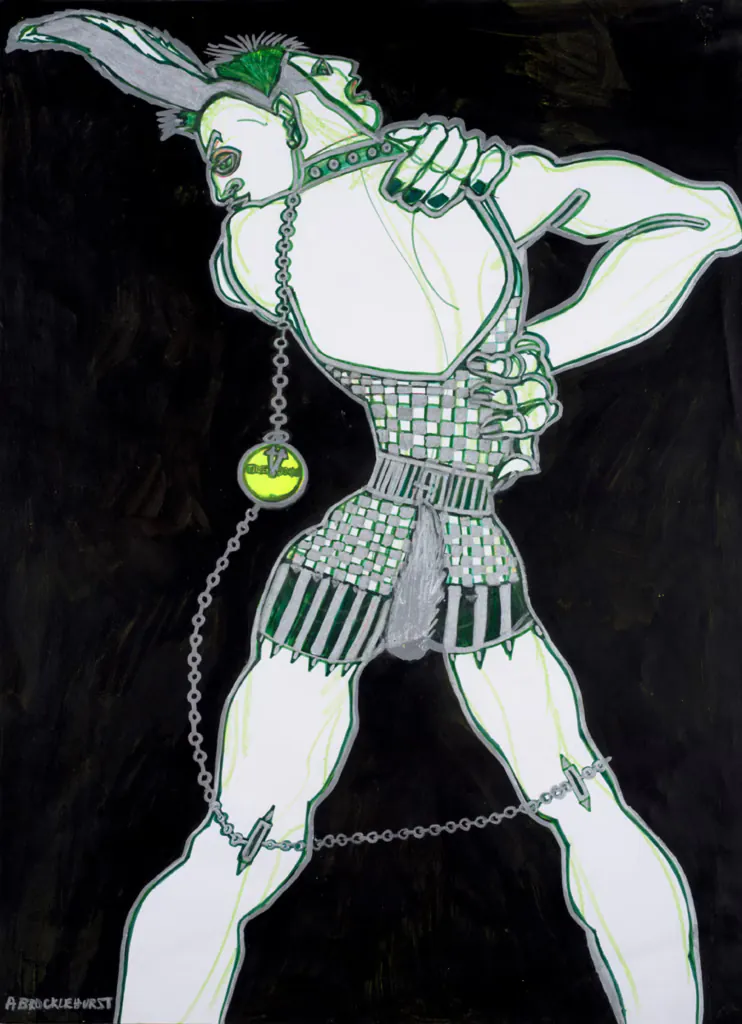
Between 2000 and 2002, after returning from an extended stay in New York, she embarked on a vast, evolving body of work that was partly an autobiographical reflection of her club years and part Victorian fever dream. The walls of her home were crowded with vivid figures drawn from Alice Through the Looking-Glass, though each character bore the unmistakable imprint of the fetish club.
Fascinated by how Lewis Carroll was a carefully constructed alter ego of Charles Dodgson, she saw parallels in the act of performance between him, her own life, and the atmosphere of clubbing, thus titling the project Brocklehurst Through the Looking Glass. The strident, electric drawings contrasted sharply with the lace tablecloths, fine china, and delicate afternoon teas she was known to serve to visitors throughout her life, staging a collision between Victorian gentility and nocturnal subculture.
She had long been interested in revealing the feminine within the masculine and the masculine within the feminine, an idea that once struck many as eccentric. She encouraged sitters to play dress-up, and the Alice series pushed this fluidity further, blending gender codes through costume and posture. Her deep knowledge of dress and anatomy allowed her to portray women as fearless rather than passive, charged with presence rather than ornament.
In her studio, drawings were set in frames inlaid with bright plastic gemstones and hung across every available surface, creating a theatrical setting for tea gatherings that felt part salon, part dream sequence. Around the same period she spent time on the south coast with a cousin, producing a handful of uncharacteristic seascapes that quite literally shimmered, as their surfaces were dusted with glitter, a lingering sliver of glam from her days at the clubs.
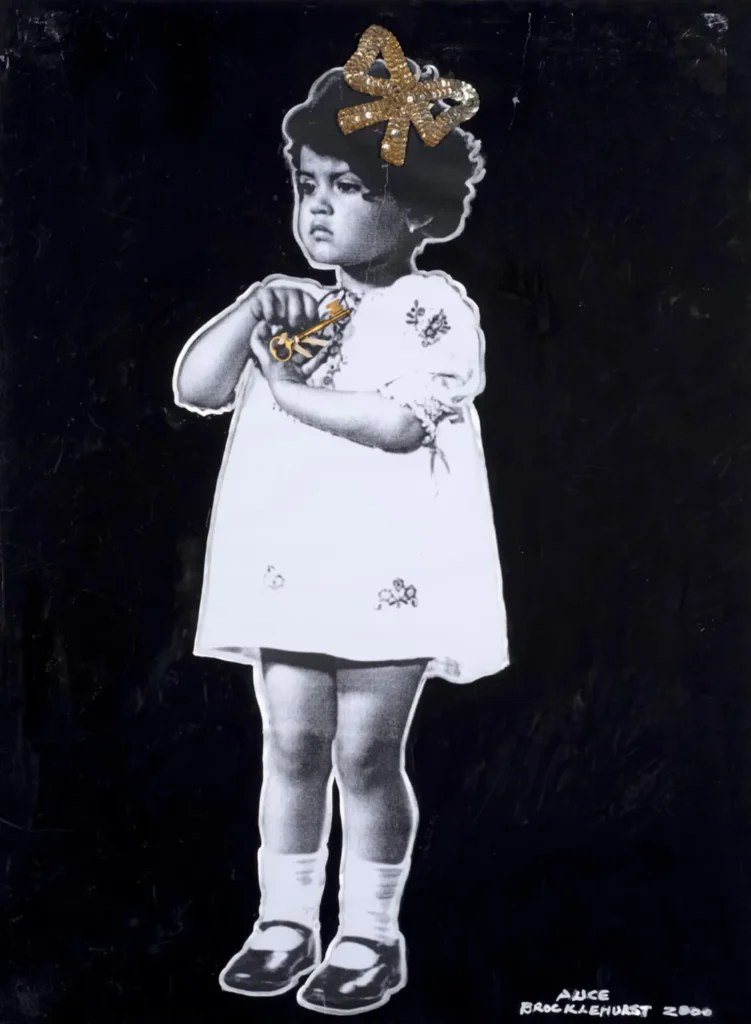
As part of her final major work, she placed an image of herself as a child at its center as it expanded outward into hundreds of drawings reimagining Carroll’s characters. The rest of the subjects were devoted club-goers dressed in hybrid Victorian and fetish attire, collapsing time periods and social codes into a single visual language. The project functioned as self-portrait, cultural archive, and mythmaking exercise all at once: a late-life synthesis in which childhood memory, underground nightlife, gender play, and English literary tradition coexisted under one roof on a quiet North London street.
The work took the form of an installation inside her own studio, a deliberately ambiguous Victorian drawing room that staged a dialogue between restraint and excess, propriety and subculture, ironically presented in one of her most innermost and personal spaces, as if a quiet release of openness after a lifetime of pronounced secrecy. Friends who experienced it understood it as a culmination of her sensibility, and there remains a quiet hope that it might one day be seen beyond that intimate circle.
Jo Brocklehurst died on August 6, 2006, leaving behind a body of work that feels inseparable from the shadowed interiors and nocturnal worlds she inhabited. There is still much about her life that has not been uncovered, if it ever will be. If her life was carefully veiled, her drawings were anything but: they possess a clarity bordering on the interrogative.
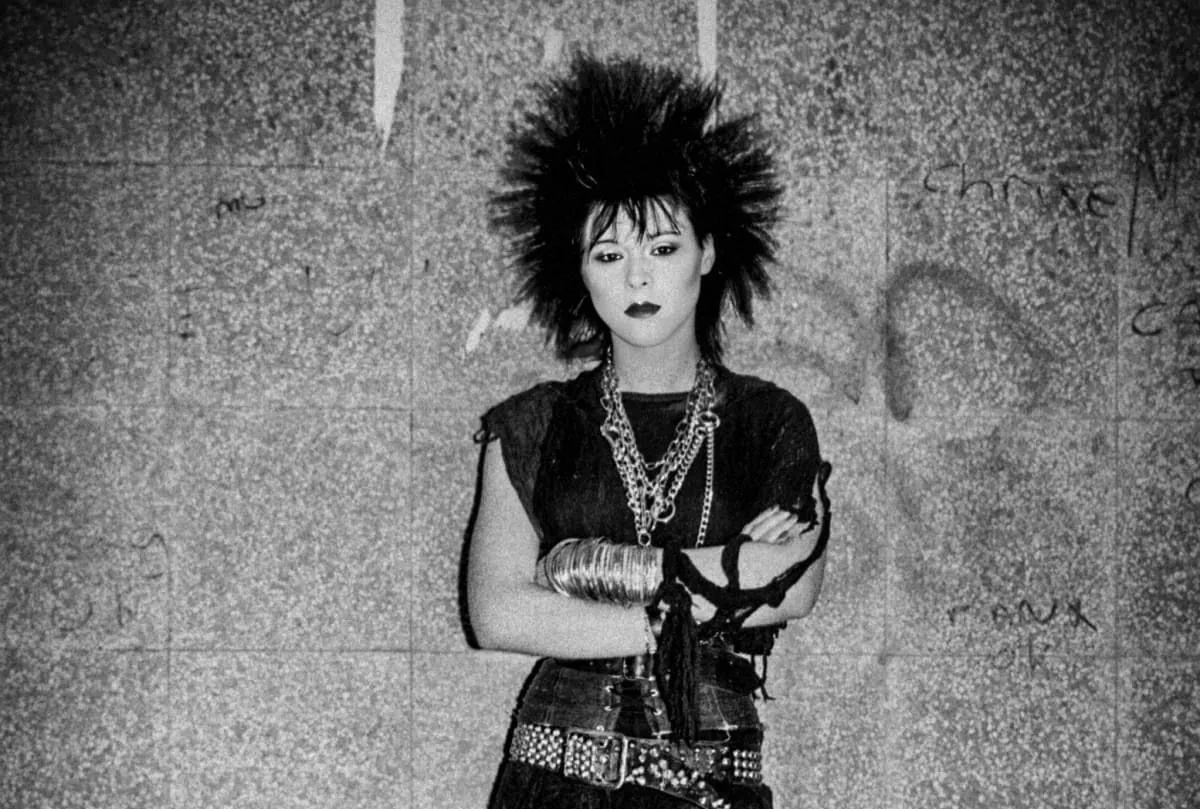
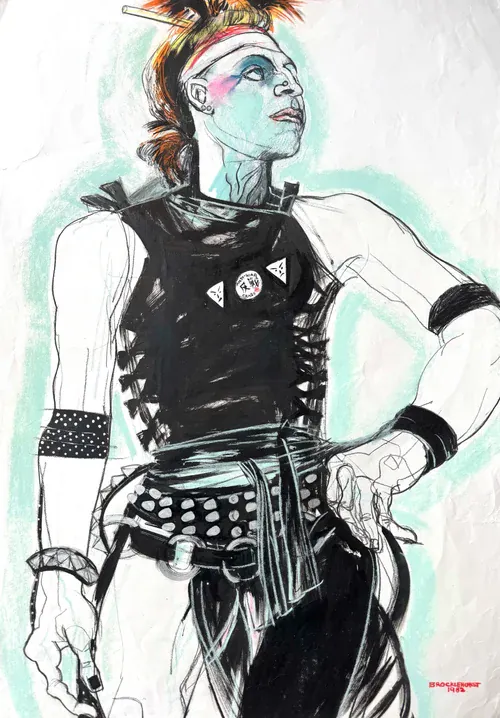
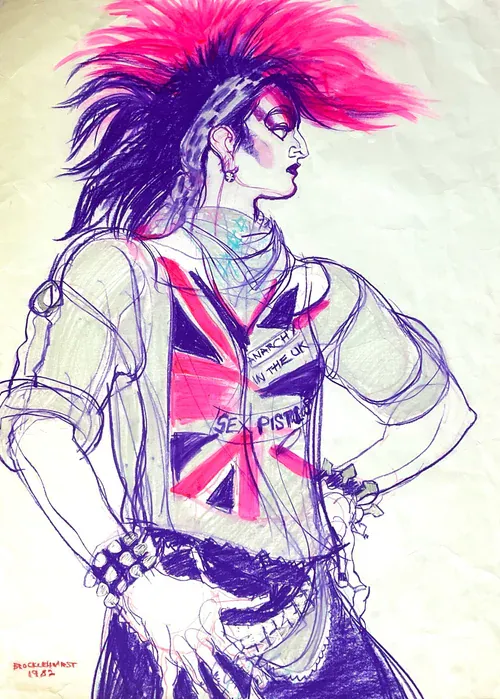
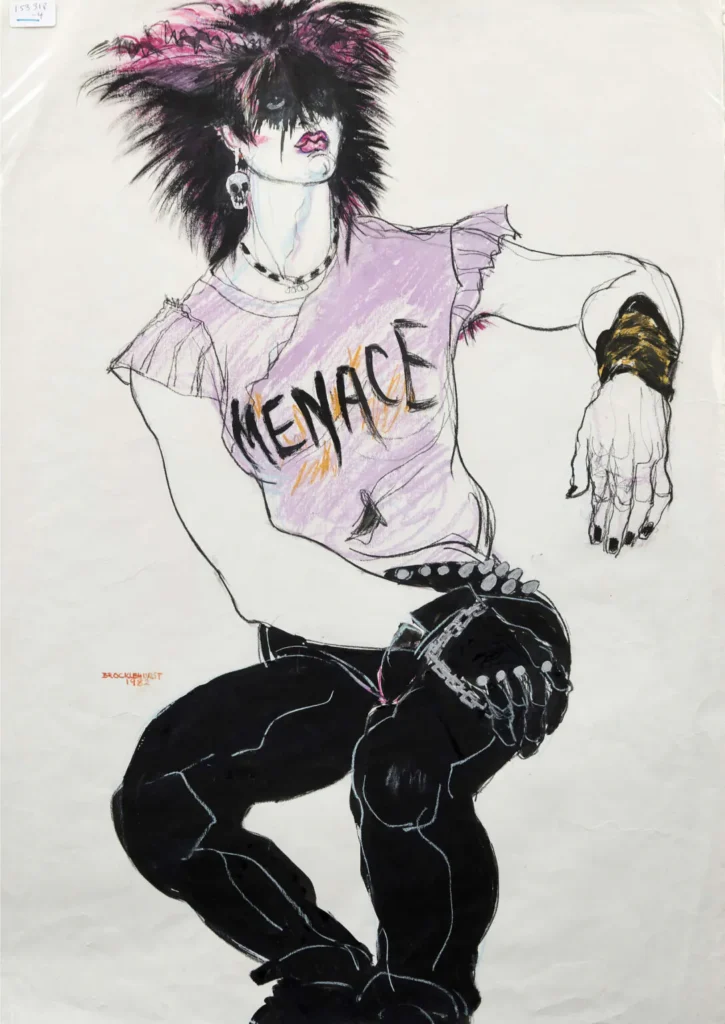
Even such details as the text on shirts and buttons would be preserved, unashamedly political in nature such as “American Indians died so you can eat hamburgers” and “lovers of the world unite! awaken the seeds of confusion. we are the minds agitators”. Other times, signs of the culture were included, with references to bands of the time including Bauhaus, Japan, The Damned, Menace, Sex Pistols, Adolescents, Blink 182, and Be Bop Deluxe.
Those who knew her describe a woman of contradictions: sociable yet private, imperious yet tender, glamorous yet deeply modest. Jackie Athram remembered her as “an original” who loved dancing and parties but reserved her deepest devotion for work. Though she was reserved, Athram says eventually “she lost her shyness and, while remaining a private person, she blossomed as her artistic ability developed and she created her own charmed world. As a friend she was loyal and caring. She could be as imperious as a warrior queen, passionate in argument, but there was a strain of vulnerability to her, and above all she had a tender, gentle and generous heart.”
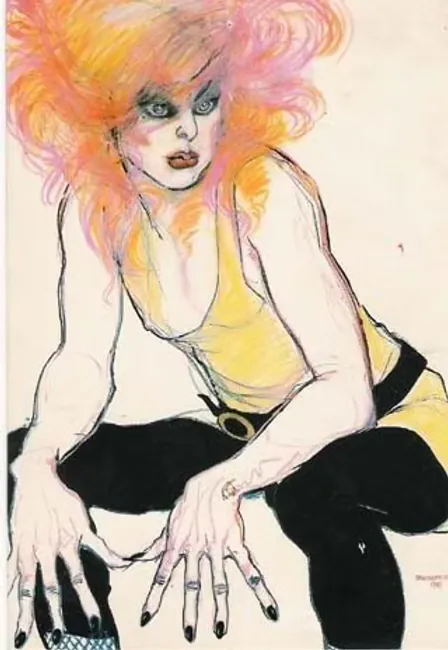
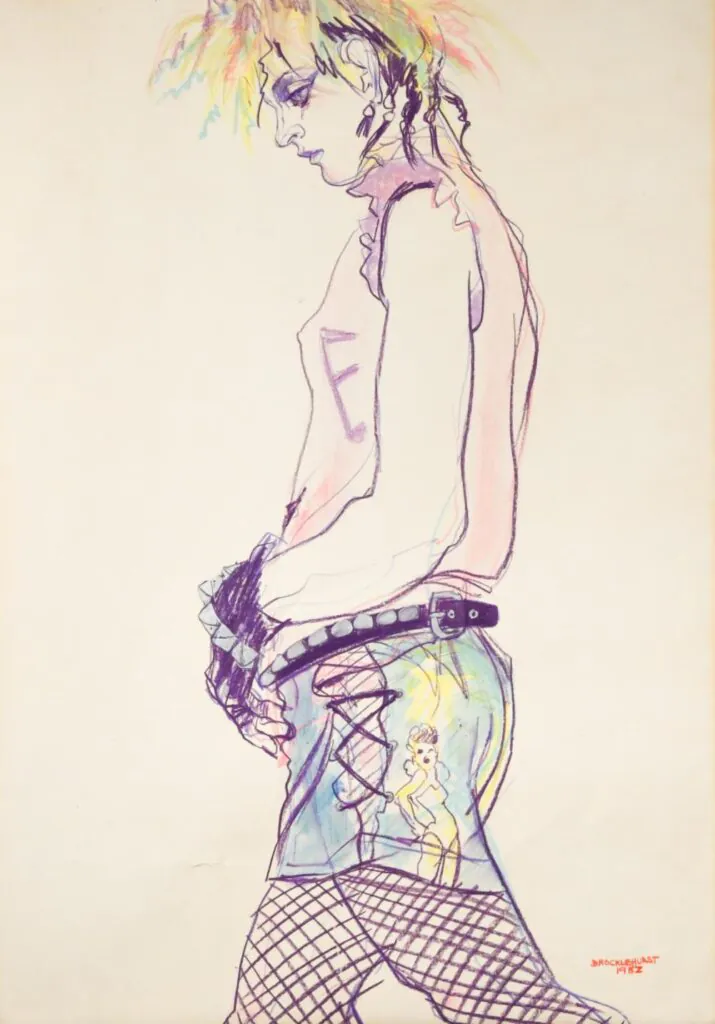
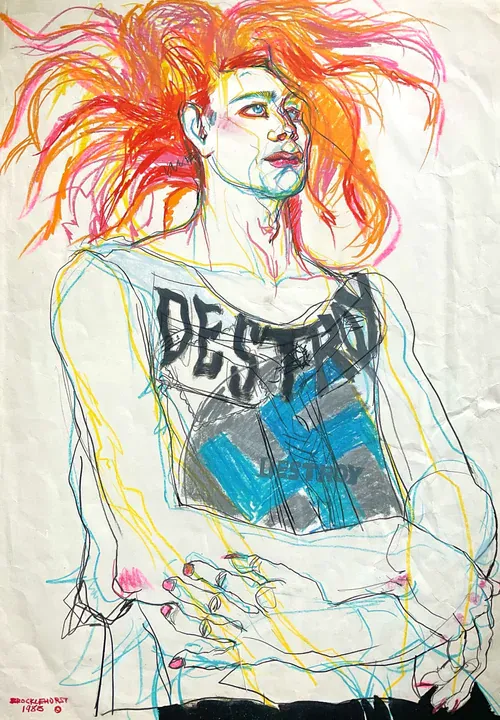
Friends have suggested she felt kinship with outsiders because she herself was treated as one early on in life. Despite her striking natural looks, she continued to wear her disguises for most of her life, almost always including a blonde wig and sunglasses, likely as a form of retreat, having never recovered from the initial experience of being seen in such an exclusionary way.
Others knew her as a teacher that was exacting but transformative. At Central Saint Martins, she demanded discipline and seriousness from students and models alike, yet her generosity and encouragement left a lasting imprint. She insisted that black was not a color until one had learned to draw, urging students to understand structure and chromatic force before relying on darkness. She spoke obsessively about color theory and favored Elsa Schiaparelli’s “shocking pink,” a hue she considered aggressive, electric, and oddly gendered.
Even in her own line work she layered tones before introducing black at the very end. “Jo Brocklehurst was a tough taskmaster and I would often have to warn the models of her expectations. We lost a few, but all said afterwards they were glad to have had the experience and the results that had come out of it.” recalled Tangye, writing her obituary for The Independent.
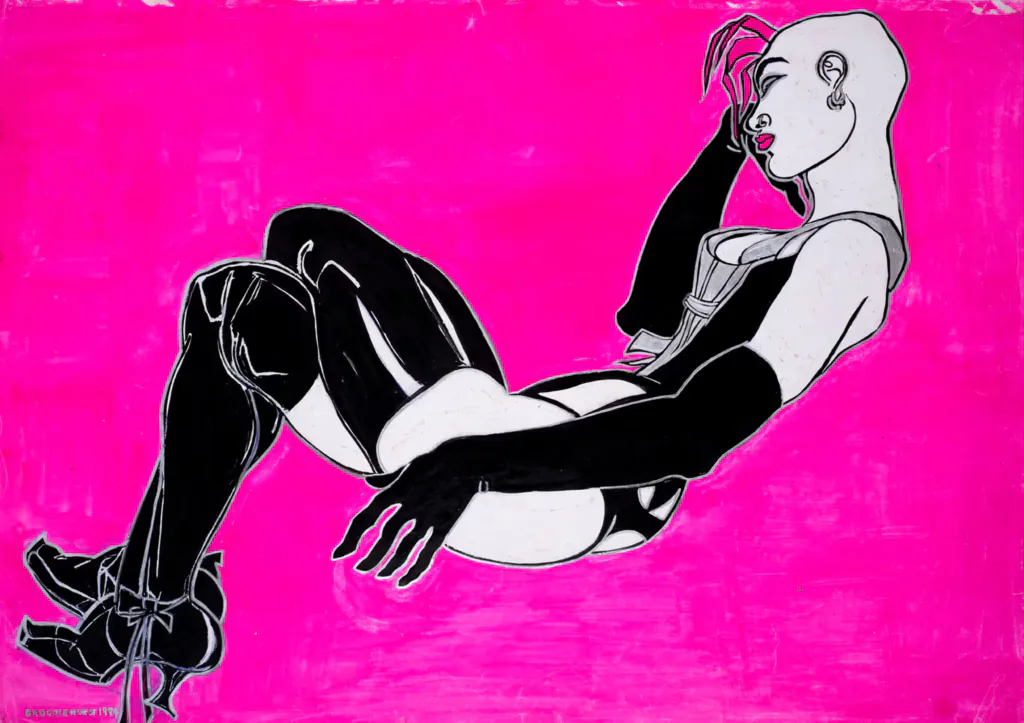
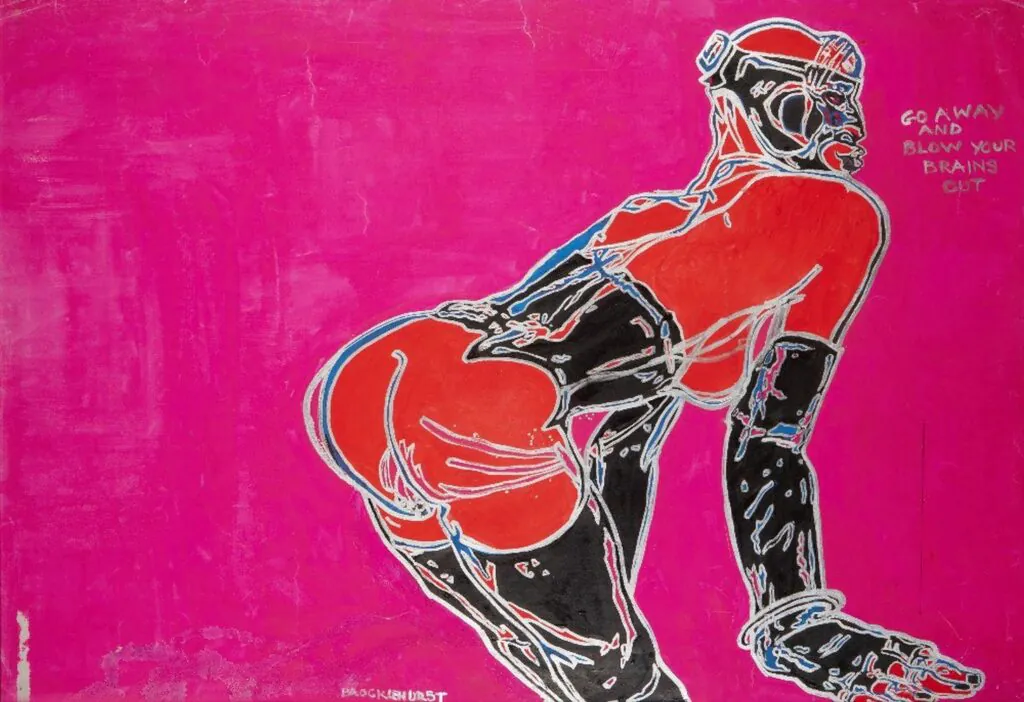
Navigating the art world as a woman required strategy and defiance. She shortened her name so dealers assumed she was an assistant to “Joe” rather than the artist himself, a misunderstanding that amused her. Her drawings of men were threaded with private jokes and psychological observations, skewering vanity and self-regard with quiet precision. One example came in the form of a portrait of Iggy, a male roommate of Bricknall’s, who she described as “a real trollop but very charismatic.” The portrait ultimately shows him looking at his own reflection in a mirror – “a classic narcissist.”
Her looks also meant that she needed to have the strength to turn down unwanted attention. “She was gorgeous, which meant men were always trying to jump on her bones and she had to bat them off.” recalls Bricknall. Beyond admirers and their advances, Brocklehurst’s strength extended to a lifelong resistance to prejudice and expectations, all of which she deflected while constructing a self-contained world governed by her own rules. “I often thought she lived in a kind of wonderment of the world, in another dimension — it was natural for her and we all looked on slightly stunned and just going along for the ride.” Tangye wrote.
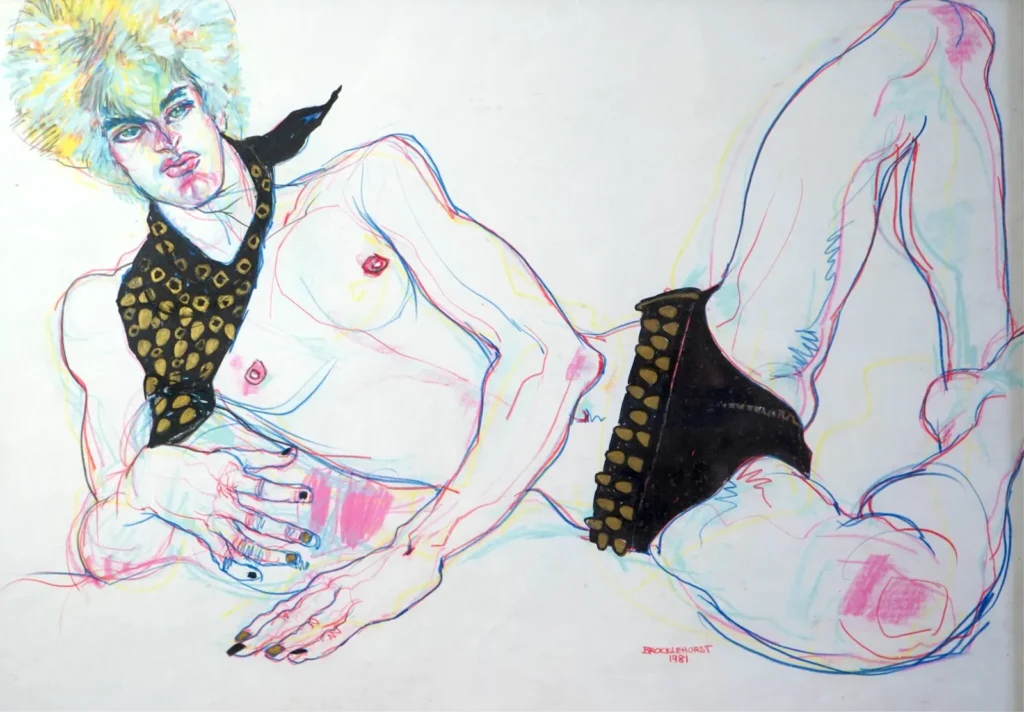
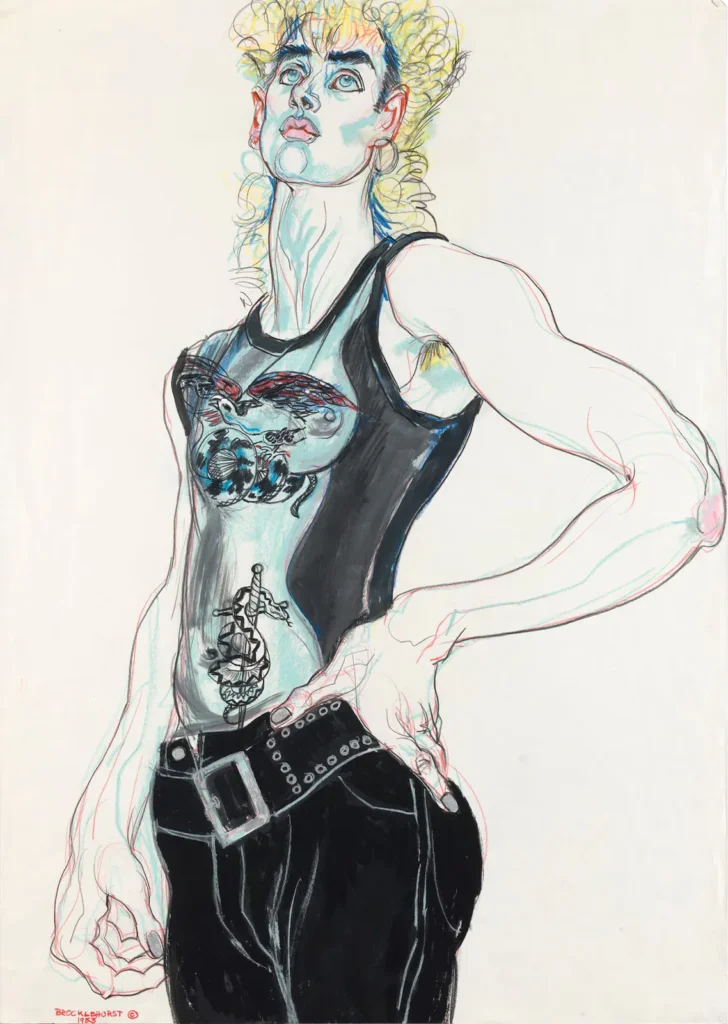
Portrait of Tony Drayton, 1981
Since her death, Jo Brocklehurst’s work has rarely been seen. In Britain and around the world, much of her career remains strangely under-documented. Most of her work resides in private hands: friends’ homes, garages, and scattered collections, while ongoing ownership disputes and the absence of institutional archiving have left gaps in the record. Only a small number of pieces entered public collections, including holdings at London’s Victoria and Albert Museum, while most of the drawings remain with surviving members of her family.
Her indifference to the expectations of the art market meant she sold little during her lifetime, despite the sheer size of her output. Olivia Ahmad has noted that Brocklehurst was “incredibly prolific,” and that a portion of the work is thought to be missing, adding a layer of mystery to an already elusive legacy. Even the limited material exhibited so far suggests a vast, still-unmapped archive and stands as a unique drawn record of punk from a vivid, personal, and distinctly female perspective.
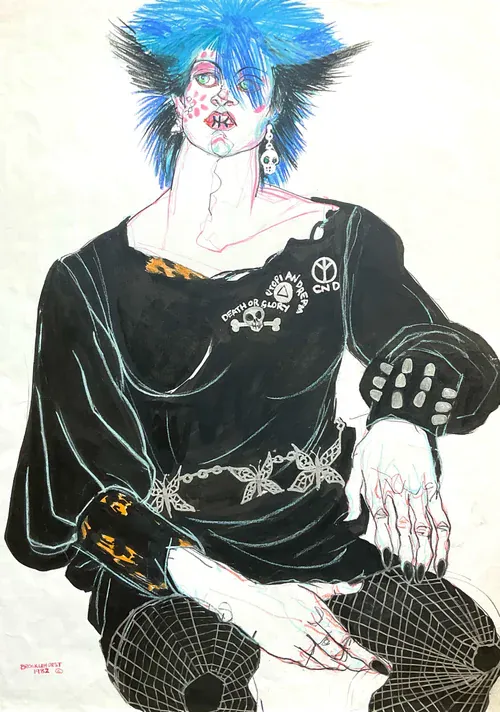
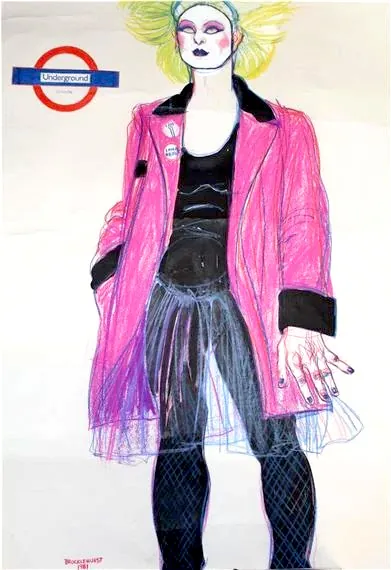
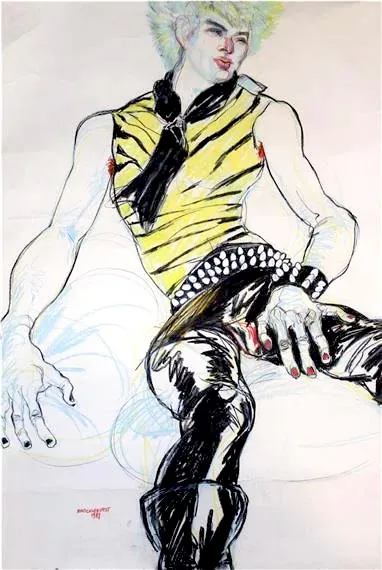
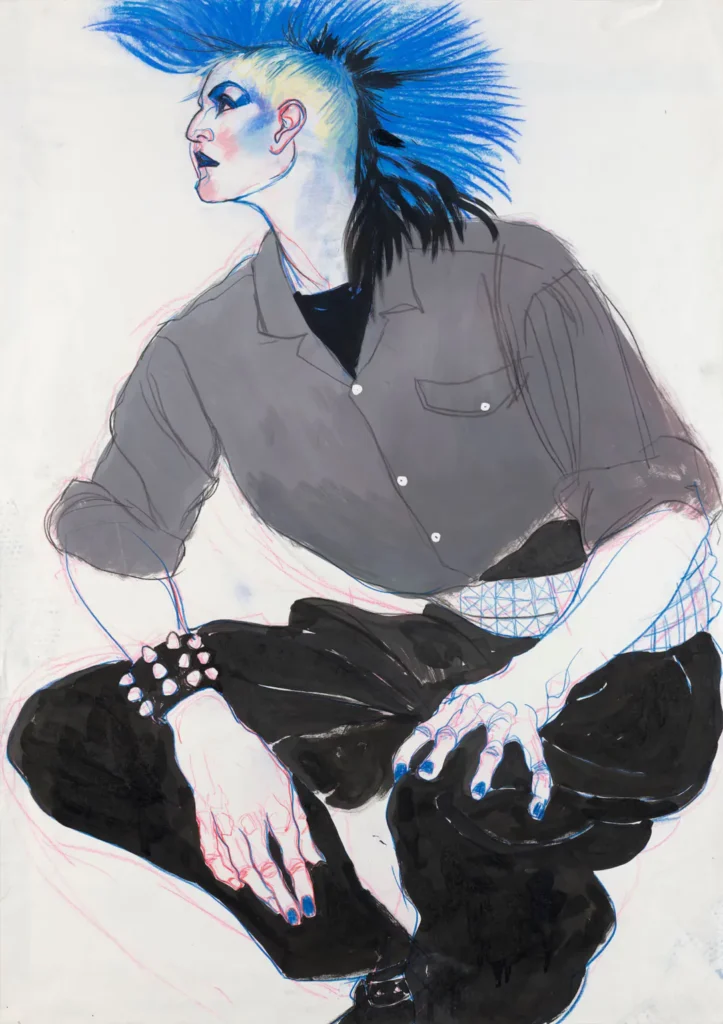
Her wiry, fluid line has often invited comparison to Egon Schiele, yet despite her work tracing a lineage to early expressionism, the resemblance is largely technical. Whereas Schiele’s figures can feel intense or self-aggrandizing, Brocklehurst’s subjects are granted dignity without spectacle. Her contorted poses, theatrical gestures, and luminous, arresting eyes serve observation rather than ego.
In spirit she aligns more closely with documentary artists such as Diane Arbus or Mary Ellen Mark, and with the quiet, posthumously discovered practice of Vivian Maier: artists who placed their subjects first and themselves second, attending to those who lived beyond the margins of polite society, and sparing no time for their own reputation in life.
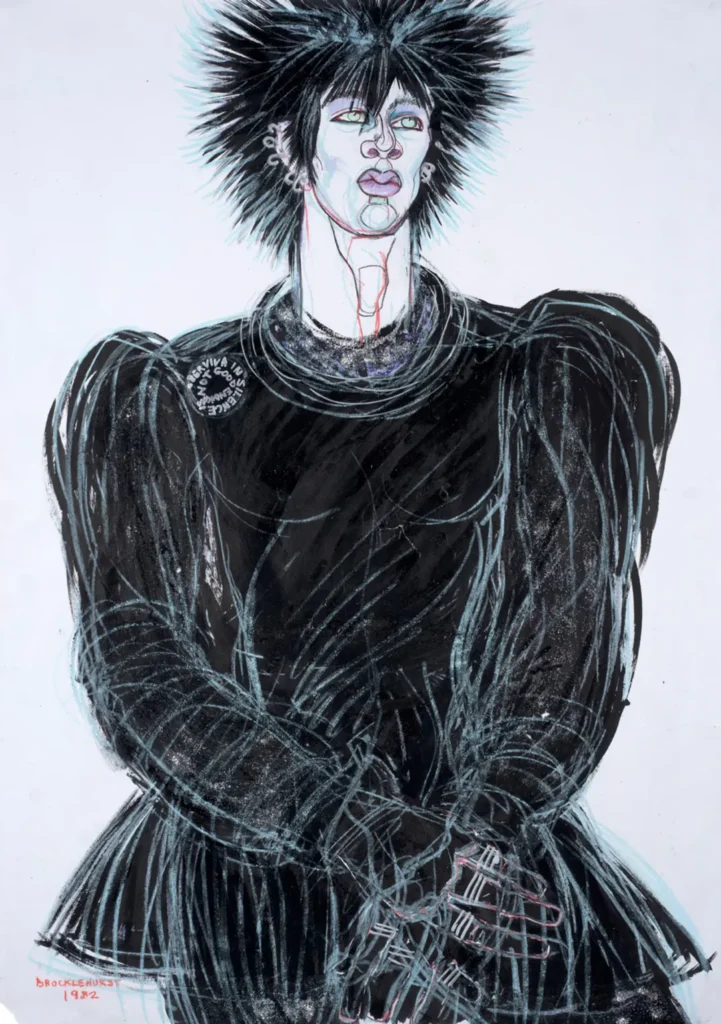
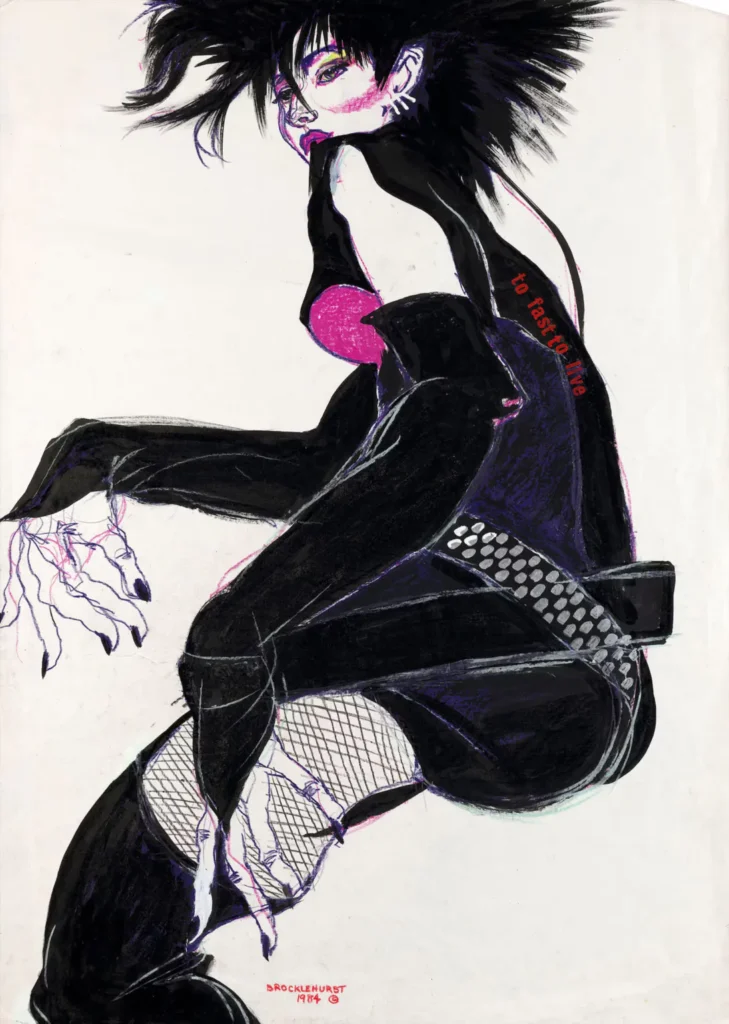
Friends recall her admiration for women of conviction such as Leonora Carrington and Frida Kahlo, figures who stepped outside prescribed roles set for women. “She was aware of the importance of her gender in being a documentary artist, because there’s a certain trust afforded to women that means they can go places men can’t. Even though she could be quite an intimidating presence – fabulous looking and a lady of mystery – people were drawn to her like a magnet.” Bricknall says. She abandoned a promising career in fashion illustration to pursue an uncompromising project: documenting those who valued freedom over respectability, just as she did. On paper, her subjects radiate freedom: individuals unapologetically themselves.
Isabelle Bricknall described her as “the real deal,” drawing every day of her life with no concern for money or institutional approval. “The art establishment at that time wouldn’t have touched punks with a ten-foot bargepole, but she saw something there. She was ahead of her time.” according to Bricknall. The drawings also function as a corrective to the familiar black-and-white photography of punk’s early years.
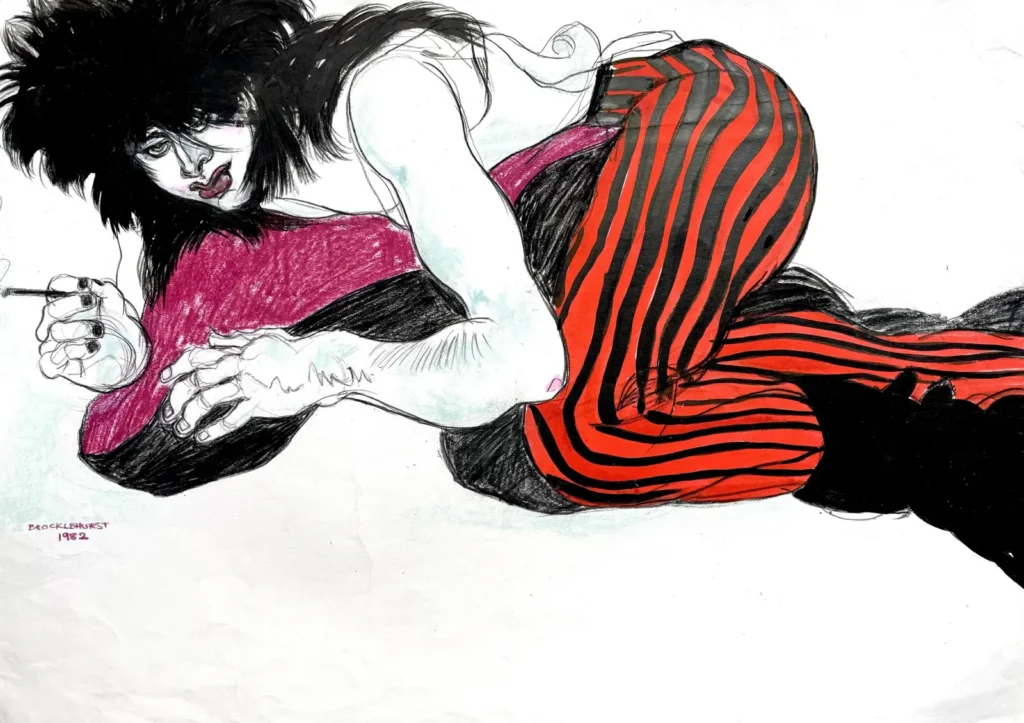
Brocklehurst saw the scene in pulsing color, punctuated by undeniably human qualities of flushed cheeks, bulging veins. By isolating her figures from the chaos of clubs and squats and presented them to the viewer in front of a plain white background, she grants them seductive subjectivity, leaving viewers to construct their own narratives for these strange, compelling characters.
Her output was vast and internationally exhibited, spanning Germany, New York, Amsterdam, and London. She experimented constantly with color, movement, performance, and social environment, producing drawings that feel immediate, uncompromising, and unmistakably her own. The line never slackened; the discipline of drawing daily kept it alive. Whether by circumstances of birth and surroundings or solely through her inclination, she remained an outsider within the art world, and one senses she preferred it that way, perhaps even now.